
NESCA’s Londonderry, NH location has immediate availability for neuropsychological evaluations. Our NH clinicians specialize in the following evaluations: Neuropsychological; Autism; and Emotional and Psychological, as well as Academic Achievement and Learning Disability Testing. Our NH clinicians also conduct evaluations for students who are at boarding schools, and two of our NH clinicians have PsyPACT authorization, allowing them to conduct evaluations out-of-state.

Visit www.nesca-newton.com/intake for more information or to book an evaluation.

Tag

adoption Archives - NESCA

Subscribe to NESCA Notes

image of adoption papers and a quote from Sean Hyde O'Brien

Myth vs. Reality: Adoption, Development, and the Role of Neuropsychology

By | NESCA Notes 2024

image of adoption papers and a quote from Sean Hyde O'BrienBy: Sean Hyde O’Brien, Psy.D., ABPdN 
Pediatric Neuropsychologist, NESCA

Adoption is a wonderful way to create family. I say this both as a psychologist who has extensive research and clinical experience working with this population, as well as a person who was adopted. However, my experience working with children and families in the “adoption triad” over the past 20 years has made me aware of the negative stereotypes that are perpetuated by well-meaning professionals that are simply not based in fact and can, in fact, have a deleterious impact on the health and development of those children whom they are trying to serve.

In simplest terms, there is nothing inherently pathological about the process of adoption or individuals who were adopted. Yes, there can be particular family dynamics and developmental issues unique to the adoptive experience (for an interesting perspective on child development through an adoptive lens, see Dr. Joyce Pavao’s “The Family of Adoption”). However, these can be thought of much like other demographic factors that contribute to our development but do not define who we are in totality, such as ethnicity, gender, sexual orientation, or socioeconomic status.

So, if adoptive status is not a causal factor for later psychopathology, why do some children who were adopted display emotional, behavioral, and learning challenges? This is where neuropsychology comes into play. Research suggests that children adopted at older ages, from foster care, or from institutional settings have a higher risk for certain psychological challenges compared to non-adopted peers. However, this increased risk is not due to adoption itself but rather to neurobiological factors that are known to result in developmental challenges regardless of adoptive status. These can include sensory, cognitive, and social deprivation; chronic early stress; attachment disruptions; and teratogenic exposure (e.g., factors that can cause developmental abnormalities in a fetus); all factors that are known to impact the developing brain.

For example, a child who has been separated from their primary caregiver during an early sensitive period of development may show delays in social cognition, understanding others’ emotions, and their ability to form peer relationships. While this child could have been adopted after living in an orphanage, they may also be a non-adoptive child who was separated from their birth parent secondary to an injury/illness and subsequent hospitalization or had a birth parent who was not consistently available due to their own medical or mental health issues. The adoptive status of the child is not the issue at hand, rather the specific experiences of the individual, and for a professional to simply label a child’s challenges as a result of their adoptive status is overly simplistic and possibly unethical.

Thus, as with all children, it is important to understand the “whys” (e.g., why are they having this particular problem) to figure out the “hows” (e.g., how do parents and professionals best address it) when working with children who were adopted. This often requires a comprehensive evaluation of neuropsychological functioning that goes beyond the label of “adopted child” and helps to identify both the risk and protective factors unique to that individual that will impact their health and development.


About the Author

Dr. Sean O’Brien has been providing comprehensive neuropsychological evaluations in the GreaterSean Hyde O'Brien Boston area since 2006. He specializes in the assessment of children and adolescents who present with a wide range of developmental conditions, such as  Attention-Deficit/Hyperactivity Disorder, Specific Learning Disorder (reading, writing, math), Intellectual Disability, and Autism Spectrum Disorder; as well as children whose cognitive functioning has been impacted by medical, psychiatric, and genetic conditions. He also has extensive experience working with children who were adopted both domestically and internationally.

To schedule an appointment with one of NESCA’s neuropsychologists, please complete our online intake form

NESCA is a pediatric neuropsychology practice and integrative treatment center with offices in Newton, Plainville, and Hingham, Massachusetts; Londonderry, New Hampshire; the greater Burlington, Vermont region; and Brooklyn, NY (coaching services only) serving clients from infancy through young adulthood and their families. For more information, please email info@nesca-newton.com or call 617-658-9800.

Sean O'Brien headshot and quote

Introducing Pediatric Neuropsychologist Sean Hyde O’Brien, Psy.D., ABPdN

By | NESCA Notes 2024

Sean O'Brien headshot and quoteBy: Jane Hauser
Director of Marketing & Outreach, NESCA

NESCA is excited to welcome Sean Hyde O’Brien, Psy.D., ABPdN, to our team, conducting evaluations in the Newton, Massachusetts office! My interview with Dr. O’Brien offers an opportunity for readers to get to know him, his professional background, experiences and expertise, and his approach to working with children, adolescents, and young adults as a pediatric neuropsychologist.

You covered a broad swath of academic, emotional, and developmental challenges in your career as a pediatric neuropsychologist. Tell us more about that.

I think I’m a good generalist as far as pediatric neuropsychology goes, covering a lot of the high-incidence disorders, like ADHD, autism spectrum disorder, and learning disorders, but there are a couple groups that I really like working with.

What are the groups of children or students you find the most interesting?

I really like kids that are on the high functioning end of the autism spectrum, so I did one of my post-doctoral years at McLean at the Center for Neurointegrative Services, which is a DOE-approved special education school for kids who used to have what was called Asperger’s Disorder, which is now part of the ASD diagnosis. I got to spend a lot of time honing my assessment skills, but also spending quality time getting to know this group of students. They have a special place in my heart.

Another area I enjoy is working with children who came from other countries and may have moved because of war, famine, or simply for better opportunities for their families. They often come to this new country, perhaps not with the best English skills, and a lot of complex developmental and psychiatric challenges. Teasing all of those components apart and helping them acclimate to a new school, culture, and world has been interesting to me.

It takes a lot of thinking on your feet from an assessment standpoint to work with this population. For example, when you evaluate a child who speaks Russian and has only been learning English for six months, you’re not going to be able to do your standard battery of tests to figure out what their cognitive functioning is like. You have to think creatively and find ways to work slightly outside the domain of standard evaluation procedures. I’ve learned so much being with them, watching, and observing them in different settings, and, of course, getting the information from multiple sources, like teachers and parents. Those kids along with those who come from other countries through adoption are the most challenging, but also probably the most rewarding to me.

My wife and I were both adopted, so I come from a family of people who know and are part of the adoption community. I did a lot of research and clinical work involving international adoption. I love working with children who are coming from China, India, Korea, or domestically and their adoptive parents who are trying to figure out how to best support them with the range of strengths and weaknesses that they might have. These are also some of the kids who stick out to me.

Why did you come to NESCA?

I was looking for a change. I’ve been a partner in a private practice that we built from scratch for about 15 years, handling all of the many aspects of running a small business and evaluating students. I felt that the operational and clinical duties became too time-consuming to have a healthy work-life balance. I decided that it was time for a recalibration that would allow me to continue to evaluate children, but not have to stress over all of the other time-consuming operational details.

Throughout my career, I’ve had many NESCA reports come across my desk. They were very well done, and the practice has an incredible reputation. I met with NESCA’s founder and I knew it was the right place. She values the same things that I value – collegiality, warmth, and child-centric care. I was looking for a place where I could do good work and do it in a way that feels good at the end of the day. I found that in NESCA.

What do you feel you can contribute to NESCA families and staff?

The feedback I received over the years is that my ability to connect with children makes me an ally to them, especially those who may be a little resistant to the process. Some kids come in and are scared or angry that they have to be there for an evaluation. I always find a way to let them know this is in their best interest. I will explain what an evaluation will do for them in the end and that I want to work with them to figure out their “operating system” to make life work better for them. Families feel that I’m warm, approachable, and just a nice guy. I make sure that the individuals I evaluate don’t see me as Dr. O’Brien – I’m just Sean, and I’m a “learning detective,” of sorts, who helps figure out what’s going on with them.

I’ve had a number of students who I’ve seen three or so times over the course of the past 15 years. They may have come to me as a struggling six- or seven-year-old and are now in college. It’s the long-term relationships and knowing that the work I did, or that we did together, changed their developmental trajectory and helped them start to feel better about themselves as a learner and/or a person. That’s the piece that keeps me loving the work that I do and feeling young, fresh, and energized. I couldn’t ask for a better job.

What are your thoughts on the field of neuropsychology overall?

We’re a field that is a mixture of art and science. We are students of the brain; not experts, and we are all still learning about how the brain works. That is continuously being questioned, refuted, and remodeled. Since I first started studying neuroanatomy, we have come so far and yet we still know so little.

We can’t become rigid or complacent in the evaluation of children, adolescents, or adults, because that will be the biggest disservice we can give to our clients. We have to always be learning and evolving. Using antiquated models, not being open to new tests or new ways of thinking about things will not help anyone. I have the feeling I will learn a lot of new, creative, proven approaches while I am at NESCA, and that is very exciting to me.

I don’t think you get that kind of ongoing learning and exposure to innovative ways of doing things in many places. Often, neuropsychologists have to go outside of their practices to get that kind of knowledge from colleagues. Having that built in here at NESCA is something I am excited about.


About the AuthorHeadshot of Sean Hyde O'Brien

Dr. Sean Hyde O’Brien has been providing comprehensive neuropsychological evaluations in the Greater Boston area since 2006. He specializes in the assessment of children and adolescents who present with a wide range of developmental conditions, such as  Attention-Deficit/Hyperactivity Disorder, Specific Learning Disorder (reading, writing, math), Intellectual Disability, and Autism Spectrum Disorder; as well as children whose cognitive functioning has been impacted by medical, psychiatric, and genetic conditions. He also has extensive experience working with children who were adopted both domestically and internationally.

To book a consultation with Dr. O’Brien or one of our many other expert neuropsychologists or other clinicians, complete NESCA’s online intake form.

NESCA is a pediatric neuropsychology practice and integrative treatment center with offices in Newton, Plainville, and Hingham, Massachusetts; Londonderry, New Hampshire; the greater Burlington, Vermont region; and Brooklyn, New York (coaching services only) serving clients from infancy through young adulthood and their families. For more information, please email info@nesca-newton.com or call 617-658-9800.

When No One Looks Like Me

By | NESCA Notes 2020

By:  Stephanie Monaghan-Blout, Psy.D.

Coordinator of Therapy Services; Trauma-informed Therapist; Pediatric Neuropsychologist

We form our sense of identity by “trying on” aspects of other people to see how their ideas, tastes and values “fit,” keeping those things that seem to resonate and discarding those that don’t. We find those models for identification in our families, schools and community. We also find those sources in the books we read, the news we catch and the movies we see – the larger community in which we live. This larger community offers many models who may offer something that resonates with us.

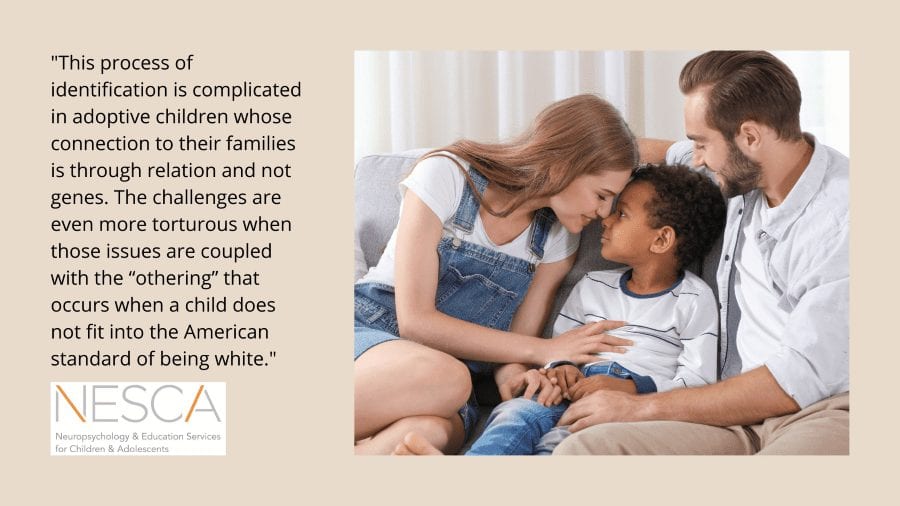
This process of identification is complicated in adoptive children whose connection to their families is through relation and not genes. The challenges are even more torturous when those issues are coupled with the “othering” that occurs when a child does not fit into the American standard of being white. In my neuropsychological practice assessing adoptive children, my own little bubble of white privilege has been pricked many times by a child saying, sometimes to me or sometimes through their parent, that “no one looks like me.” The loneliness of this statement is palpable, but the cost goes beyond to indicate impediments to the healthy development of identity, which includes that of racial identity.

In an article for Time Magazine written by the parent of a transracially adopted child and with the help of adoptees and their parents, the following four “comforting but dangerous” myths about race and difference were identified:

Myth 1: Color doesn’t matter. Oh, but it does; just ask the child who has been called the “N” word or the one who is assumed to be a math whiz because they are Asian. Adopted children who are raised by a Caucasian family and in a Caucasian community will tend to think of themselves as white – sort of – until they hit the wall of the way others perceive them. People have expectations about others based on race and ethnicity and insisting that people “should” be colorblind is ignoring reality. It leaves no room for the child to ask questions about what makes them the person that they are and prevents the parent from giving them what they most need – a caring listener when they are hurt or confused.

Myth 2: If I talk to my kids about race, I’m just creating an issue. As parents, we cannot protect our children from the verbal and physical assaults of others, but we can prepare them for how to handle it if it happens. One adoptee and current adoption advocate asks parents if they would not teach their children how to safely cross a street because they may become frightened of being hit by a car. This includes having “the talk” with our African American boys about how to handle themselves with police officers and other authority figures.

Myth 3: No matter what, a “good” school is best for my child. This is the source of the “No one looks like me” plaint of many of my clients but it is the toughest of all myths to unpack for most white parents to whom education has been touted as pretty much the solution for everything. A “good school” may be the one with high test scores and good real estate value, but it is unlikely to be the school with a diverse student and teacher population that could provide a non-white child with a rich source of role models and narratives to use in the development of their own identity. Other sources of identification include churches, community groups and cultural organizations, such as language schools and adoptive family groups. Lacking these sources, the child’s options for racial identity are determined by those who know nothing about their culture.

Myth 4: You are the hero of your child’s story. As someone who has heard many terrible and tragic origin stories and stood in awe of the efforts adoptive parents have made to help their children, I have often been guilty of encouraging this kind of thinking without considering the consequence to the child who has been rescued. The burden of “forced gratitude” is emotionally crippling and prevents the child from asking questions about their biological parents or fantasizing (in the way that all children do) about what it would have been like to be in a different family. Conversely, the concept of “saving” a child feeds into the parental fantasy that if we just love our child enough and do all the right things, we can protect them from being hurt by the loss of adoption and the ugly reality of racism. This is also an ultimately futile effort. As Martha Crawford, psychotherapist and mother of two transracially adopted children, stated, “An adoptive parent’s job is to be a sturdy scaffold for kids to do their own work, not to tell them how to construct their own identities.”


About the Author:

Dr. Stephanie Monaghan-Blout is a senior clinician who joined NESCA at its inception in 2007. She specializes in the neuropsychological and psychological assessment of children and adolescents with complex learning and emotional issues and enjoys consulting to schools on these issues. Her responsibilities at NESCA also include acting as Clinical Coordinator, overseeing therapeutic services, providing therapy and psychoeducational counseling and, in the time of the COVID-19 crisis, providing teletherapy to parents and teens.

In her early career as an adolescent and family therapist, Dr. Monaghan-Blout became very interested in the needs of those contending with traumatic experiences. She brought that interest to her work as a pediatric neuropsychologist and continues to be passionate about treating this population. She has developed an expertise in working with adoptive children and others who have experienced early trauma. She is a longtime member of the Trauma and Learning Policy Initiative (TLPI) associated with Massachusetts Advocates for Children and the Harvard Law Clinic and presents nationally and regionally on assessment and treatment of children with complex/developmental trauma.

Dr. Monaghan-Blout graduated from Bowdoin College and received a Master’s Degree in Counselor Education from Boston University. She obtained her Doctorate in Clinical Psychology from Antioch New England Graduate School with a dissertation entitled, “A Different Kind of Parent; Resisting the Intergenerational Legacy of Maltreatment.” She completed an internship in pediatric neuropsychology and child psychology at North Shore University Hospital in New York, and a postdoctoral fellowship at HealthSouth/Braintree Rehabilitation Hospital.

She joined Dr. Ann Helmus at Children’s Evaluation Center in 2003, and again at NESCA in 2007. A member of the Massachusetts Neuropsychological Society Board of Directors from 2010 – 2013 and from 2014-2017, Dr. Monaghan-Blout served in many capacities, including as President. Dr. Monaghan-Blout is the mother and stepmother of four children and the grandmother of six. She is also an avid ice hockey player, cook, gardener and devotee of urban fantasy.


To book therapy services with Dr. Monaghan-Blout or an evaluation with one of our many expert neuropsychologists and transition specialists, complete NESCA’s online intake form.


Neuropsychology & Education Services for Children & Adolescents (NESCA) is a pediatric neuropsychology practice and integrative treatment center with offices in Newton, Massachusetts, Plainville, Massachusetts, and Londonderry, New Hampshire, serving clients from preschool through young adulthood and their families. For more information, please email info@nesca-newton.com or call 617-658-9800.
Skip to content