To accommodate requests for neuropsychological evaluations after the start of the new school year, NESCA has added evaluation dates in its Newton, MA office. Immediate openings are now available for scheduling. Please complete our Inquiry/Intake Form for more information or to start the scheduling process.

Tag

language-based learning disability Archives - NESCA

Subscribe to NESCA Notes

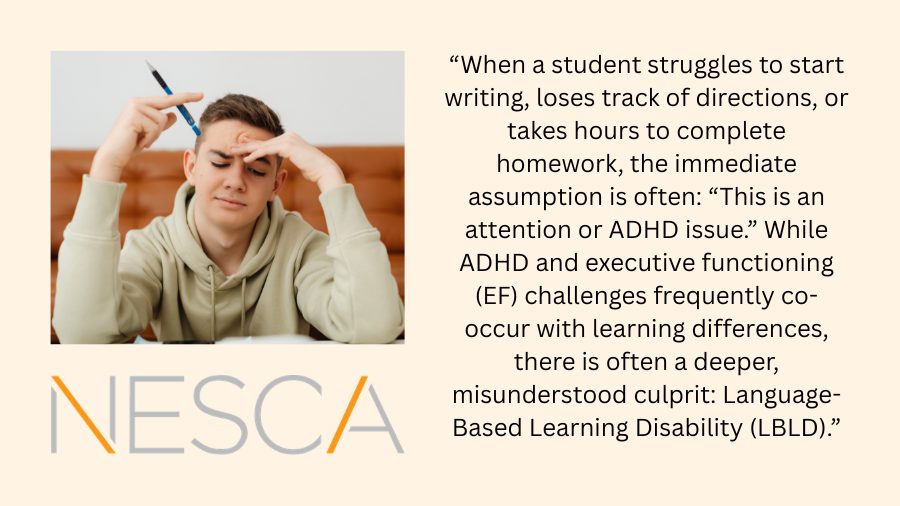
Image of a student having a hard time initiating homework. Quote from a NESCA clinician.

Understanding LBLD and Executive Functioning: Securing the Right IEP or 504 Support

By | NESCA Notes 2026

Image of a student having a hard time initiating homework. Quote from a NESCA clinician.By: Alissa Talamo, PhD
Pediatric Neuropsychologist, NESCA

When a student struggles to start writing, loses track of directions, or takes hours to complete homework, the immediate assumption is often: “This is an attention or ADHD issue.” While ADHD and executive functioning (EF) challenges frequently co-occur with learning differences, there is often a deeper, misunderstood culprit: Language-Based Learning Disability (LBLD).

For parents, advocates, and educators, understanding the relationship between language processing and EF is critical. Without this insight, schools risk implementing accommodations that merely bypass the problem, rather than providing the specialized instruction a student needs to build independence.

What are LBLD and Executive Functioning?

An LBLD is a neurodevelopmental spectrum of difficulties affecting how individuals process, understand, and use spoken and written language. It is a processing difference entirely unrelated to intelligence, motivation, or instructional quality. LBLD typically impacts:

  • Reading (Dyslexia): Decoding, phonics, and comprehension.
  • Written Expression (Dysgraphia): Mechanics, spelling, and organizing thoughts.
  • Spoken Language: Receptive (understanding instructions) and expressive (word retrieval) language.
  • Organization & Memory: Working memory deficits and difficulty planning multi-step tasks.

Executive Functioning is the brain’s “management system” – housed in the prefrontal cortex – enabling individuals to plan, focus, remember instructions, regulate emotions, and prioritize tasks.

The Intersection: How Language Weaknesses Disrupt EF

To support these students, we must distinguish between primary ADHD and LBLD-driven executive dysfunction:

  • Primary ADHD: Driven by global deficits in behavioral inhibition and executive control.
  • LBLD: Executive dysfunction is a secondary consequence of the high cognitive load of language processing.

When a student expends immense energy decoding words, retrieving vocabulary, or analyzing syntax, it rapidly drains their cognitive battery. This cognitive fatigue manifests as apparent executive dysfunction (task avoidance, distractibility, or poor initiation). Treating this solely as an attention issue misses the opportunity to provide necessary language-based instruction.

This breakdown occurs in three key areas:

  1. Working Memory Overload: Weaknesses in word meaning require so much conscious effort to decode that the student’s working memory overflows, causing them to lose track of multi-step directions.
  2. The Processing “Bottleneck”: Translating auditory language into an internal concept, and then into a written response, takes longer. This delay acts as a bottleneck when trying to get ideas onto paper.
  3. The Absence of “Internal Language”: Cognitive flexibility and task initiation rely on “internal language” (self-talk used to plan and organize). Students with LBLD lack strong internal language, resulting in task initiation paralysis.

Moving Beyond Accommodations to Specialized Instruction

Schools often default to accommodations, such as providing extra time, pre-filled graphic organizers, or reduced assignments. While these accommodations act as a passive bypass – altering the environment or format to circumvent a deficit – they do not teach skills. By bypassing the weakness without remediating it, accommodations can create prompt-dependency, where the student relies on an adult or a tool to do the cognitive heavy lifting.

In contrast, specialized instruction serves as active remediation by explicitly and systematically teaching cognitive and linguistic strategies. For example, instead of simply handing a student a graphic organizer, specialized instruction teaches the metacognitive process of how and when to use it. This approach targets the deficit directly, transforming the student from a passive recipient of support into an active, self-regulating learner.

To foster independence, students must learn to internalize strategies through:

  • Explicit Strategy Instruction: Teaching how to identify and map the relationship between main ideas and details.
  • Self-Monitoring Training: Teaching students to use self-talk checklists (e.g., “Stop, Review Prompt, Check”) to monitor their own progress.
  • Working Memory Strategies: Instructing students in verbal rehearsal, visualization, and chunking.

Drafting Measurable EF/LBLD Goals for IEPs and 504s

IEP goals must shift from passive task completion to active skill acquisition by targeting the underlying cognitive-linguistic process, not just the final academic product.

Goal Comparison

  • Weak Goal (Product-Oriented): “Student will use an organizer to complete writing assignments with 80% accuracy.”
    • Why it fails: Focuses on worksheet completion (the product), not the planning skill. It does not define independence level or the specific strategy used.
  • Strong Goal (Skill- & Strategy-Oriented): “Given a multi-step writing prompt, the student will independently apply a 3-step planning strategy (brainstorm, categorize, sequence) to initiate writing within 5 minutes, in 4 out of 5 opportunities.”
    • Why it works: Targets the executive functions of planning and initiation, defines the exact strategy, and measures independence to build internal language.

Three Essential Elements of an EF/LBLD Goal

When advocating for IEP goals, ensure these three elements are explicitly defined:

  1. The Specific Strategy (The “How”): Name the exact cognitive tool (e.g., verbal rehearsal, a 3-step planning strategy, a self-monitoring checklist).
  2. The Level of Independence (Prompt Fading): Quantify the support required using precise, observable terms (e.g., independently, given no more than one verbal prompt), avoiding vague terms like “with minimal assistance.”
  3. Measurement of the EF Skill: Directly measure the executive function deficit (e.g., task initiation latency, planning time) rather than curriculum accuracy.

By shifting the focus of IEPs and 504 plans from passive accommodations to explicit, strategy-based specialized instruction, we can help students with LBLD build the internal language and executive functioning skills they need to navigate school – and life – independently.


About the Author

Alissa Talamo headshotWith NESCA since its inception in 2007, Dr. Talamo had previously practiced for many years as a child and adolescent clinical psychologist before completing postdoctoral re-training in pediatric neuropsychology at the Children’s Evaluation Center.

After receiving her undergraduate degree from Columbia University, Dr. Talamo earned her doctorate in clinical health psychology from Ferkauf Graduate School of Psychology and the Albert Einstein College of Medicine at Yeshiva University.

She has given a number of presentations, most recently on “How to Recognize a Struggling Reader,” “Supporting Students with Working Memory Limitations,” (with Bonnie Singer, Ph.D., CCC-SLP of Architects for Learning), and “Executive Function in Elementary and Middle School Students.”

Dr. Talamo specializes in working with children and adolescents with language-based learning disabilities including dyslexia, attentional disorders, and emotional issues. She is also interested in working with highly gifted children.

Her professional memberships include MAGE (Massachusetts Association for Gifted Education), IDA (International Dyslexia Association), MABIDA (the Massachusetts division of IDA) and MNS (the Massachusetts Neuropsychological Society).

She is the mother of one daughter.

To book a consultation or evaluation with one of our many other expert neuropsychologists, complete NESCA’s online intake form.

NESCA is a pediatric neuropsychology and related services practice with offices in Newton, Plainville, and Hingham, Massachusetts; Londonderry, New Hampshire; and Coral Gables, Florida, serving clients from infancy through young adulthood and their families. For more information, please email info@nesca-newton.com or call 617-658-9800.

Summer Reading Ideas

By | NESCA Notes 2022

By: Alissa Talamo, PhD
Pediatric Neuropsychologist, NESCA

Research demonstrates that children lose reading skills over the summer break. A 2020 study found that students in 3rd to 5th grades lost, on average, about 20 percent of their school-year gains in reading during the summer. So, how do we encourage a reluctant reader to read during the summer? There are several fun opportunities that allow your child to read a book of their choice and earn prizes at the same time!

For example:

www.scholastic.com/site/summer-reading.html Scholastic Books offers a program that encourages children to “read books and stories; attend author events; interact with their favorite characters; play book-based games and activities; join dance parties; and more!” Children can read any book of their choice. They can also download and print a report of their reading progress. Additionally, by keeping Reading Streaks™, your child will help unlock a donation of 100,000 books from Scholastic to Save the Children, providing books to children in rural America with limited or no access to books.

Bookworm Wednesdays | Showcase Cinemas According to their website, Bookworm Wednesdays is “A fun and rewarding summer reading program developed to encourage young children to read during the summer months.” Bookworm Wednesdays allows children to earn free movie admission to a select children’s film when they present a book report at a participating Cinema de Lux, Showcase, or Multiplex Cinemas box office. There are several local participating sites, including Patriot Place and Legacy Place. (Parents, as well as children under the age of 6, receive free admission and do not need to submit a book report).

www.barnesandnobleinc.com This is an opportunity for your child to earn free books! Your child can read any 8 books and complete the reading journal available at the Barnes & Noble website. Then your child brings the completed reading journal to any participating Barnes & Noble bookstore and chooses their free book from the books listed on the Reading Journal list (see the website for the list of titles available to choose from this summer). Free reward books must be collected from a local Barnes & Noble store during July and August.

Finally, check out your local library for programs! Most local libraries have reading incentive programs that children can participate in all summer long.

Other ideas include…

  • Have your child read a book that has been made into a movie (If the book is above their reading level, read the book to them or allow them to listen to the book as an audio recording). Once the child has completed their reading, enjoy a family movie night with popcorn and more.
  • Have your child read about a specific topic or place and then plan a field trip. For example, an older student could read “Little Women” and then visit Louisa May Alcott’s house in Concord, MA, or watch the 2019 version of the movie and then visit Lyman Estate in Waltham where some of the filming took place!
  • Allow your child to pick their own books. Allow them to choose from subjects of interest to them (parent-approved, of course), as they are more likely to read something they picked! Also, allow them to choose books from different book types (e.g., paperback, graphic novel, audiobooks).
  • If you are going on a family vacation, encourage your child to read books about the area (fact or fiction) and plan to visit some of the places mentioned in the book. Day trips are also encouraged. Your child could read a book about animals and then visit a local zoo or aquarium.

If you are unsure of which books are at your child’s reading level, many libraries break down books by grade level. Ultimately, summer reading should not be so easy that it is boring, but it also should not be too difficult, as that can cause frustration. Allowing children to pick out books at their independent reading level is best. Research has found that children read more and learn best when they are allowed to select the books they read.

Happy Summer Reading!


About the Author

With NESCA since its inception in 2007, Dr. Talamo had previously practiced for many years as a child and adolescent clinical psychologist before completing postdoctoral re-training in pediatric neuropsychology at the Children’s Evaluation Center.

After receiving her undergraduate degree from Columbia University, Dr. Talamo earned her doctorate in clinical health psychology from Ferkauf Graduate School of Psychology and the Albert Einstein College of Medicine at Yeshiva University.

She has given a number of presentations, most recently on “How to Recognize a Struggling Reader,” “Supporting Students with Working Memory Limitations,” (with Bonnie Singer, Ph.D., CCC-SLP of Architects for Learning), and “Executive Function in Elementary and Middle School Students.”

Dr. Talamo specializes in working with children and adolescents with language-based learning disabilities including dyslexia, attentional disorders, and emotional issues. She is also interested in working with highly gifted children.

Her professional memberships include MAGE (Massachusetts Association for Gifted Education), IDA (International Dyslexia Association), MABIDA (the Massachusetts division of IDA) and MNS (the Massachusetts Neuropsychological Society).

She is the mother of one teenage girl.


To book a consultation with Dr. Talamo or one of our many other expert neuropsychologists, complete NESCA’s online intake form.

Neuropsychology & Education Services for Children & Adolescents (NESCA) is a pediatric neuropsychology practice and integrative treatment center with offices in Newton, Massachusetts, Plainville, Massachusetts, and Londonderry, New Hampshire, serving clients from preschool through young adulthood and their families. For more information, please email info@nesca-newton.com or call 617-658-9800.

October is Dyslexia Awareness Month

By | NESCA Notes 2022

By: Alissa Talamo, PhD
Pediatric Neuropsychologist, NESCA

According to the International Dyslexia Association (IDA), “Dyslexia is a language-based learning disability. Dyslexia refers to a cluster of symptoms, which result in people having difficulties with specific language skills, particularly reading. Students with dyslexia usually experience difficulties with other language skills such as spelling, writing, and pronouncing words. Dyslexia affects individuals throughout their lives; however, its impact can change at different stages in a person’s life. It is referred to as a learning disability because dyslexia can make it very difficult for a student to succeed academically in the typical instructional environment, and in its more severe forms, will qualify a student for special education, special accommodations, or extra support services.” Also, it is important to recognize that dyslexia is not due to either a lack of intelligence or a lack of desire to learn, and with appropriate and sufficient teaching methods, students with dyslexia can learn successfully.

Fortunately, there are effective strategies to help students with dyslexia. However, some common approaches to teaching reading (e.g., guided reading, balanced literacy) have not been found to be effective enough for the struggling reader. What research has found to be most effective is Structured Literacy. Structured Literacy instruction includes specific elements that are necessary for a dyslexic reader to make reading progress. Such elements include phonemic awareness (the ability to notice, think about, and work with individual sounds in words, such as separating the spoken word “cat” into three distinct phonemes), phonological awareness (the ability to recognize and manipulate the spoken parts of sentences and words), sound-symbol association (e.g., identify printed letters and what sounds they make), syllable instruction, morphology (smallest unit of meaning in the language), syntax (e.g., grammar), and semantics (meaning). In order to be most effective, students with dyslexia need to be taught using an explicit instruction method, with a teacher trained in a program that meets that student’s specific needs, the instruction needs to be taught in a logical order (basic concepts before more difficult ones), and each step needs to be based on previously learned concepts (cumulative).

According to the IDA, a comprehensive evaluation to assess for dyslexia, as well as to assess for any other potential language challenges or learning disabilities, should include intellectual and academic achievement testing, as well as assessment of critical underlying language skills that are closely linked to dyslexia, such as receptive and expressive language skills, phonology (phonological awareness, phonemic awareness), and rapid naming (e.g., quickly reading single letters or numbers). Additionally, a full evaluation should assess a student’s ability to read a list of unrelated real words as well as a list of pseudowords (made up pretend words to assess a child’s ability to apply reading rules), in addition to a student’s ability to read in context (e.g., stories). If a student is found to demonstrate that they meet criteria for a diagnosis of dyslexia, a specialized program should be developed by the school in order to provide appropriate services and accommodations.

Sources:

https://dyslexiaida.org/dyslexia-basics-2

https://dyslexiaida.org/effective-reading-instruction-for-students-with-dyslexia

www.readingrockets.org


About the Author

With NESCA since its inception in 2007, Dr. Talamo had previously practiced for many years as a child and adolescent clinical psychologist before completing postdoctoral re-training in pediatric neuropsychology at the Children’s Evaluation Center.

After receiving her undergraduate degree from Columbia University, Dr. Talamo earned her doctorate in clinical health psychology from Ferkauf Graduate School of Psychology and the Albert Einstein College of Medicine at Yeshiva University.

She has given a number of presentations, most recently on “How to Recognize a Struggling Reader,” “Supporting Students with Working Memory Limitations,” (with Bonnie Singer, Ph.D., CCC-SLP of Architects for Learning), and “Executive Function in Elementary and Middle School Students.”

Dr. Talamo specializes in working with children and adolescents with language-based learning disabilities including dyslexia, attentional disorders, and emotional issues. She is also interested in working with highly gifted children.

Her professional memberships include MAGE (Massachusetts Association for Gifted Education), IDA (International Dyslexia Association), MABIDA (the Massachusetts division of IDA) and MNS (the Massachusetts Neuropsychological Society).

She is the mother of one teenage girl.


To book a consultation with Dr. Talamo or one of our many other expert neuropsychologists, complete NESCA’s online intake form.

Neuropsychology & Education Services for Children & Adolescents (NESCA) is a pediatric neuropsychology practice and integrative treatment center with offices in Newton, Massachusetts, Plainville, Massachusetts, and Londonderry, New Hampshire, serving clients from preschool through young adulthood and their families. For more information, please email info@nesca-newton.com or call 617-658-9800.

When the Struggle with Writing is Real

By | NESCA Notes 2022

By: Alissa Talamo, PhD
Pediatric Neuropsychologist, NESCA

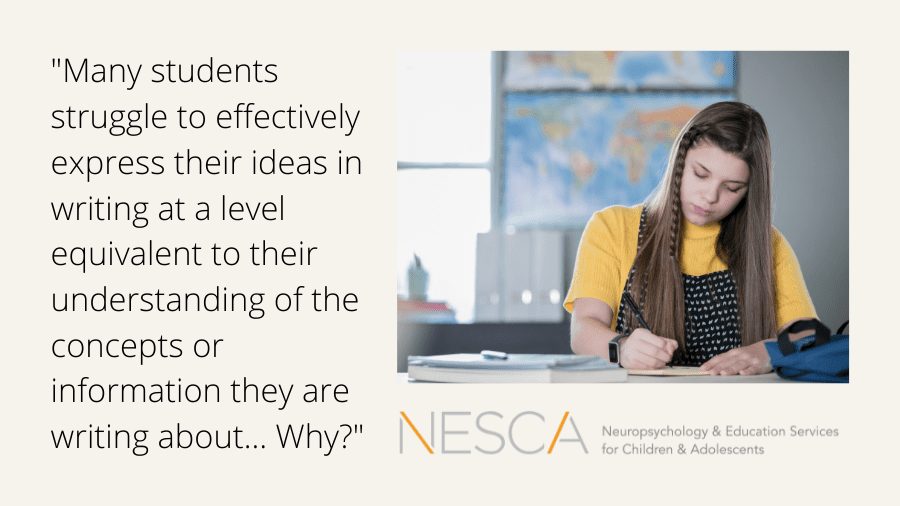
Many students struggle to effectively express their ideas in writing at a level equivalent to their understanding of the concepts or information they are writing about… Why?

There are many reasons a student may struggle with academic (expository) writing. Such writing requires a student to evaluate evidence, expand upon ideas, and demonstrate knowledge in a clear and concise way. In order to write effectively, a student must access and implement several higher order processes simultaneously, including but not limited to:

  • thinking
  • organization of ideas
  • retrieval of needed information
  • being able to remember an idea long enough to write it down…

while at the same time, the student also needs to think about writing mechanics (e.g., handwriting, spelling, punctuation).

All of these sub-components need to be pulled together for a student to create a well-written product. As a result, students often avoid writing or write only the minimal amount necessary.

Students with both language-based learning disabilities (LBLD) and AD/HD are at particular risk to struggle, as student with LBLD often have difficulty with word retrieval, syntax, and spelling to name a few, while students diagnosed with AD/HD inherently struggle with task initiation, planning, distractibility, and are vulnerable to reduced handwriting skills and careless errors.

In order to support all students, we need to help them develop more efficient skills. Research has shown that students can be taught to organize their language and ideas. Graphic organizers are an example of an organizational strategy. Some well-researched and effective programs include “Brain Frames,” a set of six graphical patterns that students draw to organize their language and ideas (www.architectsforlearning.com) and “Thinking Maps,” a set of eight visual patterns that correlate to specific cognitive processes (www.thinkingmaps.com). Another benefit of the graphic organizers is that the skills learned can be applied to more than just writing, but as writing is a critical skill necessary for school success as well as in the workforce, it is important that we help our students develop these skills and recognize that they do have the ability to demonstrate their knowledge in written form.

If your child is having difficulty with writing, let us know by completing our online Intake Form.

Resources used for this blog include:

  • Architectsforlearning.com
  • Thinkingmaps.com
  • PBS.org
  • adlit.org


About the Author

With NESCA since its inception in 2007, Dr. Talamo had previously practiced for many years as a child and adolescent clinical psychologist before completing postdoctoral re-training in pediatric neuropsychology at the Children’s Evaluation Center.

After receiving her undergraduate degree from Columbia University, Dr. Talamo earned her doctorate in clinical health psychology from Ferkauf Graduate School of Psychology and the Albert Einstein College of Medicine at Yeshiva University.

She has given a number of presentations, most recently on “How to Recognize a Struggling Reader,” “Supporting Students with Working Memory Limitations,” (with Bonnie Singer, Ph.D., CCC-SLP of Architects for Learning), and “Executive Function in Elementary and Middle School Students.”

Dr. Talamo specializes in working with children and adolescents with language-based learning disabilities including dyslexia, attentional disorders, and emotional issues. She is also interested in working with highly gifted children.

Her professional memberships include MAGE (Massachusetts Association for Gifted Education), IDA (International Dyslexia Association), MABIDA (the Massachusetts division of IDA) and MNS (the Massachusetts Neuropsychological Society).

She is the mother of one teenage girl.


To book a consultation with Dr. Talamo or one of our many other expert neuropsychologists, complete NESCA’s online intake form.

Neuropsychology & Education Services for Children & Adolescents (NESCA) is a pediatric neuropsychology practice and integrative treatment center with offices in Newton, Massachusetts, Plainville, Massachusetts, and Londonderry, New Hampshire, serving clients from preschool through young adulthood and their families. For more information, please email info@nesca-newton.com or call 617-658-9800.
Skip to content