By Olivia Rogers, MA, CCC-SLP
Speech-Language Pathologist, NESCA
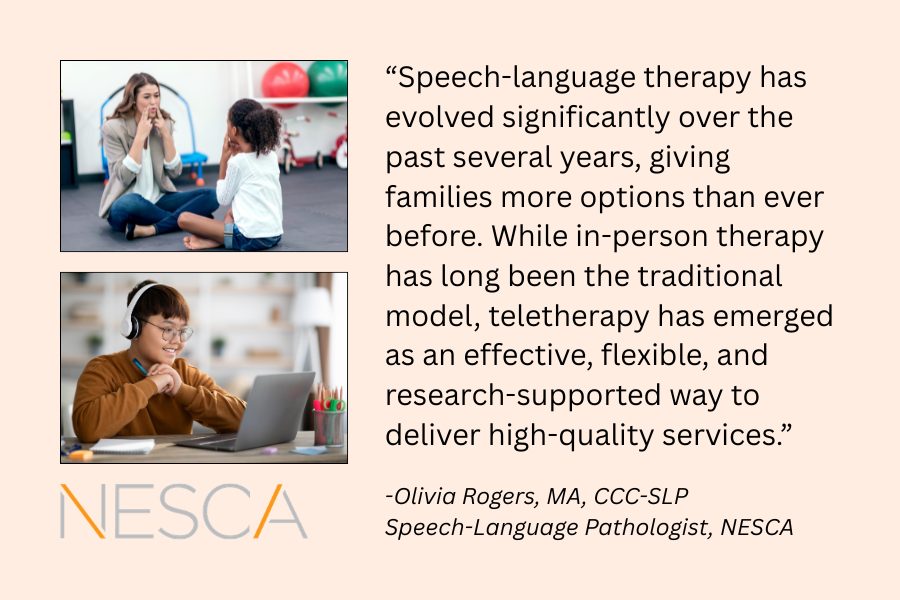
Speech-language therapy has evolved significantly over the past several years, giving families more options than ever before. While in-person therapy has long been the traditional model, teletherapy has emerged as an effective, flexible, and research-supported way to deliver high-quality services.
Both approaches can support meaningful progress, but they offer different advantages depending on a student’s needs, learning style, and family schedule.
What is In-Person Therapy?
In-person therapy takes place face-to-face in a clinic, school, or home setting. Sessions often include hands-on materials, physical movement, and direct interaction with the clinician in the same space.
Benefits of In-Person Therapy
- Natural opportunities for play-based learning
- Physical prompts and hands-on support
- Easier for very young children who need frequent redirection
- Helpful when targeting feeding, articulation placement, or sensory-motor skills
For some students – particularly younger children or those needing physical cueing – in-person therapy can be an important option.
What is Teletherapy?
Teletherapy delivers speech, language, and coaching services through a secure video platform. Sessions remain interactive, individualized, and structured and use digital materials, shared screens, real-time coaching, and collaborative activities. Teletherapy is not “less than” in-person therapy. In many cases, it offers unique advantages that directly support academic and functional skill development.
The Benefits of Teletherapy
- Therapy Happens in the Student’s Real Learning Environment
Students often join sessions from home or school, allowing strategies to be applied immediately to real assignments, writing tasks, and classroom demands. This is especially powerful for:
- Academic language
- Writing
- Executive functioning
- Organization and study skills
Skills transfer more naturally because therapy is embedded in everyday routines.
- Increased Engagement for Older Students
Many school-age students and adolescents are highly responsive to digital learning. Interactive slides, collaborative documents, and visual supports can increase participation and independence. Teletherapy often feels:
- Less intimidating
- More conversational
- Provides more room for independence
- More aligned with how students already learn
This can lead to stronger buy-in and carryover.
- Greater Family Involvement
Caregivers can easily observe sessions, ask questions, and learn strategies without travel. Due to the ease of meeting, consultation time can easily be built into teletherapy sessions or added on as a monthly service. This improves consistency between therapy and daily life – one of the biggest predictors of progress.
- Flexible Scheduling and Reduced Barriers
Teletherapy eliminates commuting, waiting rooms, and geographic limitations. Families can access specialized services that may not exist locally. This flexibility is particularly helpful for:
- Busy families
- Students with extracurricular schedules
- Students who fatigue easily
- Families planning transitions or moves
- Strong Fit for Language, Literacy, and Executive Functioning
Many higher-level communication skills naturally occur on screens, such as reading passages, writing responses, organizing ideas, and managing tasks. Middle and High School students now type essays, rather than handwriting. Teletherapy allows clinicians to:
- Model writing in real time
- Scaffold comprehension strategies
- Practice planning and organization
- Teach digital learning skills students already need
For these goals, the teletherapy environment can actually mirror classroom expectations more closely than a clinic setting.
When One Approach May Be Better Than the Other
In-person therapy may be preferred when:
- Physical cueing is essential
- Attention regulation is extremely challenging
- Sensory-motor or feeding work is a primary goal
Teletherapy may be ideal when:
- Goals are academic or language-based
- Students benefit from visual/digital supports
- Families need scheduling flexibility
- Collaboration with caregivers or teachers is important
Often, the best approach is individualized, and some students benefit from a combination over time.
Final Thoughts
Teletherapy has expanded what is possible in speech-language support. For many students, particularly those working on language, literacy, and executive functioning, it provides a flexible, effective, and highly relevant model of care.
Rather than replacing in-person therapy, teletherapy offers another pathway for families to access specialized support and help students build skills that extend beyond the therapy session.
At NESCA, we know that the research shows that outcomes depend less on location and more on the clinician’s expertise, individualized goals, consistency of sessions, and strategy carryover into daily life. Whether sessions occur in-person or online, meaningful progress happens when therapy is functional, engaging, and connected to a student’s real-world demands. For more information on Speech and Language Therapy and services at NESCA, please complete our online Inquiry/Intake Form or email me directly at orogers@nesca-newton.com.
About the Author
To learn more about NESCA’s Speech and Language Services or schedule appointments, complete our online Intake Form or email orogers@nesca-newton.com.
NESCA is a pediatric neuropsychology and related services practice with offices in Newton, Plainville, and Hingham, Massachusetts; Londonderry, New Hampshire; and Coral Gables, Florida, serving clients from infancy through young adulthood and their families. For more information, please email info@nesca-newton.com or call 617-658-9800.