
By Olivia Rogers, MA, CCC-SLP
Speech-Language Pathologist, NESCA
When we think about learning, we often separate skills into categories – language, executive functioning, literacy, academics, just to name some. But in real life, these systems don’t operate independently. They are deeply intertwined and recursive, meaning they continuously influence, shape, and strengthen one another over time.
What Is Executive Functioning?
Executive functioning refers to the brain’s management system. These skills help students plan and organize ideas, initiate tasks, hold information in working memory, monitor understanding, shift between strategies, and manage time and attention.
What Is Language?
Language includes understanding directions, expressing ideas clearly orally and in writing, narrative organization, comprehension of complex oral and written information, academic language use, and internal self-talk.
How Executive Functioning Depends on Language
Students rely on language to talk themselves through steps, plan written responses, explain reasoning, organize narratives, monitor comprehension, and use strategies independently.
How Language Depends on Executive Functioning
Producing and understanding language requires holding ideas in working memory, sequencing information, shifting between topics, inhibiting irrelevant details, revising messages, and planning written expression.
The Recursive Relationship 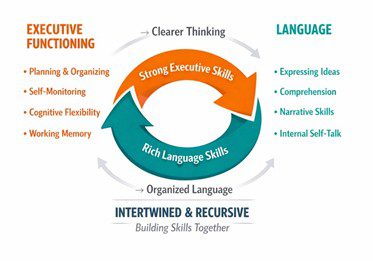
Growth in one area supports growth in the other. Stronger language supports clearer thinking, and better executive skills support more organized language.
The Big Picture
Integrated support helps students explain their thinking, plan before speaking or writing, use language as a strategy, monitor understanding, and become more independent learners. Executive functioning and language are overlapping systems that continuously shape each other. Supporting both together makes learning more accessible, meaningful, and transferable.
At NESCA, we view communication holistically. Our speech language pathologists use a comprehensive approach to treat the systems of learning as integrative, helping students develop valuable skills they can use in and out of the classroom! For more information on Speech and Language Therapy at NESCA, please complete our online Intake Form or email me directly at orogers@nesca-newton.com.
About the Author
To learn more about NESCA’s Speech and Language Services or schedule appointments, complete our online Intake Form or email orogers@nesca-newton.com.
NESCA is a pediatric neuropsychology and related services practice with offices in Newton, Plainville, and Hingham, Massachusetts; Londonderry, New Hampshire; and Coral Gables, Florida, serving clients from infancy through young adulthood and their families. For more information, please email info@nesca-newton.com or call 617-658-9800.
