By: Jessica Greene, Psy.D.
Postdoctoral Fellow, NESCA
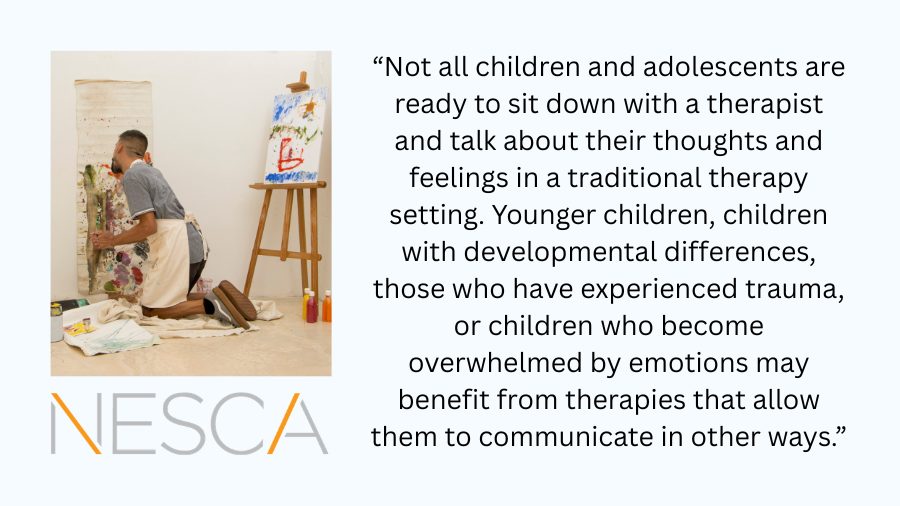
When parents receive a recommendation that their child begin therapy, it can feel overwhelming. Many people are familiar with traditional “talk therapy,” but some may not realize there are many different therapeutic approaches designed to meet children where they are at developmentally or emotionally. After receiving a recommendation for therapy, many parents immediately ask, “Do you recommend anyone?” While that is an important question, it can be just as helpful to first ask, “What type of therapy is the best fit for my child?” Not all children and adolescents are ready to sit down with a therapist and talk about their thoughts and feelings in a traditional therapy setting. Younger children, children with developmental differences, those who have experienced trauma, or children who become overwhelmed by emotions may benefit from therapies that allow them to communicate in other ways.
Fortunately, there are several therapeutic approaches that may be a better fit.
Play-based Therapy
In play-based therapy, children use play to work through challenging feelings, day-to-day stressors, and/or difficult experiences. Rather than relying on conversation, the play allows the child to express themselves in the way that comes most naturally to them. Through the child’s play, the therapist may gain insight into how the child understands experiences, relationships, or emotions. For example, a child may use toy cars to make sense of a car accident, replaying the accident as they work toward understanding and processing the experience.
It is important to know that registered play therapy is different from simply playing games with a child during a therapy session. In play therapy, play itself is the therapeutic language, and the therapist has specialized training in using play to support assessment and treatment. It is okay to ask a potential therapist about their approach.
Find a Registered Play-based Therapist: https://www.a4pt.org/search/custom.asp?id=3571
Music Therapy, Dance/Movement Therapy, and Art Therapy
Music, dance/movement, and art therapy use creative expression as the primary way children explore emotions, build coping skills, strengthen self-awareness, and process difficult experiences. For some children, creating art, moving their bodies, or making music feels safer and more natural than talking. What they may not be able to say in words, they may be able to demonstrate through one of these other forms. These therapies naturally offer rhythmic, patterned, repetitive movements that can support internal regulation while giving children an alternative avenue to express themselves.
Find a Music Therapist: https://my.cbmt.org/cbmtssa/f?p=CRTSSA:17800:1865299384:::17800::
Find an Art Therapist: https://arttherapy.org/art-therapist-locator/
Find a Dance/Movement Therapist: https://www.adta.org/find-a-dmt#/
Occupational Therapy
Occupational Therapy is another alternative that may be a better entry point for some children who are not quite ready for the above-listed therapies. Although occupational therapy is often associated with fine motor skills or handwriting, many occupational therapists also specialize in sensory processing and emotional regulation. Through movement, sensory experiences, and structured activities, children learn what helps their bodies feel calm, organized, and ready to participate in everyday activities. As children engage with swings, climbing equipment, crash pads, sensory tools, and other therapeutic activities, they begin to recognize what helps them feel better regulated. As occupational therapists can provide support for many different needs, seek an occupational therapist that focuses on sensory processing and/or emotion regulation.
To learn more about NESCA’s Occupational Therapy services, visit: https://nesca-newton.com/educational-occupational-therapy-services/
Sensory Motor Arousal Regulation Treatment (SMART)
SMART is a trauma-informed therapy that combines sensory experiences with movement, while also focusing on the importance of the caregiver/child relationship to help children feel safer and more regulated. If your child has experienced trauma, SMART therapy may be an appropriate place to begin. Similar to occupational therapy, the SMART room provides various types of therapeutic equipment to help a child regulate their body throughout the session. Sessions may include crashing into crash pads, throwing a ball back and forth, or jumping on a trampoline to help the client increase or decrease their level of arousal, depending on their needs. Caregivers are an important part of the therapeutic process, helping strengthen attachment, during sessions, while learning to recognize what supports their child’s regulation. The process also encourages caregivers to better understand their own emotional responses and how these can influence their child’s ability to feel safe and regulated.
Find a SMART-trained Therapist: https://smartmovespartners.com/find-a-smart-therapy-therapist/
Regardless of the type of therapy, one factor consistently predicts better outcomes: the relationship between the child and therapist. Children are most likely to make progress when they feel safe, understood, and connected to the person supporting them. If your child does not seem comfortable with a therapist after an appropriate adjustment period, it is okay to ask questions or explore whether another provider may be a better fit.
About the Author
Dr. Jessica Greene is a licensed clinical psychologist who has worked After working with Dr. Angela Currie in NESCA’s Londonderry, N.H. office from 2023-2024 as a practicum student, Dr. Jessica Greene re-joins NESCA to complete her postdoctoral fellowship in pediatric neuropsychological assessment. Dr. Greene has a particular interest in understanding clients’ strengths as well as differences, integrating a therapeutic assessment approach, when appropriate.
To book an evaluation with one of our many expert neuropsychologists or other clinicians, complete NESCA’s online intake form.
NESCA is a pediatric neuropsychology and related services practice with offices in Newton, Plainville, and Hingham, Massachusetts; Londonderry, New Hampshire; and Coral Gables, Florida, serving clients from infancy through young adulthood and their families. For more information, please email info@nesca-newton.com or call 617-658-9800.