
By: Julie Weieneth, Ph.D.
Pediatric Neuropsychologist, NESCA
As summer winds down, many families begin shifting their focus to the upcoming school year. We start to notice store shelves filled with backpacks and notebooks. We update our calendars with orientation events and fall sports schedules. Parents also start thinking about new teachers, changing routines, and everything their children will need for a successful start.
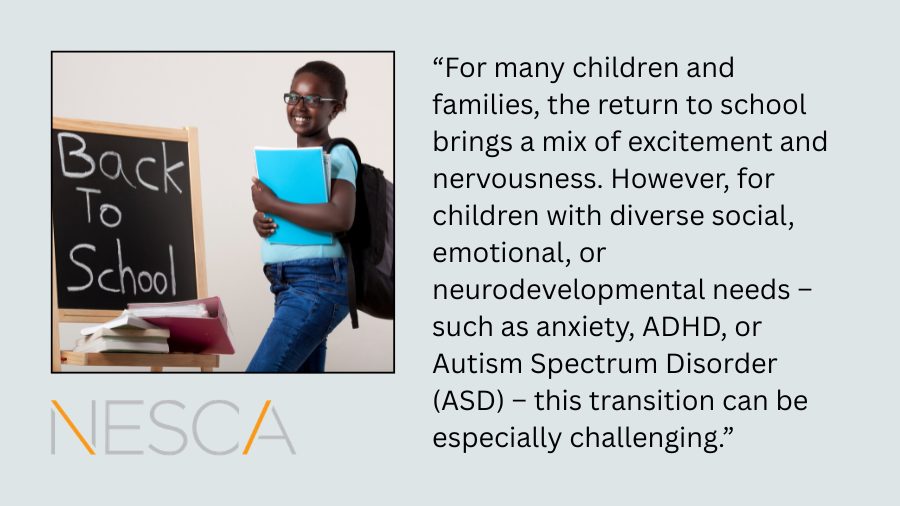
For many children and families, the return to school brings a mix of excitement and nervousness. However, for children with diverse social, emotional, or neurodevelopmental needs – such as anxiety, ADHD, or Autism Spectrum Disorder (ASD) – this transition can be especially challenging. Sudden shifts in routines, expectations, sensory environments, and social dynamics can trigger significant stress, even when the changes are positive.
Fortunately, with proactive planning and preparation, families can make the transition smoother and reduce anticipatory anxiety before the first day of school arrives.
Why the Back-to-School Transition Can Be Difficult
Children with anxiety, ADHD, or ASD often rely on predictability, structure, and familiar environments to feel secure and regulated:
- For children with anxiety, the unknown can trigger a cycle of worry. This may include apprehension about academic performance, social acceptance, or simply not knowing the daily schedule.
- For children with ADHD, the transition from the relatively relaxed pace of summer to the high executive functioning demands of the classroom – which requires sustained attention, organization, and self-regulation – can feel overwhelming.
- For children with ASD, differences in social communication and a strong preference for sameness mean that new teachers, different peer groups, and novel sensory environments require significantly more cognitive effort to manage.
Helping children understand exactly what to expect before these changes occur builds confidence and makes unfamiliar situations feel manageable. Below are some practical steps that families can take to help reduce this stress:
- Visit the School Before Classes Begin
One of the most effective ways to reduce first-day anxiety is to make the new environment feel physically familiar. This sensory and spatial familiarity benefits anxious, hyperactive, and sensory-sensitive children alike. Replacing uncertainty with physical familiarity significantly lowers anxiety on the first day of school.
If possible, arrange a visit to the school before classes officially start. Many schools host orientation days or can accommodate a brief walk-through during teacher preparation week. During the visit, your child can:
- Meet their new teacher to establish an early, positive connection.
- Locate their classroom, desk, and cubby or locker.
- Walk the routes to key locations like the cafeteria, gym, library, and bathrooms.
- Identify a “safe space” or a designated staff member they can access if they feel overwhelmed during the day.
- Use Social Narratives and Visual Schedules
Social narratives are personalized, step-by-step stories that help children understand what to expect in specific situations and outline helpful coping strategies. While originally developed for children with autism, these narratives are highly effective for children with ADHD and anxiety, as they clarify expectations and reduce executive functioning demands.
Using photos taken during your school visit can make the story even more meaningful. For example:
Tomorrow is my first day of fifth grade. I will walk into my classroom and see my teacher, Mrs. Smith. I will put my backpack in my cubby and find my desk. The classroom might be loud, or I might feel nervous, and that is okay. I can take deep breaths or ask to use my sensory tool. At the end of the day, I will take the bus home, and my family will be waiting for me.
Reading this narrative together several times before school starts allows children to mentally rehearse the day, reducing anxiety and boosting their sense of control.
- Utilize Video Modeling and Visual Walkthroughs
Many neurodivergent children are strong visual learners who process information more effectively through images and video than through verbal explanations alone.
Before school begins, consider recording a brief video on your phone during your school visit. Narrate the steps as you walk through the building: entering the front doors, finding the classroom, opening a locker, or navigating the cafeteria. Watching this video repeatedly at home allows your child to familiarize themselves with the sights and sounds of the school layout from the safety of a comfortable environment.
If you cannot visit the school in person to record, check the school’s website or reach out to the principal – many schools now host virtual tours or welcome videos recorded by staff that you can watch together at home. Video modeling is a highly versatile tool; it can also be used to prepare children for other transitions, such as medical appointments, family gatherings, or community outings.
- Gradually Shift Routines Before Day One
The transition from the relaxed schedule of summer to the highly structured routine of the school year can be a shock to a child’s internal clock. For children with ADHD and ASD, sleep disruption directly impacts daytime attention and emotional regulation.
About two weeks before school starts, begin incrementally shifting bedtimes and wake-up times by 15 minutes each day. Additionally, start practicing the morning routine – waking up, getting dressed, and having breakfast in the same sequence they will on school mornings. This gradual shift prevents first-week sleep deprivation and makes the first real school morning feel like a routine they have already mastered.
- Share a “One-Page Profile” with the New Teacher
Teachers receive a significant amount of paperwork at the start of the year, but a brief, personalized “One-Page Profile” (or “About Me” sheet) can be incredibly helpful. Before the first day, email a simple, bulleted summary to your child’s teacher. Consider including:
- My Strengths: What your child loves and what motivates them (e.g., “loves space science,” “highly creative”).
- What Helps Me: Strategies that work well (e.g., “needs a visual timer,” “benefits from sitting near the front”).
- What I Struggle With: Early warning signs of distress (e.g., “fidgets when overwhelmed,” “may shut down if confused”).
This quick-reference guide helps the teacher understand your child’s unique profile from day one, fostering a collaborative home-school partnership.
- Plan for the “After-School Letdown”
For children with diverse needs, holding it together during a highly structured school day requires immense cognitive and emotional effort. When they finally return to their safe haven at home, it is incredibly common for them to release that built-up tension. This often looks like sudden irritability, meltdowns, or extreme fatigue right after school – a very normal reaction often referred to as the “after-school letdown” or decompression.
To help your child gently decompress at the end of the day:
- Keep the transition quiet: Avoid immediately asking, “How was your day?” as they get in the car or walk through the door. Give them time to transition in comfortable silence.
- Provide a comforting snack: Have a favorite snack ready immediately to address any hunger-related irritability.
- Schedule quiet downtime: Allow for 30 to 60 minutes of unstructured, low-demand time (like quiet play, outdoor movement, or relaxing screen time) before starting homework or chores.
Small Steps Make a Big Difference
Transitions naturally involve uncertainty, which can fuel anxiety and behavioral challenges. Providing opportunities to preview and practice what lies ahead helps children feel more secure and confident.
Whether it is visiting the school, reading a personalized narrative, watching a video walkthrough, or gradually adjusting routines, these proactive strategies can help children with diverse needs approach the new school year with greater ease. While every child’s profile is unique, thoughtful preparation can make the transition back to school a more positive experience for the entire family.
Wishing you and your family a smooth transition back to school. Please feel free to reach out with any questions, or to share your own transition strategies with the NESCA community!
About the Author
Dr. Weieneth is a licensed clinical psychologist who has worked with children and families with complex diagnostic and treatment needs for the last twenty years. Her areas of specialty include ADHD, autism spectrum disorders, anxiety, mood disorders, learning disabilities, executive functioning, and school-related challenges. That being said, Dr. Weieneth also understands that not all individuals fit cleanly into diagnostic groups or labels. Her goals for each evaluation are to help families feel comfortable with the process, use all the tools available to best understand each individual’s unique strengths and needs, and to write a clear and comprehensive report that will guide educational and treatment planning.
To book a consultation with Dr. Weieneth or one of our many other expert neuropsychologists or other clinicians, complete NESCA’s online intake form.
NESCA is a pediatric neuropsychology practice and integrative treatment center with offices in Newton, Plainville, and Hingham, Massachusetts; Londonderry, New Hampshire; the greater Burlington, Vermont region; and Brooklyn, New York (coaching services only) serving clients from infancy through young adulthood and their families. For more information, please email info@nesca-newton.com or call 617-658-9800.
