By: Sarah LaFerriere, M.Ed.
Transition Specialist, NESCA
For many families, high school graduation is viewed as the finish line.
After years of IEP meetings, evaluations, academic goals, and services, earning a diploma can feel like the moment when a student is finally ready to move on. But for students with disabilities, graduation is not necessarily the end of the transition process. In fact, it can be the point when transition planning becomes even more important.
Massachusetts is experiencing significant changes in how we think about high school graduation and what students need to be prepared for in their life after high school. For families of students with disabilities, understanding these changes and separating the diploma from true postsecondary readiness is especially important.
A Diploma and Readiness Are Not the Same Thing
In November 2024, Massachusetts voters approved Ballot Question 2, removing the requirement that students pass MCAS in order to earn a high school diploma. Massachusetts still has a statewide Competency Determination, which requires students to demonstrate mastery of core skills and satisfactorily completed coursework established by their district. MCAS continues to be administered for state and federal purposes, but it is no longer the mechanism students must pass to earn a diploma.
This is an important change, but it does not change one of the central questions transition specialists ask:
“What does this particular student need to be successful after high school?”
A student may meet the requirements for a diploma while still needing significant support with executive functioning, communication, self-advocacy, employment, transportation, independent living, social skills, or navigating adult systems. This is not an argument against graduation. Rather, it is a reminder that graduation status and readiness for adulthood are two different conversations.
What Is Changing in Massachusetts?
Massachusetts is also considering a broader statewide approach to graduation requirements. The state’s 2026 recommendations include components such as postsecondary planning, a culminating experience, financial literacy, digital literacy, work-based learning, and other preparation for life after high school. These recommendations are not yet fully in effect and would still require legislative action.
The direction of this work is notable: preparation for life after high school is increasingly being recognized as an important part of what it means to graduate. For students with disabilities, this reinforces something transition professionals have long emphasized: postsecondary preparation should not be limited to academic achievement.
So…What Should Families Be Thinking About?
When a student is approaching graduation, families often ask: “Is my child ready to graduate?”
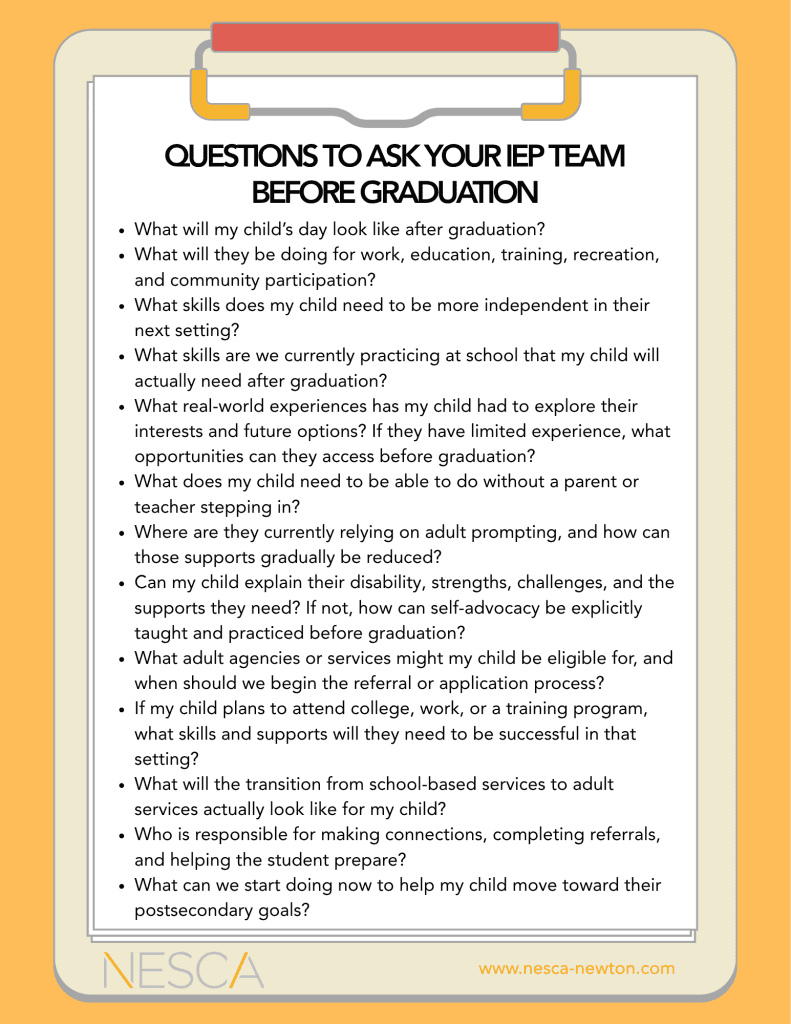
To help parents and caregivers with some of the critical questions they should be thinking and asking about, we created this graphic that can serve as a reminder of what type of preparation, planning, and skills may still be needed. If you have questions about your child’s transition, let us know if you are interested in a consult to help you get started.
About the Author

Sarah LaFerriere, M.Ed., is a transition specialist and special educator who has nearly a decade of experience working with transition aged students in public schools, college, and home-based settings. She provides transition assessment, consultation, and coaching services to a wide range of clients, and specializes in supporting students with autism, intellectual disabilities, developmental disabilities, mental health conditions, and medical conditions.
To book a transition assessment or consultation, complete NESCA’s online intake form.