By: Jane Hauser
Director of Marketing & Outreach, NESCA
I recently had the opportunity to learn more about NESCA’s latest addition to its Pediatric Neuropsychology staff, Dr. James Lynch. We are thrilled to have Dr. Lynch on our team at NESCA! I hope you enjoy getting to learn more about him here as well.
What are your areas of expertise in pediatric neuropsychology?
I have worked with many individuals with a wide range of ages and ability areas from my previous educational and professional experiences. Most of my experience is with children and adolescents who show signs of Attention-Deficit/Hyperactivity Disorder (ADHD), autism spectrum disorders (ASD), learning disorders, developmental delays, and intellectual disabilities, as well as the interventions that are used to support those students.
How did you get your start in pediatric neuropsychology?
I started in clinical psychology by training in evaluating children and adolescents with concerns for ADHD and/or autism. While that is my area of specialty, I was also doing a lot of evaluations during my fellowship at Boston Children’s Hospital with complex presentations in children who were often considered “difficult to test” for many reasons, whether due to behavioral challenges, language abilities, or other factors.
What is your approach in evaluating children and young people?
I try to optimize the performance of the evaluations for the students with whom I work. I like to focus specifically on what I am trying to measure and whether I am getting the information that will help me identify the root cause of the challenges the individual is experiencing. I try to look for the patterns of skills – whether they are strong or need support to find out what we are looking for.
What kind of guidance do you offer to parents and caregivers about going through the evaluation process for their child?
It can be scary for families. I try to help parents and caregivers understand that we know how to work with kids and that we understand that the challenges they and their child are experiencing can be very difficult. I explain that our aim is to help them better understand what is causing those struggles and recommend a treatment plan that is targeted specifically to their child. I assure them that while their child’s challenges may be new to them, we are very used to working with kids with similar presentations and that they are not alone.
You have a lot of research experience. Can you tell us more about that?
I’ve done a lot of research into neuropsychological functioning – and how that may help explain differences in real-world outcomes. For example, kids with ADHD tend to have executive functioning (EF) challenges, but there is so much variability in this… so how can we use this variability to make predictions about real-world outcomes. For example, I’ve conducted research examining whether children with ADHD are more susceptible to EF challenges or post-concussive symptoms after a season of high school football or soccer. I’ve also done a study on whether EF can predict which teenagers with ADHD are more or less likely to have automobile crashes or near-crashes when they begin to drive. I’ve also conducted research examining whether differences in reinforcement processing and temperament predict which kids are more likely to respond to an external reward system or develop future anxiety or mood symptoms.
I have also been involved in a lot of caregiver-focused research, such as whether the outcomes for autistic children were better when families participated in an adapted Applied Behavior Analysis (ABA)-based program and if participating had downstream impacts on other services for the child or the wellness of parents of kids with autism.
You join NESCA from Boston Children’s Hospital. What did that experience give you and how will that support you in your work at NESCA?
Working at Children’s for two years allowed me to see a wide range of kids with highly complex challenges, including those with ADHD and ASD, as well as those who were also experiencing GI, genetic, and neurological complexities. We also frequently worked with children whose symptoms made it difficult to tease apart exactly what the underlying issues were.
Children’s also gave me the training on and regular opportunity to make decisions on the fly. This has been extremely beneficial in being able to select the individualized battery of tests we use in our evaluations. Based on behavioral observations mid-testing, I have learned to easily pivot, incorporating additional tests that will allow me to better identify cognitive challenges, which helps to home in on an accurate diagnosis. It’s those in-the-moment choices that I’ve become very accustomed to that are so helpful in getting to the bottom of what’s actually going on with a child.
Finally, the interdisciplinary experience Children’s provided has also been extremely helpful in understanding a child as a whole during evaluations so I can create a targeted treatment plan that will support them once the evaluation is concluded.
What drew you to NESCA?
I was drawn to the focus on helping families in areas that other neuropsychology practices may not focus on, mainly how we can support children with their education based on our evaluation findings. I really wanted to move my career forward in a place where I could make an impact on a child’s everyday life, whether behaviorally, developmentally, or helping them thrive academically.
I also really appreciate the efforts that NESCA makes in keeping its clinical staff trained and current on evidence-based treatments, school-based interventions, among other areas from internal and external experts. The case conference and seminar trainings were very familiar to me from the hospital setting, and I greatly appreciate that I can continue to further my education in this manner.
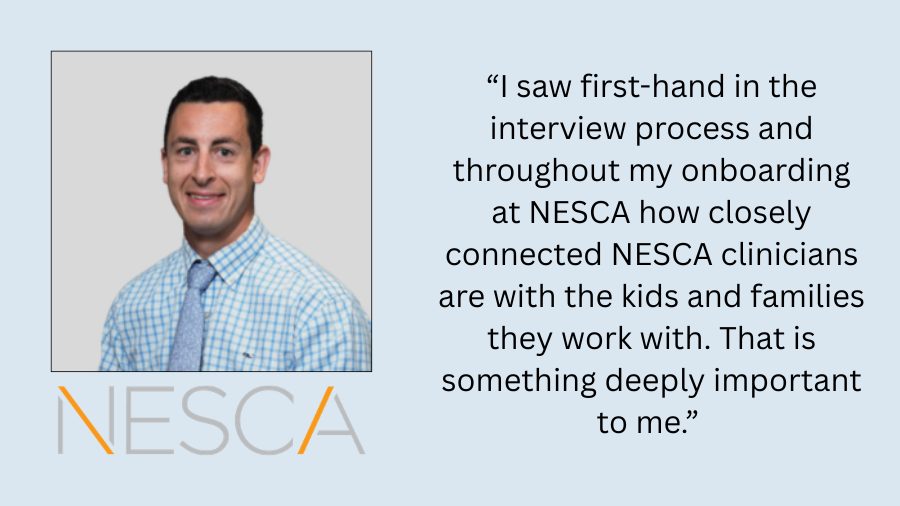
Finally, I saw first-hand in the interview process and throughout my onboarding at NESCA how closely connected NESCA clinicians are with the kids and families they work with. That is something deeply important to me.
About Dr. James Lynch
 Pediatric Neuropsychologist Dr. James Lynch, Ph.D., conducts comprehensive evaluations of toddlers, preschoolers, school-aged children, and adolescents with developmental concerns. These include challenges with cognitive functioning, behavior and emotion regulation, communication skills, and academics. He has expertise in the evaluation of neurodevelopmental disorders such as ADHD, autism, developmental delays, intellectual disabilities, and learning disorders.
To book a consultation or evaluation with one of our many other expert neuropsychologists, complete NESCA’s online intake form.