By: Sarah LaFerriere, M.Ed.
Transition Specialist, NESCA
Start With the Life You Are Preparing For
Transition planning works best when it begins with the student’s desired adult life and works backward.
For example, if a student hopes to attend college, the team should consider more than grades and admission requirements. Can the student manage a schedule? Navigate campus? Communicate with professors? Access disability services? Complete assignments without constant adult reminders? Know what to do when they are struggling?
If employment is the goal, the conversation should extend beyond identifying a career interest. Has the student had opportunities to explore different types of work? Have they practiced workplace communication, time management, transportation, problem-solving, and asking for help?
If the student will participate in an adult day or community-based program, the team should still consider meaningful activities, relationships, independence, community participation, and opportunities for skill development. And for many young adults, the answer will be a combination of these pathways. There is no single definition of a successful transition.
Don’t Wait Until Senior Year
One of the most common challenges I see in transition planning is that families are asked to make major decisions about adulthood before students have had enough opportunities to explore what adulthood could look like.
A student cannot always tell us what they want to do when they have never had the opportunity to try it. Career exploration might mean volunteering at an animal shelter, visiting a college campus, trying a vocational program, participating in a work-based learning experience, taking a cooking class, shadowing someone at work, or learning how public transportation works.
These experiences provide information.
A student might discover, “I love working with animals.” They might also discover, “I thought I would like this, but I really don’t.” Both outcomes are valuable. Transition planning should create opportunities for students to try, reflect, adjust, and try again.
What About Adult Services?
For some students, graduation also means transitioning from the educational system to adult service systems. In Massachusetts, Chapter 688, often referred to as the “Turning 22” law, provides a formal planning process for eligible students with disabilities who will need continued disability-related services after leaving special education. The Bureau of Transitional Planning coordinates this process. Families should not assume that adult services will automatically replace school-based services after graduation.
Instead, transition planning should include early conversations about potential eligibility, referrals, applications, timelines, and the types of supports a young adult may need. This is particularly important because adult services are not simply an extension of special education. Eligibility requirements, service models, and available supports can be very different.
The Commonwealth’s FY2027 budget also created a special commission focused specifically on improving transition planning and outcomes for young adults with disabilities. The commission is charged with examining gaps in transition services, coordination among schools and adult-service agencies, employment, residential supports, and other post-school outcomes. That attention at the state level underscores how important this transition period has become.
The Most Important Question May Be, “What Comes Next?”
Graduation is an important milestone. But for a student with a disability, it should not be the moment when the adults around them finally begin asking what adulthood will look like.
The goal of transition planning is not simply to get a student to graduation. It is to help the student build a meaningful adult life: with the skills, experiences, relationships, supports, and self-advocacy abilities necessary to participate in that life as fully as possible.
So, if your child is approaching graduation, don’t stop at:
- “Will they receive a diploma?”
Also ask:
- “What will their life look like the week after graduation?”
- “What skills will they need to participate in that life?”
- “What experiences do they need before they leave school?”
- And perhaps most importantly:
- “What can we start practicing now?”
The diploma may mark the end of high school. It should not mark the end of planning for the future.
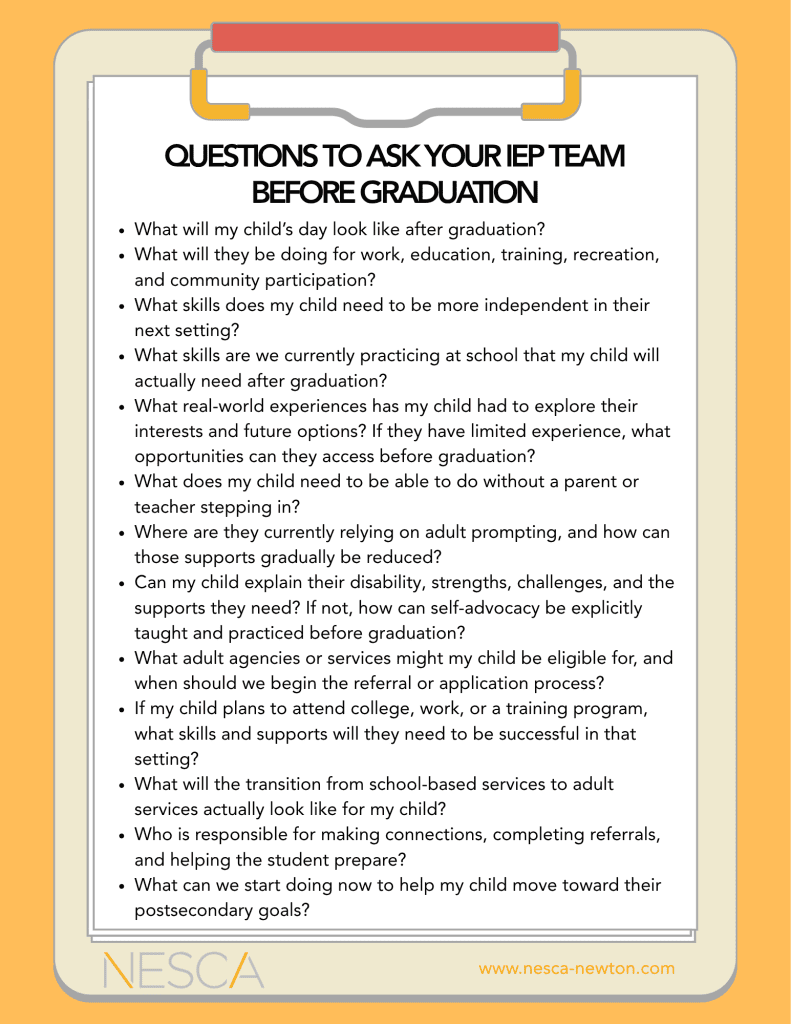
To help parents and caregivers with some of the critical questions they should be thinking and asking about, we created this graphic that can serve as a reminder of what type of preparation, planning, and skills may still be needed. If you have questions about your child’s transition, let us know if you are interested in a consult to help you get started.
About the Author

Sarah LaFerriere, M.Ed., is a transition specialist and special educator who has nearly a decade of experience working with transition aged students in public schools, college, and home-based settings. She provides transition assessment, consultation, and coaching services to a wide range of clients, and specializes in supporting students with autism, intellectual disabilities, developmental disabilities, mental health conditions, and medical conditions.
To book a transition assessment or consultation, complete NESCA’s online intake form.