By: Yvonne Asher, Ph.D.
NESCA Pediatric Neuropsychologist
This is the time of year where things can go off the rails. Standardized testing, planning for summer, planning for next year, winter sports wrapping up, spring sports starting, recitals, end of year performances, science fairs, prom, graduation. And somewhere on social media are the perfect families with the impeccable photo collages of their children’s activities, everyone posed in matching outfits, effortlessly adorable.
Somewhere far more real are the rest of us, begging one child to put on anything other than sweatpants for their piano recital while comforting another because they KNOW they will “never have friends again” once they start middle school, all while someone eats too many cookies at the lacrosse banquet and pukes all over the car.
Extracurricular activities can be wonderful – they can teach valuable motor and self-regulation skills, build creativity and independence, help children gain self-confidence, build friendships and social competence, and support emotional development. As neuropsychologists, we recommend a multitude of non-school-based activities – sports, martial arts, tutoring, outpatient therapies, therapeutic horseback riding, social skills groups, and more.
And.
They can be a lot. Draining, expensive, exhausting, and unpleasant. For some kids, some families, and some situations, extracurricular activities are the lynchpin. Maybe your kid lives to play soccer. Or participate in competitive gymnastics. Or play violin. If it works for your kid and your family, that is amazing. However, for many families, there is downward pressure into toddlerhood to “expose” children to dozens of structured activities. This can cause stress and anxiety for kids, parents, and siblings, and can eat away at the small amounts of calm family time remaining in between work and school.
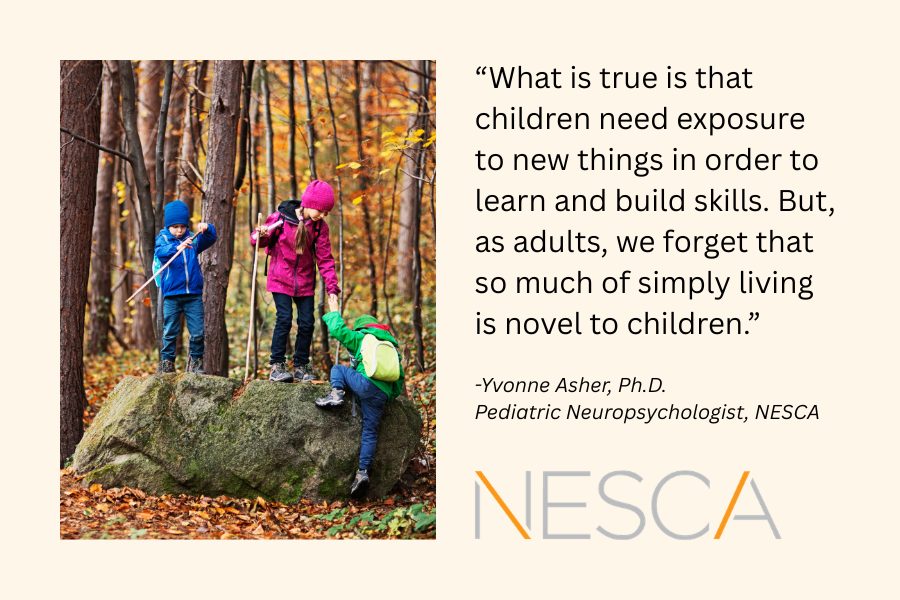
What is true is that children need exposure to new things in order to learn and build skills. But, as adults, we forget that so much of simply living is novel to children. Going to a new grocery store? Let’s figure out how to get there using a map and our visual-spatial skills. Beautiful spring day? Take a walk in a new neighborhood. Better yet? Take a hike! What plants do you see? Bugs? Animals? Habitats? Science abounds outside. Have a weekend day with nothing to do? Make a new recipe! Read the recipe, write a shopping list, use math to double it or halve it.
Extracurricular activities themselves are, of course, not the true problem. As often happens in this digital age of parenting, the problem is pressure from others. Feeling like our kids are falling behind the curve, late to the game. And this is dramatically exacerbated for kids with disabilities or challenges, when parents know that they are, in some areas, behind their peers already. It can feel embarrassing to have the one kid who won’t stand up for the choir concert or cries when it is their turn at bat in t-ball. So why must we push them into it?
Of course, sometimes there is a very good “why.” Maybe they love it most of the time and are anxious at recitals. Maybe it’s deeply important to your family and a long tradition for kids to learn this particular skill. Maybe they really need outpatient speech therapy. Many “whys” make it worthwhile to push through an activity. But, sometimes, the “why” is simply “everyone else seems to be doing it” or “they have to do something.”
In these cases, a step back may be worthwhile. At least for now. Enjoy some Saturday mornings spent in pajamas making six different kinds of pancakes because you have nowhere else to be. Play a board game after a lengthy family dinner because everyone got home early. Let your kid pick up every rock they see on the way home from school – maybe today is a good day to paint some for your garden.
About the Author
Dr. Yvonne M. Asher enjoys working with a wide range of children and teens, including those with autism spectrum disorder, developmental  delays, learning disabilities, attention difficulties and executive functioning challenges. She often works with children whose complex profiles are not easily captured by a single label or diagnosis. She particularly enjoys working with young children and helping parents through their “first touch” with mental health care or developmental concerns.
Dr. Asher’s approach to assessment is gentle and supportive, and recognizes the importance of building rapport and trust. When working with young children, Dr. Asher incorporates play and “games” that allow children to complete standardized assessments in a fun and engaging environment.
Dr. Asher has extensive experience working in public, charter and religious schools, both as a classroom teacher and psychologist. She holds a master’s degree in education and continues to love working with educators. As a psychologist working in public schools, she gained invaluable experience with the IEP process from start to finish. She incorporates both her educational and psychological training when formulating recommendations to school teams.
Dr. Asher attended Swarthmore College and the Jewish Theological Seminary. She completed her doctoral degree at Suffolk University, where her dissertation looked at the impact of starting middle school on children’s social and emotional wellbeing. After graduating, she completed an intensive fellowship at the MGH Lurie Center for Autism, where she worked with a wide range of children, adolescents and young adults with autism and related disorders.
NESCA is a pediatric neuropsychology and related services practice with offices in Newton, Plainville, and Hingham, Massachusetts; Londonderry, New Hampshire; Coral Gables, Florida; and Coral Gables, Florida, serving clients from infancy through young adulthood and their families. For more information, please email info@nesca-newton.com or call 617-658-9800.
To book an appointment with a NESCA clinician, please complete our Inquiry/Intake Form today. For more information about NESCA, please email info@nesca-newton.com or call 617-658-9800.