By Olivia Rogers, MA, CCC-SLP
Speech-Language Pathologist, NESCA
Literacy is often viewed as a set of academic skills – reading, writing, spelling. But at its core, literacy is a language process. Scarborough’s Reading Rope illustrates how language comprehension and word recognition weave together to create skilled reading.
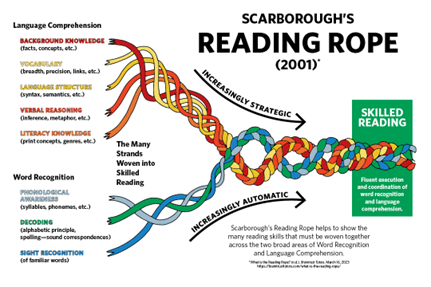
Image courtesy of Dr. Hollis Scarborough, 2001.
Language Is the Foundation of Literacy
Students may decode fluently but without language, they will struggle with retelling, summarizing, inferencing, written organization, and academic demands. Before students can read for meaning or write to communicate ideas, they need the language system that carries meaning. Literacy is not just recognizing words on a page; it is understanding and expressing ideas through text. That requires language.
Language supports literacy through several mechanisms:
- Vocabulary gives words meaning. Decoding tells a student how to say a word. Language tells them what it means. If a student reads the word “evaporation” but doesn’t know the concept, comprehension breaks down. Depth of vocabulary – not just number of words – predicts reading comprehension.
- Syntax supports sentence comprehension. Written language is more complex than spoken language. Students must interpret longer sentences, embedded clauses, passive voice, academic phrasing. Understanding sentence structure is a language skill that allows students to follow these complex texts.
- Narrative language supports text structure. Stories, informational texts, and essays all follow organizational patterns. Students rely on language to understand text features buried within, such as cause and effect, problem–solution, character motivation, sequencing events, and more. Narrative and discourse skills are the blueprint for comprehension and writing.
- Internal language supports strategy use. Skilled readers talk themselves through text using internal dialogues such as, “This part is confusing,” or “Let me reread.” Skilled readers make connections, with internal dialogues, such as, “This reminds me of….” This internal self-talk is language acting as executive control over literacy.
Literacy Strengthens Language
The relationship then flips. Reading and writing expand vocabulary, syntactic complexity, narrative structure, verbal reasoning, and metalinguistic awareness. Literacy becomes one of the most powerful engines for language growth. Reading and writing expose students to language they rarely hear in conversation.
Literacy strengthens language in several ways:
- Literacy expands vocabulary exponentially. Books contain more rare and precise words than everyday speech. Research shows that repeated text exposure builds semantic networks, conceptual knowledge, word relationships, and morphological awareness.
- Text builds complex language. Students encounter longer, more complex sentence structures through reading. Over time they begin to understand complex syntax, produce more sophisticated sentences, use academic language, and embed ideas within ideas. Writing then reinforces this!
- Literacy develops discourse and organization. Writing requires students to externalize language structure. In order to write, they must plan ideas, sequence information, clarify meaning, and revise their work. This strengthens expressive language far beyond conversation.
- Reading builds knowledge, which builds language. Background knowledge fuels comprehension. As students read, they gain concept knowledge, world knowledge, topic vocabulary, and schema (a fancy word for background knowledge and how it is organized). Language becomes richer because knowledge expands.
The Big Picture
Literacy and language are strands of the same rope, continuously shaping each other as students grow. Targeting both areas together can improve comprehension, written expression, and classroom participation. Language makes literacy possible, and literacy accelerates language growth.
At NESCA, we use evidence-based strategy to target language and literacy. Our clinicians use a comprehensive approach to treat the systems of learning as integrative, helping students develop valuable skills they can use in and out of the classroom! For more information on Speech and Language Therapy and Literacy Support at NESCA, please complete our online Inquiry/Intake Form or email me directly at orogers@nesca-newton.com.
Reference:
Scarborough, Hollis S. “Connecting Early Language and Literacy to Later Reading (Dis)Abilities: Evidence, Theory, and Practice.” Handbook of Early Literacy Research, edited by Susan B. Neuman and David K. Dickinson, Guilford Press, 2001, pp. 97–110.
About the Author
To learn more about NESCA’s Speech and Language Services or schedule appointments, complete our online Intake Form or email orogers@nesca-newton.com.
NESCA is a pediatric neuropsychology and related services practice with offices in Newton, Plainville, and Hingham, Massachusetts; Londonderry, New Hampshire; and Coral Gables, Florida, serving clients from infancy through young adulthood and their families. For more information, please email info@nesca-newton.com or call 617-658-9800.