
By Olivia Rogers, MA, CCC-SLP
Speech-Language Pathologist, NESCA
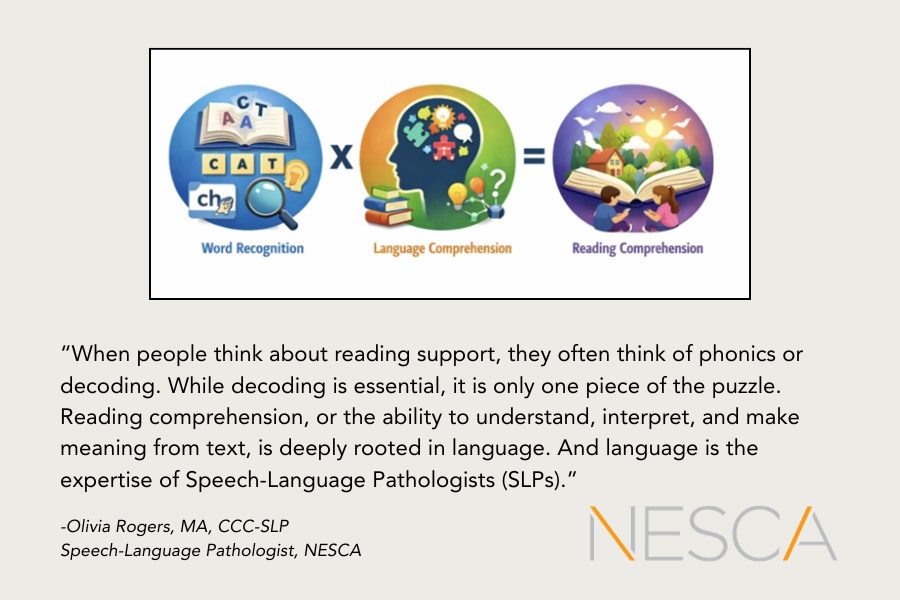
When people think about reading support, they often think of phonics or decoding. While decoding is essential, it is only one piece of the puzzle. Reading comprehension, or the ability to understand, interpret, and make meaning from text, is deeply rooted in language. And language is the expertise of Speech-Language Pathologists, SLPs.
Image Courtesy of NESCA
Reading Comprehension Is Language
- Understanding vocabulary
- Processing complex sentences
- Holding information in working memory
- Making inferences – Connecting ideas across paragraphs
- Monitoring understanding
These are not just reading skills. They are oral language and executive functioning skills applied to print. Students can decode fluently and still struggle to answer questions, retell a story, or explain the main idea because comprehension depends on background knowledge, syntax, semantics, and discourse-level language.
Why SLPs Are Uniquely Equipped
- Sentence structure (syntax)
- Word meaning and relationships (semantics)
- Narrative organization
- Inferencing and pragmatic understanding
- Working memory and language processing
SLPs explicitly teach the language structures that make comprehension possible rather than simply asking comprehension questions.
Evidence-based Approach: Visualizing and Verbalizing®
While support is individualized, one program that SLPs frequently use is Visualizing and Verbalizing®, developed by Lindamood-Bell Learning Processes. Visualizing and Verbalizing® focuses on strengthening a student’s ability to create mental imagery while reading or listening – a skill strongly correlated with comprehension.
- Improves memory for details
- Strengthens understanding of cause and effect
- Builds inferencing skills
- Supports organized retell
- Deepens vocabulary understanding
Instead of passively decoding, students actively build a movie in their mind – increasing both engagement and comprehension.
When Students May Need Language-based Comprehension Support
- Reads fluently but cannot explain what was read
- Struggles with inferencing
- Provides vague or disorganized retells
- Has difficulty identifying story grammar elements (character, setting, problem, etc.)
- Has difficulty answering why and how questions
- Avoids longer texts
- Has a history of language delay or concurring language disorder
Reading is not just decoding. It is meaning. And meaning lives in language. When SLPs integrate structured, evidence-based approaches like Visualizing and Verbalizing® with explicit language intervention, we strengthen the cognitive-linguistic foundation that allows reading to truly make sense.
At NESCA, our therapists use a comprehensive approach to treat the systems of learning as integrative, helping students develop valuable skills they can use in and out of the classroom! For more information on Speech and Language Therapy, Literacy, and Executive Functioning Support at NESCA, please complete our online Inquiry/Intake Form or email me directly at orogers@nesca-newton.com.
About the Author
To learn more about NESCA’s Speech and Language Services or schedule appointments, complete our online Intake Form or email orogers@nesca-newton.com.
NESCA is a pediatric neuropsychology and related services practice with offices in Newton, Plainville, and Hingham, Massachusetts; Londonderry, New Hampshire; and Coral Gables, Florida, serving clients from infancy through young adulthood and their families. For more information, please email info@nesca-newton.com or call 617-658-9800.
