By Olivia Rogers, MA, CCC-SLP
Speech-Language Pathologist, NESCA
Understanding the Difference
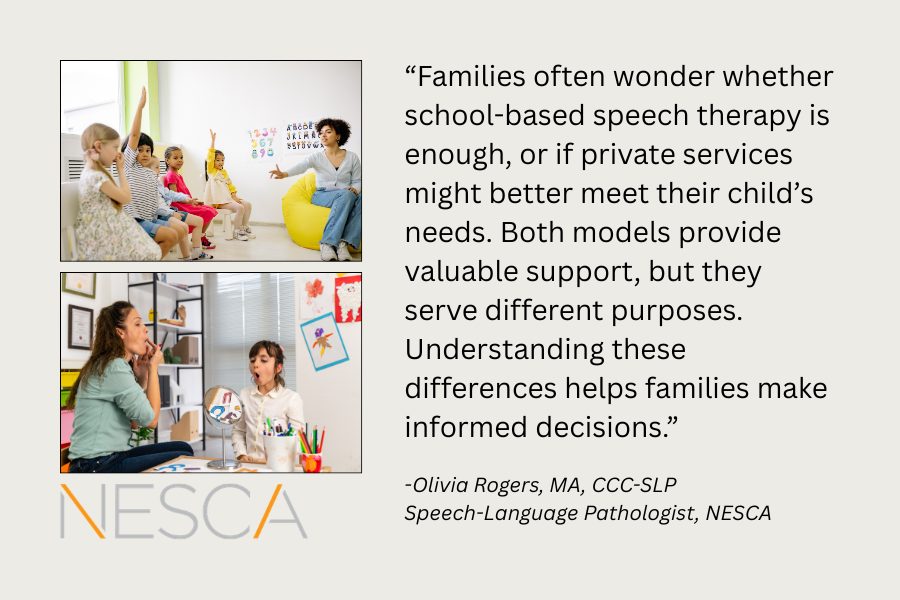
Speech-language support can be life-changing for students, helping them by improving communication, academic access, confidence, and independence. Families often wonder whether school-based speech therapy is enough, or if private services might better meet their child’s needs. Both models provide valuable support, but they serve different purposes. Understanding these differences helps families make informed decisions.
The Role of School Speech-Language Services
School speech-language pathologists (SLPs) help students access their education. Services are designed to support academic participation rather than address every area of communication difficulty.
School SLPs often manage large caseloads, group therapy, strict eligibility criteria, and limited session frequency. Therapy typically focuses on what is necessary for a student to function at school – not always what would be most beneficial for overall communication growth.
What Private Speech-Language Services Offer
Private speech-language services allow therapy to be individualized based on the student’s whole profile. Sessions can be one-to-one, more frequent, and flexible. Goals often extend beyond minimum academic access and may integrate language, literacy, and executive functioning.
Importantly, students do not need to “qualify” for private services. Support can begin based on functional concerns, prevention, or a family or client’s desire for more targeted growth.
Why Families Use Both
Many students benefit from a combined approach. School services ensure educational access, while private services deepen skill development and allow more intensive work on underlying skills.
Quality vs. Capacity
The difference between school and private therapy is often capacity. Private therapy provides more time for practice, feedback, collaboration, and personalization, which can support faster progress and stronger carryover.
Take It From Me – I’ve Been on Both Sides
Having worked inside public schools and now providing private services, I’ve seen how system limitations impact therapy. School therapy is essential in some cases, but private services create space to address skills more deeply.
When Private Services May Be Helpful
Families often explore private therapy when progress feels slow, their child does not qualify for school services, needs extend beyond speech sounds, literacy overlaps with language, or they want more individualized or preventative support.
Final Thoughts
School speech-language services are designed to ensure access to the curriculum. Private speech-language services are designed to optimize growth. Both are valuable and work best when coordinated.
At NESCA, our speech language pathologists have been in both settings. They provide individualized, contextualized, functional, and curriculum-based support to facilitate generalization to the real world. For more information on Speech and Language Therapy at NESCA, please complete our online Inquiry/Intake Form or email me directly at orogers@nesca-newton.com.
About the Author
To learn more about NESCA’s Speech and Language Services or schedule appointments, complete our online Intake Form or email orogers@nesca-newton.com.
NESCA is a pediatric neuropsychology and related services practice with offices in Newton, Plainville, and Hingham, Massachusetts; Londonderry, New Hampshire; and Coral Gables, Florida, serving clients from infancy through young adulthood and their families. For more information, please email info@nesca-newton.com or call 617-658-9800.