By: Alissa Talamo, PhD
Pediatric Neuropsychologist, NESCA
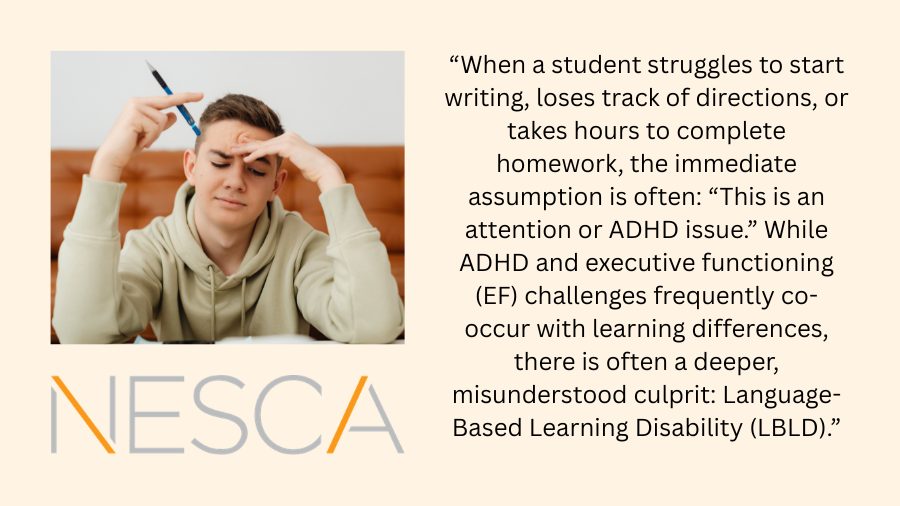
When a student struggles to start writing, loses track of directions, or takes hours to complete homework, the immediate assumption is often: “This is an attention or ADHD issue.” While ADHD and executive functioning (EF) challenges frequently co-occur with learning differences, there is often a deeper, misunderstood culprit: Language-Based Learning Disability (LBLD).
For parents, advocates, and educators, understanding the relationship between language processing and EF is critical. Without this insight, schools risk implementing accommodations that merely bypass the problem, rather than providing the specialized instruction a student needs to build independence.
What are LBLD and Executive Functioning?
An LBLD is a neurodevelopmental spectrum of difficulties affecting how individuals process, understand, and use spoken and written language. It is a processing difference entirely unrelated to intelligence, motivation, or instructional quality. LBLD typically impacts:
- Reading (Dyslexia): Decoding, phonics, and comprehension.
- Written Expression (Dysgraphia): Mechanics, spelling, and organizing thoughts.
- Spoken Language: Receptive (understanding instructions) and expressive (word retrieval) language.
- Organization & Memory: Working memory deficits and difficulty planning multi-step tasks.
Executive Functioning is the brain’s “management system” – housed in the prefrontal cortex – enabling individuals to plan, focus, remember instructions, regulate emotions, and prioritize tasks.
The Intersection: How Language Weaknesses Disrupt EF
To support these students, we must distinguish between primary ADHD and LBLD-driven executive dysfunction:
- Primary ADHD: Driven by global deficits in behavioral inhibition and executive control.
- LBLD: Executive dysfunction is a secondary consequence of the high cognitive load of language processing.
When a student expends immense energy decoding words, retrieving vocabulary, or analyzing syntax, it rapidly drains their cognitive battery. This cognitive fatigue manifests as apparent executive dysfunction (task avoidance, distractibility, or poor initiation). Treating this solely as an attention issue misses the opportunity to provide necessary language-based instruction.
This breakdown occurs in three key areas:
- Working Memory Overload: Weaknesses in word meaning require so much conscious effort to decode that the student’s working memory overflows, causing them to lose track of multi-step directions.
- The Processing “Bottleneck”: Translating auditory language into an internal concept, and then into a written response, takes longer. This delay acts as a bottleneck when trying to get ideas onto paper.
- The Absence of “Internal Language”: Cognitive flexibility and task initiation rely on “internal language” (self-talk used to plan and organize). Students with LBLD lack strong internal language, resulting in task initiation paralysis.
Moving Beyond Accommodations to Specialized Instruction
Schools often default to accommodations, such as providing extra time, pre-filled graphic organizers, or reduced assignments. While these accommodations act as a passive bypass – altering the environment or format to circumvent a deficit – they do not teach skills. By bypassing the weakness without remediating it, accommodations can create prompt-dependency, where the student relies on an adult or a tool to do the cognitive heavy lifting.
In contrast, specialized instruction serves as active remediation by explicitly and systematically teaching cognitive and linguistic strategies. For example, instead of simply handing a student a graphic organizer, specialized instruction teaches the metacognitive process of how and when to use it. This approach targets the deficit directly, transforming the student from a passive recipient of support into an active, self-regulating learner.
To foster independence, students must learn to internalize strategies through:
- Explicit Strategy Instruction: Teaching how to identify and map the relationship between main ideas and details.
- Self-Monitoring Training: Teaching students to use self-talk checklists (e.g., “Stop, Review Prompt, Check”) to monitor their own progress.
- Working Memory Strategies: Instructing students in verbal rehearsal, visualization, and chunking.
Drafting Measurable EF/LBLD Goals for IEPs and 504s
IEP goals must shift from passive task completion to active skill acquisition by targeting the underlying cognitive-linguistic process, not just the final academic product.
Goal Comparison
- Weak Goal (Product-Oriented): “Student will use an organizer to complete writing assignments with 80% accuracy.”
- Why it fails: Focuses on worksheet completion (the product), not the planning skill. It does not define independence level or the specific strategy used.
- Strong Goal (Skill- & Strategy-Oriented): “Given a multi-step writing prompt, the student will independently apply a 3-step planning strategy (brainstorm, categorize, sequence) to initiate writing within 5 minutes, in 4 out of 5 opportunities.”
- Why it works: Targets the executive functions of planning and initiation, defines the exact strategy, and measures independence to build internal language.
Three Essential Elements of an EF/LBLD Goal
When advocating for IEP goals, ensure these three elements are explicitly defined:
- The Specific Strategy (The “How”): Name the exact cognitive tool (e.g., verbal rehearsal, a 3-step planning strategy, a self-monitoring checklist).
- The Level of Independence (Prompt Fading): Quantify the support required using precise, observable terms (e.g., independently, given no more than one verbal prompt), avoiding vague terms like “with minimal assistance.”
- Measurement of the EF Skill: Directly measure the executive function deficit (e.g., task initiation latency, planning time) rather than curriculum accuracy.
By shifting the focus of IEPs and 504 plans from passive accommodations to explicit, strategy-based specialized instruction, we can help students with LBLD build the internal language and executive functioning skills they need to navigate school – and life – independently.
About the Author
 With NESCA since its inception in 2007, Dr. Talamo had previously practiced for many years as a child and adolescent clinical psychologist before completing postdoctoral re-training in pediatric neuropsychology at the Children’s Evaluation Center.
After receiving her undergraduate degree from Columbia University, Dr. Talamo earned her doctorate in clinical health psychology from Ferkauf Graduate School of Psychology and the Albert Einstein College of Medicine at Yeshiva University.
She has given a number of presentations, most recently on “How to Recognize a Struggling Reader,” “Supporting Students with Working Memory Limitations,” (with Bonnie Singer, Ph.D., CCC-SLP of Architects for Learning), and “Executive Function in Elementary and Middle School Students.”
Dr. Talamo specializes in working with children and adolescents with language-based learning disabilities including dyslexia, attentional disorders, and emotional issues. She is also interested in working with highly gifted children.
Her professional memberships include MAGE (Massachusetts Association for Gifted Education), IDA (International Dyslexia Association), MABIDA (the Massachusetts division of IDA) and MNS (the Massachusetts Neuropsychological Society).
She is the mother of one daughter.
To book a consultation or evaluation with one of our many other expert neuropsychologists, complete NESCA’s online intake form.
NESCA is a pediatric neuropsychology and related services practice with offices in Newton, Plainville, and Hingham, Massachusetts; Londonderry, New Hampshire; and Coral Gables, Florida, serving clients from infancy through young adulthood and their families. For more information, please email info@nesca-newton.com or call 617-658-9800.