By: Rebecca Dautoff, Psy.D.
Pediatric Neuropsychologist, NESCA
Pathological Demand Avoidance (PDA) is a term that has sparked both interest and debate within the autism community and among professionals. While some families and clinicians find the concept meaningful, it remains a debated and not formally recognized profile within current diagnostic frameworks.
First described by British psychologist Elisabeth Newson in the 1980s and formally introduced in a 2003 research paper, PDA was proposed as a way to identify a group of children who did not fit the prevailing definitions of autism at that time. Instead, these children shared a key characteristic: a persistent and marked resistance to everyday demands. Since then, researchers and clinicians have suggested variations to this list, but the core descriptions have remained largely consistent.
The most commonly cited core features of PDA include:
- Resisting and avoiding the ordinary demands of life: This resistance is continual and can be seen in daily routines, requests, or expectations.
- Using social strategies (e.g., excuses or negotiation) as forms of resistance to avoid demands.
Other proposed characteristics include:
- Appearing sociable, but experiencing differences in social understanding (such as recognizing social and family hierarchies);
- Experiencing intense mood swings and impulsivity;
- Appearing comfortable in role play; and
- Displaying dedicated and focused interests, often centered on other people.
It’s important to note that historically, descriptions of PDA have used language associated with the “deficit model” of autism vs. a strengths-based perspective. Many now consider such language outdated and prefer terminology that recognizes the diversity of neurodevelopmental profiles without pathologizing difference.
While demand avoidance, especially when accompanied by social strategies, is widely recognized as a characteristic observed in some individuals, research has not yet provided strong evidence for the full group of traits proposed for PDA. Because of the current lack of research, PDA is not recognized as a clinical diagnosis in major U.S. or international medical manuals, such as the ICD or DSM. Although PDA is not a formal diagnosis recognized by the DSM, some individuals receive a diagnosis of autism with a “demand avoidant profile” or even a “PDA profile” noted. Others may self-identify with the PDA label and as a “PDAer.” There is also discussion about the terminology itself, with some objecting to the word “pathological,” preferring alternatives like “Persistent Drive for Autonomy.”
At NESCA, we focus less on labels and more on understanding the underlying drivers of a child’s behavior, such as anxiety, cognitive flexibility, sensory sensitivities, and social-emotional development,so that supports and recommendations can be individualized and clinically grounded, regardless of the terminology used.
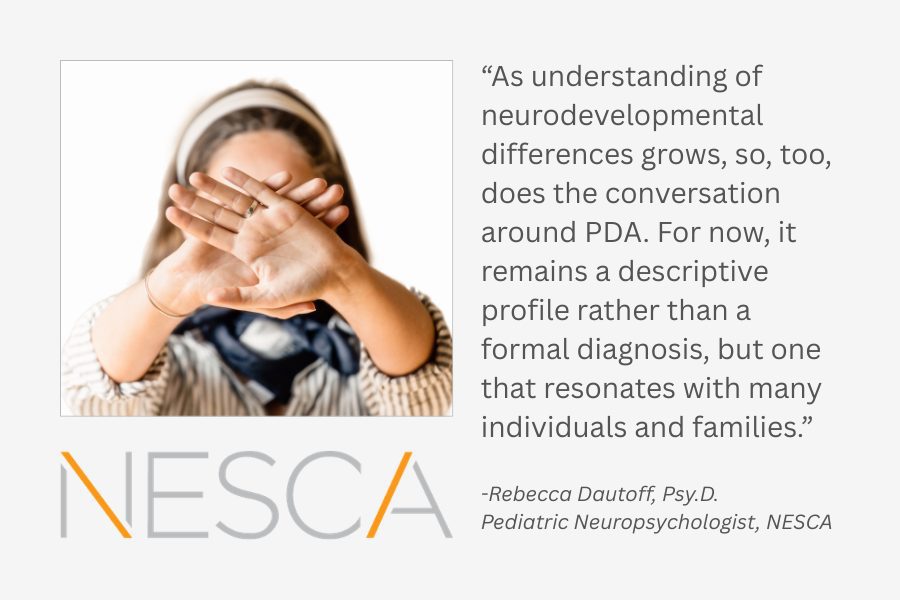
As understanding of neurodevelopmental differences grows, so, too, does the conversation around PDA. For now, it remains a descriptive profile rather than a formal diagnosis, but one that resonates with many individuals and families. Continued research and open dialogue are essential to better understand the experiences of this population and to ensure that support and language reflect their needs and perspectives.
About the Author
Dr. Rebecca Dautoff provides comprehensive neuropsychological and psychological (projective) evaluation services for children, adolescents, and young adults who have complex presentations with a wide range of concerns, including attention deficit disorders, psychiatric disorders, intellectual disabilities, and autism spectrum disorders (ASD). She also values collaboration with families and outside providers to facilitate supports and services that are tailored to each child’s specific needs.
If you are interested in booking an appointment for an evaluation with Dr. Dautoff or another NESCA neuropsychologist/clinician, please fill out and submit our online intake form.
NESCA is a pediatric neuropsychology and related services practice with offices in Newton, Plainville, and Hingham, Massachusetts; Londonderry, New Hampshire; and the Coral Gables, Florida, serving clients from infancy through young adulthood and their families. For more information, please email info@nesca-newton.com or call 617-658-9800.