By Olivia Rogers, MA, CCC-SLP
Speech-Language Pathologist, NESCA
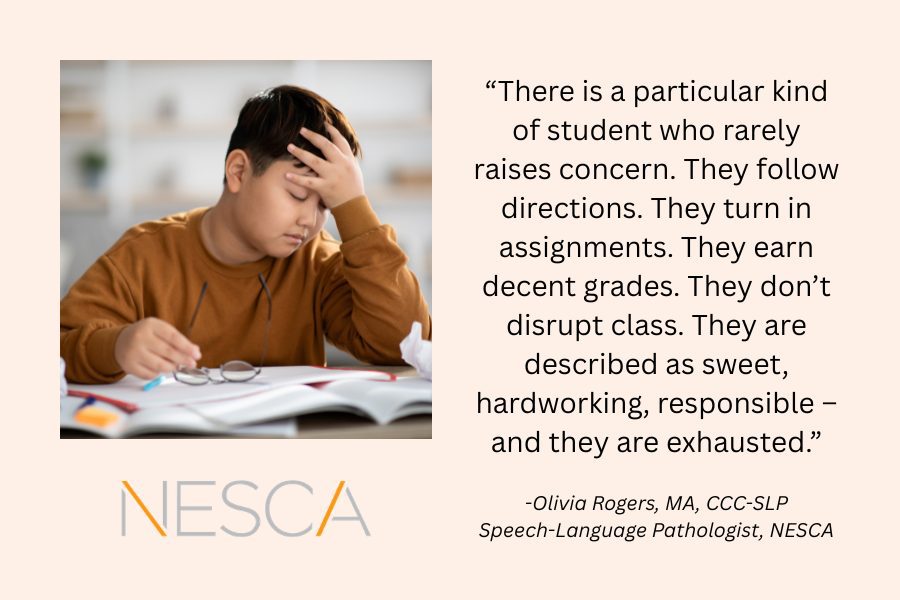
There is a particular kind of student who rarely raises concern. They follow directions. They turn in assignments. They earn decent grades. They don’t disrupt class. They are described as sweet, hardworking, responsible – and they are exhausted.
These are the students who fly under the radar. You may notice it at home before anyone else does. Homework takes hours. Writing assignments feel disproportionately heavy. Reading requires constant rereading. They erase and rewrite sentences repeatedly. They melt down at home – not at school. From the outside, everything appears fine. From the inside, everything feels effortful.
Tiered support systems are designed to identify clear gaps: measurable academic decline, benchmark concerns, noticeable skill deficits, etc. But under-the-radar students often compensate beautifully. They memorize sentence frames. They overprepare and tend to avoid risks. They rely on intelligence to mask inefficiencies and oftentimes, they meet expectations…but at a cost.
Compensation works…until it doesn’t. As academic demands increase, including longer texts, multi-paragraph essays, and independent projects, the effort curve steepens. Middle school is often when the cracks begin to show – not because the child suddenly can’t, but because the system was never optimized.
These students frequently have subtle weaknesses in:
- Academic language processing
- Sentence formulation flexibility
- Discourse-level organization
- Working memory under load
- Cognitive flexibility
- Idea generation efficiency
They can explain ideas verbally but struggle to organize them in writing. They understand what they read, but only after rereading. Frequently they know the answer, but tend to hesitate to share it. The issue is rarely intelligence; instead, it’s about efficiency.
Over time, this exhaustive effort can unfortunately become a student’s identity. Students begin to believe school is supposed to feel this hard. They start to internalize messages like, “I just need to try harder. I’m just slow. I’m not good at writing.” But often, they are working around systems that were never explicitly strengthened. This is not about remediation; these students are not failing. They are often highly capable.
What they need is system strengthening. When we strengthen language networks, syntactic flexibility, executive functioning integration, organizational frameworks, and generalization across contexts, tasks that once felt overwhelming become manageable.
Support does not have to begin with failure. Some of the most powerful growth happens when we intervene before burnout. An integrative model that targets language, literacy, and executive functioning together addresses the systems underneath performance, not just the performance itself.
When these systems are strengthened, families often tell us that it no longer takes three hours to do homework, that they are raising their hands to answer questions in class again, that students don’t dread writing anymore, and that everything seems to feel lighter. Strong academic performance isn’t just about effort. It’s really about the systems.
Working Smarter, Not Harder
High-functioning students don’t always need remediation. Sometimes they may need optimization. When we strengthen the underlying systems, like language organization, executive functioning integration, and discourse-level structure, effort decreases and independence increases. The goal is not to push harder; it’s about building smarter.
If your child is capable but working harder than they should be, an integrative approach focused on building foundational skills with a speech-language pathologist may provide the missing layer of support.
If you’re curious whether this integrative approach would benefit your child, I welcome the opportunity to connect to identify what kind of targeted support would make the greatest difference. For more information on Speech and Language Therapy, Literacy, and Executive Functioning Support at NESCA, please complete our online Intake Form or email me directly at orogers@nesca-newton.com.
About the Author
To learn more about NESCA’s Speech and Language Services or schedule appointments, complete our online Intake Form or email orogers@nesca-newton.com.
NESCA is a pediatric neuropsychology and related services practice with offices in Newton, Plainville, and Hingham, Massachusetts; Londonderry, New Hampshire; and Coral Gables, Florida, serving clients from infancy through young adulthood and their families. For more information, please email info@nesca-newton.com or call 617-658-9800.