NESCA’s Londonderry, NH location has immediate availability for neuropsychological evaluations. Our NH clinicians specialize in the following evaluations: Neuropsychological; Autism; and Emotional and Psychological, as well as Academic Achievement and Learning Disability Testing. Our NH clinicians also conduct evaluations for students who are at boarding schools, and two of our NH clinicians have PsyPACT authorization, allowing them to conduct evaluations out-of-state.

Visit www.nesca-newton.com/intake for more information or to book an evaluation.

Category

NESCA Notes 2021

Subscribe to NESCA Notes

Put Me In, Coach!

By | NESCA Notes 2021


Coaching Services at NESCA

For students and young adults with social, emotional, organizational and/or learning differences, hands-on instruction in real-world environments is a critical means of developing skills for postsecondary living, learning and working. NESCA is pleased to offer individualized home-, community-,and office-based coaching services as well as remote coaching services, delivered by a team of seasoned Occupational Therapists (OTs), Vocational Counselors and Transition Specialists to support the needs of transition-age youth.


Meet the Coaches


Sophie Bellenis, OTD, OTR/L

Dr. Sophie Bellenis is Licensed Occupational Therapist in Massachusetts, specializing in pediatrics and occupational therapy, including school-based service delivery. Dr. Bellenis has expertise in working with tweens, teens, and young adults with a wide range of social, emotional, and developmental needs. She joined NESCA full-time in the fall of 2019 in order to oversee the Real-life Skills Coaching program as well as to carry out transition assessment, occupational therapy assessment and treatment services. One of the keys to Dr. Bellenis’ success coaching students and young adults is her ability to form a meaningful relationship with each client and use that relationship to motivate lasting change.


Aubrey Matthews, OTD, OTR/L

Aubrey Matthews, OTD, OTR/L, is an occupational therapist who has focused most of her career on mental health and skill building for adolescents and young adults. She currently works full-time at a behavioral health hospital, splitting her time between the inpatient adolescent unit and the young adult intensive outpatient program. Aubrey tends to focus on building emotional regulation, executive function, and social skills through occupation-based strategies. Aubrey’s doctoral research at the MGH Institute of Health Professions focused on using LEGO therapy to build social skills at a pro-bono pediatric program, and she uses many of these creative strategies to increase client motivation and success.


Jasmine Badamo, MA

Jasmine is an executive function coach, and a New York State Certified ENL and Special Education teacher. She earned her bachelor’s degree in Biological Sciences from Cornell University and her masters degree in TESOL from CUNY Hunter College. She has over 10 years of teaching experience across three countries, and has worked with students ranging in age from 7 years to adults.
Her work focuses on creating individualized supports based on the specific needs and strengths of each client, and supporting the development of metacognition, executive function skills, and independence. Building an authentic connection with clients is a top priority, as this allows her to provide the best supports possible.


Lyndsay Wood, OTD, OTR/L

Lyndsay Wood, OTD, OTR/L, is an occupational therapist who focuses on helping students and young adults with disabilities to build meaningful skills in order to reach their goals. She has spent the majority of her career working in a private school for students with ASD and related social, emotional and executive functioning challenges. She has also spent some time working in an inpatient mental health setting. Lyndsay uses occupation-based interventions and strategies to develop life skills, executive functioning, and emotional regulation. While completing her doctoral degree at MGH Institute of Health Professions, Lyndsay worked with the Boston Center for Independent Living to evaluate transition-age services. She uses the results from her research to deliver services in a way that is most beneficial for clients. Specifically, she focuses on hands-on, occupation-based learning that is tailored to the client’s goals and interests.


Visit our website for more information about NESCA’s Coaching Services or complete our online Intake Form

Executive Function Tips: The Google Drive

By | NESCA Notes 2021

By: Sophie Bellenis, OTD, OTR/L
Occupational Therapist; Real-life Skills Program Manager and Coach, NESCA

As we slowly start to emerge from lockdown measures, social distancing guidelines, and living life through the screen, there are few lessons that we have learned that still hold importance and should maintain their place in our lives. When it comes to executive function, a lesson that sticks with me is the need for digital organization and functional systems that help us stay in control. One tool that students often use every day, but very rarely receive direct instruction in, is the Google Drive. I have found that students often do not fully understand the concept of an online drive, including how this differs from saving a document to a hard drive, or why it is important to have folders and systems in place.

Now that students often have email address that they set up early (some parents reserve email addresses long before their children can use them!), and stay with them long-term, there is a risk of Google Drive quickly becoming unmanageable or filled with unnecessary documents. Once the drive becomes cluttered, many students are unable to reign it back in and put systems into place. Below, find some tips for how to help students use the Google Drive as a tool to promote digital organization, as opposed to a landing spot for any new download, file, or assignment.

Tips

  • Set up folders. Through high school and often beyond, our students live their lives on a September through August calendar. They see September as the beginning of a year and often think of time in terms of grade level, as opposed to biological age or calendar year. Starting in either kindergarten or first grade, students should have a folder for any academic work from each grade. By setting up this system early, students start to build the habit of saving documents to the correct place. It can also be helpful to have folders for extracurricular activities, such as Boy Scouts, Math Tutoring, Club Soccer, or simply Personal Work.
  • Set up subfolders. Once students start taking multiple classes at a time, there is a need to further organize. Starting in fourth or fifth grade, many students switch classrooms to see different teachers for their core subjects. As soon as this starts, add folders for each subject, such as Math, Science, History, and ELA.
  • Name documents purposefully. Some of the students I work with spend longer trying to find their assignments than they do working on the assignment itself. This is often because folders are not set up, but also because students often do not remember what they named an assignment. Teach your children to name their files in a fashion that they can quickly find again. Examples include: year_subject_assignment (20/21_math_knowledge check1), teacher name_year_assignment (Smith_20/21_WWII Article), or teacher name_assignment (Jones_Mockingbird Essay).
  • Set up an end of year clean out. At the end of each school year, take the time to sit with your student and clear their drive of clutter. Many students will only want to save a few important assignments or essays from each school year. That being said, make sure they do not delete important resources! This sets them up for success when they jump back into school in the fall.
  • Review the hard drive. Teaching our students which documents should be saved to a hard drive or printed out and saved as a hard copy is hugely helpful. Even reviewing the difference between a hard drive and an online drive helps provide valuable information. Many of us were introduced to computers when saving to the hard drive was the only option. Once an online drive was introduced, we naturally knew the difference. This is not the case for current students. For most of their academic lives, there have been two options or places to save their assignments, and it can be hard to define the differences between the two.


About the Author
Sophie Bellenis is a Licensed Occupational Therapist in Massachusetts, specializing in educational OT and functional life skills development. Bellenis joined NESCA in the fall of 2017 to offer community-based skills coaching services as a part of the Real-life Skills Program within NESCA’s Transition Services team. Bellenis graduated from the MGH Institute of Health Professions with a Doctorate in Occupational Therapy, with a focus on pediatrics and international program evaluation. She is a member of the American Occupational Therapy Association, as well as the World Federation of Occupational Therapists. Having spent years delivering direct services at the elementary, middle school and high school levels, Bellenis has extensive background with school-based occupational therapy services.  She believes that individual sensory needs and visual skills must be taken into account to create comprehensive educational programming.


To book an appointment or to learn more about NESCA’s Occupational Therapy Services, please fill out our online Intake Form, email info@nesca-newton.com or call 617-658-9800.


Neuropsychology & Education Services for Children & Adolescents (NESCA) is a pediatric neuropsychology practice and integrative treatment center with offices in Newton, Massachusetts, Plainville, Massachusetts, and Londonderry, New Hampshire, serving clients from preschool through young adulthood and their families. For more information, please email info@nesca-newton.com or call 617-658-9800.


Why Work Matters for Teens

By | NESCA Notes 2021

By: Kelley Challen, Ed.M., CAS
Director of Transition Services; Transition Specialist, NESCA

“The share of teens participating in the labor force peaked 40 years ago and has declined ever since.”[1] There are many reasons why employment rates among teens ages 16-19 have declined, such as increased schoolwork and graduations requirements, summer program and extracurricular opportunities, and work competition. Now, roughly only one-third of youth in this age range are part of the workforce. But research tells us that teens who work during high school, whether during the school year or summer months, are more likely to persevere in college (if they choose this academic route) and also more likely to be hired in adulthood. For teenagers with disabilities, a population of young people who face a high risk for unemployment in adulthood, work experience in high school is even more critical.

Some of the benefits of paid employment for all students include:

  1. A new sense of identity—as a worker
  2. Learning workplace norms and expectations
  3. Developing important executive functioning skills, like time and task management
  4. Building social skills by collaborating and negotiating with other workers and/or customers
  5. Improving self-awareness through receiving coworker and employer feedback
  6. Reading a paycheck and learning to manage earned money
  7. Starting to identify learning and career goals (“I never want to do this again, so I am going to need to get a degree or some training.”) and/or gaining experience in a field of interest

Even failed work experiences—and failed application processes—are extremely valuable tools for learning the above skills as well as building coping and problem-solving skills.

And since it is almost summer and teenagers are finishing, or have finished, their classes for the school year, this is a great time to make a plan for summer employment. Teens can look in traditional places such as grocery stores, retailers, and fast-food restaurants, or may want to pursue something non-traditional like doing yard work, dog walking/pet sitting, cleaning/detailing, or odd jobs for family friends and neighbors. Those 18 and over with driver’s licenses may enjoy the flexibility of working with a delivery service like Instacart or Uber Eats.

Because work—whether a summer, part-time, traditional or non-traditional job—is such a critical aspect of transition planning, NESCA has authored many blogs related to career assessment, career planning, and career counseling. Some of these include:

We hope you will enjoy reading these blogs. More importantly, we hope you will help teenagers in your life get out there and work!

Reference:

[1] https://www.cnbc.com/2019/10/06/why-so-few-teenagers-have-jobs-anymore.html


About the Author
Kelley Challen, Ed.M., CAS, is NESCA’s Director of Transition Services, overseeing planning, consultation, evaluation, coaching, case management, training and program development services. Ms. Challen also provides expert witness testimony in legal proceedings related to special education. She is also the Assistant Director of NESCA, working under Dr. Ann Helmus to support day-to-day operations of the practice. Ms. Challen began facilitating programs for children and adolescents with special needs in 2004. After receiving her Master’s Degree and Certificate of Advanced Study in Risk and Prevention Counseling from Harvard Graduate School of Education, Ms. Challen spent several years at the MGH Aspire Program where she founded an array of social, life and career skill development programs for teens and young adults with Asperger’s Syndrome and related profiles. She additionally worked at the Northeast Arc as Program Director for the Spotlight Program, a drama-based social pragmatics program, serving youth with a wide range of diagnoses and collaborating with several school districts to design in-house social skills and transition programs. Ms. Challen is co-author of the chapter “Technologies to Support Interventions for Social- Emotional Intelligence, Self-Awareness, Personality Style, and Self-Regulation” for the book Technology Tools for Students with Autism. She is also a proud mother of two energetic boys, ages six and three. While Ms. Challen has special expertise in supporting students with Autism Spectrum Disorders, she provides support to individuals with a wide range of developmental and learning abilities, including students with complex medical needs.


Neuropsychology & Education Services for Children & Adolescents (NESCA) is a pediatric neuropsychology practice and integrative treatment center with offices in Newton, Massachusetts, Plainville, Massachusetts, and Londonderry, New Hampshire, serving clients from preschool through young adulthood and their families. For more information, please email info@nesca-newton.com, call 617-658-9800 or complete our online Intake Form.

The Importance of Play in Speech-Language Therapy

By | NESCA Notes 2021

By: Abigael Gray, MS, CCC-SLP
NESCA Speech-Language Pathologist

As a speech-language pathologist, I immediately think about toys and games when planning my therapy sessions. Parents may wonder why speech-language therapy often looks like “just playing.” Children learn about their world through play. It facilitates their cognitive, emotional, physical, and social development. As young children develop, they begin understanding, learning how to communicate, and socializing within the context of play.

As I discussed in my last blog post, Five Ways to Facilitate Language Growth at Home, motivation and interest are key in language development, and play is highly motivating and interesting for children. When children learn in the context of play, these new concepts, sounds, and words became relevant and meaningful to the child. This promotes retention and generalization, which both increase learning.

Symbolic play is especially important in the development of language. Symbolic play is the use of objects to represent other objects (e.g., using a block as a phone). Language itself is symbolic since signs, gestures, and words represent ideas, objects, or relationships. Early symbolic play helps children understand that objects can be used to represent another object. Development of symbolic play often correlates with development of language: children often start to use single words when they begin using one object to represent another, and they may begin combining words when they combine two symbolic play actions.

Speech-language pathologists may even use play within assessment. Play in evaluations “is a nonthreatening way to gather information about general symbolic skills, linguistic skills, behaviors skills (i.e., attention and organization), and task persistence in a child-friendly setting” (Fewell & Rich, 1987; Short et al., 2011). I also use play to take language samples, which allows me to look at language understanding and use in a naturalistic environment.

For my older elementary- or middle school-aged clients, play often looks like playing games in therapy. The turn taking of games mimics the social reciprocity that we see in conversation and social communication. This facilitates older children’s understanding of taking the lead when it is their turn and waiting, listening, and watching when it is the other person’s turn. I also find more willingness to participate in therapy when it is fun and centered around specific interests.

In my opinion, we are never too old to play! I’ve found that most people learn and retain information better within the context of fun and enjoyable activities, which is why play is such an important aspect of speech-language therapy.

References:

Jarrold C, Boucher J, Smith P. Symbolic play in autism: a review. J Autism Dev Disord. 1993 Jun;23(2):281-307. doi: 10.1007/BF01046221. PMID: 7687245.

Short EJ, Schindler RC, Obeid R, Noeder MM, Hlavaty LE, Gross SI, Lewis B, Russ S, Manos MM. Examining the Role of Language in Play Among Children With and Without Developmental Disabilities. Lang Speech Hear Serv Sch. 2020 Jul 15;51(3):795-806. doi: 10.1044/2020_LSHSS-19-00084. Epub 2020 May 13. PMID: 32402229.

Terrell, B. Y., Schwartz, R. G., Prelock, P. A., & Messick, C. K. (1984). Symbolic play in normal and language-impaired children. Journal of Speech & Hearing Research, 27(3), 424–429. https://doi.org/10.1044/jshr.2703.424


About the Author

Abigael Gray has over six years of experience in assessment and treatment of a variety of disorders, including dysphagia, childhood apraxia of speech, speech sound disorder, receptive and expressive language disorder, autism spectrum disorder and attention deficit hyperactivity disorder. She has a special interest and experience in working with children with feeding and swallowing disorders, including transitioning infants to solid foods, weaning from tube feeding, improving sensory tolerance, developing chewing skills, increasing variety and volume of nutritional intake and reducing avoidance behaviors during mealtimes.


To book an appointment with or to learn more about NESCA’s Speech & Language Therapy, please fill out our online Intake Form, email NESCA’s Director of Clinical Services Julie Robinson or call 617-658-9800.


Neuropsychology & Education Services for Children & Adolescents (NESCA) is a pediatric neuropsychology practice and integrative treatment center with offices in Newton, Massachusetts, Plainville, Massachusetts, and Londonderry, New Hampshire, serving clients from preschool through young adulthood and their families. For more information, please email info@nesca-newton.com or call 617-658-9800.


Playgrounds & Their Role in Child Development

By | NESCA Notes 2021

By: Madelyn (Maddie) Girardi, OTD, OTR/L
Occupational Therapist, NESCA

Growing up, I remember spending hours and hours at playgrounds with friends and family. Running around, scraping our knees, and swinging from one structure to the next. While we all know that playgrounds can be loads of fun, the therapeutic benefit children can gain from these unique environments is often overlooked. Playgrounds allow children to explore the environment around them, develop important social/emotional skills, and build the necessary motor abilities to be successful in life.

Think of your average playground and consider the range of equipment that is present. Each type of equipment offers its own benefits in helping a child to build skills in different areas. Some common examples of playground equipment include:

  • Slides
  • Swings
  • Spinning equipment (e.g., tire swing, Sit N’ Spin, merry go round)
  • See-saw
  • Zipline, Static trapeze
  • Climbing structures
    • Ladders, monkey bars, stepping stones, vertical/fireman’s pole, coil climber, rock wall, rope structures
  • Imaginative play/Sensory-based equipment
    • Sandboxes, ball pits, splash pads, water tables, playhouse/kitchen set-ups

Gross Motor Skills

Playgrounds are great places for children to gain exposure and practice using gross motor skills. Some of the gross motor skills that can be targeted include upper and lower extremity strength, core strength and postural control, balance, shoulder/elbow/wrist stability, and bilateral coordination. Gross motor skills are important because they allow us to perform everyday functions, navigate and interact with our environment, and engage in leisure activities like sports! They also lay the foundation for our body to develop more refined motor skills in the hands. In other words, the child must have proximal stability before achieving distal mobility (Miss Jamie O.T, 2021). As our bodies develop these gross motor skills, this sets the groundwork for fine motor control. The more opportunities we give children to practice and explore, the better!

Image Credit: (Miss Jamie O.T, 2021)

Fine Motor Skills

Traditionally, we think of seated activities, such as coloring, writing, puzzles, or beads, as targeting our fine motor –  or hand –  skills. While this may be true, engagement in playground activities is also a great way to build hand strength, dexterity, grasp patterns, upper extremity coordination, and more. Think of a child climbing on a ladder, up a slide, or across a monkey bar structure. Our hands play a vital role in these activities. While engaging with playground environment, a child has ample opportunity to develop and use what is known as the “power grasp.” This is the grip needed to stabilize an object with the pinky side of the hand, while the thumb side of the hand wraps around the object (Miss Jamie O.T, 2021). This grasp is used in everyday life, such as when holding a cup, turning a doorknob, or opening a jar. Many skills established in this environment can then be transferred to the functional tasks performed in our daily routines. The playground is the perfect place to learn them!

Sensory Processing and Integration

In addition to motor skill practice, a playground environment can provide children with a plethora of sensory experiences that benefit overall regulation. When we think of playgrounds, many times swinging, spinning, and sliding activities come to mind. These activities provide a child with important vestibular information that allow for understanding of head/body position in space. This input can be crucial for regulation, social interaction, and successful navigation of the environment. Additionally, playground activities give our bodies ample proprioceptive, tactile, and visual input. Consider a child swinging on the monkey bars. While suspended, a child receives pulling/pushing input to the joints, which allows for increased body awareness and accurate grading of movements through space. Furthermore, a child is interacting with his or her environment, constantly taking in tactile, auditory, and visual information. For many children, exposure to these sensory-rich experiences can positively impact regulation, arousal, and social and emotional development.

Social/Emotional, Play Skills

Playground environments also provide abundant social interaction for children as they are often shared, public spaces utilized by mixed ages, genders, and abilities. We know that many children are highly motivated by peers and benefit from the opportunity to observe and learn from the actions of others. Consider the different components of a playground; each promotes different patterns of play, and therefore, reinforces different developmental skills. For example, overhead structures, such as monkey bars, tend to attract older children and facilitate independent, gross motor play. This kind of activity promotes problem-solving and persistence. See-saws and swings tend to promote collaboration between children, as they require turn-taking skills, communication, and teamwork. An area such as a sandbox or water table may facilitate imagination skills, as children use their creativity and explore tool use. While we know a playground allows for progression of development in various areas, the actual type of equipment being used may influence which specific skills are being targeted (Landscape Structures Incorporated, 2021).

References

  1. Landscape Structures Incorporated. (2021). Developmental Benefits of Playground Equipment. Benefits of Playground Equipment. https://www.playlsi.com/en/playground-planning-tools/education/playground-equipment-benefits/#:~:text=Stimulate%20Development%20through%20Playground%20Equipment&text=The%20movements%20children%20perform%20on,and%20develops%20better%20body%20awareness.
  2. Miss Jaime O.T. (2021). Promoting Fine Motor Skills on the Playground. Developing Fine Motor Skills at the Playground. https://www.missjaimeot.com/promoting-fine-motor-skills-playground/


About the Author
Madelyn (Maddie) Girardi is a Licensed Occupational Therapist in Massachusetts with experience in both school-based and outpatient pediatric settings. Maddie received her undergraduate degree in Exercise Science/Kinesiology at The College of Charleston in South Carolina and  earned her Doctorate degree in Occupational Therapy from The MGH Institute of Health Professions in Boston.

Maddie is a passionate therapist with professional interest in working with young children with neurodevelopmental disorders, fine and gross motor delays and Autism Spectrum Disorder (ASD).

To book an appointment or to learn more about NESCA’s Occupational Therapy Services, please fill out our online Intake Form, email info@nesca-newton.com or call 617-658-9800.


Neuropsychology & Education Services for Children & Adolescents (NESCA) is a pediatric neuropsychology practice and integrative treatment center with offices in Newton, Massachusetts, Plainville, Massachusetts, and Londonderry, New Hampshire, serving clients from preschool through young adulthood and their families. For more information, please email info@nesca-newton.com or call 617-658-9800.


Neuropsychological Evaluation Results: What, When and How to Share with Children and Teens

By | NESCA Notes 2021

By: Moira Creedon, Ph.D. 
Pediatric Neuropsychologist, NESCA

During intake and feedback meetings with families, I find the same question comes up often from parents: what do I tell my child about all of this? NESCA’s Dr. Erin Gibbons gracefully tackled how to prepare your child for their neuropsychological evaluation. After an evaluation is done, you as a parent now have more than 20 pages of historical information, test descriptions, tables, summaries, and recommendations. How do you translate that information into something a child or teen will actually understand? It does not need to be a secret code or a hidden message. Feedback about a child’s strengths and weakness can be an incredibly powerful intervention.

Let’s take a page from Carol Dweck’s work and use a growth mindset to frame the experience. A growth mindset tells us that skills can be learned and neural connections can be strengthened. I advise parents to tell children and teens that testing is a chance for a “healthy check-up” for our brain and our learning, just the same way that the pediatrician performs a yearly healthy check-up for our bodies. The same way that a doctor pays attention to how all of our systems grow and interact with each other, a neuropsychologist can see how a child or teen is growing and how parts of the brain can talk to each other. I shape the dialogue right away that this kind of evaluation can tell us how strong some of the parts of our learning are, like a super strong muscle that has been exercised and practiced with gusto. The evaluation can also tell us what muscles or parts of our learning are a little weaker and need some more “exercise.” Pulling in a growth mindset, we can set the frame that any weakness can be made stronger if we have the right types of exercise, the right amount of practice, the right coaches, and a willingness to work hard. Most children and teens are pretty savvy and can often predict what their weak muscles are (e.g., “math is so hard!”; “I can’t spell!”; or “I can’t pay attention in school and I’m always in trouble for getting out of my seat!”).

Now, back to those 20-plus pages of dense text. It’s rarely helpful for a child or teen to read each page. There are parts of the normal curve, standard scores, confidence intervals, on and on that children and teens have not even learned yet! Those scores are an incredibly important source of information for schools, pediatricians, psychiatrists, therapists, and other neuropsychologists. They are not nearly as helpful when sharing information with children and teens, so do not stress about trying to translate it for kids. It is also not as helpful to have this conversation with your children when you are late for a meeting or they cannot find a soccer cleat on the way to practice. Plan your conversation for a time when your stress level is low as a parent and your child or teen is also more relaxed.

Your neuropsychologist can help you in your personal feedback meeting to identify a few important strengths to share with your child or teen – from your child’s positive attitude, to their strong decoding of new words, to their memory for things they see, to their ability to make and keep friends. With a sense of confidence about their strengths, I share what the “weaker muscle” is using language like, “I can see that word problems can be harder for you,” or “Keeping your anxious thoughts quiet when you are at school so you can concentrate on schoolwork is really hard.” Most of the time, children and teens find this validating rather than shaming – finally someone sees that their struggle is not their fault, not because their brain is wrong or bad, not because they are not trying hard enough. They just need more of the right kind of practice.

Knowing their strengths and their weaknesses, it is much easier to shape the game plan for the future. I tell children and teens that the good news is that we know what strategies can help make that weaker area even stronger. So choose your metaphor: coaches have different plays or practices, music teachers have different pieces for someone to play, artists can try out a new medium or set of supplies, or gamers practice different strategies and read tips and tricks from other gamers. By choosing a relatable experience for your child or teen in that moment, we can make the information both relevant and accessible. Your neuropsychologist can speak with you about how you as a parent can share this information with your child, or they can arrange a time to share the information directly from neuropsychologist to client. It is helpful for you to listen, too, so you can hear the language used by the neuropsychologist. Be prepared that these meetings are not very long to suit a child or teen’s attention span. Children and teens need time to process the information the same way adults do. You might expect a child to return to you a few days later with questions, or for the topic to more organically arise when your teen faces a challenge. Feedback is a unique chance for your child to feel validated, encouraged, and empowered!


About the Author

Dr. Creedon has expertise in evaluating children and teens with a variety of presenting issues. She is interested in uncovering an individual’s unique pattern of strengths and weaknesses to best formulate a plan for intervention and success. With experiences providing therapy and assessments, Dr. Creedon bridges the gap between testing data and therapeutic services to develop a clear roadmap for change and deeper of understanding of individual needs.
 

If you are interested in booking an evaluation with Dr. Creedon or another NESCA neuropsychologist, please fill out and submit our online intake form


Neuropsychology & Education Services for Children & Adolescents (NESCA) is a pediatric neuropsychology practice and integrative treatment center with offices in Newton and Plainville, Massachusetts, and Londonderry, New Hampshire, serving clients from preschool through young adulthood and their families. For more information, please email info@nesca-newton.com or call 617-658-9800.

Executive Function Tasks – Medication Management

By | NESCA Notes 2021

By: Sophie Bellenis, OTD, OTR/L
Occupational Therapist; Real-life Skills Program Manager and Coach, NESCA

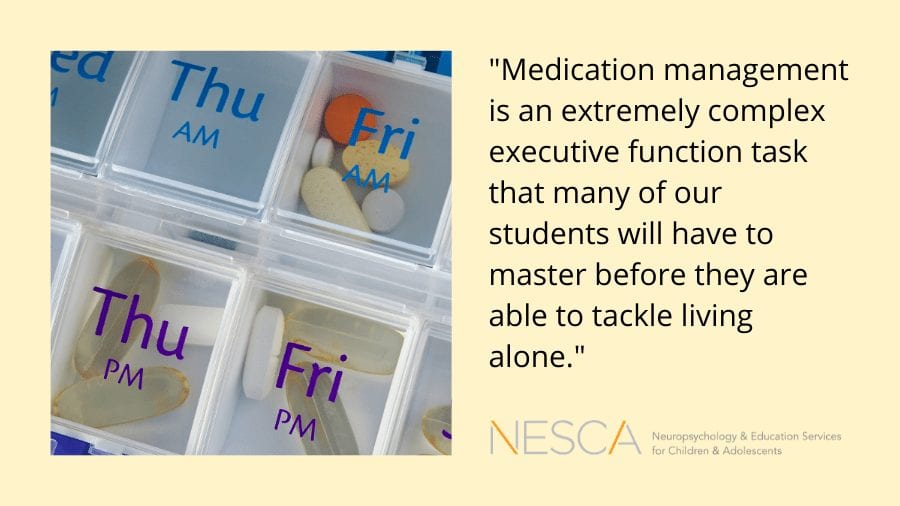
Medication management is an extremely complex executive function task that many of our students will have to master before they are able to tackle living alone. While there are many executive function tools available to help organize and remind individuals about their medication, there are also some long-term teaching strategies and opportunities for habit building throughout a students’ middle and high school career that parents may want to capitalize on before their children leave the home. Today we will explore some of the commonly used tools to help with medication adherence and touch on a few tips and suggestions to help adolescents develop a base of knowledge around their own health status and need for medication.

Tools

Seven Day Pillbox – The most ubiquitous tool to help individuals keep track of medication is a weekly pillbox. This may seem like a simple tool, but pillboxes are hugely varied and have many different additional features. Make sure to consider how many boxes there are per day (morning, afternoon, evening, etc.), whether there is a need for different colors to help with visual discrimination, and whether an audible or vibrating alarm could be beneficial. All of these are potential options that are built into the different pillbox options provided below:

Automatic Pill Dispenser – Some individuals may benefit from having the added support of a pill dispenser that automatically dispenses the correct prescriptions at the time they should be taken. Here is one example of this tool:

The Calendar – Those who have read my previous blog regarding the wonders of a functional digital calendar are likely unsurprised by this suggestion, but make use of this fabulous tool! Adding in an appointment to refill pillboxes, marking down anticipated dates to refill prescriptions, and setting notifications or alarms to go off when it is time to take medication each day can help students remember each step of the process.

Tips

Involve children in filling their pillboxes as early as possible. Many children will enjoy sitting down with a parent to place the pills in each little box and feel special when they are given some responsibility. When this is normalized as a typical part of a week, it becomes an expected activity of daily living for children. Make sure to point out the things that you notice as you fill the box. For example, stating, “Oh! I only count five pills left, that means I need to call and refill the prescription today,” each month will help your child to associate a nearly empty bottle with the need to problem solve.

Set a specific time or day of the week to refill pillboxes. Many children will continue to stick to routines and habits that they built up through childhood once they venture out of the home. Consider designating a specific time of the week to fill a pillbox together. For example, if Sunday after dinner works consistently, make this part of the family routine.

Pair medication with a daily task. Some individuals enjoy using alarms as reminders; however, others feel much more empowered by simply building medication into their routine. Pairing medication with an activity that happens daily anyways, such as brushing teeth in the morning, makes it easier to remember without direct prompting.

Help your child or adolescent put together a medication chart. Many of our children do not know the reasons for their medication. They are unaware of the intent, potential side effects, exact dosage, or name of the medication itself. The more our children and adolescents understand, the better they are able to advocate for themselves to doctors or other health professionals. Putting together a one-page medication chart that outlines all of this important information – in terms that can be easily understood and communicated to others by the child – can help children feel empowered in their conversation about their health. Consider adding a picture of each pill or capsule if they routinely appear the same. At times, pharmacies may unexpectedly need to fill generic prescriptions from different manufacturers, based on availability or other factors, therefore lending to a different appearance of the same generic prescription. This medication chart can also be a helpful tool to reference when adolescents start to independently fill their pillboxes.

Refill prescriptions together. While refilling prescriptions at the pharmacy is often a task that needs to be led and managed by adults, it’s still possible to include adolescents so that they start to learn the process. A great first step is to call the pharmacy on speaker phone and allow your child to listen in for a few months in a row.


About the Author
Sophie Bellenis is a Licensed Occupational Therapist in Massachusetts, specializing in educational OT and functional life skills development. Bellenis joined NESCA in the fall of 2017 to offer community-based skills coaching services as a part of the Real-life Skills Program within NESCA’s Transition Services team. Bellenis graduated from the MGH Institute of Health Professions with a Doctorate in Occupational Therapy, with a focus on pediatrics and international program evaluation. She is a member of the American Occupational Therapy Association, as well as the World Federation of Occupational Therapists. Having spent years delivering direct services at the elementary, middle school and high school levels, Bellenis has extensive background with school-based occupational therapy services.  She believes that individual sensory needs and visual skills must be taken into account to create comprehensive educational programming.


To book an appointment or to learn more about NESCA’s Occupational Therapy Services, please fill out our online Intake Form, email info@nesca-newton.com or call 617-658-9800.


Neuropsychology & Education Services for Children & Adolescents (NESCA) is a pediatric neuropsychology practice and integrative treatment center with offices in Newton, Massachusetts, Plainville, Massachusetts, and Londonderry, New Hampshire, serving clients from preschool through young adulthood and their families. For more information, please email info@nesca-newton.com or call 617-658-9800.


Why Taking Competency Tests, like the MCAS, can be Critical for Transition and College Planning

By | NESCA Notes 2021

By: Kelley Challen, Ed.M., CAS
Director of Transition Services; Transition Specialist, NESCA

Most states require some form of competency testing for students, particularly students who will graduate with a state standard diploma. But in the past year, standardized competency testing has become more complicated, if not impossible, to carry out.

In Massachusetts, graduation requirements have been altered for several grades of students. Students graduating in 2021-2023 are being offered alternative options for meeting state competency determination in one or more of the required subject areas (e.g., science and technology/engineering, mathematics, English Language Arts). For more details about those alternatives, see MA Graduation Requirements and Related Guidance on the Massachusetts Department of Elementary and Secondary Education (DESE) website.

The opportunity for students in the Class of 2022 to graduate without ever sitting for 10th grade MCAS is something that many students, parents, and teachers are excited about. While I understand, and even agree with, criticisms of standardized testing, there are also many reasons that I am disappointed for the students who are missing out on the opportunity to sit for this testing. These students, especially those with disabilities, are missing out on a vital transition planning activity.

Preparing for, and sitting for, (and coping with,) high stakes tests is an important part of life. Whether you pass or fail, being able to show up and perform your best in a high-pressure situation is a valuable life skill. Moreover, being able to demonstrate competency in a test situation is a reasonable and necessary college and career skill.

Additionally, standardized tests like MCAS provide objective feedback regarding the student’s level of achievement with high school material. Grades can be tremendously subjective, and are highly dependent on the teachers and types of classes that the student is exposed to during high school. In contrast, students participating in honors, college prep, and functional math classes all sit for the same standardized math tests. This is especially important when students in all three of those classes are interested in heading off to college after high school, and when we want to get a sense of their readiness for handling college coursework. Generally, students who do not earn passing scores (i.e., students who score in the “Needs Improvement” or “Partially Meeting Expectations” categories) on the MCAS, especially by 12th grade, will struggle with college placement exams, such as the Accuplacer, and may end up needing to take remedial coursework at the start of college. Students have a right to know how ready they are for the academic rigors of college as they are making their college plans, and standardized testing results can be helpful information (although they are by no means the whole picture).

With the new competency determination options, many students in Massachusetts view sitting for MCAS as something that is only worth doing if they are possible candidates for the John and Abigail Adams Scholarship (a merit-based state scholarship program). However, I hope students will also consider the other positive reasons I have listed above when deciding whether to sit for the test. For college-bound students who do choose not to sit for MCAS, I strongly recommend sitting for other standardized exams during high school, such as SAT, ACT, Accuplacer, etc. These experiences are important opportunities to build confidence in high stakes situations, to assess college readiness skills, and to identify skill gaps that may need shoring up.

Certainly, there are many legitimate concerns about standardized test contents and validity, including significant equity issues. I also believe that competency tests and college placement tests provide important information for many college-bound students. They are one metric, among many, that are worth having for transition and college planning.


About the Author
Kelley Challen, Ed.M., CAS, is NESCA’s Director of Transition Services, overseeing planning, consultation, evaluation, coaching, case management, training and program development services. Ms. Challen also provides expert witness testimony in legal proceedings related to special education. She is also the Assistant Director of NESCA, working under Dr. Ann Helmus to support day-to-day operations of the practice. Ms. Challen began facilitating programs for children and adolescents with special needs in 2004. After receiving her Master’s Degree and Certificate of Advanced Study in Risk and Prevention Counseling from Harvard Graduate School of Education, Ms. Challen spent several years at the MGH Aspire Program where she founded an array of social, life and career skill development programs for teens and young adults with Asperger’s Syndrome and related profiles. She additionally worked at the Northeast Arc as Program Director for the Spotlight Program, a drama-based social pragmatics program, serving youth with a wide range of diagnoses and collaborating with several school districts to design in-house social skills and transition programs. Ms. Challen is co-author of the chapter “Technologies to Support Interventions for Social- Emotional Intelligence, Self-Awareness, Personality Style, and Self-Regulation” for the book Technology Tools for Students with Autism. She is also a proud mother of two energetic boys, ages six and three. While Ms. Challen has special expertise in supporting students with Autism Spectrum Disorders, she provides support to individuals with a wide range of developmental and learning abilities, including students with complex medical needs.


Neuropsychology & Education Services for Children & Adolescents (NESCA) is a pediatric neuropsychology practice and integrative treatment center with offices in Newton, Massachusetts, Plainville, Massachusetts, and Londonderry, New Hampshire, serving clients from preschool through young adulthood and their families. For more information, please email info@nesca-newton.com or call 617-658-9800.

Cyberbullying and Autism Spectrum Disorders

By | NESCA Notes 2021

By Yvonne M. Asher, Ph.D. 
Pediatric Neuropsychologist

I recently had the opportunity to attend a webinar by Justin Patchin, Ph.D., one of the foremost cyberbullying researchers. I have used his work myself in designing both my master’s thesis and doctoral dissertation research, so it was wonderful to hear him speak. He began with a story about his childhood and some of the rules he was taught – don’t meet up with strangers that you meet online, don’t get into anyone’s car if you don’t know them well – lessons I was also taught as a child. These are the kind of rules that individuals with Autism Spectrum Disorders (ASD) often crave – black and white, clear, no middle ground. The online world, he argued, does not allow for such stark and rigid rules. Rather, he says, it calls for “guidelines.” Working with children with ASD, when I hear “guidelines,” I think, “grey,” “fuzzy,” and “it depends.” These can be some of the toughest situations for an individual who is not neurotypical.

I think he’s right. The online world is fast, fluid, ever-changing, and highly dependent on specific circumstances. It calls for the kind of flexible thinking and evaluation of context that kids with ASD are so often challenged by. Yet, as the adults parenting, educating, and supporting these young people, these are exactly the skills that they need. The online world is not going anywhere anytime soon, and it is not likely to slow down either.

Cyberbullying is one of the difficult online phenomena to manage, as youth who are bullied online are most frequently also bullied in “real life,” usually at school. The bullies are often peers they know and must see on a regular basis. For children with social challenges, navigating bullying that is occurring across settings is an especially difficult task. And the solution is not to take away technology. Now more than ever, children need access to technology for homework, classwork, enjoyable peer activities, and hobbies. Where does that leave us?

Unfortunately, Dr. Patchin did not give any practical advice for how to support individuals with autism around cyberbullying. I think that one important starting point is to help these individuals learn to check in with themselves. Time and time again, I hear from students, “I’m not really sure what was going on, but I think they were being mean.” (In fact, I hear this from children who are decidedly not on the autism spectrum, especially when bullying is occurring by older peers.) Bullying is hurtful (intentionally so), and recognizing that hurt is an important first step. Once children and adolescents identify that something is hurtful, adults can help and support them in navigating through the situation.

Whether bullying, cyberbullying, or a misunderstanding, it is important for adults to listen carefully when children come to us with social concerns. In addition, we must have a solid understanding of the online world in which students are living, learning, and engaging. Social media shifts rapidly, with new platforms becoming wildly popular in a matter of weeks. Working with youth requires us to keep as current as we can, making certain that we understand the “ins and outs” of each platform. It is also incumbent upon us to ensure that all children and adolescents (not just those with an autism diagnosis) learn guidelines that will allow them to safely make their way through a constantly evolving world of platforms, apps, and services. Safety online is as critical as safety in person.


About the Author

Dr. Yvonne M. Asher enjoys working with a wide range of children and teens, including those with autism spectrum disorder, developmental delays, learning disabilities, attention difficulties and executive functioning challenges. She often works with children whose complex profiles are not easily captured by a single label or diagnosis. She particularly enjoys working with young children and helping parents through their “first touch” with mental health care or developmental concerns.

Dr. Asher’s approach to assessment is gentle and supportive, and recognizes the importance of building rapport and trust. When working with young children, Dr. Asher incorporates play and “games” that allow children to complete standardized assessments in a fun and engaging environment.

Dr. Asher has extensive experience working in public, charter and religious schools, both as a classroom teacher and psychologist. She holds a master’s degree in education and continues to love working with educators. As a psychologist working in public schools, she gained invaluable experience with the IEP process from start to finish. She incorporates both her educational and psychological training when formulating recommendations to school teams.

Dr. Asher attended Swarthmore College and the Jewish Theological Seminary. She completed her doctoral degree at Suffolk University, where her dissertation looked at the impact of starting middle school on children’s social and emotional wellbeing. After graduating, she completed an intensive fellowship at the MGH Lurie Center for Autism, where she worked with a wide range of children, adolescents and young adults with autism and related disorders.


Neuropsychology & Education Services for Children & Adolescents (NESCA) is a pediatric neuropsychology practice and integrative treatment center with offices in Newton, Massachusetts, Plainville, Massachusetts, and Londonderry, New Hampshire, serving clients from preschool through young adulthood and their families. For more information, please email info@nesca-newton.com or call 617-658-9800.


To book an appointment with Dr. Yvonne Asher, please complete our Intake Form today. For more information about NESCA, please email info@nesca-newton.com or call 617-658-9800.


Learning to Ride a Bike: A Rite of Passage

By | NESCA Notes 2021

By: Jessica Hanna MS, OTR/L
Occupational Therapist, NESCA

If there is one positive takeaway from the COVID-19 pandemic, it’s the ever-growing love for being outdoors. It’s spring, the flowers are blooming, the sun is out, and the air is light. Everything in our body is telling us to go outside and play.

For many kids with and without disabilities, bike riding is meaningful, liberating, and a rite of passage. Close your eyes and try to remember the first time you rode a two-wheel bike. Can you remember the color of your bike? The smell in the air? The complete joy it brought you? That was the day we all felt a bit more confident and like we grew a bit taller.

So how do we help our children achieve this meaningful occupation? The days of running behind our children while holding onto their bike seat, telling them to pedal, not to stop, and hoping for the best and that they will forgive us when we let go (when we clearly promised we would not let go!) should be far behind us. But are they?

A lot goes into learning how to ride a bike, so do not let your child give up so soon when it takes more than a couple of days, weeks, or months to get it right. Consider the following skills that are addressed in learning to ride a bike:

  • Attention and concentration
  • Bilateral coordination
  • Balance
  • Body awareness
  • Core strength
  • Hand-eye coordination
  • Motor planning
  • Postural stability
  • Sensory processing
  • Upper and lower extremity strength
  • Visual scanning

Children as young as five years of age will begin to acquire and develop the skills needed to ride a two-wheel bike, and still others may not feel ready until they are pre-teens or even into adulthood.

Before getting started, here are a couple things to consider regarding the equipment involved in learning how to ride a bike:

  • Bike – The height of the bike is a crucial element to success when learning how to ride. When seated on the bike, your child’s feet should be firmly planted on the ground. The bike seat may appear too low and the bike too small; however, this technique enables movement security, engages proper core and postural stability, and increases confidence.
  • Braking System – Be sure to learn the difference between hand brakes vs. coaster brakes (using feet to backpedal). Both braking systems have pros and cons. Hand brakes are a personal favorite. They are more flexible to position, offer better control, but require adequate hand strength and coordination to manipulate. Coaster brakes (using your feet to pedal backward to brake) use an intuitive motor planning motion for children. When you pedal forward, you go; when pedaling backward, you stop. They are helpful for children who lack the hand strength skills to wrap and squeeze their hands around a hand brake; however, they provide awkward foot positioning and the constant tendency to backpedal.
  • Helmet – Safety, Safety, Safety! When handling a bike for any occasion (i.e., walking a bike, doing balance drills on a bike, or riding a bike), it should become an automatic habit to wear a helmet. Your child should be in charge of putting on and taking off their helmet independently. There is nothing more important than wearing a helmet that fits correctly with fasteners that can be easily manipulated. When choosing a helmet, be cognizant of the type of fastener/clasp it comes with and if your child has the fine motor skills to adjust it (this skill could take time to learn).If you are unsure if your child’s helmet is a good fit, any cycling store will be more than pleased to assist in finding your child the most appropriate size. 
  • Pedals – When learning to ride for the first time, the removal of pedals should be highly considered. It provides the opportunity to address balance, core, and postural stability for both younger and older children while also increasing movement security.
  • Training Bike – Which is best…balance bikes vs. training wheels? Balance bikes are light in weight and can be introduced to children at a much younger age than a pedal bike. They promote core strength and increase motor planning, sequencing, and balance training skills, making the transition from a balance bike to a two-wheel pedal bike more fluid and easier to manage. Training wheels promote ease in learning motor planning techniques to push on pedals while providing assisted balance. It’s important to note that removing the balance component can be disadvantageous when transitioning from training wheels to a two-wheel pedal bike.

Overall, the literature supports the observation that, for children with and without disabilities, learning to ride a bike is a popular activity that increases confidence, provides opportunities for shared recreation with families and peers, and promotes social inclusion (Dunford, Bannigan, Rathmell (2016).

Several of the many clinical diagnoses of children who can ride a bike follow here; however, this list is certainly not inclusive of the many other diagnoses that do not preclude children from bike riding:

  • ADHD
  • Anxiety
  • Autism Spectrum Disorder
  • Cerebral Palsy
  • Developmental Coordination Disorder
  • General learning disability
  • Hearing impairment
  • No diagnosis

The art of bike riding can be broken down into various steps, from learning how to use the kickstand to the act of pedaling. Each step deserves attention, because through repetition and practice, confidence is achieved.

If using these tips feels difficult or is not helping your child with the level of focus and skill they need to successfully achieve their goal to use a bike, we recommend reaching out to your occupational therapist or getting an occupational therapy evaluation. If in-person direct services continue to be a concern, biking riding skills can be offered via telehealth from the comfort of  your home. Jessica offers successful biking riding drills and adaptive home exercise plans through telehealth that address the skills required to learn to ride a bike. Contact NESCA’s Director of Clinical Services Julie Robinson, OT, to learn more at: jrobinson@nesca-newton.com.


References
Dunford, Bannigan, Rathmell (2016) Learning to ride a bike: Developing a therapeutic intervention. Children Young People & Families Occupational Therapy Journal 20(1) 10-18


About the Author

Jessica Hanna has over 10 years of pediatric OT experience in conducting assessments and providing treatment of children and adolescents with a broad range of challenges and disabilities, including autism spectrum disorders, sensory processing disorders, visual impairments, cerebral palsy, executive function deficits and developmental disorders of motor function. Prior to joining NESCA, Jessica trained and worked in a variety of settings, including inpatient and outpatient hospital settings, private practice, schools and homes. She has served on interdisciplinary treatment teams and worked closely with schools, medical staff and other service providers in coordinating care. In addition, Jessica provided occupational therapy services at Perkins School for the Blind and Spaulding Rehabilitation Hospital pediatric inpatient unit, where she conducted comprehensive evaluations and interventions for children with a broad range of presentations.


To book an appointment or to learn more about NESCA’s Occupational Therapy Services, please fill out our online Intake Form, email info@nesca-newton.com or call 617-658-9800.


Neuropsychology & Education Services for Children & Adolescents (NESCA) is a pediatric neuropsychology practice and integrative treatment center with offices in Newton, Massachusetts, Plainville, Massachusetts, and Londonderry, New Hampshire, serving clients from preschool through young adulthood and their families. For more information, please email info@nesca-newton.com or call 617-658-9800.


Skip to content