

By: Stephanie Monaghan-Blout, Psy.D.
Pediatric Neuropsychologist
Let’s face it – a lot of parenting involves socializing children whose brains are in the process of being built. This means:
- They do not yet have the cognitive capacity to understand the moral principles behind such behaviors as “sharing, “being nice” and “using our words.”
- They are in the process of learning how to inhibit the impulse to grab, say whatever one thinks and using physical force to get what one wants.
Behavioral reinforcement strategies (rewarding desirable behavior) can be quite effective as a socialization technique – but only if the strategy is keyed to both an understanding of the level of the child’s cognitive/moral development and their capacity for impulse control. All too often, the parent’s efforts to shape their child’s behavior run aground because of problems in assessing either (or both) of these areas. The concept of a “mulligan” can be a very useful in compensating for either child or parent error.
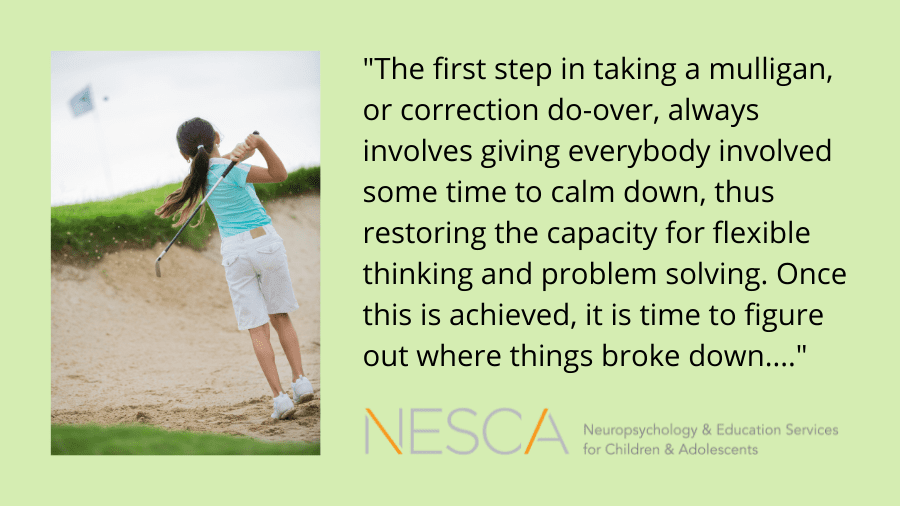
The term “mulligan” comes from the game of golf where it means getting an extra stroke after a poor shot. There are several stories about the origin of the term, but most involve a player named Mulligan who had been so rattled by a variety of events that he made a very poor shot on his first effort and claimed a “correction” – basically a do-over. This fits well with the dilemma presented to parents when a child has not been able to stick to an agreement, like “if you boys can work out your differences without verbal or physical fighting this morning, we will get some ice cream this afternoon.”
The first step in taking a mulligan, or correction do-over, always involves giving everybody involved some time to calm down, thus restoring the capacity for flexible thinking and problem solving. Once this is achieved, it is time to figure out where things broke down: was it overestimating the child’s capacity for controlling their impulses over time, in certain situations, or with certain people? Or was it because the child did not know how or why to take certain actions? If the problem involves impulse control, it will be up to the parent to restructure the situation in order to make it more realistically doable for the child or children – in other words, the parent takes a mulligan. For instance, s/he might say, “Look, this is not working out. I’m going to take a mulligan. Every 15 minutes that you guys can get along and work out your differences, I will give you a point. If you can get 3 points this morning, we will go for ice cream this afternoon.” Notice that this directive leaves some room for inevitable error, but still imposes reasonable expectations.
When the problem falls in the “how” or “why” category, parents also need to consider the child’s developmental status before engaging in problem solving. It is really important to appreciate that a child’s understanding of common conventions, like “sharing” and “fair.” In the egocentric and preconventional thinking of young children, “sharing” is too abstract of a concept and “fair” means “I get my way.” To speak about “taking turns,” make more sense to them. In the more conventional thinking of elementary school children, the key element in sharing is “fairness,” or, is the exchange equal? (In high school or college, some students will begin to struggle with the concept of equity, or how to allocate resources and opportunities in order to ensure an equal outcome, but this is a foreign thought to most children when it applies to their own resources, like candy or access to video games). Once the parent is clear about how the child is viewing the problem and where their strategies broke down, they can offer a chance for a mulligan while teaching more effective strategies than brute force or crying. Concrete aids, such as wind-up timers that show minutes, can help children understand the passing of time. Whimsical strategies, such as “shooting fingers” or “Rock, Paper, Scissors” are fun ways of determining who goes first or who gets to choose the video that also teach tenets of compromise and collaboration.
Resources:
https://www.golfdigest.com/story/did-you-know-where-did-the-term-mulligan-originate
About the Author:
Formerly an adolescent and family therapist, Dr. Stephanie Monaghan-Blout is a senior clinician who joined NESCA at its inception in 2007. Dr. Monaghan-Blout specializes in the assessment of clients with complex learning and emotional issues. She is proficient in the administration of psychological (projective) tests, as well as in neuropsychological testing. Her responsibilities at NESCA also include acting as Clinical Coordinator, overseeing psycho-educational and therapeutic services. She has a particular interest in working with adopted children and their families, as well as those impacted by traumatic experiences. She is a member of the Trauma and Learning Policy Initiative (TLPI) associated with Massachusetts Advocates for Children and the Harvard Law Clinic, and is working with that group on an interdisciplinary guide to trauma sensitive evaluations.
To book an evaluation with Dr. Monaghan-Blout or one of our many other expert neuropsychologists and transition specialists, complete NESCA’s online intake form.
Neuropsychology & Education Services for Children & Adolescents (NESCA) is a pediatric neuropsychology practice and integrative treatment center with offices in Newton, Massachusetts, Plainville, Massachusetts, and Londonderry, New Hampshire, serving clients from preschool through young adulthood and their families. For more information, please email info@nesca-newton.com or call 617-658-9800.

 (Movement Matters, 2020).
 pediatric settings. Maddie received her undergraduate degree in Exercise Science/Kinesiology at The College of Charleston in South Carolina and earned her Doctorate degree in Occupational Therapy from The MGH Institute of Health Professions in Boston.


 By:
By:  Londonderry, NH office. She specializes in the evaluation of anxious children and teens, working to tease apart the various factors lending to their stress, such as underlying learning, attentional, or emotional challenges. She particularly enjoys working with the seemingly “unmotivated” child, as well as children who have “flown under the radar” for years due to their desire to succeed.


 unique pattern of strengths and weaknesses to best formulate a plan for intervention and success. With experiences providing therapy and assessments, Dr. Creedon bridges the gap between testing data and therapeutic services to develop a clear roadmap for change and deeper of understanding of individual needs.



 complex, inter-related needs, with a particular emphasis on identifying co-occurring neurodevelopmental and psychiatric challenges. She specializes in the evaluation of developmental disabilities including autism spectrum disorder and social-emotional difficulties stemming from mood, anxiety, attachment and trauma-related diagnoses. She often assesses children who have “unique learning styles” that can underlie deficits in problem-solving, emotion regulation, social skills and self-esteem.
Connect with Us