To accommodate requests for neuropsychological evaluations after the start of the new school year, NESCA has added evaluation dates in its Newton, MA office. Immediate openings are now available for scheduling. Please complete our Inquiry/Intake Form for more information or to start the scheduling process.

Tag

academic demands Archives - NESCA

Subscribe to NESCA Notes

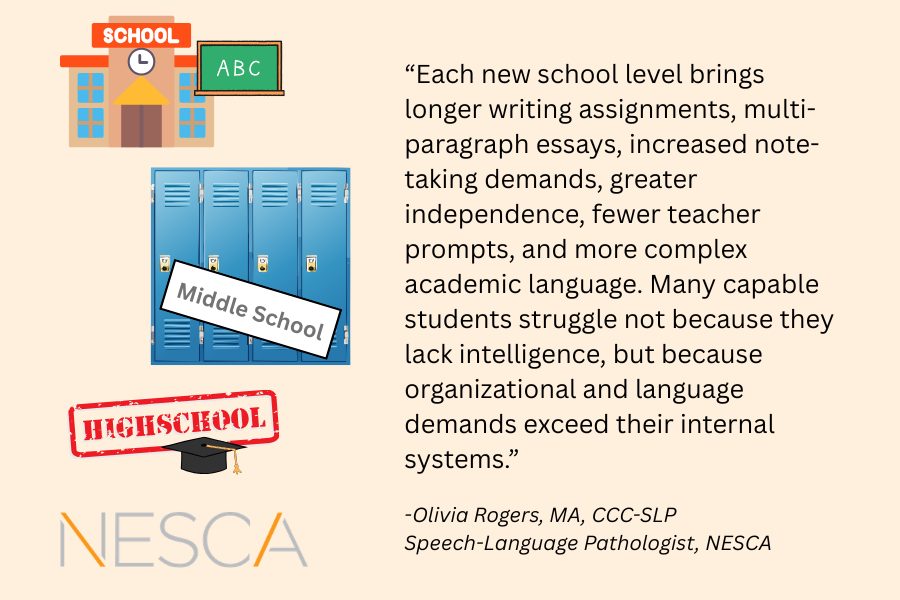
Graphic showing the transition from elementary to middle to high schools and a quote from Olivia Rogers, CCC-SLP

What Is a School Transition Intensive – And Who Is It For?

By | NESCA Notes 2026

Graphic showing the transition from elementary to middle to high schools and a quote from Olivia Rogers, CCC-SLPBy Olivia Rogers, MA, CCC-SLP
Speech-Language Pathologist, NESCA

Transitions between school levels are exciting – but they are also academically demanding. Whether a student is moving from elementary to middle school, middle to high school, or into a new independent school environment, expectations around writing, organization, and independence increase dramatically. A School Transition Intensive is a short-term, highly focused summer program designed to strengthen the language and executive functioning systems students need before those expectations rise. It’s not tutoring. It’s proactive skill-building.

Why School Transitions Are So Challenging
Each new school level brings longer writing assignments, multi-paragraph essays, increased note-taking demands, greater independence, fewer teacher prompts, and more complex academic language. Many capable students struggle not because they lack intelligence, but because organizational and language demands exceed their internal systems.

What Skills Are Targeted?
Depending on grade level, a transition intensive may include:

  • Paragraph structure foundations
  • Expanding sentences with detail
  • Multi-paragraph writing
  • Analytical paragraph writing
  • Text-based evidence integration
  • Academic vocabulary development
  • Written summaries of complex texts
  • Comprehension of texts of varying length and complexity
  • Note-taking systems
  • Planning and project organization routines
  • Independent study and homework systems

The focus is always on integrating language and executive functioning together.

Who Would Benefit Most?
A School Transition Intensive is particularly helpful for students who are:

  • Bright but disorganized
  • Struggle to get ideas onto paper
  • Avoid writing or academic tasks
  • Require extra support to get homework or assignments done
  • Have ADHD or executive functioning weaknesses
  • Receive feedback such as “needs more organization” or “struggles with written expression.”
  • It is also ideal for students entering competitive independent schools where writing expectations are high from day one.

Why Summer Is the Ideal Time
During the school year, students juggle multiple subjects, deadlines, and social demands. Summer allows for focused, structured practice without grade pressure, helping students build independence and confidence before the school year begins.

The Real Goal
The goal is not simply better essays. It is stronger internal organization, reduced academic anxiety, clearer thinking on paper, increased independence, and confidence walking into a new academic environment.

At NESCA, we offer intensive summer therapy that targets communication (such as listening comprehension, and expressive language), written language, and academic executive functioning.  For more information on summer intensives at NESCA, please complete our online Inquiry/Intake Form or email me directly at orogers@nesca-newton.com.


About the AuthorOlivia Rogers

Olivia Rogers is a licensed speech-language pathologist with experience in pediatric clinics and public schools, working with children from age 2 through young adulthood across a range of communication challenges. With a special interest in the connection between oral language and literacy, Ms. Rogers is trained in the Orton-Gillingham method and the Brain Frames program, supporting students in language comprehension, expression, and written organization. She is dedicated to making therapy engaging and personalized for each child.

To learn more about NESCA’s Speech and Language Services or schedule appointments, complete our online Intake Form or email orogers@nesca-newton.com.


NESCA is a pediatric neuropsychology and related services practice with offices in Newton, Plainville, and Hingham, Massachusetts; Londonderry, New Hampshire; and Coral Gables, Florida, serving clients from infancy through young adulthood and their families. For more information, please email info@nesca-newton.com or call 617-658-9800.
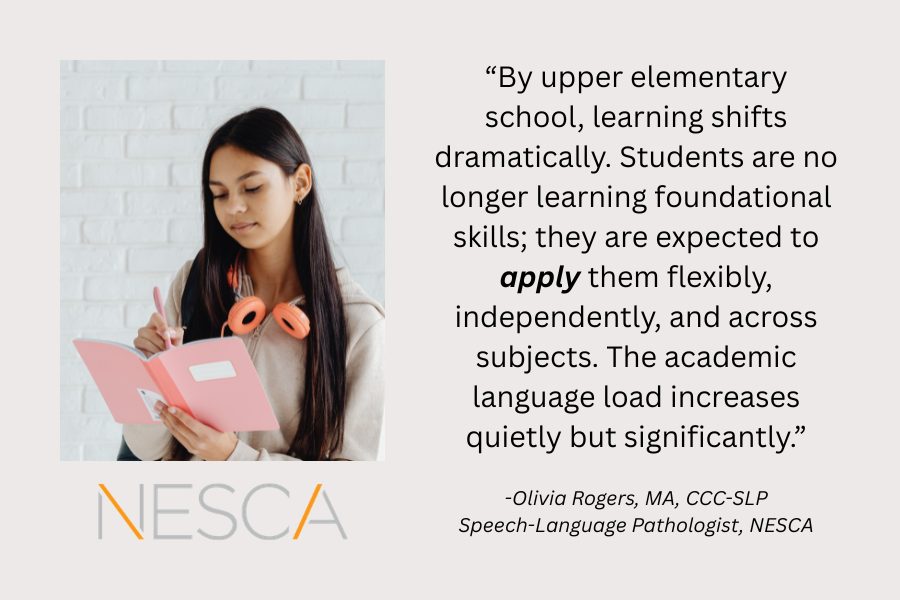
 

Student trying to write despite hidden language demands

The Hidden Language Demands of Upper Elementary and Middle School

By | NESCA Notes 2026

Student trying to write despite hidden language demandsBy Olivia Rogers, MA, CCC-SLP
Speech-Language Pathologist, NESCA

By upper elementary school, learning shifts dramatically. Students are no longer learning foundational skills; they are expected to apply them flexibly, independently, and across subjects. The academic language load increases quietly but significantly.

What Changes in Grades 4 to 7?

  • Students are reading to learn
  • Texts become denser and more abstract
  • Vocabulary shifts from concrete to conceptual
  • Sentence structures become longer and more syntactically complex
  • Students are expected to compare, analyze, justify, and synthesize
  • Writing moves from short responses to multi-paragraph compositions

The Cognitive Load Increases
Students must now hold multiple ideas in working memory, track shifting perspectives in texts, interpret figurative language, and integrate background knowledge – often simultaneously. These demands require strong executive functioning and well-developed language networks.

The Invisible Language Skills Required

  • Understanding complex sentences with embedded clauses
  • Interpreting nuanced vocabulary and morphology
  • Making inferences beyond literal meaning
  • Organizing ideas cohesively in speech and writing
  • Explaining reasoning using precise academic language

Common Signs of Strain

  • Strong verbal knowledge but weak written output
  • Short, underdeveloped written responses
  • Difficulty summarizing or explaining key ideas
  • Avoidance of reading-heavy assignments
  • Homework taking significantly longer than expected
  • Increased anxiety or shutdown around school tasks

Why This Stage Matters
Upper elementary and early middle school are pivotal years for our students. If language organization, executive functioning, and literacy systems are strengthened during this window, students often transition into higher grades with greater confidence and independence. When gaps remain unaddressed, demands compound year after year.

If This Sounds Familiar…
If your child is bright but suddenly struggling with writing, comprehension, or workload, it may not be motivation. It may be due to the increased language load. Strong academic performance is not just about effort. It’s about systems of learning. When language, executive functioning, and literacy are strengthened together, students gain not only skill, but confidence.


At NESCA, we view communication holistically. Our therapists use a comprehensive approach to treat the systems of learning as integrative, helping students develop valuable skills they can use in and out of the classroom! If you’re curious whether this integrative approach would benefit your child, I welcome the opportunity to connect to identify what targeted support may make the greatest difference. For more information on Speech and Language Therapy, Literacy, and Executive Functioning Support at NESCA, please complete our online Intake Form or email me directly at orogers@nesca-newton.com.


About the AuthorOlivia Rogers

Olivia Rogers is a licensed speech-language pathologist with experience in pediatric clinics and public schools, working with children from age 2 through young adulthood across a range of communication challenges. With a special interest in the connection between oral language and literacy, Ms. Rogers is trained in the Orton-Gillingham method and the Brain Frames program, supporting students in language comprehension, expression, and written organization. She is dedicated to making therapy engaging and personalized for each child.


To learn more about NESCA’s Speech and Language Services or schedule appointments, complete our online Intake Form or email orogers@nesca-newton.com.


NESCA is a pediatric neuropsychology and related services practice with offices in Newton, Plainville, and Hingham, Massachusetts; Londonderry, New Hampshire; and Coral Gables, Florida, serving clients from infancy through young adulthood and their families. For more information, please email info@nesca-newton.com or call 617-658-9800.


Skip to content