

By Luisa Hernandez Medellin, Psy.D., PMH-C
Bilingual Pediatric Neuropsychologist; PSYPACT-authorized
If your child is learning English at school while also using another language at home, you are not alone. Millions of children in the U.S. are English Language Learners (ELLs). These students bring rich language skills, culture, and life experiences into their classrooms, but they also face unique challenges that schools don’t always understand well.
As a parent, understanding what your child truly needs can help you advocate more effectively and feel more confident working with schools.
English Learners Are Not All the Same
One of the biggest misunderstandings about English learners is the idea that they are all similar. In reality, ELL students come from many different backgrounds. Some were born in the United States, while others arrived recently. Some had strong schooling in their home country, and others experienced interruptions due to migration, poverty, or trauma.
Children may speak one language, two languages, or several. Some can speak well but struggle to read or write. Others understand more than they can say. All of this matters when teachers and specialists try to figure out how a child is doing in school.
Speaking English Isn’t the Same as Doing Schoolwork in English
Many parents hear, “Your child speaks English just fine,” and assume that means they should also be doing well academically. But everyday conversation and school language are very different.
Children often learn social English (chatting with friends, answering simple questions) within a few years. Academic English, the language needed for reading stories, writing essays, solving math word problems, and taking tests, takes much longer to develop. This means a child can sound fluent but still may struggle with schoolwork, and that struggle may be completely normal.
When a Child Is Struggling, What Should Happen?
Teachers are usually the first to notice when a child is having a hard time. The key is figuring out why.
Is the child still learning English? Is the instruction matched to the child’s language level? Has the child had access to consistent schooling? Or is there something more, like a learning or language disorder?
Schools should never rush to label a child with a disability just because they are learning English. At the same time, children who truly have learning challenges should not be ignored because “they just need more time.”
The goal is to understand the whole child, not just test scores.
Parents Must Be Part of the Process
Families play a critical role in helping schools understand a child’s strengths and challenges. However, many parents feel left out because of language barriers or unfamiliarity with the school system.
Schools are responsible for making sure parents understand what’s happening. This includes:
- Providing interpreters and translated documents
- Explaining processes step by step
- Avoiding educational jargon
- Checking for understanding, not just agreement
Parents should never be expected to rely on their child to translate important information.
Evaluations Should Be Fair and Culturally Sensitive
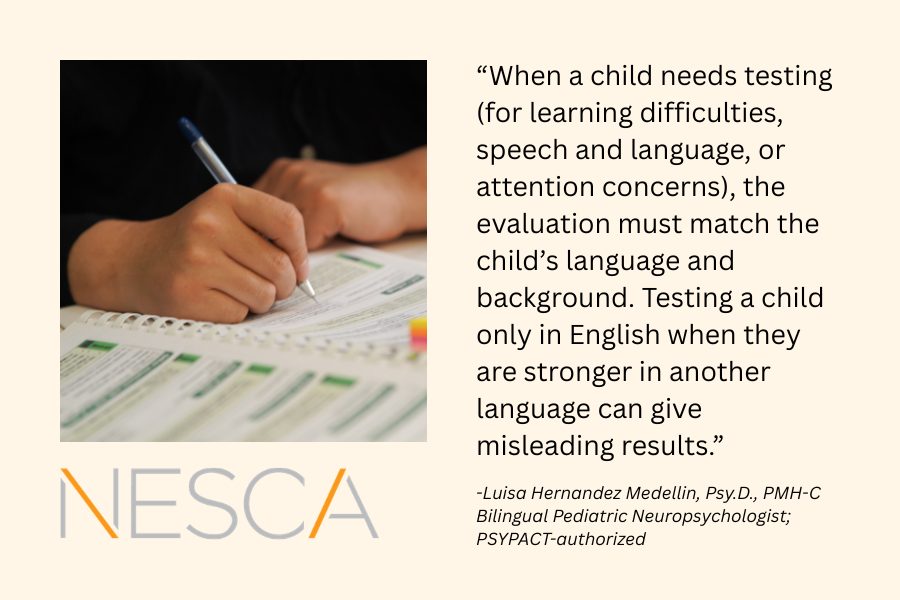
When a child needs testing (for learning difficulties, speech and language, or attention concerns), the evaluation must match the child’s language and background. Testing a child only in English when they are stronger in another language can give misleading results.
Good evaluations consider:
- Which language the child is strongest in
- How long the child has been learning English
- The language used at home and at school
- Cultural differences that may affect test performance
Sometimes, no formal diagnosis is given, and that’s okay. Evaluations can still identify areas of need and lead to helpful supports and accommodations.
Understanding Results and Moving Forward
Test results should be explained in plain language. Parents deserve to understand what the findings mean, how English learning affects their child’s performance, and what steps can help next.
Recommendations should be realistic and respectful of family values, beliefs, and resources. The most important part of the process is collaboration – parents, teachers, and specialists working together for the child’s success.
The Bottom Line
Children who are learning English are capable, resilient, and full of potential. What they need most is time, appropriate instruction, fair assessment, and adults who understand the difference between language learning and learning problems.
When schools take a whole‑child approach – one that respects language, culture, and family – English learners don’t just catch up. They thrive.
If you ever feel unsure, ask questions. Your voice matters, and you are your child’s strongest advocate.
 About the Author
As a bilingual pediatric neuropsychologist, Dr. Hernandez Medellin conducts comprehensive and culturally sensitive neurodevelopmental and neuropsychological assessments, comprehensive diagnostic evaluations, and effective care plans, providing appropriate recommendations for the client’s school, home, and the community. She specializes in the identification and assessment of neurodevelopmental disorders such as Autism Spectrum Disorders, ADHD, developmental and learning disorders, and their co-occurrence with anxiety and mood disorders. She also works with children and young adults with acquired brain injuries, epilepsy, brain tumors, strokes, general medical conditions, and genetic disorders affecting the nervous system. She is a native Spanish-speaker, passionate about serving the eclectic and vibrant South Florida community, as well as international patients looking for high-quality and compassionate care.
To book evaluation services at NESCA in Coral Gables, Florida, complete NESCA’s online intake form.
To book a neuropsychological evaluation or other services at NESCA’s New England offices, complete NESCA’s online intake form.
NESCA is a pediatric neuropsychology and related services practice with offices in Newton, Plainville, and Hingham, Massachusetts; Londonderry, New Hampshire; and Coral Gables, Florida, serving clients from infancy through young adulthood and their families. For more information, please email info@nesca-newton.com or call 617-658-9800.

 complex, inter-related needs, with a particular emphasis on identifying co-occurring neurodevelopmental and psychiatric challenges. She specializes in the evaluation of developmental disabilities including autism spectrum disorder and social-emotional difficulties stemming from mood, anxiety, attachment and trauma-related diagnoses. She often assesses children who have “unique learning styles” that can underlie deficits in problem-solving, emotion regulation, social skills and self-esteem.
Connect with Us