

By Luisa Hernandez Medellin, Psy.D., PMH-C
Pediatric Neuropsychologist, NESCA
A practical guide for finding the right balance between enrichment, rest, and family life
Back-to-school season often comes with a long list of sign-ups: soccer, dance, music, tutoring, art, clubs, and more. As parents, it is easy to feel like we should say yes to everything so our kids do not miss out.
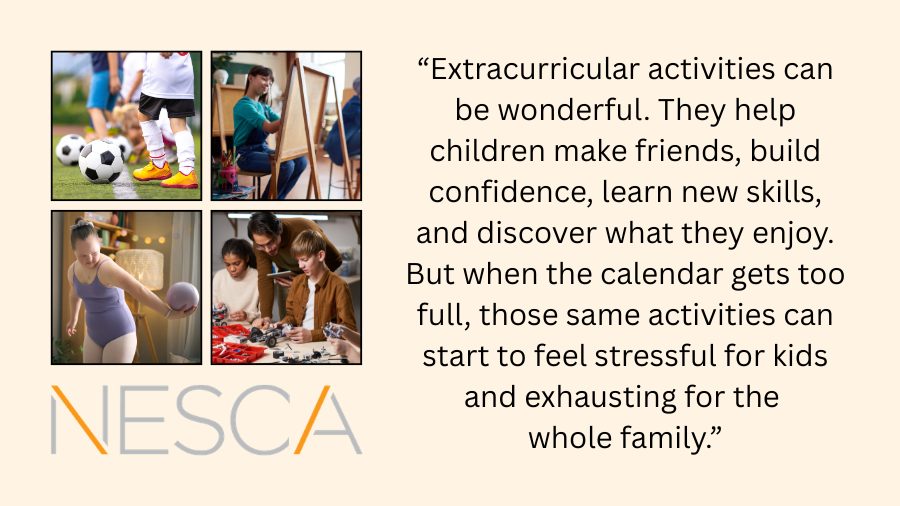
Extracurricular activities can be wonderful. They help children make friends, build confidence, learn new skills, and discover what they enjoy. But when the calendar gets too full, those same activities can start to feel stressful for kids and exhausting for the whole family.
Start With One Simple Question: Why Are We Doing This?
Before signing up, pause and ask yourself: Is my child truly interested? Are we choosing this because everyone else seems to be doing it? Will this activity fit our family’s schedule, budget, and energy level?
There is no perfect answer. Some children need to try a few things before they find what they love. Others may be happier with one activity and plenty of time to play, rest, and just be kids.
Why Activities Can Be Good for Kids
When the fit is right, activities can support a child in many ways. Sports can teach teamwork and patience. Music, art, and dance can give children a way to express themselves. Clubs and volunteer opportunities can help older kids feel connected and responsible.
Activities can also help children build confidence. A child who struggles in one area of life may feel proud and capable when they learn a song, finish a swim lesson, score a goal, or make something with their hands.
But Downtime Matters, Too
Kids need space in their day that is not scheduled, coached, graded, or rushed. Free play helps younger children solve problems, use their imagination, and learn how to manage boredom. Older kids also need quiet time to think, relax, and recover from school demands.
If your child goes from school to homework to practice to bed most days, it may be too much. A busy schedule is not automatically a better schedule.
Signs Your Child May Need a Break
It is normal for kids to have hard days or feel nervous when trying something new. But if the stress keeps showing up, it may be time to pause and reassess, especially if the following behaviors or signs become frequent:
- Crying, meltdowns, or big resistance before every practice or class
- Stomachaches, headaches, or complaints about going
- Trouble sleeping because of pressure or a packed schedule
- Falling behind on schoolwork
- Loss of joy in an activity they used to like
- Constant exhaustion for your child – or for you
Stopping does not always mean quitting forever. Sometimes a child just needs a season off, a shorter class, a different coach, or an activity that better matches their personality.
Choose Activities That Fit Your Child’s Age
Young children usually do best with playful activities that focus on movement, fun, and simple skills, like tumbling, swimming, music, or art. They may not be ready for competition, strict rules, or teamwork in the way adults sometimes expect.
School-age children may enjoy trying team sports, clubs, or lessons, but they still need support with time management and those emotional ups and downs. Older children and tweens may be ready for more focused activities, but fun and balance should still come first over competition.
Think Beyond the Usual Options
Extracurriculars do not have to mean competitive sports or five-days-a-week commitments. A nature club, library program, art workshop, scouting, coding class, animal shelter volunteer opportunity, or adaptive recreation/therapeutic movement program may be a better fit.
For children with developmental, behavioral, or health needs, the right activity can be especially meaningful. Look for programs that are welcoming, flexible, and willing to make supports available when needed. Your child’s pediatrician or therapist may also be able to suggest options that match their developmental level.
A Family-friendly Rule of Thumb
Try starting with one activity at a time, especially during busy school seasons. After a few weeks, ask: Is my child enjoying this? Are we still eating dinner together sometimes? Is there time for homework, sleep, and unstructured play? Are we calmer…or more stressed?
If the activity is helping your child grow and still leaves room for family life, great. If not, it is okay to make a change. Parenting is not about creating THE perfect schedule. It is about noticing what your child and your family need right now.
The Bottom Line
Activities can enrich childhood, but they should not take over childhood. The goal is not to do everything. The goal is to help your child feel supported, confident, curious, and connected – while still protecting time for rest, play, and family.
 About the Author
As a bilingual pediatric neuropsychologist, Dr. Hernandez Medellin conducts comprehensive and culturally sensitive neurodevelopmental and neuropsychological assessments, comprehensive diagnostic evaluations, and effective care plans, providing appropriate recommendations for the client’s school, home, and the community. She specializes in the identification and assessment of neurodevelopmental disorders such as Autism Spectrum Disorders, ADHD, developmental and learning disorders, and their co-occurrence with anxiety and mood disorders. She also works with children and young adults with acquired brain injuries, epilepsy, brain tumors, strokes, general medical conditions, and genetic disorders affecting the nervous system. She is a native Spanish-speaker, passionate about serving the eclectic and vibrant South Florida community, as well as international patients looking for high-quality and compassionate care.
To book evaluation services at NESCA in Coral Gables, Florida, complete NESCA’s online intake form.
To book a neuropsychological evaluation or other services at NESCA’s New England offices, complete NESCA’s online intake form.
NESCA is a pediatric neuropsychology and related services practice with offices in Newton, Plainville, and Hingham, Massachusetts; Londonderry, New Hampshire; the greater Burlington, Vermont region; and Miami/Coral Gables, Florida, serving clients from infancy through young adulthood and their families. For more information, please email info@nesca-newton.com or call 617-658-9800.
 delays, learning disabilities, attention difficulties and executive functioning challenges. She often works with children whose complex profiles are not easily captured by a single label or diagnosis. She particularly enjoys working with young children and helping parents through their “first touch” with mental health care or developmental concerns.

Connect with Us