NESCA’s Londonderry, NH location has immediate availability for neuropsychological evaluations. Our NH clinicians specialize in the following evaluations: Neuropsychological; Autism; and Emotional and Psychological, as well as Academic Achievement and Learning Disability Testing. Our NH clinicians also conduct evaluations for students who are at boarding schools, and two of our NH clinicians have PsyPACT authorization, allowing them to conduct evaluations out-of-state.

Visit www.nesca-newton.com/intake for more information or to book an evaluation.

Tag

Florida Archives - NESCA

Subscribe to NESCA Notes

Image of an adult looking at a tablet with a child and a quote from Dr. Hernandez Medellin

Looking for the Best Holiday Gift?

By | NESCA Notes 2025

Image of an adult looking at a tablet with a child and a quote from Dr. Hernandez MedellinBy Luisa Hernandez Medellin, Psy.D., PMH-C
Pediatric Neuropsychologist, NESCA

I have three children, ages 7, 13, and 20. I have seen most consoles from the past two decades, from the Wii U to the PS5, including a couple of Nintendo DS versions and X-Boxes. I have purchased Minecraft swords, mini kitchens, baby dolls, Little People, tablets, costumes, skateboards, Rubik’s Cubes, bikes, Pokémon cards, Ninja Turtles, makeup sets, Robux, Battle passes, and phones. And every year, I get the same mixed feelings about the value of gifts, their meaning, and their purpose, especially when it comes to electronics.

As a pediatric neuropsychologist, I want my children to get toys and games that are fun and instill curiosity and creativity. I want their gifts to encourage them to learn new skills, go outside, and play with other kids, but I also understand that some of the skills they learn now will be different from the ones we learned as we grew up.

Online group games can teach kids how to play as a team, communicate with others, assign and/or accept roles, strategize, and reach a common goal. Supervised and monitored by adults, video games can also teach them discipline, limits, and boundaries. How? Because even if they are teenagers, our kids need to learn that using electronics is a privilege, not a right. They need to be monitored regarding the content of their games, their online conversations, and the impact of their actions in the digital world. To use their devices, parental controls must be enabled, and their game’s rating must be appropriate for their age. Their Discord account – if allowed one – must be accessible to the parents for them to check it as needed. The older they get, the “spicier” the conversations. But that also opens the door to having more thoughtful and meaningful conversations with them about cyberbullying, racism, discrimination, sexting, and pornography, as well as where you stand regarding family values, ethics, morals, and life in general.

The same is true of phone use and social media. Research says that having access to social media before the age of 16 has a major negative impact on self-esteem, body image, and mental health – especially in girls – as unfortunately, the algorithms feed them negative ideas and unrealistic expectations about their bodies, as well as relationships, making them more prone to depression and anxiety. While the emotional effects on boys are typically not as severe, the free access to the virtual world tends to expose them to sex, pornography, drugs, and aggressive content earlier, if social media is not supervised.

Therefore, if you ask me, and all the other concerned parents and social scientists, I would not recommend giving kids a smartphone until they are 12-13, depending on their level of maturity and the level of honest communication with each other. And once they have one, the apps downloaded to their phones must be approved by their parents (both iPhones and Androids let you create that set-up). Likewise, their access to YouTube, Instagram, Snapchat, etc., must continue to be monitored by parents until they are adults. The misuse of devices and social media should have consequences and must not be taken lightly. If, as a parent or caregiver, you would not allow certain behavior or vocabulary in person, it should not be allowed in the virtual world either.

Here are other factors to consider when deciding when your child is ready for a smartphone:

  • Child’s maturity: Assess your child’s responsibility, self-control, and ability to handle the device’s features and potential social pressures.
  • Need for communication: Consider if the child needs a phone for safety and communication due to independence (e.g., biking to school, after-school activities).
  • Alternatives to a smartphone: Before getting a smartphone, consider alternatives like a basic phone or a smartwatch with tracking and communication features but without internet access.
  • Wait Until 8th pledge: A movement called “Wait Until 8th” encourages parents to delay giving children smartphones until at least eighth grade, with the support of other families to reduce peer pressure.

Now, for the younger ones, I also have a word of caution for the use of tablets and other devices. Research shows that children under two should not be “plugged” into a tablet, as it reduces socialization time and may affect language development. With supervision, including limiting the time of use, after age four, children could use it for specific educational games and to watch videos for short periods. All tablets allow you to set up parental controls as to what they can do/watch, and for how long, so parents… learn to use them. And please, make sure you do not set up an Apple account/number with free texting or FaceTime on your child’s tablet, as it would pretty much work the same way as giving them a smartphone.

I once read that the best holiday gift a child can get is the one that comes accompanied by a caring adult – and I think that is still true for all electronics. The world we grew up in no longer exists, and this era requires involved parents who are willing to learn, guide, set limits, and model responsibility and integrity while having fun with the new technologies at hand.


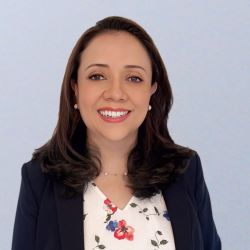
Headshot of NESCA Pediatric Neuropsychologist Dr. Luisa Hernandez MedellinAbout the Author

As a bilingual pediatric neuropsychologist, Dr. Hernandez Medellin conducts comprehensive and culturally sensitive neurodevelopmental and neuropsychological assessments, comprehensive diagnostic evaluations, and effective care plans, providing appropriate recommendations for the client’s school, home, and the community. She specializes in the identification and assessment of neurodevelopmental disorders such as Autism Spectrum Disorders, ADHD, developmental and learning disorders, and their co-occurrence with anxiety and mood disorders. She also works with children and young adults with acquired brain injuries, epilepsy, brain tumors, strokes, general medical conditions, and genetic disorders affecting the nervous system. She is a native Spanish-speaker, passionate about serving the eclectic and vibrant South Florida community, as well as international patients looking for high-quality and compassionate care.

To book evaluation services at NESCA in Coral Gables, Florida, complete NESCA’s online intake form. 

To book a neuropsychological evaluation or other services at NESCA’s New England offices, complete NESCA’s online intake form

NESCA is a pediatric neuropsychology and related services practice with offices in Newton, Plainville, and Hingham, Massachusetts; Londonderry, New Hampshire; the greater Burlington, Vermont region; and Miami/Coral Gables, Florida, serving clients from infancy through young adulthood and their families. For more information, please email info@nesca-newton.com or call 617-658-9800.

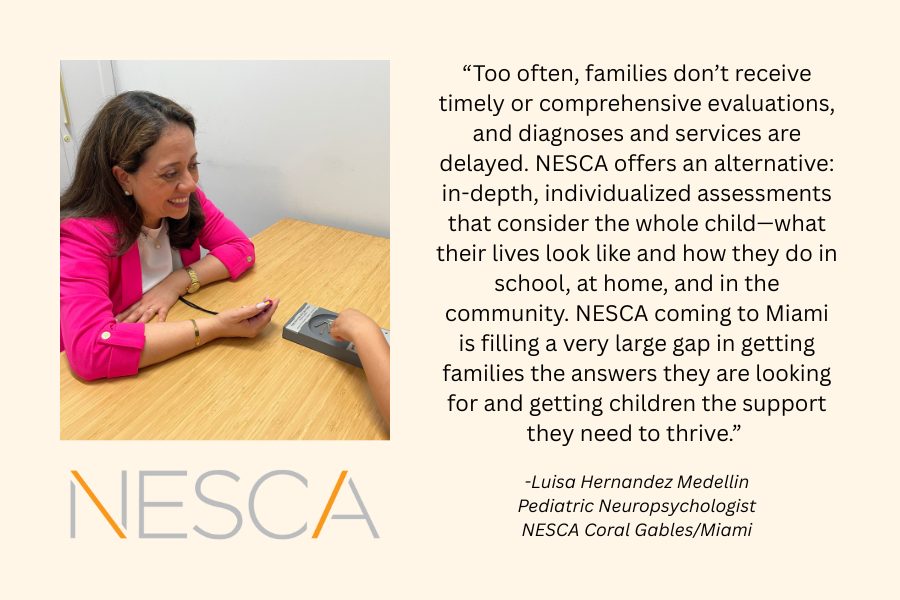
Dr. Luisa Hernandez Medellin evaluating a child

NESCA’s Heading South to Care for Children and Empower Families

By | NESCA Notes 2025

Dr. Luisa Hernandez Medellin evaluating a childBy Jane Hauser
Director of Marketing & Outreach, NESCA

Dr. Luisa Hernandez Medellin Discusses NESCA’s Miami Launch

NESCA recently opened its latest pediatric neuropsychology office in Coral Gables/Miami, Florida, headed up by Dr. Luisa Hernandez Medellin. I had the opportunity to speak with Dr. Luisa Hernandez Medellin to get to know more about her background, the current evaluation landscape in South Florida, Latin America, and the Caribbean, and to hear from her what unmet needs NESCA addresses in bringing its expertise to that region.

Tell us about your background and how you chose to become a pediatric neuropsychologist.
I was born and raised in Mexico City in a family that valued service and helping others. As a teen, I considered becoming a missionary nun because I wanted to travel to deliver services and support to children in need. During those years, I spent time in Cuba, Nicaragua, Guatemala, and Costa Rica, where I witnessed numerous disparities in the way people lived. That experience shaped my commitment to serving children and families.

When I returned to Mexico, I explored different careers, including teaching and medicine, as my father was a doctor, and eventually landed in psychology almost by chance—but it felt like home as soon as I discovered it. Later, when I moved to Miami, I completed my bachelor’s degree and entered a doctoral program in child psychology. During my training, I discovered neuropsychology, and it was a perfect fit: a way to combine psychology with the medical world, caring for both the mind and the body of an individual.

I trained at Jackson Memorial Hospital, where I fell in love with pediatric neuropsychology, working with children with neurodevelopmental disorders in both inpatient and outpatient settings. That experience set the foundation for my career. Since then, I’ve worked in hospitals, private practice, and now with NESCA, where I get to provide high-quality evaluations in a compassionate way that will help children and their families have a path to move forward on.

What is your philosophy when working with children and families?
I treat every child as I would my own. I’m a mother of three, all neurodivergent in different ways, so I understand how hard it can be to navigate the challenges of having children with disabilities while also loving them so deeply. My role is to get to know each child who comes in for an evaluation—what makes them unique, what’s important to them—and to help uncover what’s happening so they can flourish.

How do you feel neuropsychological evaluations benefit individuals and families?
Evaluations give us a deeper, objective understanding of a child’s strengths and challenges. Parents often come to me worried that they’ve done something wrong that caused their child’s struggles. I reassure them that no one is at fault. The goal is not to find problems or identify something or someone to blame; rather, it’s to identify the root cause of a child’s challenges while also highlighting each child’s strengths. It’s about finding the “lights AND the shadows.” For example, if a child struggles in math but loves music, we lean into music as a source of joy and growth for the child while knowing how to  properly provide support in areas like math, that may be more stressful.

How do you approach parents or caregivers who are resistant to the evaluation process or the possibility of their child receiving a diagnosis from it?
In Miami, many families are hesitant about their child receiving a diagnosis(es). I take the time during the intake process to listen to their concerns and gently plant seeds about the types of issues we may be seeing. That way, parents aren’t shocked during the feedback session where they learn the findings from the evaluation, which may include one or more diagnosis(es). It helps them process the information and reduces their fears. I emphasize that neurodivergence isn’t caused by parenting choices or styles, screen time, or the Covid experience. It’s just how a child is wired. My focus is on supporting families and children and building hope with new information from the evaluation.

How did you connect with NESCA, and what excites you about bringing NESCA to Miami?
While considering a move to Boston, I met NESCA’s founder and director, Dr. Ann Helmus, and our conversation felt like meeting a kindred spirit. She reminded me of my attending supervisor from Jackson Memorial Hospital in that they both expect very high quality evaluations, really care about their patients, and truly value the quality of the training provided to their trainees. That’s not always the way with providers, so that was very important to me.

She shared that NESCA was planning to open a Miami office, which felt like the perfect match. Now, I get to help NESCA bring its 30 years of expertise to our region, while I’m also contributing my own 20 years of experience right here in Miami. Together, we’re offering high-quality, culturally-sensitive evaluations in both Spanish and English.

Why does Miami need a practice like NESCA?
The system here in South Florida often creates delays in the identification of developmental, emotional, or learning disabilities. Pediatricians sometimes use a “wait and see” approach; bilingualism is sometimes mistaken for a speech delay when it’s really a sign of autism; and schools often face huge, lengthy backlogs for testing students.

It can be tricky to find the right resource or professional to help identify challenges early on. Neurologists tend to be trained in the brain as “hardware,” whereas we examine the brain’s operating system and how it functions when there is a brain injury, a developmental disorder, or other issue. More often, they look to scans and imaging for answers, where we look at the child’s wellbeing and growth, especially when there is a more complex presentation that may lead to several diagnoses, like ADHD, autism, and anxiety, all co-occurring. And due to productivity pressures in large Miami hospitals, they are only able to see patients for 15 minutes or so and often via telehealth.

And again, with our medical system not being optimized, there is a lot of overwhelm among pediatricians who are forced to operate in a factory-like system. Many people here in South Florida don’t actually have a dedicated pediatrician who knows them and their families. It’s more of a walk-in urgent care system, and that means there is no follow-up in six months or even a year to see how a child is progressing or not. No one is tracking them and is dedicated to their developmental well-being. This is another reason for the frequent delays in diagnosis here.

Because of all of these issues, too often, families don’t receive timely or comprehensive evaluations, and diagnoses and services are delayed. NESCA offers an alternative: in-depth, individualized assessments that consider the whole child—what their lives look like and how they do in school, at home, and in the community. NESCA coming to Miami is filling a very large gap in getting families the answers they are looking for and getting children the support they need to thrive.

What do you evaluate at NESCA in Coral Gables?
I focus primarily in pediatric neurodevelopmental disorders, ADHD, Autism Spectrum Disorders, and learning disabilities, providing evaluations and highly tailored recommendations for interventions. I have also been training practicum students in the Miami area, which we will continue to do as part of the NESCA practice in Coral Gables. There are currently only two sites in Miami where doctoral-level students can train at a practicum level in pediatric neuropsychology, and one of them is now NESCA.

What are your plans for working with schools and international families?
International families and private schools are actively seeking support for their students. Many families from Latin America and the Caribbean face limited resources in their home countries. They come to NESCA for specialized, highly personalized evaluations and recommendations on how to support their child or student at home or in school, in their country. NESCA in Miami will provide these families with the guidance and expertise they need—tailored to their cultural context and delivered with compassion.

Any final thoughts?
NESCA offers families in South Florida, Latin America, and the Caribbean the best of both worlds. We’re bringing NESCA’s legacy of excellence from 30 years of practice in New England, along with my decades of experience living and practicing in Miami, to serve families in this diverse, multicultural community. My goal is simple: to help every child be understood, supported, and given the guidance and tools necessary to thrive.

Headshot of NESCA Pediatric Neuropsychologist Dr. Luisa Hernandez MedellinAbout the Author

As a bilingual pediatric neuropsychologist, Dr. Hernandez Medellin conducts comprehensive and culturally sensitive neurodevelopmental and neuropsychological assessments, comprehensive diagnostic evaluations, and effective care plans, providing appropriate recommendations for the client’s school, home, and the community. She specializes in the identification and assessment of neurodevelopmental disorders such as Autism Spectrum Disorders, ADHD, developmental and learning disorders, and their co-occurrence with anxiety and mood disorders. She also works with children and young adults with acquired brain injuries, epilepsy, brain tumors, strokes, general medical conditions, and genetic disorders affecting the nervous system. She is a native Spanish-speaker, passionate about serving the eclectic and vibrant South Florida community, as well as international patients looking for high-quality and compassionate care.

To book evaluation services at NESCA in Coral Gables, Florida, complete NESCA’s online intake form. 

To book a neuropsychological evaluation or other services at NESCA’s New England offices, complete NESCA’s online intake form

NESCA is a pediatric neuropsychology practice with offices in Newton, Plainville, and Hingham, Massachusetts; Londonderry, New Hampshire; the greater Burlington, Vermont region; and Miami/Coral Gables, Florida, serving clients from infancy through young adulthood and their families. For more information, please email info@nesca-newton.com or call 617-658-9800.
Skip to content