
NESCA’s Newton, MA location has immediate availability for neuropsychological evaluations. Our MA clinicians specialize in the following evaluations: Neuropsychological; Autism; and Emotional and Psychological, as well as Academic Achievement and Learning Disability Testing.

Visit www.nesca-newton.com/intake for more information or to book an evaluation.

Tag

Hingham Archives - NESCA

Subscribe to NESCA Notes

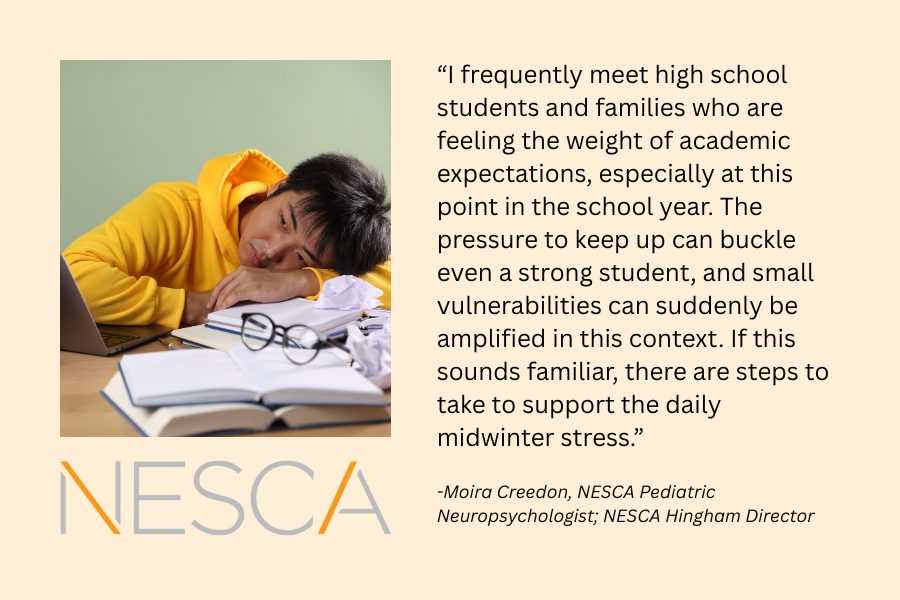
High school student image who is struggling with the overwhelm of school pressures

When High School Feels Overwhelming: How Neuropsychology Can Help Students Thrive

By | NESCA Notes 2025

High school student image who is struggling with the overwhelm of school pressuresBy: Moira Creedon, Ph.D. 
NESCA Hingham Director & Pediatric Neuropsychologist

I frequently meet high school students and families who are feeling the weight of academic expectations, especially at this point in the school year. Maybe your child recently finished midterms and the results weren’t what you hoped for. Maybe the daily stress of managing coursework of AP classes, standardized test preparation, extracurriculars, and college research feels like too much. The pressure to keep up can buckle even a strong student, and small vulnerabilities can suddenly be amplified in this context. If this sounds familiar, there are steps to take to support the daily midwinter stress.

Why Are So Many Students Struggling?

The challenges of high school are not limited to academics alone. It is a time of rapid growth in physical size, independence, academic demands, social environment, and emotional development. For some students, it is a time to shine with increased independence and responsibility. For others, the demands quickly exceed their skill set. The minor organizational and study challenges of middle school are amplified with more content and the burden to juggle simultaneous demands. Put simply, the executive functioning system gets put to the test in high school. These struggles do not mean you have a student who is not capable or intelligent. It may mean they need support for their unique learning profile.

What are Some Warning Signs of the Mid-year Slump?

Warning signs can include trouble keeping track of deadlines or assignments. It can be studying for hours for a test with a lackluster performance that doesn’t match the effort. It can come in the form of increased procrastination, trouble finishing tasks, and poor follow-through. It can also come in the form of increased fatigue, a sense of “burn out,” anxiety, or overall perception of stress. For some students, it can feel like their plate is too full but without a great plan for how to prioritize to make life manageable.

What Can Help?

  1. Consider a Neuropsychological Evaluation

A neuropsychological evaluation is a comprehensive assessment that looks at how a student learns with an eye toward their unique pattern of strengths and weaknesses. A neuropsychological examination can help clarify a diagnosis or diagnoses (ADHD, anxiety, or a learning disability, to name a few), but it can also provide a detailed understanding of the overall process of learning. Bright students who feel overloaded can learn valuable information about their approach to learning so they can figure out how to study smarter, not longer. These evaluations can also include tailored recommendations for how to approach the stress, with suggestions for where and how to seek the appropriate help.

  1. Explore Executive Functioning Coaching

Executive functioning coaches work with students to develop practical strategies for organization, time management, and study skills. Unlike a tutor in a specific subject domain, executive functioning coaches work across subject areas. Coaching sessions are individualized and can help students learn how to break down large assignments, create effective study schedules, prioritize tasks, and manage distractions. In addition to improvement in your academic performance, coaching can help students build independence and confidence.

  1. Seek Support at School

Start with your academic advisor, adjustment counselor, or favorite teacher. Let them know your student is struggling to manage all the demands of their academic life. Many students pursue learning supports or accommodations at school via special education. Your school will need to review evaluations to determine if your child qualifies for a 504 Plan or Individualized Education Program (IEP) as these formalized supports require a diagnosis of a disability. Outside of these more formal support avenues, many schools offer peer tutoring or after-school homework support. Your student does not have to hide their struggles from their teachers!

  1. Take Care of Yourself

With all of the growth in high school, it is important to remember to prioritize emotional health. Your academic success cannot last if it comes at the expense of your mental health. I encourage students to prioritize the basics – to get enough sleep, eat nutritious foods, exercise or move daily, and leave time for fun. If you sit down to create a calendar or task list with your child, keep these items on the list. A rested and restored brain is far more effective at learning.

We Can All Be in This Together

It is normal for your teen to feel a little overwhelmed at times in high school. Instead of viewing this as an opportunity for panic, let’s see it as an opportunity for growth. It does not have to be a journey you and your child take alone. With the right supports, your high schooler can manage their workload, develop more effective study habits, and build resilience to handle future stress. Neuropsychologists at NESCA are happy to support you in this journey through evaluations, consultation, and to connect you to executive functioning and school resources.


About the Author

Dr. Creedon offers her expertise in evaluating children and teens with a variety of presenting issues. SheMoira Creedon headshot is interested in uncovering an individual’s unique pattern of strengths and weaknesses to best formulate a plan for intervention and success. She tailors each assessment to address a range of referral questions, such as developmental disabilities, including Autism Spectrum Disorder, learning disabilities, attention challenges, executive functioning deficits, and social-emotional struggles. She also evaluates college-/grad school-age/adult individuals with developmental issues, such as ASD and ADHD, particularly when there is a diagnostic clarity or accommodation question.


If you are interested in booking an evaluation with Dr. Creedon or another NESCA neuropsychologist, please fill out and submit our online intake form


NESCA is a pediatric neuropsychology and related services practice with offices in Newton, Plainville, and Hingham, Massachusetts; Londonderry, New Hampshire; and Coral Gables, Florida, serving clients from infancy through young adulthood and their families. For more information, please email info@nesca-newton.com or call 617-658-9800.
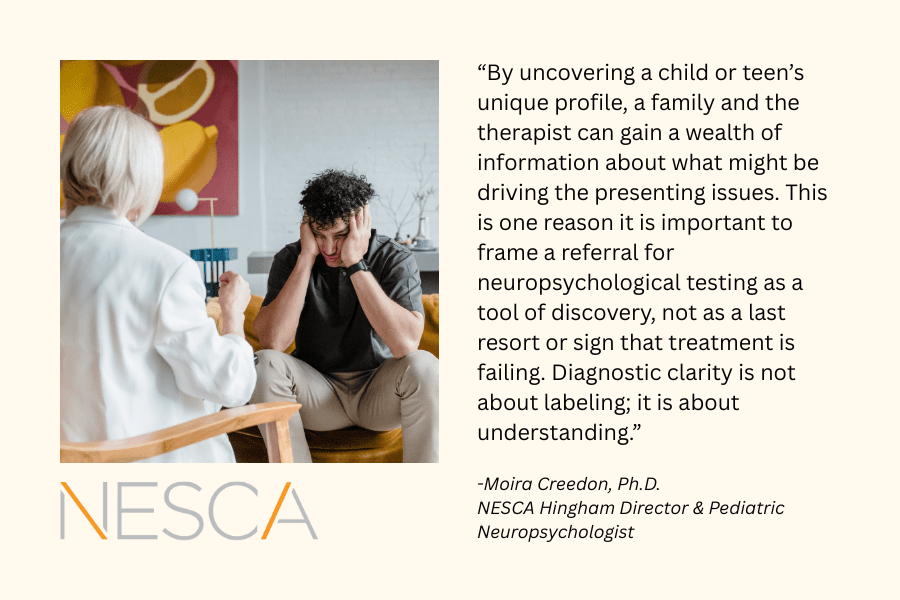
Image of a teen male feeling frustrated with a therapist and a quote from Dr. Moira Creedon

Bridging the Gap between Neuropsychological Testing and Therapy

By | NESCA Notes 2024

Image of a teen male feeling frustrated with a therapist and a quote from Dr. Moira CreedonBy: Moira Creedon, Ph.D. 
NESCA Hingham Director & Pediatric Neuropsychologist

Sometimes therapy hits a wall. A child or teen may be attending sessions regularly but still seems “stuck.” They might be unable to make progress, reluctant to engage, or struggling in ways that don’t fully add up. Even the most dedicated clients, those who do their therapy “homework” and participate openly, may continue to face challenges outside of the therapy room. This can be both frustrating and confounding for everyone involved. In these situations, neuropsychological testing does not have to be a last resort. It can be a powerful, collaborative tool that helps uncover what might be happening or why certain obstacles keep getting in the way. By clarifying diagnoses, identifying how a child or teen processes information, and highlighting cognitive or emotional patterns, neuropsychological testing offers insight that can shape therapeutic work to offer meaningful change.

There are few key gaps that neuropsychological testing can help to fill that are not a part of the normal course of therapy. First, neuropsychologists tend to get more extensive histories across all domains. Often times, therapists get some history about the presenting symptoms right away, but then they quickly have to dive into supporting a child, building rapport, providing psychoeducation, or practicing new coping strategies.

Neuropsychologists tend to get data across a broader range of developmental patterns for a holistic understanding of how the child has developed. Secondly, neuropsychologists then get concrete, quantifiable data on how a child or teen processes information – what their cognition is, how they encode and store information in their memory, how they tackle a hard problem, how they interpret a social challenge, and how they reflect on their own emotional experience. The focus is on how a person processes information, not just what their current symptoms are.

Why is this important? Take, for example, the case of a recent 16-year-old seen for neuropsychological testing who was in therapy for years due to a general sense of worry. Neuropsychological testing helped to highlight problems with cognitive flexibility, poor working memory, and distractibility. In addition to her anxiety, she was also struggling with ADHD. Lapses in attention were making her more anxious, leading her to long hours studying, blaming herself for her shortcomings. these long study sessions were disorganized and inefficient because of inherent executive functioning problems.

Take another example of a younger child who was 7-years-old. His parents felt frustrated by his dysregulated behaviors at home. He was disengaged in therapy and seemed unable to talk with his parents about what was going on after a big incident. Neuropsychological testing helped to undercover significant problems with language processing. This led to more frustration as he could not explain why he was upset, and traditional “talk therapy” methods had to be adapted so that language was simple and concrete.

By uncovering a child or teen’s unique profile, a family and the therapist can gain a wealth of information about what might be driving the presenting issues. This is one reason it is important to frame a referral for neuropsychological testing as a tool of discovery, not as a last resort or sign that treatment is failing. Diagnostic clarity is not about labeling; it is about understanding. It is a process of giving a complete picture of a child or teen’s functioning, seeking alternative pathways for change, and capitalizing on the client’s strengths.

With new information provided in neuropsychological testing, therapists can collaborate with a neuropsychologist to individualize treatment. Here are some examples for how testing can help therapists:

  • A therapist can slow down their interventions and offer more repetition for children with processing speed troubles.
  • A therapist can use simplified language for a child with cognitive impairments or reduced language skills.
  • A therapist can reduce the “homework” they assign for a teen with weak working memory and executive functioning deficits.
  • A therapist can pull in a new evidence-based treatment when anxiety veers into a pattern of intense obsessions and compulsive behaviors in a teen with OCD.
  • A therapist can support a teen overwhelmed with anxiety when facing a mountain of assignments at school if their executive functioning challenges make it hard for them to break down these tasks into smaller steps.
  • A therapist can explore the opportunity to collaborate with an executive functioning coach, group therapy program, or psychiatrist if a child’s profile suggests this is helpful.

When therapy stalls, it doesn’t mean a child isn’t trying or the treatment isn’t helpful. It might mean we are missing part of the picture. Neuropsychological testing can offer the insight needed to move forward with greater compassion, precision, and effectiveness.

Being “stuck” does not have to be seen as a sign of failure. It can be a turning point or an opportunity to uncover processing patterns that shift the focus from blame to change. When testing and therapy work hand in hand, they offer families not just answers, but a compassionate and informed way forward.


About the Author

Dr. Creedon offers her expertise in evaluating children and teens with a variety of presenting issues. SheMoira Creedon headshot is interested in uncovering an individual’s unique pattern of strengths and weaknesses to best formulate a plan for intervention and success. She tailors each assessment to address a range of referral questions, such as developmental disabilities, including Autism Spectrum Disorder, learning disabilities, attention challenges, executive functioning deficits, and social-emotional struggles. She also evaluates college-/grad school-age/adult individuals with developmental issues, such as ASD and ADHD, particularly when there is a diagnostic clarity or accommodation question.


If you are interested in booking an evaluation with Dr. Creedon or another NESCA neuropsychologist, please fill out and submit our online intake form


NESCA is a pediatric neuropsychology practice and integrative treatment center with offices in Newton, Plainville, and Hingham, Massachusetts; Londonderry, New Hampshire; and the greater Burlington, Vermont region, serving clients from infancy through young adulthood and their families. For more information, please email info@nesca-newton.com or call 617-658-9800.

Map of Hingham, MA and quote by Dr. Moira Creedon

Strengthening the South Shore Community: Supporting Our Children, Teens, and Adults

By | NESCA Notes 2024

Map of Hingham, MA and quote by Dr. Moira CreedonBy: Moira Creedon, Ph.D. 
Pediatric Neuropsychologist, NESCA

It was an exciting dream realized when our NESCA South Shore office in Hingham opened in November 2023. As a resident of the South Shore, I was looking forward to connecting to my community closer to home. I was expecting to enjoy a shorter commute and great location. Pausing to reflect after 16 months with our doors open in Hingham, I realize that it is so much more.

I am grateful for how quickly we were welcomed by pediatricians, therapists, psychiatrists, tutors and executive functioning coaches, attorneys, advocates, and public and private schools. We have all quickly aligned on the needs of our communities. There are many children, teens, and adults struggling with gaps in learning, trouble with social connections, high anxiety, depressed mood, and behavioral troubles. Many of these collaborations have also communicated the frustration and sense of burnout facing families who feel like they have been working hard and trying to make changes. Teachers feel discouraged when they have dedicated their hearts and minds to support students, and yet students continue to struggle. Adults are also going through this in record numbers. The experience in our community is universal – it’s so hard to watch our kids, teens, young adults, and our contemporaries struggle.

This can leave many wondering if neuropsychological testing is just one more “hoop” to jump through. Within the trenches of the daily struggle, it can be hard to see how testing might help – especially when change is so slow. I do all that I can to explain why neuropsychological testing is way more than a hoop; it can be a roadmap. How?

  1. Even if you or your child has had “evaluations before,” neuropsychological testing is a chance at an integrated and comprehensive evaluation. What does that mean? It means that if you have had pieces of testing before, you still have a pile of pieces – an educational evaluation from school, a private OT evaluation, an early speech evaluation, a diagnostic interview with a therapist, etc. My goal is to take all of those pieces, plus the new ones I add, and put them together into one cohesive puzzle demonstrating how a child or teen thinks and learns.  This is one of the reasons NESCA does academic testing as part of its testing batteries, because these pieces are essential for diagnostic clarity, to see how the profile impacts a person’s real life skills/functioning, and because being a student is a kid or teen’s full time job. It’s not a piece to be overlooked.
  2. Neuropsychological testing can be a chance to understand the “why” when there are many complicated layers. When an individual is struggling, we often start in the middle of the process. Often, parents and/or schools want to try to solve the problem with school support, or interventions such as a referral to a therapist or connection to a social skills group. When those efforts stall, the impulse is to try a different solution.  Neuropsychological testing lets us step back, learn about a larger profile or picture of all aspects of a child’s learning or thinking to make meaning of what is happening. Then, we can choose a path for intervention that has the best chance of success. When a child is struggling, trying to see what works in a way that’s not fully informed or that addresses the child as a whole, is often not the best use of time and resources. The same goes for adults who seem to be missing a piece of their own puzzle.
  3. Neuropsychological testing uses the data collected from the testing to outline the steps for what to do next. Any good plan needs a detailed understanding of a problem. Oftentimes, it’s a combination of services that are needed – in the community, at home, and/or at school. It can be hard to figure out how to prioritize the steps, and it’s important to consider what is realistic and feasible. Neuropsychological evaluation can help make those steps clearer.
  4. Neuropsychological testing can give us a good baseline and measure of progress. Caretakers know their children best, so they can often spot subtle issues before they bloom into the bigger issues. Neuropsychological testing can be proactive, and it can help to track how a student responds to interventions. We can also use neuropsychological testing to maximize potential, including how students find their strengths, build their “academic diet” of courses in high school and college, and build stronger study skills along the way.
  5. At NESCA, neuropsychological testing involves important collaboration, perspective, and insight. The reason I mention the community that I’ve met through our South Shore office is because collaboration is key. The observations and insight offered by anyone who comes in contact with a child or teen is invaluable. Standardized test measures are a critical piece of the puzzle, but it’s one part of the critical triad of history, observations, and testing. These collaborations are also helpful to keep the neuropsychological test report “alive” as the community putting the recommendations into action works best through communication.

In the upcoming year, we set many goals for NESCA as a leader in our field. I want to pledge to my community that we will continue to provide the highest quality care and to respect and value our clients and families.  We will continue to build connections to our community members to join the efforts in supporting children, teens, and young adults. I am thrilled for upcoming opportunities to learn and grow alongside you all.  I am deeply grateful to be part of the South Shore community supporting children, teens, and young adults.


About the Author

Dr. Creedon offers her expertise in evaluating children and teens with a variety of presenting issues. SheMoira Creedon headshot is interested in uncovering an individual’s unique pattern of strengths and weaknesses to best formulate a plan for intervention and success. She tailors each assessment to address a range of referral questions, such as developmental disabilities, including Autism Spectrum Disorder, learning disabilities, attention challenges, executive functioning deficits, and social-emotional struggles. She also evaluates college-/grad school-age/adult individuals with developmental issues, such as ASD and ADHD, particularly when there is a diagnostic clarity or accommodation question.


If you are interested in booking an evaluation with Dr. Creedon or another NESCA neuropsychologist, please fill out and submit our online intake form


NESCA is a pediatric neuropsychology practice and integrative treatment center with offices in Newton, Plainville, and Hingham, Massachusetts; Londonderry, New Hampshire; the greater Burlington, Vermont region; and Brooklyn, NY (coaching services only) serving clients from infancy through young adulthood and their families. For more information, please email info@nesca-newton.com or call 617-658-9800.

Going South: NESCA Announces New Hingham, MA Location

By | Nesca Notes 2023

By: Jane Hauser
Director of Marketing & Outreach, NESCA

NESCA is excited to announce that it is opening a Hingham location to serve clients on the South Shore of Massachusetts. NESCA is currently booking appointments now for Neuropsychological and Psychological Evaluation Services commencing on November 1, 2023. Learn more about what is being offered by our Hingham-based staff from my interview with Hingham Director; Pediatric & Adult Neuropsychologist Moira Creedon, Ph.D.

What prompted NESCA’s expansion to the South Shore or Massachusetts, and how can clients benefit from our Hingham location’s services?
NESCA is expanding our in-person services to Hingham on the South Shore to widen the breadth of neuropsychological and educational evaluation and consulting services offered within the state. We know that families have options as they partner with neuropsychologists, and we want to be in close proximity to communities we hope to serve. This is an exciting opportunity to support students in elementary, middle, and high school as well as adults, as they navigate the complexities of their daily lives. It is our priority to continue providing detailed, client-centered, thorough evaluations that highlight a client’s areas of strength and vulnerability. I am also excited to strengthen relationships with local care providers and schools, and to build new relationships as a new clinician within the South Shore community.

What services do you offer?
At this time, NESCA’s South Shore-based practice will offer Neuropsychological Evaluations and Projective Assessments. The goal of these services is to build a complete picture of a client’s functioning, including their intellectual, academic, and social-emotional profile. Team members are also available to participate in team meetings at school (IEP meetings), conduct school observations, and offer consultation to parents and team members. Sometimes, a child has already participated in evaluations in other settings (schools, hospitals), and a family needs help to review these documents and make meaning of the findings.

What types of clients will NESCA serve in its South Shore location?
NESCA’s South Shore-based practice is similar to our other locations and will serve children, teens, and adults with a range of presenting issues. The focus is in working with students in elementary, middle, and high school as well as young adults. I can see clients with diagnostic questions, including Autism Spectrum Disorder (ASD), Learning Disorders (e.g., dyslexia, dysgraphia), Attention-Deficit/Hyperactivity Disorder (ADHD), anxiety, depression, and complex psychiatric diagnoses.

A specialty we have at NESCA – including in Hingham – is working with clients who have multiple diagnoses or who don’t fit neatly into a singular diagnostic box. I also see clients who are high functioning and curious about their learning style, how to improve their study skills, and how to plan for their academic future based on their unique profile.

Where are you on the South Shore? Are services in-person or remote?
We are practicing in person in an office at 99 Derby Street, Suite 200, in Hingham, MA. Hingham is uniquely positioned to serve the South Shore/Southcoast, and the Cape and Islands. For those traveling for appointments, most clients schedule testing in two longer (2.5 hour) blocks of time so the commute is reduced for families. I am also available to participate in IEP team meetings and conduct student observations in person on the South Shore, which is an exciting way to collaborate and build strong relationships with families, schools, and organizations.

What is different about what NESCA offers on the South Shore compared to other organizations or services available locally?
NESCA is highly respected in the community for providing detailed, comprehensive evaluations of students that speak to their strengths as well as their needs. Compared to some practices, your child or teen will be assessed directly by a neuropsychologist rather than a technician. You can depend on your neuropsychologist to bring their own expertise as well as the “village” of NESCA, as I am always collaborating with NESCA’s team of innovative neuropsychologists, transition specialists, educational consultants, speech and language pathologists, occupational therapists, and therapists. We work routinely with special education attorneys, advocates, therapists, and school personnel in collaborative relationships to support children, teens, and adults. At NESCA, we live our core values everyday: being creative problem solvers, being collaborative and building lasting relationships, and caring deeply for students, their families, and the community.

Does insurance cover your services in Hingham?
Several NESCA providers take both Blue Cross Blue Shield and private pay for services. I am paneled with BCBS. Some families are able to obtain some coverage or reimbursement through other insurance agencies, and we can provide those families with brief billing information to submit to their insurance company. We can never guarantee insurance reimbursement, so it is important that families check with their insurance plan regarding covered services.

What if I am unsure if I should refer my child or client for an evaluation?
Give us a call! Our administrative team is happy to support you in navigating this process. We are also planning some community events to provide information to our community about a variety of topics, including who we are and how to recognize signs that an individual may need additional support. There is also a ton of information on our website.

How do people get more information about NESCA’s South Shore services?
You can fill out our online intake form, call 617-658-9800 to speak with an intake coordinator, or reach Hingham-based Pediatric Neuropsychologist Dr. Moira Creedon directly at mcreedon@nesca-newton.com.


About the Author

Hingham Director; Pediatric & Adult Neuropsychologist Dr. Moira Creedon has expertise in evaluating children, teens, and adults with a variety of presenting issues. She is interested in uncovering an individual’s unique pattern of strengths and weaknesses to best formulate a plan for intervention and success. With experiences providing therapy and assessments, Dr. Creedon bridges the gap between testing data and therapeutic services to develop a clear roadmap for change and deeper of understanding of individual needs.


If you are interested in booking an evaluation with Dr. Creedon or another NESCA neuropsychologist, please fill out and submit our online intake form


NESCA is a pediatric neuropsychology practice and integrative treatment center with offices in Newton, Plainville, and Hingham (coming soon), Massachusetts; Londonderry, New Hampshire; and the greater Burlington, Vermont region, serving clients from infancy through young adulthood and their families. For more information, please email info@nesca-newton.com or call 617-658-9800.

Skip to content