To accommodate requests for neuropsychological evaluations after the start of the new school year, NESCA has added evaluation dates in its Newton, MA office. Immediate openings are now available for scheduling. Please complete our Inquiry/Intake Form for more information or to start the scheduling process.

Tag

interoception Archives - NESCA

Subscribe to NESCA Notes

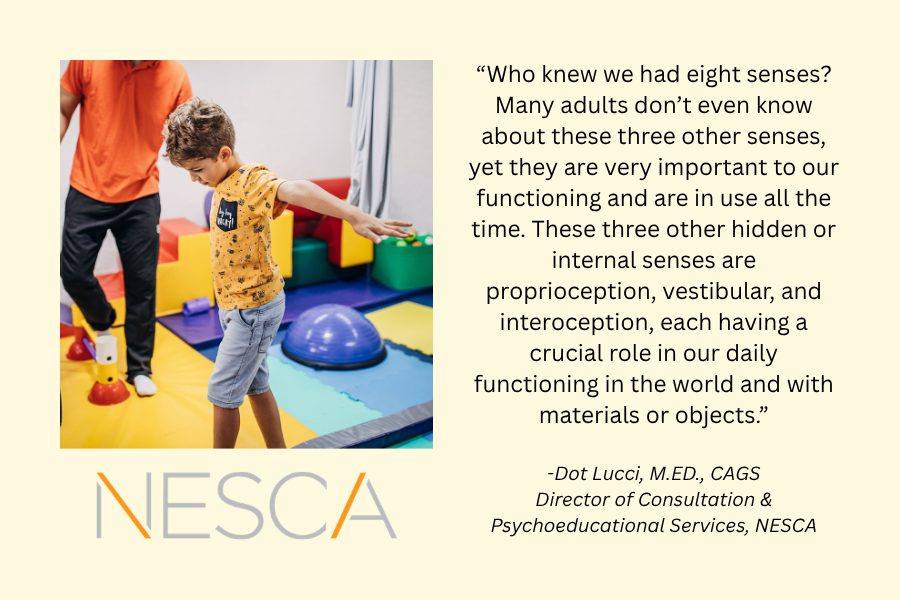
Image of child working in an OT session on balance and movement; quote from Dot Lucci of NESCA

Coming to our Senses

By | NESCA Notes 2026

Image of child working in an OT session on balance and movement; quote from Dot Lucci of NESCABy Dot Lucci, M.Ed., CAGS
Director of Consultation and Psychoeducational Services, NESCA

If you ask young children and adults to name their senses, they will typically name the five senses that are taught to all children in school – taste, smell, sight, hearing, and touch. Some of these senses “come on board” at birth while others continue to develop, refine, and mature into early adulthood. Then as we age, some of our senses may diminish – think eyesight and hearing, as well as fluidity of movement and balance. Most people wouldn’t think of fluidity of movement and balance as senses, but they are. These are considered part of our “hidden or internal senses,” and are connected to the three others. Who knew we had eight senses? Many adults don’t even know about these three other senses, yet they are very important to our functioning and are in use all the time. These three other hidden or internal senses are proprioception, vestibular, and interoception, each having a crucial role in our daily functioning in the world and with materials or objects.

Proprioception is often described as a sense of our body awareness in relation to the world around us. This system helps us integrate systems such as our musculoskeletal and central nervous systems. We get feedback from our muscles, ligaments, and joints so we know how to coordinate movements, sense where our body parts are in relation to our surroundings, and how to determine and apply the right amount of pressure or tension needed for certain tasks or movements. Proprioception is the secret ingredient that makes our motor skills intentional.

People with excellent proprioception are coordinated and may even be graceful. They rarely bump into things/people, don’t spill food on themselves, or misjudge how much pressure to use when touching someone else. They navigate their environment and materials well.

On the other hand, a person with poor proprioception may often bump into people, especially if the room/hallway is crowded. Or they may step on others’ toes while waiting in a line, stub their own toe, spill things on themselves, touch other people too hard or too lightly when playing tag, tear the paper when erasing, and so on. They may also experience difficulty with handwriting, using scissors, and doing other weight-bearing activities.

The vestibular system is located in the middle ear and is concerned with balance and gravitational awareness. I often use the term “sea legs” to describe this sense. If you are not familiar with “sea legs,” it is often used to describe a person’s ability to adjust their balance to a ship’s motion and not get seasick as well as the lingering sensation of movement or rocking when on land after disembarking a ship. It also is responsible for an awareness of gravity. Think of the astronauts who recently left the Artemis shuttle. They needed to be helped onto the “porch platform” and were then sat down as their bodies, having just been in space, had to adjust to the gravitational pull of the earth. This sense helps us to know if we are moving or stationary, how fast/slow we are moving, if we are standing still/speeding up, lying down, and more. Our vestibular system can be impacted by inner ear infections, head injuries, and other medical conditions. People with heightened vestibular systems may get dizzy often, suffer from car sickness, and dislike swinging, spinning, having their feet off the ground, or being upside down. On the flip side, some individuals have a hypo-responsive vestibular system. This can look like a constant hunger for movement. In this situation you may see someone excessively rocking back and forth, spinning for a long period of time without getting dizzy, happily swinging for hours, trying to reach the highest height, and have the constant need for high speed. People with “intact” vestibular system are seen as perfectly calibrated and can smoothly multitask balance, movement, and purposeful actions to move through the world with more ease.

Interoception is the third “hidden sense” and is related to what is happening inside our bodies – bringing our internal needs and awareness to our minds. This sense makes us aware of our internal organs, helping us to know when we are in pain, hungry, thirsty, or full, have to use the bathroom, are cold or hot, tired, ill, or have a fast heart rate. They can easily identify these sensations, whereas people with diminished awareness of their internal states have difficulty identifying feelings or sensations in their bodies. They may not notice when they are hungry, in pain, have to use the restroom, have a stomach or headache, are feeling their heart race, among other internal sensations. They may forget to drink or eat and get dehydrated or shake from low blood sugar, whereas people with heightened interoception may get “hangry” (hungry and angry) because they can’t tolerate hunger…and they recognize it. They may be overly sensitive to pain or temperature changes. Likewise, some foods are intolerable due to texture (smooth, chewy, etc.), and certain flavors (sweet, bitter, sour, etc.) may also not be tolerated. Therefore, they only eat bland foods.

People with impacted interoception “know they have a need or sensation,” but can’t identify it. This disrupts their quality of life as they may overeat or drink. People who are overly aware may become so anxious about these sensations that their anxiety may intensify until their need to handle the sensation is met.

Our senses and sensory profiles change with development, age, lifestyle, and health. Many of our senses work independently or behind the scenes, without our even thinking about them. However, if you try to walk on a balance beam versus just walking down the sidewalk, your balance may be challenged, requiring more conscious awareness. All of the senses work together to help us utilize, understand, and integrate sensory information to be in the world in a “functional way.” Many individuals with impacted sensory processing or integration systems may experience physical, mental, emotional, and social consequences as a result of an atypical sensory profile. Understanding one’s own sensory profile is important to living a full life. If warranted, an occupational and sensory evaluation may be necessary to help identify sensory-motor processing needs. This self-awareness and knowledge may help guide individuals to understand what they need, what they can and can’t do, what makes them comfortable, and what will help them better function and interact in the world. We are all sensory beings, and the better we are at knowing ourselves, the better we will be at advocating for ourselves.

If your child or teen can benefit from learning about their sensory system, complete NESCA’s online Inquiry/Intake Form for additional information or to book sessions with NESCA’s occupational therapists.


About the Author

NESCA’s Director of Consultation and Psychoeducational Services Dot Lucci has been active in the fields of education, psychology, research and academia for over 30 years. She is a national consultant and speaker on program design and the inclusion of children and adolescents with special needs, especially those diagnosed with Autism Spectrum Disorder (ASD). Prior to joining NESCA, Ms. Lucci was the Principal of the Partners Program/EDCO Collaborative and previously the Program Director and Director of Consultation at MGH/Aspire for 13 years, where she built child, teen and young adult programs and established the 3-Ss (self-awareness, social competency and stress management) as the programming backbone. She also served as director of the Autism Support Center. Ms. Lucci was previously an elementary classroom teacher, special educator, researcher, school psychologist, college professor and director of public schools, a private special education school and an education collaborative.

Ms. Lucci directs NESCA’s consultation services to public and private schools, colleges and universities, businesses and community agencies. She also provides psychoeducational counseling directly to students and parents. Ms. Lucci’s clinical interests include mind-body practices, positive psychology, and the use of technology and biofeedback devices in the instruction of social and emotional learning, especially as they apply to neurodiverse individuals.

To book a consultation with Ms. Lucci or one of our many expert clinicians, complete NESCA’s online intake form. Indicate whether you are seeking an “evaluation” or “consultation” and your preferred clinician/consultant/service in the referral line.

NESCA is a pediatric neuropsychology practice and related services center with offices in Newton, Plainville, and Hingham, Massachusetts; Londonderry, New Hampshire; and Coral Gables, Florida, serving clients from infancy through young adulthood and their families. For more information, please email info@nesca-newton.com or call 617-658-9800.


Interoception: Helping Children Develop their “Hidden Sense”

By | NESCA Notes 2020

By: Sophie Bellenis, OTD, OTR/L

Occupational Therapist; Real-life Skills Program Manager and Coach

In our last OT Tuesday, we reviewed the sense of interoception, the ability to perceive information coming from inside the body. From basic human experiences, such as hunger and fatigue, to more complex internal emotions, such as anxiety and fear, interoception allows us to perceive and understand the sensations coming from our own bodies. As with other senses, this sense develops as children grow and, like the rest of us, will all have varied abilities. Some of our kids are naturally in tune with their bodies – they take to potty training without a hitch, recognize when they need a snack or a drink of water, and intuitively understand what their bodies are trying to tell them. Unsurprising, these exceptionally well regulated kids are not the majority, and most of our children benefit from some guidance, modelling and direct education on how to interpret the signals and sensations they are experiencing. Let’s discuss some tips and strategies for helping children to perceive, understand and appropriately respond to this internal information. Many of these tips are simple ideas to build into daily life and ways to take advantage of naturally occurring teachable moments.

Language – Incorporating language that teaches children to acknowledge internal cues and body sensations helps them to naturally and consistently notice the clues they are receiving from their bodies.

  • Verbally describe the choices that you make based on your own sense of interoception.
    • “I am going to put on a jacket because when I stepped outside this morning, I felt really cold.”
    • “My mouth feels dry and I’m starting to get a bit of a headache, I am going to have some water because my body is telling me that I am thirsty.”
  • Link requests that your child makes to how they may be feeling inside.
    • “You asked me for a snack. Are you hungry? How is your belly telling you that you’re hungry?”
  • Point out physical clues that hint at internal sensations.
    • “I notice you are having a hard time keeping your eyes open. That tells me you are feeling tired.”
    • “You are crossing your legs and dancing around a bit while you are coloring that picture. I think that your body is giving signals that you have to pee. It is important to pay attention to those signals so that you don’t wet your pants.”

Activities

  • Check Your Pulse! – Have your child sit quietly and teach them how to feel their pulse or heartbeat. Ask them to describe it – is it slow, fast, moving, hitting their fingers, etc.? Then have them run in place and do the same thing. How has it changed? Have them describe it now. Once children understand how their heartrate may be affected by physical activity, a next step would be pointing out that strong emotions, such as anger or excitement, can also affect one’s heartrate. This is a simple activity that provides some biofeedback and teaches children how their actions can affect their bodies.
  • Mindfulness – Zen Master, Thich Nhat Hanh defines mindfulness by stating, “Mindfulness shows us what is happening in our bodies, our emotions, our minds, and in the world.” While not all mindfulness activities focus on interoception, many of the principles and activities build this skill. If you are looking for some resources to work on mindfulness with your child, explore these sites: org, susankaisergreenland.org, mindful.org, and drchristopherwillard.com. Additionally, consider some apps to use with your child: Mindful Powers, Smiling Mind, Breathe Think Do with Sesame and Headspace.
  • Breathing exercises – Breathing exercises are common in mindfulness and can help children to relax. If apps are not for you, consider researching breathing exercises, such as: five-finger breathing, lazy 8 breathing or bumblebee breathing.
  • Progressive muscle relaxation – This practice involves alternating tension and relaxation in different muscle groups in the body. Dr. Monica Fitzgerald provides an excellent script to use with children working to relax here. If you are interested in exploring this practice with children with disabilities, many resources can be found at org.
  • Yoga – Yoga focuses on intentionally moving the body, pairing body movement and breathing, and increasing the mind-body connection. There are many apps and online videos that make yoga accessible to children. Some options include Simply Yoga, Gaia.com and Cosmic Kids Yoga. For some of our children who may need yoga broken down and presented differently, consider com or childlightyoga.com.


About the Author

Dr. Sophie Bellenis is a Licensed Occupational Therapist in Massachusetts, specializing in educational OT and functional life skills development. Dr. Bellenis joined NESCA in the fall of 2017 to offer community-based skills coaching services as a part of the Real-life Skills Program within NESCA’s Transition Services team. Dr. Bellenis graduated from the MGH Institute of Health Professions with a Doctorate in Occupational Therapy, with a focus on pediatrics and international program evaluation. She is a member of the American Occupational Therapy Association, as well as the World Federation of Occupational Therapists. Having spent years delivering direct services at the elementary, middle school and high school levels, Dr. Bellenis has extensive background with school-based occupational therapy services.  She believes that individual sensory needs and visual skills must be taken into account to create comprehensive educational programming.

To book an appointment or to learn more about NESCA’s Occupational Therapy Services, please fill out our online Intake Form, email info@nesca-newton.com or call 617-658-9800.


Neuropsychology & Education Services for Children & Adolescents (NESCA) is a pediatric neuropsychology practice and integrative treatment center with offices in Newton, Massachusetts, Plainville, Massachusetts, and Londonderry, New Hampshire, serving clients from preschool through young adulthood and their families. For more information, please email info@nesca-newton.com or call 617-658-9800.


Interoception: The “Hidden Sense”

By | NESCA Notes 2020

By: Sophie Bellenis, OTD, OTR/L

Occupational Therapist; Real-life Skills Program Manager and Coach

Conventionally, children are taught that there are five different senses, and that these senses help them to experience and understand the world around them. These five senses are sight, sound, smell, taste and touch. Clinically, we refer to these sensory systems as the visual, auditory, olfactory, gustatory and tactile systems. Each system provides unique information and works to alert the brain about the environment around them. Children all develop these systems differently, and all have unique preferences, strengths and interpretations of the world around them. As adults, a sommelier likely has an incredibly refined gustatory system, while a classical musician’s strength lies in their auditory system.

As knowledge about the human body continues to expand, two additional sensory systems have started to make their way into the common lexicon—the vestibular system and the proprioceptive system—both of which describe body awareness. The vestibular system gathers information from the inner ear and tells us where our body is in space. It monitors movement, acceleration and deceleration, balance and any changes in position. A gymnast uses this sense constantly as they flip across a mat or balance on the beam. The proprioceptive system gathers information from our muscles and joints and tells our brains about our position in space and any strength or force that we are using. Proprioception allows us to touch our noses with our eyes closed! These seven senses are all generally acknowledged and frequently assessed by occupational therapists. But what is interoception? And why is it referred to as the hidden sense?

Interoception refers to the perception of information coming from inside the body. Organ systems and the autonomic nervous system provide information about heart rate, hunger, thirst, temperature, respiration and even emotion (Vaitl, 1996). This sense of interoception helps us meet our most basic needs, such as knowing when we need food and water, realizing that it is time to use the restroom and putting on a jacket if it is cold outside. It also helps us to gain a more nuanced understanding of ourselves, such as realizing that an activity is making us anxious by acknowledging heightened heart rate and perspiration. This sensory system is often referred to as the “hidden sense,” because it is completely unique to each individual and no one knows exactly what someone else is feeling internally.

Children develop this sense slowly, with the most basic cues, such as hunger being recognized first. As they continue to grow, different internal signals are more easily understood and start to impact behavior. For example, around the age of two or three, most children start the process of potty training when they begin to recognize what it feels like to have a full bladder. As children continue to grow through their elementary, middle and high school years, this sense continues to be refined. As is expected, this is easier for some children than others.

Recent research shows that there is a strong connection between interoception and emotional/self-regulation. Individuals with low interoception often have more difficulty with both understanding and regulating their bodies and emotions (Zamariola et al., 2019). It appears that the ability to truly understand our body allows us to more intentionally control our responses. Luckily, as with other sensory systems, there are ways to increase interoceptive awareness and help children to notice the information that their bodies are feeding to their brains. In our next OT Tuesday blog, we will discuss some tips and strategies for helping children to perceive, understand and appropriately respond to this internal information.


References

Vaitl D. (1996). Interoception. Biol. Psychol. 42 1–27. 10.1016/0301-0511(95)05144-9

Zamariola G., Frost N., Van Oost A., Corneille O., Luminet O. (2019). Relationship between interoception and emotion regulation: new evidence from mixed methods. J Affect Disord  246:480–5. doi: 10.1016/j.jad.2018.12.101

About the Author

Dr. Sophie Bellenis is a Licensed Occupational Therapist in Massachusetts, specializing in educational OT and functional life skills development. Dr. Bellenis joined NESCA in the fall of 2017 to offer community-based skills coaching services as a part of the Real-life Skills Program within NESCA’s Transition Services team. Dr. Bellenis graduated from the MGH Institute of Health Professions with a Doctorate in Occupational Therapy, with a focus on pediatrics and international program evaluation. She is a member of the American Occupational Therapy Association, as well as the World Federation of Occupational Therapists. Having spent years delivering direct services at the elementary, middle school and high school levels, Dr. Bellenis has extensive background with school-based occupational therapy services.  She believes that individual sensory needs and visual skills must be taken into account to create comprehensive educational programming.

To book an appointment or to learn more about NESCA’s Occupational Therapy Services, please fill out our online Intake Form, email info@nesca-newton.com or call 617-658-9800.


Neuropsychology & Education Services for Children & Adolescents (NESCA) is a pediatric neuropsychology practice and integrative treatment center with offices in Newton, Massachusetts, Plainville, Massachusetts, and Londonderry, New Hampshire, serving clients from preschool through young adulthood and their families. For more information, please email info@nesca-newton.com or call 617-658-9800.


Skip to content