NESCA’s Newton, MA location has immediate availability for neuropsychological evaluations. Our MA clinicians specialize in the following evaluations: Neuropsychological; Autism; and Emotional and Psychological, as well as Academic Achievement and Learning Disability Testing.

Visit www.nesca-newton.com/intake for more information or to book an evaluation.

Tag

Jasmine Badamo Archives - NESCA

Subscribe to NESCA Notes

How Executive Function Coaching and Therapy Complement One Another-Part 2

By | NESCA Notes 2025

Quote from NESCA and an image of two puxxle pieces fitting together showing how therapy and EF coaching can complement each otherBy Jasmine Badamo, MA
Educational Counselor; Executive Function Coach

Last week I wrote a blog about the complementary nature of executive function coaching and therapy. I discussed the ways in which each service is distinct, as well as where there are overlaps. Today I’d like to share examples of how each service can support the other. If you find the examples helpful, feel free to download the pdf version from our Resources page!

How executive function coaching can support your therapy work:

An executive function coach can…

  • Serve as another person to reinforce the concepts you’re learning in therapy and help you make note of everyday and/or academic situations that connect to your therapy goals.
  • Serve as a source of motivation and accountability to help you implement the recommendations made in therapy, such as improving your sleep hygiene, widening your social circle, or increasing your positive self-talk.
  • Consult with your therapist to provide examples of your everyday struggles and mindset towards them.
  • Provide a safe space for metacognitive and self-reflection discussions, which can serve as a stepping stone if you are not yet ready to embark on therapy or are questioning your current style of therapy. These discussions can promote a new openness to trying therapy or exploring new therapy modalities/approaches.

How therapy can support your executive function work:

A therapist can…

  • Address anxiety, depression, perfectionism, all-or-nothing thinking, or negative self-talk/narratives, all of which can present a significant barrier to coaching because they reduce your motivation and openness to trying new problem-solving strategies.
  • Provide a big picture, comprehensive understanding of the mental and emotional barriers facing you and guide you (and your executive function coach) in choosing motivation and routine-building strategies that would work best.
  • Help you to build coping strategies for managing daily life and novel tasks, freeing up energy for taking on new goals and challenges.

Every service provider brings something important to the table, and therapy and executive function coaching are an extra-special support combination that has truly benefited many of our clients at NESCA. It often takes a team to support an individual through challenging aspects of their life, and NESCA’s coaches are happy to be a part of that team!

NESCA offers executive function coaching for students from elementary school through adulthood who are looking to bolster their organization, scheduling, time management, goal setting, and routine building skills. Students work 1-on-1 with occupational therapists and education specialists to identify specific skills that will help them be more organized and in control of their academic and general life tasks. If you have concerns about your child or student’s executive function challenges and want to try our 1-on-1 coaching, please complete our online Intake Form


About the Author

Jasmine Badamo, MA, is a licensed special educator and seasoned executive function coach. SheJasmine Badamo headshot supports a wide range of clients, ranging from age 7 to adulthood, to develop executive function and independence skills necessary for success with school (including college and graduate school) and in life. She is also uniquely qualified to coach parents and train educators to support EF skill development across settings.

To book executive function coaching with an EF or Real-life Skills Coach at NESCA, complete NESCA’s online intake form

NESCA is a pediatric neuropsychology practice and integrative treatment center with offices in Newton, Plainville, and Hingham, Massachusetts; Londonderry, New Hampshire; and the greater Burlington, Vermont region, serving clients from infancy through young adulthood and their families. For more information, please email info@nesca-newton.com or call 617-658-9800.

Image of two puzzle pieces fitting together to represent therapy and EF coaching

How Executive Function Coaching and Therapy Complement One Another-Part 1

By | NESCA Notes 2025

Image of two puzzle pieces fitting together to represent therapy and EF coachingBy Jasmine Badamo, MA
Educational Counselor; Executive Function Coach

At a recent NESCA case conference, we had a thought-provoking discussion about the relationship between executive function coaching and therapy that inspired me to write this two-part blog series.

Executive function coaching is different from therapy in a few key ways:

  • Most executive function coaches are not trained mental health professionals.
  • Therapy is usually positioned to treat mental health concerns, such as anxiety, depression, OCD, and related emotional patterns.
  • Executive function coaching focuses more directly on improving cognitive skills and strategies (like planning, organizing, prioritizing, time management, focus, and self-regulation) to support clients in reaching their academic, professional, and personal goals.
  • Executive function coaching is often more practical and solution-oriented, while many therapy approaches focus on exploring past experiences and deepening a client’s understanding of themselves.

But there can also be overlap between the two supports:

  • Executive functioning and mental health both impact an individual’s self-regulation and ability to cope with daily life.
  • Executive function coaches and therapists might both implement skill-based activities with clients.
  • Executive function coaches and therapists both focus on improving an individual’s well-being by identifying challenges, setting goals, developing strategies, and building self-awareness.

The truth is that the work we executive function coaches do with our clients frequently relates to their mental health and emotional struggles. For example, we may help individuals strengthen their ability to regulate impulses; reflect inward to better understand their habits and patterns in behavior; move past low motivation to activate and take action; adapt their behavioral patterns to better meet their needs and goals; implement self-care routines; and tackle the logistical challenges of accessing other services, such as therapy.

Additionally, persistent mental health struggles (as well as a person’s naturally fluctuating emotional states) play a large role in a person’s ability to access their prefrontal cortex or “thinking brain,” where our executive function abilities reside. This is because emotional regulation and executive control are both housed in this part of the brain. When one skill set is taxed, the other suffers. Correspondingly, persistent executive function struggles can contribute to increased mental health struggles, such as anxiety or depression.

Given the connected nature of executive functioning and mental health, we recognize that executive function coaching and therapy are distinct, but are also connected and complementary. The two services not only balance each other, but help to amplify the success and effectiveness of each individual service.

Tune in for our blog next week where I’ll delve into the ways executive function coaching can support your therapy work and vice versa!

NESCA offers executive function coaching for students from elementary school through adulthood who are looking to bolster their organization, scheduling, time management, goal setting, and routine building skills. Students work 1-on-1 with occupational therapists and education specialists to identify specific skills that will help them be more organized and in control of their academic and general life tasks. If you have concerns about your child or student’s executive function challenges and want to try our 1-on-1 coaching, please complete our online Intake Form


About the Author

Jasmine Badamo, MA, is an educational counselor and executive function coach who works full-time at NESCA supporting students ranging from elementary school through young adulthood. In addition to direct client work, Ms. Badamo provides consultation and support to parents and families in order to help change dynamics within the household and/or support the special education processes for students struggling with executive dysfunction. She also provides expert consultation to educators, special educators and related professionals.

Ms. Badamo is a New York State Certified ENL and Special Education teacher. She has more than 10 years of teaching experience across three countries and has worked with students and clients ranging in age from 7 to adulthood. She earned her bachelor’s degree in Biological Sciences from Cornell University and her master’s degree in TESOL from CUNY Hunter College. She has also participated in graduate coursework focusing on academic strategies and executive function supports for students with LD, ADHD, and autism as part of the Learning Differences and Neurodiversity (LDN) certification at Landmark College’s Institute for Research and Training. In addition to being a native English speaker, Ms. Badamo is also conversationally fluent in verbal and written Spanish.

Having worked in three different New York City public schools, Ms. Badamo has seen firsthand the importance of executive function skills in facilitating student confidence and success. Her coaching and consultation work focuses on creating individualized supports based on the specific needs and strengths of each client and supporting the development of metacognition (thinking about one’s own thought processes and patterns), executive function skills, and independence. She will guide clients to generate their own goals, identify the barriers to their goals, brainstorm potential strategies, advocate for support when needed, and reflect on the effectiveness of their applied strategies.

Ms. Badamo is a highly relational coach. Building an authentic connection with each client is a top priority and allows her to provide the best support possible. Additionally, as a teacher and coach, Ms. Badamo believes in fostering strong collaborations with anyone who supports her clients including service providers, classroom teachers, parents, administrators, and community providers.

To book executive function coaching with Jasmine Badamo or another EF or Real-life Skills Coach at NESCA, complete NESCA’s online intake form

NESCA is a pediatric neuropsychology practice and integrative treatment center with offices in Newton, Plainville, and Hingham, Massachusetts; Londonderry, New Hampshire; the greater Burlington, Vermont region; and Brooklyn, New York (coaching services only) serving clients from infancy through young adulthood and their families. For more information, please email info@nesca-newton.com or call 617-658-9800.

1:1 EF coaching image with quote from Jasmine Badamo, EF coach

What Sets Executive Function Coaching Apart from Other Study Skill Supports?

By | NESCA Notes 2025

1:1 EF coaching image with quote from Jasmine Badamo, EF coachBy Jasmine Badamo, MA
Educational Counselor; Executive Function Coach

As families and schools are putting more focus on the importance of study skills for their child’s academic success, the idea of executive function coaching has become more mainstream. There are now more apps, online courses, school curriculum, and private companies offering this kind of support.  When I give families examples of executive functioning skills – organization, planning, time management, focus, prioritization – they immediately recognize them and see how their child could benefit from strengthening these skills. However, it can be difficult to understand exactly how (and why) hiring a 1-on-1 executive function coach is such an effective way to support a child’s executive function development.

While executive function skills overlap with study skills, they go beyond that. They are foundational higher-order cognitive skills that are required for every individual to engage in goal-directed behavior, which is, well…almost everything! Yes, executive function skills are necessary when your child wants to create and execute a study plan for their upcoming math exam, but they are also necessary in order for your child to wake up each morning and complete their morning routine in time to get to school at 8:00am.

A properly trained executive function coach has training and expertise in these cognitive skills and their development, and are equipped with strategies for strengthening these skills across multiple contexts. These strategies may include some of the “tips & tricks” you’ve read about online (e.g. Set a 5-min timer and see how much cleaning you can get done!), but they also include the use of coaching methodologies to guide an individual in recognizing patterns in their past experiences, identifying core barriers, and establishing meaningful goals in their life. Every day in my coaching, I make use of the training I received in my post-graduate coursework, and being a part of a group practice affords me the added benefit of pulling from the knowledge and perspectives of several masters- and doctorate-level occupational therapists, transition specialists, special educators, and neuropsychologists. 

A partnership with a trained coach offers structured, consistent, and personalized instruction that builds executive function skills in a clear progression towards a student’s goals and greater independence. Unlike using online focus apps or joining a group study-skills class, a 1-on-1 coach, especially one that has been thoughtfully matched with your child based on specialty area and personality, is able to facilitate a real connection and trust with a student. This relational approach is essential for sustainable student engagement and effective individualized support.

My colleague Sara LaFerriere perfectly described this when she said, “It’s hard for students to understand their full potential if the providers they work with can’t make a connection with them.” Aside from the increased effectiveness of a 1-on-1 coach, it’s just plain nice for a student to have another trusted adult in their corner, especially when they are struggling and feeling vulnerable (and especially when their parents or caregivers are at the end of their ropes from repeated attempts to improve their child’s executive function challenges).

On the family side, hiring an executive function coach beefs up your child’s support team. At NESCA, we put a lot of weight on collaboration, not just within our practice, but with other professionals. Whenever possible, I like to initiate communication across my students’ different service providers. For me, it provides a more robust understanding of my students and helps me ensure my coaching is aligned with the work they’re doing in other areas of their life. For families, it can provide relief to know that everyone on their child’s team is on the same page and working towards the same big-picture goals. A coach can even serve as another line of communication between a child and their family, sharing feedback with parents about the interventions and strategies that work best for their child, and giving parents ideas for successfully implementing strategies at home.

NESCA offers executive function coaching for students from elementary school through adulthood who are looking to bolster their organization, scheduling, time management, goal setting, and routine building skills. Students work 1-on-1 with occupational therapists and education specialists to identify specific skills that will help them be more organized and in control of their academic and general life tasks. If you have concerns about your child or student’s executive function challenges and want to try our 1-on-1 coaching, please complete our online Intake Form


About the Author

Jasmine Badamo, MA, is an educational counselor and executive function coach who works full-time at NESCA supporting students ranging from elementary school through young adulthood. In addition to direct client work, Ms. Badamo provides consultation and support to parents and families in order to help change dynamics within the household and/or support the special education processes for students struggling with executive dysfunction. She also provides expert consultation to educators, special educators and related professionals.

Ms. Badamo is a New York State Certified ENL and Special Education teacher. She has more than 10 years of teaching experience across three countries and has worked with students and clients ranging in age from 7 to adulthood. She earned her bachelor’s degree in Biological Sciences from Cornell University and her master’s degree in TESOL from CUNY Hunter College. She has also participated in graduate coursework focusing on academic strategies and executive function supports for students with LD, ADHD, and autism as part of the Learning Differences and Neurodiversity (LDN) certification at Landmark College’s Institute for Research and Training. In addition to being a native English speaker, Ms. Badamo is also conversationally fluent in verbal and written Spanish.

Having worked in three different New York City public schools, Ms. Badamo has seen firsthand the importance of executive function skills in facilitating student confidence and success. Her coaching and consultation work focuses on creating individualized supports based on the specific needs and strengths of each client and supporting the development of metacognition (thinking about one’s own thought processes and patterns), executive function skills, and independence. She will guide clients to generate their own goals, identify the barriers to their goals, brainstorm potential strategies, advocate for support when needed, and reflect on the effectiveness of their applied strategies.

Ms. Badamo is a highly relational coach. Building an authentic connection with each client is a top priority and allows her to provide the best support possible. Additionally, as a teacher and coach, Ms. Badamo believes in fostering strong collaborations with anyone who supports her clients including service providers, classroom teachers, parents, administrators, and community providers.

To book executive function coaching with Jasmine Badamo or another EF or Real-life Skills Coach at NESCA, complete NESCA’s online intake form

NESCA is a pediatric neuropsychology practice and integrative treatment center with offices in Newton, Plainville, and Hingham, Massachusetts; Londonderry, New Hampshire; the greater Burlington, Vermont region; and Brooklyn, New York (coaching services only) serving clients from infancy through young adulthood and their families. For more information, please email info@nesca-newton.com or call 617-658-9800.

Image of two people studying together or Body doubling

The Power of Body Doubling

By | NESCA Notes 2024

Image of two people studying together or Body doublingBy Jasmine Badamo, MA
Educational Counselor; Executive Function Coach

Have you heard of body doubling before? Body doubling is when two (or more) people lend each other their presence while doing individual work. You can think of it as a “buddy system” for productivity. Having another person with us while we work can increase our motivation to start a task, boost our focus, and even have a calming effect. In fact, the sheer act of scheduling a body doubling session with someone helps hold us accountable to our to-do list.

Body doubling is a powerful accountability strategy that I use with my clients as well as with friends and family. If you think about it, it’s likely that you have used this strategy, too. Have you ever silently studied in a group, with a friend, or in a public space such as a library or cafe? That was body doubling! What about calling up a friend and scheduling a time to go to the gym together? Body doubling! Do you ever chat with a friend while you cook, fold laundry, or grocery shop? Once again, body doubling! (It doesn’t always have to be silent.)

Body doubling is a foundational strategy that I explore with many clients – first explaining the concept and benefits of it, and then providing them with opportunities to practice it.  We may start by body doubling during our video calls, testing out if it’s more effective to keep cameras on or off, mics muted or not, screens shared or not. We’ll experiment with duration to see what’s enough time to get work done, but not too much time to get distracted. Our goal is to find the sweet spot where body doubling is supportive, but not distracting. We also implement structures to make body doubling time as productive as possible. This may look like using a prep checklist to make sure my client has all the materials they need to work; establishing a work plan that includes a goal and the first steps to take; or determining checkpoints when they want me to interrupt with prompts or reminders.

This structured practice is particularly effective because we have fostered a safe and collaborative coaching relationship that is centered on getting work done. With this guided practice, my clients can dip their toes into the world of body doubling and prepare to utilize this strategy on their own – with a natural resource (a person or group of people who is available in their everyday life).

As my clients build independence, we discuss creative ways for them to incorporate this strategy into their everyday lives. We’ll go through the list of people in their lives and think through who would make good body-doubling partners, and who would make socializing too big a temptation to resist. We might remove the temptation to talk altogether and body double with a pet dog or rabbit. I’ve even worked with clients to create “asynchronous” body doubling where they listen to audio messages from friends while they get house chores done.

As body doubling has become more popular, people have found ways to incorporate technology and social media. The YouTube channel @MerveStudyCorner has videos of various lengths showing a person studying in different locations. The Dubbii App by @adhd_love_provides body doubling videos specifically for individuals with ADHD. The FLOWN app offers “coworking” drop-in or power sessions. And some people are hosting TikTok Live while doing chores or working on homework so you can tune in and join. Very clever!

Body doubling is an adaptable and powerful strategy that can help anyone boost productivity, focus, and accountability. Whether you’re experimenting with silent study sessions, enlisting a friend to tackle errands, or exploring innovative tech tools, there’s no shortage of ways to make this strategy work for you. So, why not give it a try? If you need help getting started, reach out to NESCA to work with one of our expert real-life skills and executive function coaches by completing our Intake Form at: www.nesca-newton.com/intake.

Want to do more reading on body doubling? Check out these articles:

Additional Information

Body doubling can also be done outside the context of productivity, often referred to as “parallel play.” Sitting next to a trusted human and allowing yourself to get lost in a preferred task or hobby can be a truly enjoyable experience, deepening your relationship without even talking!  For individuals who find talking tiring or for those who have an easily-drained social battery, this is an accessible way to engage and RESIST isolation.


About the Author

Jasmine Badamo, MA, is an educational counselor and executive function coach who works full-time at NESCA supporting students ranging from elementary school through young adulthood. In addition to direct client work, Ms. Badamo provides consultation and support to parents and families in order to help change dynamics within the household and/or support the special education processes for students struggling with executive dysfunction. She also provides expert consultation to educators, special educators and related professionals.

Ms. Badamo is a New York State Certified ENL and Special Education teacher. She has more than 10 years of teaching experience across three countries and has worked with students and clients ranging in age from 7 to adulthood. She earned her bachelor’s degree in Biological Sciences from Cornell University and her master’s degree in TESOL from CUNY Hunter College. She has also participated in graduate coursework focusing on academic strategies and executive function supports for students with LD, ADHD, and autism as part of the Learning Differences and Neurodiversity (LDN) certification at Landmark College’s Institute for Research and Training. In addition to being a native English speaker, Ms. Badamo is also conversationally fluent in verbal and written Spanish.

Having worked in three different New York City public schools, Ms. Badamo has seen firsthand the importance of executive function skills in facilitating student confidence and success. Her coaching and consultation work focuses on creating individualized supports based on the specific needs and strengths of each client and supporting the development of metacognition (thinking about one’s own thought processes and patterns), executive function skills, and independence. She will guide clients to generate their own goals, identify the barriers to their goals, brainstorm potential strategies, advocate for support when needed, and reflect on the effectiveness of their applied strategies.

Ms. Badamo is a highly relational coach. Building an authentic connection with each client is a top priority and allows her to provide the best support possible. Additionally, as a teacher and coach, Ms. Badamo believes in fostering strong collaborations with anyone who supports her clients including service providers, classroom teachers, parents, administrators, and community providers.

To book executive function coaching with Jasmine Badamo or another EF or Real-life Skills Coach at NESCA, complete NESCA’s online intake form

NESCA is a pediatric neuropsychology practice and integrative treatment center with offices in Newton, Plainville, and Hingham, Massachusetts; Londonderry, New Hampshire; the greater Burlington, Vermont region; and Brooklyn, New York (coaching services only) serving clients from infancy through young adulthood and their families. For more information, please email info@nesca-newton.com or call 617-658-9800.

College advisor assisting and supporting a college student in an office, library, or classroom setting.

The Importance of College Campus Resource Planning

By | NESCA Notes 2024

College advisor assisting and supporting a college student in an office, library, or classroom setting.By Jasmine Badamo, MA
Executive Function Coach; Educational Counselor

This year I’ve started working with a new batch of freshmen who are embarking on their college journeys. The first semester is always a whirlwind of emotions: nervousness, excitement, anticipation, but most of all, overwhelm. Even at colleges that prioritize supporting students in their transition to campus life, it can be hard for students to navigate the sea of information they’re given. However, the first several weeks of the semester are the perfect time to explore the various campus resources available to students, many of which are included in the cost of tuition.

Even if students don’t use resources right away, it’s essential for them to be aware of the available services as they progress through their college journey. Understanding what’s offered can help them navigate challenges and take advantage of opportunities when the need arises.

Take a look at the wide range of potential campus resources available:

*click here for a downloadable version of this table

Given that each college (and student!) is different, I work with my clients to create a personalized spreadsheet where they not only compile information on each campus resource, but also make note of how, when, and why they would use each resource.

Students may also want to create step-by-step plans for various college situations:

Organizing all this information can be daunting and time-consuming, so it’s often helpful to work through it with someone else. Consider reaching out to your college’s Disability/Accessibility Services to get a clearer understanding of the campus resources available to you. Ask if you can collaborate with someone in that office to create your own personalized spreadsheet tailored to your needs. Don’t hesitate or feel rushed–remember, these resources are included in your tuition because navigating college life takes a village. This is your college experience, so take full advantage of it!

If you are a struggling student, or parent/caregiver/professional working with a struggling student who might benefit from executive function or life skills coaching with an experienced professional, I am proud to be one of NESCA’s team of expert executive function tutors. Feel free to complete an intake at https://www.nesca-newton.com/intake to learn more about our services!


About the Author

Jasmine Badamo, MA, is an educational counselor and executive function coach who works full-time at NESCA supporting students ranging from elementary school through young adulthood. In addition to direct client work, Ms. Badamo provides consultation and support to parents and families in order to help change dynamics within the household and/or support the special education processes for students struggling with executive dysfunction. She also provides expert consultation to educators, special educators and related professionals.

Ms. Badamo is a New York State Certified ENL and Special Education teacher. She has more than 10 years of teaching experience across three countries and has worked with students and clients ranging in age from 7 to adulthood. She earned her bachelor’s degree in Biological Sciences from Cornell University and her master’s degree in TESOL from CUNY Hunter College. She has also participated in graduate coursework focusing on academic strategies and executive function supports for students with LD, ADHD, and autism as part of the Learning Differences and Neurodiversity (LDN) certification at Landmark College’s Institute for Research and Training. In addition to being a native English speaker, Ms. Badamo is also conversationally fluent in verbal and written Spanish.

Having worked in three different New York City public schools, Ms. Badamo has seen firsthand the importance of executive function skills in facilitating student confidence and success. Her coaching and consultation work focuses on creating individualized supports based on the specific needs and strengths of each client and supporting the development of metacognition (thinking about one’s own thought processes and patterns), executive function skills, and independence. She will guide clients to generate their own goals, identify the barriers to their goals, brainstorm potential strategies, advocate for support when needed, and reflect on the effectiveness of their applied strategies.

Ms. Badamo is a highly relational coach. Building an authentic connection with each client is a top priority and allows her to provide the best support possible. Additionally, as a teacher and coach, Ms. Badamo believes in fostering strong collaborations with anyone who supports her clients including service providers, classroom teachers, parents, administrators, and community providers.

To book executive function coaching with Jasmine Badamo or another EF or Real-life Skills Coach at NESCA, complete NESCA’s online intake form

NESCA is a pediatric neuropsychology practice and integrative treatment center with offices in Newton, Plainville, and Hingham, Massachusetts; Londonderry, New Hampshire; the greater Burlington, Vermont region; and Brooklyn, New York (coaching services only) serving clients from infancy through young adulthood and their families. For more information, please email info@nesca-newton.com or call 617-658-9800.

Allow Them to be Challenged! (Examples of Balancing Support with Challenge): Part 2

By | NESCA Notes 2024

By Jasmine Badamo, MA
Educational Counselor; Executive Function Coach

Last week’s blog discussed the “zone of proximal development” and the importance of providing young people with calculated challenges in order to facilitate their executive function development (https://nesca-newton.com/allow-them-to-be-challenged-building-childrens-executive-functions-part-1/). Because the balance between providing support and allowing challenge is highly individual, I wanted to write a follow-up blog providing some examples of how this balance can be implemented:

EXAMPLE 1: A middle schooler is struggling to turn in their assignments on time, even when they already have them completed.

EXAMPLE 2: An elementary-aged child is struggling to keep their work desk clean, and it’s causing a lot of conflict and stress during homework time.

EXAMPLE 3: A high school student wants to find a summer job so they can earn some money and build their resume.

Remember that every child and family is unique, and there is no one right answer. It may take time to find the right balance for your child, but it is well worth the effort!

——————————————————————

Did you know that NESCA offers parent coaching tailored to helping parents facilitate their child’s executive function growth? While many families take advantage of the opportunity to have their student’s work directly with our executive function coach and utilize parent coaching as a support for generalizing the strategies the students are learning, this has also been an invaluable service on its own for many parents.


About the Author

Jasmine Badamo, MA, is an educational counselor and executive function coach who works full-time at NESCA supporting students ranging from elementary school through young adulthood. In addition to direct client work, Ms. Badamo provides consultation and support to parents and families in order to help change dynamics within the household and/or support the special education processes for students struggling with executive dysfunction. She also provides expert consultation to educators, special educators and related professionals.

Ms. Badamo is a New York State Certified ENL and Special Education teacher. She has more than 10 years of teaching experience across three countries and has worked with students and clients ranging in age from 7 to adulthood. She earned her bachelor’s degree in Biological Sciences from Cornell University and her master’s degree in TESOL from CUNY Hunter College. She has also participated in graduate coursework focusing on academic strategies and executive function supports for students with LD, ADHD, and autism as part of the Learning Differences and Neurodiversity (LDN) certification at Landmark College’s Institute for Research and Training. In addition to being a native English speaker, Ms. Badamo is also conversationally fluent in verbal and written Spanish.

Having worked in three different New York City public schools, Ms. Badamo has seen firsthand the importance of executive function skills in facilitating student confidence and success. Her coaching and consultation work focuses on creating individualized supports based on the specific needs and strengths of each client and supporting the development of metacognition (thinking about one’s own thought processes and patterns), executive function skills, and independence. She will guide clients to generate their own goals, identify the barriers to their goals, brainstorm potential strategies, advocate for support when needed, and reflect on the effectiveness of their applied strategies.

Ms. Badamo is a highly relational coach. Building an authentic connection with each client is a top priority and allows her to provide the best support possible. Additionally, as a teacher and coach, Ms. Badamo believes in fostering strong collaborations with anyone who supports her clients including service providers, classroom teachers, parents, administrators, and community providers.

To book executive function coaching with Jasmine Badamo or another EF or Real-life Skills Coach at NESCA, complete NESCA’s online intake form

NESCA is a pediatric neuropsychology practice and integrative treatment center with offices in Newton, Plainville, and Hingham, Massachusetts; Londonderry, New Hampshire; the greater Burlington, Vermont region; and Brooklyn, New York (coaching services only) serving clients from infancy through young adulthood and their families. For more information, please email info@nesca-newton.com or call 617-658-9800.

Allow Them to be Challenged! (Building Children’s Executive Functions): Part 1

By | NESCA Notes 2024

By Jasmine Badamo, MA
Educational Counselor; Executive Function Coach

Executive function – the ability to engage in goal-directed behaviors, such as planning, organization, focus, and self-regulation – is a set of cognitive skills that all individuals possess and use on a daily basis.

Like any skill, each person’s executive function is at varying stages of proficiency and development. Furthermore, a person’s day-to-day capacity for executive functioning can fluctuate based on a variety of factors, including age, cognitive profile, environment demands, emotional state, physical illness, stress, mental health, etc.

As the role of executive function in learning, working, and general life tasks is becoming more widely acknowledged and understood, it is also becoming more common to make accommodations for young people to support their executive function challenges. It is exciting to see more of this consideration and inclusion; however, I often find myself in conversations with families, educators, and related professionals regarding the difficulty of balancing executive function support and accommodation with allowing space and opportunities for growth and skill development.

How can we resist the temptation to completely alleviate a young person’s struggle, especially when we know that the individual needs opportunities to practice the executive function skills they are attempting to master? It comes down to exposing young people to calculated challenges.

Facing challenges is an important part of learning and developing independence. It is also important to be thoughtful about the level of challenge we present to an individual. In my coaching, I like to think of Lev Vygotsky’s theory of learning in which every person has a “zone of proximal development” that encompasses the skills or tasks that they cannot yet do on their own, but that they can achieve with guidance or assistance (often referred to as “scaffolding”). When a learner receives support attempting a task that is just beyond their individual reach or capacity, it allows them to stretch their skills and current knowledge. With guidance and repeated practice, the learner develops the ability to utilize the skills and knowledge independently; their zone of proximal development shifts, and they can tackle more complex and challenging skills (citation).

Challenge is essential to growth. But finding a person’s zone of proximal development is not an exact science – it’s individual, shifts with time and circumstances, and it can be difficult in the moment to know if you’ve struck the right balance between supporting your child while simultaneously allowing for sufficient challenge.

You may be thinking, “What’s too little challenge? What’s too much? Is my child facing an overwhelming amount of executive function demands, or are these challenges good growing and learning opportunities for them?” Next week’s blog will give a few examples of how parents and caretakers may be able to balance support vs. calculated challenge. And, in the meantime, consider collaborating with an executive function coach! It’s a great way to answer these questions and learn how to independently identify the appropriate level of challenge for your child.

——————————————————————–

Did you know that NESCA offers parent coaching tailored to helping parents facilitate their child’s executive function growth? While many families take advantage of the opportunity to have their student’s work directly with our executive function coach and utilize parent coaching as a support for generalizing the strategies the students are learning, this has also been an invaluable service on its own for many parents.


About the Author

Jasmine Badamo, MA, is an educational counselor and executive function coach who works full-time at NESCA supporting students ranging from elementary school through young adulthood. In addition to direct client work, Ms. Badamo provides consultation and support to parents and families in order to help change dynamics within the household and/or support the special education processes for students struggling with executive dysfunction. She also provides expert consultation to educators, special educators and related professionals.

Ms. Badamo is a New York State Certified ENL and Special Education teacher. She has more than 10 years of teaching experience across three countries and has worked with students and clients ranging in age from 7 to adulthood. She earned her bachelor’s degree in Biological Sciences from Cornell University and her master’s degree in TESOL from CUNY Hunter College. She has also participated in graduate coursework focusing on academic strategies and executive function supports for students with LD, ADHD, and autism as part of the Learning Differences and Neurodiversity (LDN) certification at Landmark College’s Institute for Research and Training. In addition to being a native English speaker, Ms. Badamo is also conversationally fluent in verbal and written Spanish.

Having worked in three different New York City public schools, Ms. Badamo has seen firsthand the importance of executive function skills in facilitating student confidence and success. Her coaching and consultation work focuses on creating individualized supports based on the specific needs and strengths of each client and supporting the development of metacognition (thinking about one’s own thought processes and patterns), executive function skills, and independence. She will guide clients to generate their own goals, identify the barriers to their goals, brainstorm potential strategies, advocate for support when needed, and reflect on the effectiveness of their applied strategies.

Ms. Badamo is a highly relational coach. Building an authentic connection with each client is a top priority and allows her to provide the best support possible. Additionally, as a teacher and coach, Ms. Badamo believes in fostering strong collaborations with anyone who supports her clients including service providers, classroom teachers, parents, administrators, and community providers.

To book executive function coaching with Jasmine Badamo or another EF or Real-life Skills Coach at NESCA, complete NESCA’s online intake form

NESCA is a pediatric neuropsychology practice and integrative treatment center with offices in Newton, Plainville, and Hingham, Massachusetts; Londonderry, New Hampshire; the greater Burlington, Vermont region; and Brooklyn, New York (coaching services only) serving clients from infancy through young adulthood and their families. For more information, please email info@nesca-newton.com or call 617-658-9800.

A Little Coaching for Caretakers Goes a Long Way When Building Executive Function Skills for Students

By | NESCA Notes 2024

By Jasmine Badamo, MA
Educational Counselor; Executive Function Coach

In my work as an executive function tutor, a priority is to foster collaborations with the other adults in my clients’ lives. Every relationship brings something different to a young person: different perspectives, areas of expertise, support abilities, opportunities for conflict management, etc. But while every person in your child’s life plays a unique role in their growth, family members often serve as the “control tower” for communication between the various environments of a child’s life. That’s why, of all the collaborations I engage in, parent/guardian collaboration can have the most significant impact on my clients’ executive functioning progress.

When I start working with an executive function client, I work to establish a clear line of communication with caregivers at the outset so they are well-informed of our session work. But direct parent/guardian coaching allows for collaboration on a much deeper and consistent level. Similar to executive function tutoring, parent/guardian coaching is regularly scheduled, has established goals, and serves as a space to discover and learn different strategies for supporting executive functioning skill development. Furthermore, because of the individualized nature of coaching, it can address a wide range of family needs, such as assistance with school documentation; brainstorming and creating home supports for a neurodivergent child; receiving reassurance and guidance in difficult-to-navigate or novel parenting situations; and managing your own daily demands so that you have more bandwidth for supporting your child, etc.

Here are some example situations demonstrating when and how parent/guardian coaching can have a big impact:

→ Your child is in elementary school and is still developing their self-awareness and ability to self-reflect. In their weekly executive function tutoring, they cannot always accurately self-report the daily demands they face or struggle with. You’ve set up brief weekly parent/guardian coaching in order to share important background/contextual updates that will help me direct my tutoring focus and strategy suggestions. I offer weekly tips that help you to practice accurate self-reflection with your child. It also allows you to share any new concerns that arise.

→ Your 9th grade child has been working with an executive function tutor for a little over a year now and has learned several executive function management strategies. They’ve reached the point in their development where they need to generalize their knowledge. You’ve decided to start parent/guardian coaching because you are uniquely positioned to support this generalization at home. I touch base with school staff to also support generalization at school.

→ Your high school child is struggling with executive functioning, and you want them to get support, but they are not open to meeting with an executive function tutor. You start parent/guardian coaching in order to learn concrete strategies to support your child with the executive function demands of school and home. The parent coaching is also helping you to reflect on the ways you can facilitate a better communication dynamic with your child.

As you can see in the above examples, even though the coaching sessions are attended by the parent/guardian, the purpose of the work is to supplement the executive function (EF) development of your child. Here are just a few ways in which parent/guardian coaching contributes to your child’s success. Coaching can:

→ help you further create a home environment that is supportive of your child’s EF needs and skill development

→ help you know how to “lend” your prefrontal cortex to your child in a way that reduces overwhelm, but still provides limits so that they have opportunities to develop and practice skills for managing EF tasks with greater independence

→ help you expand your strategies for responding to challenges or conflicts that arise while working on EF goals between tutoring sessions

→ help you know how to prioritize your focus in supporting your child’s goals (there are so many resources, it can be a challenge to know which to start with)

→ help you use strategies that promote a mindset of growth, reflection, and self-compassion (all important for your child’s EF skill development)

→ help normalize the act of receiving help and support. Your commitment to coaching models for your child the importance of getting support for your needs, being open to feedback, and embracing personal change/growth.

The list can go on because the opportunity to work with clients and caretakers in tandem offers exponential benefits for the client. What parent/guardian coaching does on a fundamental level is support families in developing a new filter, perspective, and framework for approaching and supporting the young person’s executive function needs.


About the Author

Jasmine Badamo, MA, is an educational counselor and executive function coach who works full-time at NESCA supporting students ranging from elementary school through young adulthood. In addition to direct client work, Ms. Badamo provides consultation and support to parents and families in order to help change dynamics within the household and/or support the special education processes for students struggling with executive dysfunction. She also provides expert consultation to educators, special educators and related professionals.

Ms. Badamo is a New York State Certified ENL and Special Education teacher. She has more than 10 years of teaching experience across three countries and has worked with students and clients ranging in age from 7 to adulthood. She earned her bachelor’s degree in Biological Sciences from Cornell University and her master’s degree in TESOL from CUNY Hunter College. She has also participated in graduate coursework focusing on academic strategies and executive function supports for students with LD, ADHD, and autism as part of the Learning Differences and Neurodiversity (LDN) certification at Landmark College’s Institute for Research and Training. In addition to being a native English speaker, Ms. Badamo is also conversationally fluent in verbal and written Spanish.

Having worked in three different New York City public schools, Ms. Badamo has seen firsthand the importance of executive function skills in facilitating student confidence and success. Her coaching and consultation work focuses on creating individualized supports based on the specific needs and strengths of each client and supporting the development of metacognition (thinking about one’s own thought processes and patterns), executive function skills, and independence. She will guide clients to generate their own goals, identify the barriers to their goals, brainstorm potential strategies, advocate for support when needed, and reflect on the effectiveness of their applied strategies.

Ms. Badamo is a highly relational coach. Building an authentic connection with each client is a top priority and allows her to provide the best support possible. Additionally, as a teacher and coach, Ms. Badamo believes in fostering strong collaborations with anyone who supports her clients including service providers, classroom teachers, parents, administrators, and community providers.

To book executive function coaching with Jasmine Badamo or another EF or Real-life Skills Coach at NESCA, complete NESCA’s online intake form

NESCA is a pediatric neuropsychology practice and integrative treatment center with offices in Newton, Plainville, and Hingham, Massachusetts; Londonderry, New Hampshire; the greater Burlington, Vermont region; and Brooklyn, New York (coaching services only) serving clients from infancy through young adulthood and their families. For more information, please email info@nesca-newton.com or call 617-658-9800.

Loving Individuals with Executive Function Challenges: Real-world Examples of Flexibility and Adaptability

By | Nesca Notes 2023

By Jasmine Badamo, MA
Educational Counselor; Executive Function Tutor

Last week I discussed how being flexible and adaptable is a great way to support individuals with executive function struggles. Today I’d like to give you a few examples of how that would look in real life!

Scenario #1
You are the parent from the nighttime routine debacle from last week. Instead of bedtime being relaxing, it fills you with anticipatory dread. Bedtime is in 15 minutes, and you are scrambling to get your child ready. After prompting your child for the 27th time to pick a pair of pajamas and put them on – something they have to do literally every night and should come as no surprise to them, you walk into your child’s room to see the contents of their backpack strewn all over the floor as they look for their favorite plushie to pack for school tomorrow. Pajamas are not on, teeth are not brushed, and now there is a room to clean. You feel your frustration boil over as you realize that it will be yet another night of everyone going to bed late and stressed out. You think to yourself, “This shouldn’t be this difficult! My kid should be able to do a simple nighttime routine and get to bed on time!”

→ Examples of Flexibility and Adaptability: You stop constantly prompting (or as your child calls it, “nagging”) and start providing external supports that help them foster more independence. After sitting down together and learning that visual reminders are helpful, you posted a nighttime routine checklist on the wall. In your discussion, you also realized that your little one runs out of steam about 15 minutes in, so you simplified the nighttime routine to the bare minimum. You even started shuffling some of the nighttime tasks to earlier in the day when everyone has more energy. It’s a little unconventional to put on pajamas before dinner, but it’s one less task to do later, and it makes dinner fun.

Scenario #2
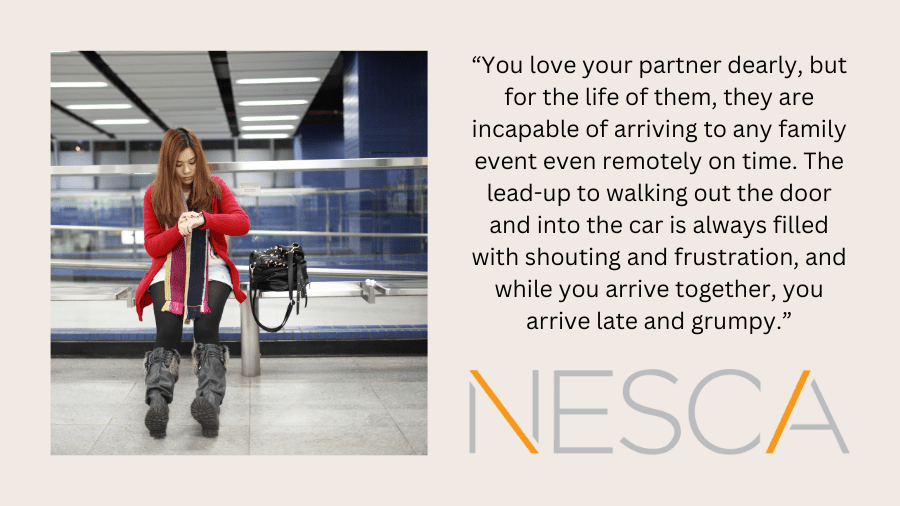
You love your partner dearly, but for the life of them, they are incapable of arriving to any family event even remotely on time. The lead-up to walking out the door and into the car is always filled with shouting and frustration, and while you arrive together, you arrive late and grumpy.

→ Examples of Flexibility and Adaptability: You started traveling separately to family events. Yeah, it confuses some of your relatives, you’re using double the gas, and your partner shows up way later than they would if you drove together, BUT you both arrive at the family gathering in great moods and enjoy your time with everyone, which is your actual priority. It’s also helped your relationship because it’s removed a lot of the push-pull dynamic that was created by rushing to get somewhere together on time. You also notice how it has opened the door to more conversations around your spouse’s neurodiversity and ways to support them. But really, the best part of this new flexible arrangement is that you can get there on time before all the tasty food runs out, and when you’re feeling generous, you even save your partner a plate!

Scenario #3
No matter how hard you try, your fridge is a warzone. Vegetables rot before you can cook them; you have multiple bottles of hot sauce because you keep forgetting you already have some; and a pack of mushrooms stares judgingly at you every time you pass over it because you still haven’t bought the other ingredients for the mushroom soup you plan(ned) to make.

→ Examples of Flexibility and Adaptability: You let go of how you thought a fridge needed to look, and organized it in a way that makes sense for your brain and eating habits. Vegetables now go in the fridge door where you’ll have a visual reminder to eat them before they go bad. Condiments are on a lazy Susan so you can quickly check what you have and don’t have. You also started shopping for only 1-2 dishes at a time, and now keep all the ingredients needed for a dish together in bins so they’re ready to go when you cook. Yes, you know pasta doesn’t need to be in the fridge, but you know what, this is your life, and this makes sense for you. And while it’s true that this new organization system is suboptimal in terms of space usage, you’ve noticed that you’re actually using more of what you do have in the fridge, which is your priority.

Want to explore this topic more?
Here are a few social media accounts that are modeling a more flexible and adaptable approach to executive function demands:
@thecenteredlifeco
@strugglecare (along with her Podcast “Struggle Care”)
@divergentcoachkelly
@adriabarich

And, if you would like to explore additional solutions to executive function challenges, NESCA’s team of expert executive function coaches is available to work with you and/or your family. We have coaches who can work in-person or remotely. Let us know how we can support you.


About the Author

Jasmine Badamo, MA, is an educational counselor and executive function coach who works full-time at NESCA supporting students ranging from elementary school through young adulthood. In addition to direct client work, Ms. Badamo provides consultation and support to parents and families in order to help change dynamics within the household and/or support the special education processes for students struggling with executive dysfunction. She also provides expert consultation to educators, special educators and related professionals.

Ms. Badamo is a New York State Certified ENL and Special Education teacher. She has more than 10 years of teaching experience across three countries and has worked with students and clients ranging in age from 7 to adulthood. She earned her bachelor’s degree in Biological Sciences from Cornell University and her master’s degree in TESOL from CUNY Hunter College. She has also participated in graduate coursework focusing on academic strategies and executive function supports for students with LD, ADHD, and autism as part of the Learning Differences and Neurodiversity (LDN) certification at Landmark College’s Institute for Research and Training. In addition to being a native English speaker, Ms. Badamo is also conversationally fluent in verbal and written Spanish.

Having worked in three different New York City public schools, Ms. Badamo has seen firsthand the importance of executive function skills in facilitating student confidence and success. Her coaching and consultation work focuses on creating individualized supports based on the specific needs and strengths of each client and supporting the development of metacognition (thinking about one’s own thought processes and patterns), executive function skills, and independence. She will guide clients to generate their own goals, identify the barriers to their goals, brainstorm potential strategies, advocate for support when needed, and reflect on the effectiveness of their applied strategies.

Ms. Badamo is a highly relational coach. Building an authentic connection with each client is a top priority and allows her to provide the best support possible. Additionally, as a teacher and coach, Ms. Badamo believes in fostering strong collaborations with anyone who supports her clients including service providers, classroom teachers, parents, administrators, and community providers.

To book executive function coaching with Jasmine Badamo or another EF or Real-life Skills Coach at NESCA, complete NESCA’s online intake form

NESCA is a pediatric neuropsychology practice and integrative treatment center with offices in Newton, Plainville, and Hingham, Massachusetts; Londonderry, New Hampshire; and the greater Burlington, Vermont region, serving clients from infancy through young adulthood and their families. For more information, please email info@nesca-newton.com or call 617-658-9800.

Reduce Your Frustrations: How Being Flexible and Adaptable Helps You and Your Loved One with Executive Function Challenges

By | Nesca Notes 2023

By Jasmine Badamo, MA
Educational Counselor; Executive Function Tutor

The Dreaded Nighttime Routine
Hey parents, tell me if this rings a bell. Instead of bedtime being relaxing, it fills you with anticipatory dread. Bedtime is in 15 minutes, and you are scrambling to get your child ready. After prompting your child for the 27th time to pick a pair of pajamas and put them on – something they have to do literally every night and should come as no surprise to them – you walk into your child’s room to see the contents of their toy bin strewn all over the floor as they look for their favorite plushie to pack for school tomorrow. Pajamas are not on, teeth are not brushed, and now there is a room to clean. You feel your frustration boil over as you realize that it will be yet another night of everyone going to bed late and stressed out. You think to yourself, “This shouldn’t be this difficult! My kid should be able to do a simple nighttime routine and get to bed on time!”

In my experience, so many of us have found ourselves in a similar situation with a child, a partner, or even ourselves. While you might like for me to launch into tips and tricks for achieving a seamless nighttime routine for your family (does that exist?!), instead I’d like to explore the idea of challenging our “shoulds,” and discuss how being more flexible with ourselves and others can help reduce our frustrations.

Yep, I’m Talking about Letting Go!…Again!
If you or a loved one struggle with executive function demands, it’s important to get more comfortable letting go of how things “should” be, and start being flexible around how things could be. I really love Dr. Russell Barkley’s shepherd analogy for parenting a child with ADHD, as it can be applied to a wide range of relationships and situations involving individuals with executive functioning challenges. He tells us that parents are not engineers, and they do not get to design their children to be the way they’d like them to be. Instead, he pushes parents to accept that they are “a shepherd to a unique individual,” and while “no shepherd is gonna turn a sheep into a dog,” parents do have the power to “pick the pastures in which the sheep will graze and develop and grow.”

Whether you are shepherding a child, a loved one, or yourself, this approach helps us let go of who a person should be, how the routines of daily life should go, or what tasks should be easy. Trying to turn a sheep into a dog (aka trying to shove a round peg into a square hole) only leads to frustration, and worse yet, often sets neurodivergent people – and those who love them – up to fail. Instead, start focusing on how daily life could be, and channel your efforts into shaping your environment and tasks accordingly.

Flexibility and Adaptability are the Tools for Letting Go
The best way to start shaping the environment to better suit the needs of an individual with executive function struggles is to be flexible and adaptive. Below is a list of strategies for being more flexible and adaptive:

Adaptivity Killers Adaptivity Enhancers
-All-or-nothing thinking

-100% optimization and productivity

-Shaming in order to motivate action

-Rejection or deprivation of needs

-Growth mindset (progress over perfection)

-Selective effort and investment

-Positive self-talk and celebrating small successes

-Self-reflection and compassion

Notice how the Adaptivity Enhancers above align with practices that will dissipate frustrations or at least help you weather them with more ease. Take a look at how each would play out in real life:

  • “I may not be the most athletic human in the world, but I’m really interested in doing more physical movement. I bet if I practiced, I could increase my athletic ability and start to enjoy physical activity more.” (growth mindset).
  • “I know I can’t go from 0 to 100, and that I only have so much expendable energy in the day. I’m going to focus my efforts on lifting weights: starting with small weights and lifting just twice a week.” (selective effort & investment).
  • “Today I lifted for less than my target time, but I’m really proud of myself for coming all the way to the gym after I had such a crummy day at work. I’m also proud that I lifted weights for as long as I did.” (positive self-talk; celebrating small successes).
  • “I notice that I’m usually cranky on Wednesdays after work, and it’s a drag to get myself to the gym – which is totally understandable. Maybe I can better support myself by going on Tuesdays when I tend to have more energy.” (self-reflection and compassion).

Stay tuned for next week’s blog for more real-life examples of how being flexible and adaptable can help you navigate everyday executive function demands.


About the Author

Jasmine Badamo, MA, is an educational counselor and executive function coach who works full-time at NESCA supporting students ranging from elementary school through young adulthood. In addition to direct client work, Ms. Badamo provides consultation and support to parents and families in order to help change dynamics within the household and/or support the special education processes for students struggling with executive dysfunction. She also provides expert consultation to educators, special educators and related professionals.

Ms. Badamo is a New York State Certified ENL and Special Education teacher. She has more than 10 years of teaching experience across three countries and has worked with students and clients ranging in age from 7 to adulthood. She earned her bachelor’s degree in Biological Sciences from Cornell University and her master’s degree in TESOL from CUNY Hunter College. She has also participated in graduate coursework focusing on academic strategies and executive function supports for students with LD, ADHD, and autism as part of the Learning Differences and Neurodiversity (LDN) certification at Landmark College’s Institute for Research and Training. In addition to being a native English speaker, Ms. Badamo is also conversationally fluent in verbal and written Spanish.

Having worked in three different New York City public schools, Ms. Badamo has seen firsthand the importance of executive function skills in facilitating student confidence and success. Her coaching and consultation work focuses on creating individualized supports based on the specific needs and strengths of each client and supporting the development of metacognition (thinking about one’s own thought processes and patterns), executive function skills, and independence. She will guide clients to generate their own goals, identify the barriers to their goals, brainstorm potential strategies, advocate for support when needed, and reflect on the effectiveness of their applied strategies.

Ms. Badamo is a highly relational coach. Building an authentic connection with each client is a top priority and allows her to provide the best support possible. Additionally, as a teacher and coach, Ms. Badamo believes in fostering strong collaborations with anyone who supports her clients including service providers, classroom teachers, parents, administrators, and community providers.

To book executive function coaching with Jasmine Badamo or another EF or Real-life Skills Coach at NESCA, complete NESCA’s online intake form

NESCA is a pediatric neuropsychology practice and integrative treatment center with offices in Newton, Plainville, and Hingham, Massachusetts; Londonderry, New Hampshire; and the greater Burlington, Vermont region, serving clients from infancy through young adulthood and their families. For more information, please email info@nesca-newton.com or call 617-658-9800.

Skip to content