To accommodate requests for neuropsychological evaluations after the start of the new school year, NESCA has added evaluation dates in its Newton, MA office. Immediate openings are now available for scheduling. Please complete our Inquiry/Intake Form for more information or to start the scheduling process.

Tag

NESCA Londonderry Archives - NESCA

Subscribe to NESCA Notes

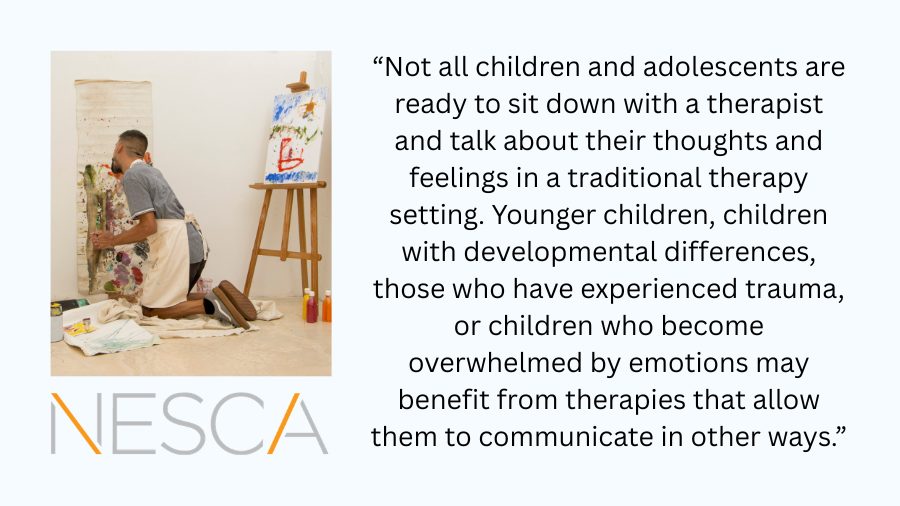
Image of teen participating in art therapy and a quote explaining why some individuals may need different forms of therapies.

What If My Child Is Not Ready For Traditional Therapy?

By | NESCA Notes 2026

Image of teen participating in art therapy and a quote explaining why some individuals may need different forms of therapies.By: Jessica Greene, Psy.D.
Postdoctoral Fellow, NESCA

When parents receive a recommendation that their child begin therapy, it can feel overwhelming. Many people are familiar with traditional “talk therapy,” but some may not realize there are many different therapeutic approaches designed to meet children where they are at developmentally or emotionally. After receiving a recommendation for therapy, many parents immediately ask, “Do you recommend anyone?” While that is an important question, it can be just as helpful to first ask, “What type of therapy is the best fit for my child?” Not all children and adolescents are ready to sit down with a therapist and talk about their thoughts and feelings in a traditional therapy setting. Younger children, children with developmental differences, those who have experienced trauma, or children who become overwhelmed by emotions may benefit from therapies that allow them to communicate in other ways.

Fortunately, there are several therapeutic approaches that may be a better fit.

Play-based Therapy

In play-based therapy, children use play to work through challenging feelings, day-to-day stressors, and/or difficult experiences. Rather than relying on conversation, the play allows the child to express themselves in the way that comes most naturally to them. Through the child’s play, the therapist may gain insight into how the child understands experiences, relationships, or emotions. For example, a child may use toy cars to make sense of a car accident, replaying the accident as they work toward understanding and processing the experience.

It is important to know that registered play therapy is different from simply playing games with a child during a therapy session. In play therapy, play itself is the therapeutic language, and the therapist has specialized training in using play to support assessment and treatment. It is okay to ask a potential therapist about their approach.

Find a Registered Play-based Therapist: https://www.a4pt.org/search/custom.asp?id=3571

Music Therapy, Dance/Movement Therapy, and Art Therapy

Music, dance/movement, and art therapy use creative expression as the primary way children explore emotions, build coping skills, strengthen self-awareness, and process difficult experiences. For some children, creating art, moving their bodies, or making music feels safer and more natural than talking. What they may not be able to say in words, they may be able to demonstrate through one of these other forms. These therapies naturally offer rhythmic, patterned, repetitive movements that can support internal regulation while giving children an alternative avenue to express themselves.

Find a Music Therapist: https://my.cbmt.org/cbmtssa/f?p=CRTSSA:17800:1865299384:::17800::

Find an Art Therapist: https://arttherapy.org/art-therapist-locator/

Find a Dance/Movement Therapist: https://www.adta.org/find-a-dmt#/

Occupational Therapy

Occupational Therapy is another alternative that may be a better entry point for some children who are not quite ready for the above-listed therapies. Although occupational therapy is often associated with fine motor skills or handwriting, many occupational therapists also specialize in sensory processing and emotional regulation. Through movement, sensory experiences, and structured activities, children learn what helps their bodies feel calm, organized, and ready to participate in everyday activities. As children engage with swings, climbing equipment, crash pads, sensory tools, and other therapeutic activities, they begin to recognize what helps them feel better regulated. As occupational therapists can provide support for many different needs, seek an occupational therapist that focuses on sensory processing and/or emotion regulation.

To learn more about NESCA’s Occupational Therapy services, visit: https://nesca-newton.com/educational-occupational-therapy-services/

Sensory Motor Arousal Regulation Treatment (SMART)

SMART is a trauma-informed therapy that combines sensory experiences with movement, while also focusing on the importance of the caregiver/child relationship to help children feel safer and more regulated. If your child has experienced trauma, SMART therapy may be an appropriate place to begin. Similar to occupational therapy, the SMART room provides various types of therapeutic equipment to help a child regulate their body throughout the session. Sessions may include crashing into crash pads, throwing a ball back and forth, or jumping on a trampoline to help the client increase or decrease their level of arousal, depending on their needs. Caregivers are an important part of the therapeutic process, helping strengthen attachment, during sessions, while learning to recognize what supports their child’s regulation. The process also encourages caregivers to better understand their own emotional responses and how these can influence their child’s ability to feel safe and regulated.

Find a SMART-trained Therapist: https://smartmovespartners.com/find-a-smart-therapy-therapist/

Regardless of the type of therapy, one factor consistently predicts better outcomes: the relationship between the child and therapist. Children are most likely to make progress when they feel safe, understood, and connected to the person supporting them. If your child does not seem comfortable with a therapist after an appropriate adjustment period, it is okay to ask questions or explore whether another provider may be a better fit.


About the Author

Dr. Jessica Greene is a licensed clinical psychologist who has worked After working with Dr. Angela Currie in NESCA’s Londonderry, N.H. office from 2023-2024 as a practicum student, Dr. Jessica Greene re-joins NESCA to complete her postdoctoral fellowship in pediatric neuropsychological assessment. Dr. Greene has a particular interest in understanding clients’ strengths as well as differences, integrating a therapeutic assessment approach, when appropriate.

To book an evaluation with one of our many expert neuropsychologists or other clinicians, complete NESCA’s online intake form.

NESCA is a pediatric neuropsychology and related services practice with offices in Newton, Plainville, and Hingham, Massachusetts; Londonderry, New Hampshire; and Coral Gables, Florida, serving clients from infancy through young adulthood and their families. For more information, please email info@nesca-newton.com or call 617-658-9800.

Image of someone who could head in multiple directions; quote from Dr. Jessica Greene about where to start with recommendations from neuropsychological evaluations

What to Do with All the Recommendations?

By | NESCA Notes 2026

Image of someone who could head in multiple directions; quote from Dr. Jessica Greene about where to start with recommendations from neuropsychological evaluationsBy: Jessica Greene, Psy.D.
Postdoctoral Fellow, NESCA

Your child’s neuropsychological evaluation is complete, and your family now has a greater understanding of your child – and a long list of recommendations. After you review the list, it can feel as though every recommendation is the most important one. How do you know where to start? The steps outlined below are general guidance; your team may recommend a different timeline based on your child’s needs.

Prioritize

Recommendations are meant to provide a roadmap for the next two to three years. Step back and ask yourself, “What is most important for my child and for my family right now?” Choose one to two recommendations that make the most sense and gradually find ways to work them into your routine. Making intentional changes, at a reasonable pace, gives everyone time to adjust. Also, it is much easier to tell whether a strategy, intervention, or service is helping when you try one thing at a time.

Reflect

After you have tried the chosen recommendations for a reasonable amount of time, take a moment to consider your child’s progress. Day-to-day life can make growth easy to overlook, particularly when there are still other pressing needs. But, before returning to your list of recommendations, consider the changes that have occurred. Growth is not always linear, so perhaps your child has made growth in one area, but something new has presented itself. On the other hand, perhaps things have moved forward for the better and there is time to focus on recommendations that were less pressing.

Review

When ready, return to recommendations and consider what to implement next. Again, choose one or two items, so as not to overwhelm yourself or the family system.

Set Boundaries with Others (if needed)

Caregivers often tell me they feel flooded with opinions from everyone they know. While outside input can be helpful at times, it’s also okay to set boundaries. You might simply thank people for their advice and say you have a plan you intend to follow. That response acknowledges their concern without letting you get derailed.

Need Help Choosing a Next Step?

If you are unsure where to start or what to focus on next, reach out to a trusted provider that understands your child’s needs. That may be the NESCA neuropsychologist who completed the evaluation, an outside provider (occupational therapist, counselor, speech-language pathologist), your pediatrician, or a school contact (special education teacher or school counselor). They can help you plan next steps.

If you’d like more details about next steps and who to share the report with, see Dr. Maggie Rodriguez’s post, which outlines practical actions to take after a neuropsychological evaluation. Read her full article here: https://nesca-newton.com/navigating-life-after-a-neuropsychological-evaluation-what-comes-next/.


About the Author

Dr. Jessica Greene is a licensed clinical psychologist who has worked After working with Dr. Angela Currie in NESCA’s Londonderry, N.H. office from 2023-2024 as a practicum student, Dr. Jessica Greene re-joins NESCA to complete her postdoctoral fellowship in pediatric neuropsychological assessment. Dr. Greene has a particular interest in understanding clients’ strengths as well as differences, integrating a therapeutic assessment approach, when appropriate.

To book an evaluation with one of our many expert neuropsychologists or other clinicians, complete NESCA’s online intake form.

NESCA is a pediatric neuropsychology and related services practice with offices in Newton, Plainville, and Hingham, Massachusetts; Londonderry, New Hampshire; and Coral Gables, Florida, serving clients from infancy through young adulthood and their families. For more information, please email info@nesca-newton.com or call 617-658-9800.
Getting to Know NESCA Pediatric Neuropsychologist J. Michael Abrams, Ph.D.

By | Nesca Notes 2023

By: Jane Hauser
Director of Marketing & Outreach

I recently spoke with J. Michael Abrams, Ph.D., pediatric neuropsychologist practicing in NESCA’s Londonderry, New Hampshire office. Dr. Abrams joined NESCA last fall. Take a few minutes to learn more about him in today’s blog interview. 

How did you became interested in neuropsychology?

Back in the mid-80s, I worked at McLean Hospital, in the Child & Adolescent Inpatient program. They had an educational program set up for the kids that was run by psychologists who were embedded in the classrooms. There was a fair amount of test development going on at that time that used a lot of materials to build executive function and cognitive skills among the students. I was always interested in education and special education, but it was this experience that changed my career mindset toward psychology. So, I went back to school to study psychology.

Tell us about your career journey.

I always wanted to work with children and adolescents. That desire stemmed from my initial interest in special education and education in general, and I was on that path. I spent about seven and a half years at McLean, with the first couple of years working on an inpatient unit. Then I transferred to the psychologist-run education program, where I was a classroom educator.

After switching to psychology, my original clinical interest was with children who had experienced abuse and neglect and those who were involved in children’s eyewitness testimony. The focus was on how the experiences they had been through affected their memory, attention, and cognitive development. The more I worked with children and adolescents, the more I recognized how these neuropsychological factors impacted all aspects of their lives. It became much more than what I saw in the context of a legal case; instead, I saw how their experiences affected the management of themselves, their image of themselves, their hopes and aspirations, etc. I became really interested in how their neuropsychology intersected with their opportunities and experiences.

What segment of children and adolescents do you primarily work with? What is your specialty area?

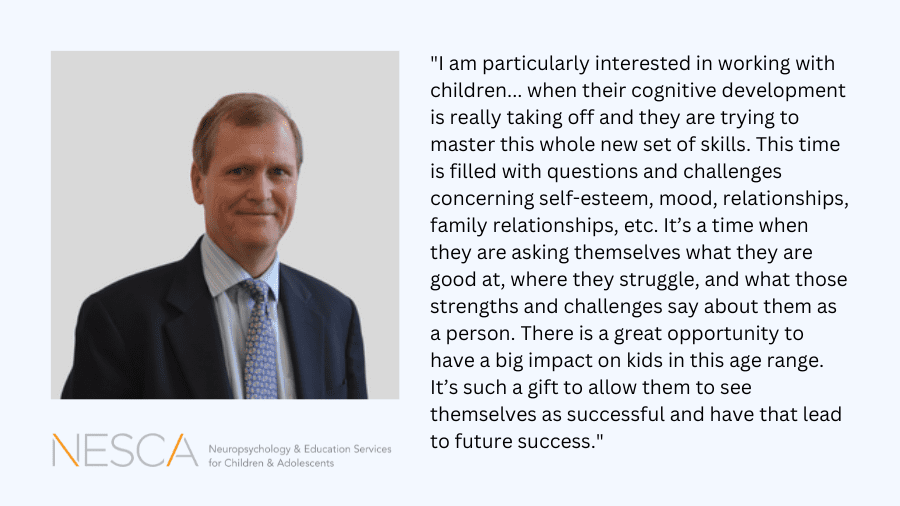
I am particularly interested in working with children from age eight through 14, when their cognitive development is really taking off and they are trying to master this whole new set of skills. This time is filled with questions and challenges concerning self-esteem, mood, relationships, family relationships, etc. It’s a time when they are asking themselves what they are good at, where they struggle, and what those strengths and challenges say about them as a person. There is a great opportunity to have a big impact on kids in this age range. It’s such a gift to allow them to see themselves as successful and have that lead to future success.

What do you find most rewarding and most challenging about your profession?

The rewarding part is two-fold. The first is the interpersonal emotional piece. On a personal level, it’s rewarding to be able to contribute to other peoples’ success, whether it’s the clients, the practice, or the field overall. The second piece is more personal and intellectual. It’s intellectually stimulating to be able to integrate all of the information we gather or identify about a person, and to be able to communicate those findings or revelations to a child and their parents or caregivers. The intellectual reward lies in the ability to effectively communicate a child’s cognitive complexity in a way that they understand and can use to help reach their goals.

The challenging part has to do with the mental health landscape overall. As someone who is involved in neuropsychological assessments, it can feel like operating within a silo in the overall landscape. So many of the systems, such as insurance and education, are not set up for seamless collaboration with psychology practices or other areas of behavioral health. Unfortunately, this can make getting the appropriate mental health care or educational/therapeutic interventions a cumbersome, sometimes adversarial process. It’s the frustration that accompanies the much larger, more overarching need to develop a genuine collaboration among all the pieces within the health and mental health care settings.

What interested you about NESCA?

I was drawn to the opportunity NESCA provides to interact with other psychologists and affiliated clinicians on an ongoing basis. Professionally, I am not operating in a silo. At NESCA, there is more regular consultation and collaboration on how to put together a comprehensive and coherent plan for these kids. I was very excited to have a team of highly qualified, very experienced professionals, within the same organization, who can provide a range of supports and services for the kids we work with. Having this as a resource is a great opportunity for our clients and our staff, alike.


About Pediatric Neuropsychologist J. Michael Abrams, Ph.D.

Dr. J. Michael Abrams has over 30 years of experience in psychological, educational, and neuropsychological assessment and psychotherapy in various settings. A significant aspect of Dr. Abrams’ continuing interest and experience also includes the psychological care and treatment of children, adolescents, and young adults with a broad variety of emotional and interpersonal problems, beyond those that arise in the context of developmental differences or learning-related difficulties.


To book a neuropsychological evaluation with Dr. Abrams in Londonderry, NH, or to book with another expert NESCA neuropsychologist, complete NESCA’s online intake form. 


Neuropsychology & Education Services for Children & Adolescents (NESCA) is a pediatric neuropsychology practice and integrative treatment center with offices in Newton and Plainville, Massachusetts, Londonderry, New Hampshire, and Burlington, Vermont, serving clients from preschool through young adulthood and their families. For more information, please email info@nesca-newton.com or call 617-658-9800.

Skip to content