To accommodate requests for neuropsychological evaluations after the start of the new school year, NESCA has added evaluation dates in its Newton, MA office. Immediate openings are now available for scheduling. Please complete our Inquiry/Intake Form for more information or to start the scheduling process.

Tag

recommendations Archives - NESCA

Subscribe to NESCA Notes

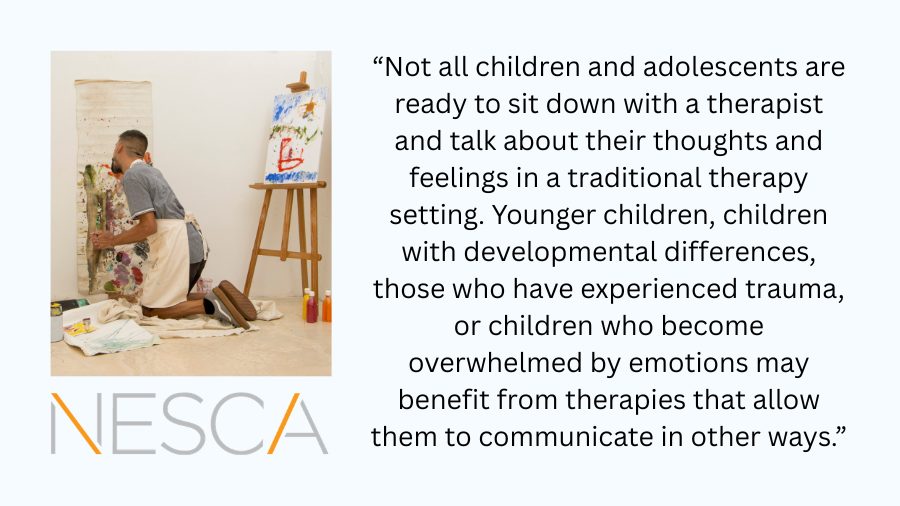
Image of teen participating in art therapy and a quote explaining why some individuals may need different forms of therapies.

What If My Child Is Not Ready For Traditional Therapy?

By | NESCA Notes 2026

Image of teen participating in art therapy and a quote explaining why some individuals may need different forms of therapies.By: Jessica Greene, Psy.D.
Postdoctoral Fellow, NESCA

When parents receive a recommendation that their child begin therapy, it can feel overwhelming. Many people are familiar with traditional “talk therapy,” but some may not realize there are many different therapeutic approaches designed to meet children where they are at developmentally or emotionally. After receiving a recommendation for therapy, many parents immediately ask, “Do you recommend anyone?” While that is an important question, it can be just as helpful to first ask, “What type of therapy is the best fit for my child?” Not all children and adolescents are ready to sit down with a therapist and talk about their thoughts and feelings in a traditional therapy setting. Younger children, children with developmental differences, those who have experienced trauma, or children who become overwhelmed by emotions may benefit from therapies that allow them to communicate in other ways.

Fortunately, there are several therapeutic approaches that may be a better fit.

Play-based Therapy

In play-based therapy, children use play to work through challenging feelings, day-to-day stressors, and/or difficult experiences. Rather than relying on conversation, the play allows the child to express themselves in the way that comes most naturally to them. Through the child’s play, the therapist may gain insight into how the child understands experiences, relationships, or emotions. For example, a child may use toy cars to make sense of a car accident, replaying the accident as they work toward understanding and processing the experience.

It is important to know that registered play therapy is different from simply playing games with a child during a therapy session. In play therapy, play itself is the therapeutic language, and the therapist has specialized training in using play to support assessment and treatment. It is okay to ask a potential therapist about their approach.

Find a Registered Play-based Therapist: https://www.a4pt.org/search/custom.asp?id=3571

Music Therapy, Dance/Movement Therapy, and Art Therapy

Music, dance/movement, and art therapy use creative expression as the primary way children explore emotions, build coping skills, strengthen self-awareness, and process difficult experiences. For some children, creating art, moving their bodies, or making music feels safer and more natural than talking. What they may not be able to say in words, they may be able to demonstrate through one of these other forms. These therapies naturally offer rhythmic, patterned, repetitive movements that can support internal regulation while giving children an alternative avenue to express themselves.

Find a Music Therapist: https://my.cbmt.org/cbmtssa/f?p=CRTSSA:17800:1865299384:::17800::

Find an Art Therapist: https://arttherapy.org/art-therapist-locator/

Find a Dance/Movement Therapist: https://www.adta.org/find-a-dmt#/

Occupational Therapy

Occupational Therapy is another alternative that may be a better entry point for some children who are not quite ready for the above-listed therapies. Although occupational therapy is often associated with fine motor skills or handwriting, many occupational therapists also specialize in sensory processing and emotional regulation. Through movement, sensory experiences, and structured activities, children learn what helps their bodies feel calm, organized, and ready to participate in everyday activities. As children engage with swings, climbing equipment, crash pads, sensory tools, and other therapeutic activities, they begin to recognize what helps them feel better regulated. As occupational therapists can provide support for many different needs, seek an occupational therapist that focuses on sensory processing and/or emotion regulation.

To learn more about NESCA’s Occupational Therapy services, visit: https://nesca-newton.com/educational-occupational-therapy-services/

Sensory Motor Arousal Regulation Treatment (SMART)

SMART is a trauma-informed therapy that combines sensory experiences with movement, while also focusing on the importance of the caregiver/child relationship to help children feel safer and more regulated. If your child has experienced trauma, SMART therapy may be an appropriate place to begin. Similar to occupational therapy, the SMART room provides various types of therapeutic equipment to help a child regulate their body throughout the session. Sessions may include crashing into crash pads, throwing a ball back and forth, or jumping on a trampoline to help the client increase or decrease their level of arousal, depending on their needs. Caregivers are an important part of the therapeutic process, helping strengthen attachment, during sessions, while learning to recognize what supports their child’s regulation. The process also encourages caregivers to better understand their own emotional responses and how these can influence their child’s ability to feel safe and regulated.

Find a SMART-trained Therapist: https://smartmovespartners.com/find-a-smart-therapy-therapist/

Regardless of the type of therapy, one factor consistently predicts better outcomes: the relationship between the child and therapist. Children are most likely to make progress when they feel safe, understood, and connected to the person supporting them. If your child does not seem comfortable with a therapist after an appropriate adjustment period, it is okay to ask questions or explore whether another provider may be a better fit.


About the Author

Dr. Jessica Greene is a licensed clinical psychologist who has worked After working with Dr. Angela Currie in NESCA’s Londonderry, N.H. office from 2023-2024 as a practicum student, Dr. Jessica Greene re-joins NESCA to complete her postdoctoral fellowship in pediatric neuropsychological assessment. Dr. Greene has a particular interest in understanding clients’ strengths as well as differences, integrating a therapeutic assessment approach, when appropriate.

To book an evaluation with one of our many expert neuropsychologists or other clinicians, complete NESCA’s online intake form.

NESCA is a pediatric neuropsychology and related services practice with offices in Newton, Plainville, and Hingham, Massachusetts; Londonderry, New Hampshire; and Coral Gables, Florida, serving clients from infancy through young adulthood and their families. For more information, please email info@nesca-newton.com or call 617-658-9800.
a roadmap wirh a treatment plan sign showing the way; quote from Dr. Ann Helmus

Beyond Recommendations: Creating a Roadmap for Change

By | NESCA Notes 2026

a roadmap wirh a treatment plan sign showing the way; quote from Dr. Ann HelmusBy Ann Helmus, Ph.D.
Founder & Director, NESCA

I recently attended a continuing education course on the treatment of sleep problems. The instructor shared something not altogether surprising, but genuinely thought-provoking: simply giving people a list of “sleep hygiene” recommendations has not been shown to be particularly effective.

Most of us have heard these recommendations before:

  • Turn off screens before bed
  • Keep the room cool and dark
  • Avoid caffeine late in the day
  • Maintain a consistent sleep schedule

The problem isn’t that these recommendations are wrong. The problem is that they are often delivered as a generic list. So, what does work? A personalized approach to a plan.

For example, instead of handing someone a list of 10 recommendations, an effective approach by a clinician might be to say: “Let’s focus on one thing this week – moving your afternoon coffee a little earlier in the day. We’ll see how that goes, what obstacles come up, and whether it makes a difference before we add anything else.”

Here, the recommendations are tailored to the individual, prioritized based on what is most likely to help, and then followed up on to determine what is working and what needs adjustment.

The same can be said about the recommendations that are provided after a neuropsychological evaluation. After an assessment, families receive evaluation reports that often contain pages of recommendations. While many of those suggestions may be reasonable, a long list can leave parents wondering where to start, which recommendation matters the most, or which recommendation will make the biggest difference for my child right now. It can be overwhelming.

At NESCA, our goal is not simply to generate recommendations. Our goal is to develop a treatment plan.

A treatment plan factors in the full understanding of the child’s unique strengths and challenges, identifies the issues that are having the greatest impact on daily functioning, and prioritizes the interventions that are most likely to improve quality of life and long-term improvement.

For one child, improving sleep may be the most important first step. For another, it may be anxiety management, executive functioning support, social skills coaching, speech-language intervention, or school accommodations. The recommendations may look similar on paper, but the strategy is very different.

A thoughtful evaluation should answer not only what to do, but why, when, and in what order.

Most importantly, meaningful change rarely comes from a report sitting on a shelf. It comes from partnership, implementation, progress monitoring, and adjustments as needed.

Just as effective treatment for sleep difficulties involves more than a list of sleep hygiene tips, effective support for a child involves more than an exhaustive list of recommendations.

It requires a roadmap. At NESCA, our goal is to help families build one.


About the Author

NESCA Founder and Director Ann Helmus, Ph.D., is a licensed clinical neuropsychologist who has beenAnn Helmus headshot practicing neuropsychology for 35 years and has been director of NESCA’s Neuropsychology practice for nearly three decades, continuously training and mentoring  neuropsychologists to meet the highest professional standards.

To book a neuropsychological evaluation at NESCA, complete NESCA’s online intake form. 

NESCA is a pediatric neuropsychology and related services group practice with offices in Newton, Plainville, and Hingham, Massachusetts; Londonderry, New Hampshire; and Coral Gables, Florida, serving clients from infancy through young adulthood and their families. For more information, please email info@nesca-newton.com or call 617-658-9800.

Image of someone who could head in multiple directions; quote from Dr. Jessica Greene about where to start with recommendations from neuropsychological evaluations

What to Do with All the Recommendations?

By | NESCA Notes 2026

Image of someone who could head in multiple directions; quote from Dr. Jessica Greene about where to start with recommendations from neuropsychological evaluationsBy: Jessica Greene, Psy.D.
Postdoctoral Fellow, NESCA

Your child’s neuropsychological evaluation is complete, and your family now has a greater understanding of your child – and a long list of recommendations. After you review the list, it can feel as though every recommendation is the most important one. How do you know where to start? The steps outlined below are general guidance; your team may recommend a different timeline based on your child’s needs.

Prioritize

Recommendations are meant to provide a roadmap for the next two to three years. Step back and ask yourself, “What is most important for my child and for my family right now?” Choose one to two recommendations that make the most sense and gradually find ways to work them into your routine. Making intentional changes, at a reasonable pace, gives everyone time to adjust. Also, it is much easier to tell whether a strategy, intervention, or service is helping when you try one thing at a time.

Reflect

After you have tried the chosen recommendations for a reasonable amount of time, take a moment to consider your child’s progress. Day-to-day life can make growth easy to overlook, particularly when there are still other pressing needs. But, before returning to your list of recommendations, consider the changes that have occurred. Growth is not always linear, so perhaps your child has made growth in one area, but something new has presented itself. On the other hand, perhaps things have moved forward for the better and there is time to focus on recommendations that were less pressing.

Review

When ready, return to recommendations and consider what to implement next. Again, choose one or two items, so as not to overwhelm yourself or the family system.

Set Boundaries with Others (if needed)

Caregivers often tell me they feel flooded with opinions from everyone they know. While outside input can be helpful at times, it’s also okay to set boundaries. You might simply thank people for their advice and say you have a plan you intend to follow. That response acknowledges their concern without letting you get derailed.

Need Help Choosing a Next Step?

If you are unsure where to start or what to focus on next, reach out to a trusted provider that understands your child’s needs. That may be the NESCA neuropsychologist who completed the evaluation, an outside provider (occupational therapist, counselor, speech-language pathologist), your pediatrician, or a school contact (special education teacher or school counselor). They can help you plan next steps.

If you’d like more details about next steps and who to share the report with, see Dr. Maggie Rodriguez’s post, which outlines practical actions to take after a neuropsychological evaluation. Read her full article here: https://nesca-newton.com/navigating-life-after-a-neuropsychological-evaluation-what-comes-next/.


About the Author

Dr. Jessica Greene is a licensed clinical psychologist who has worked After working with Dr. Angela Currie in NESCA’s Londonderry, N.H. office from 2023-2024 as a practicum student, Dr. Jessica Greene re-joins NESCA to complete her postdoctoral fellowship in pediatric neuropsychological assessment. Dr. Greene has a particular interest in understanding clients’ strengths as well as differences, integrating a therapeutic assessment approach, when appropriate.

To book an evaluation with one of our many expert neuropsychologists or other clinicians, complete NESCA’s online intake form.

NESCA is a pediatric neuropsychology and related services practice with offices in Newton, Plainville, and Hingham, Massachusetts; Londonderry, New Hampshire; and Coral Gables, Florida, serving clients from infancy through young adulthood and their families. For more information, please email info@nesca-newton.com or call 617-658-9800.

Skip to content