
NESCA’s Newton, MA location has immediate availability for neuropsychological evaluations. Our MA clinicians specialize in the following evaluations: Neuropsychological; Autism; and Emotional and Psychological, as well as Academic Achievement and Learning Disability Testing.

Visit www.nesca-newton.com/intake for more information or to book an evaluation.

Tag

Sarah LaFerriere Archives - NESCA

Subscribe to NESCA Notes

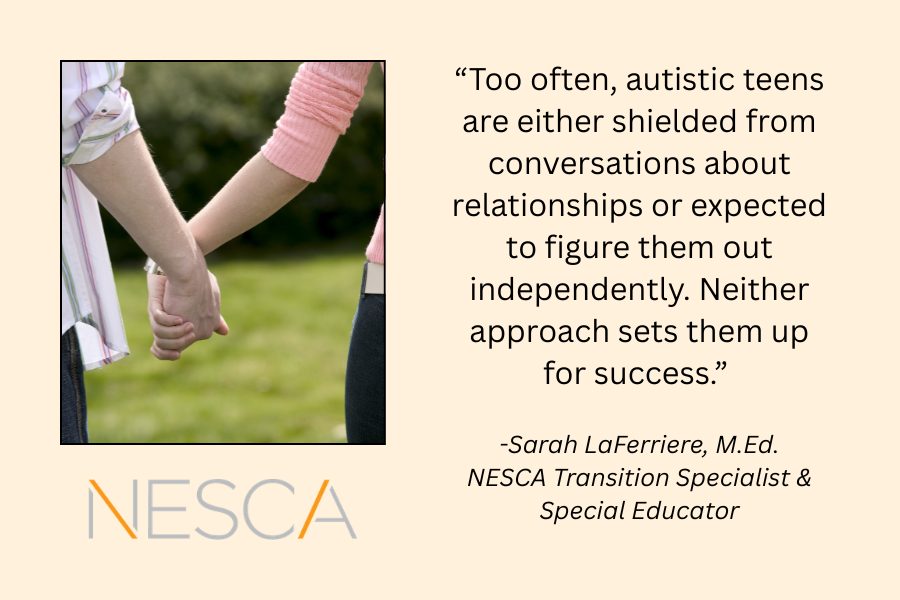
Image of teens holding hands, signifying a romantic relationship along with a quote by Sexual Health Educator Sarah LaFerriere

How to Teach Consent to Teens with Autism – A Guide for Parents and Professionals

By | NESCA Notes 2026

Image of teens holding hands, signifying a romantic relationship along with a quote by Sexual Health Educator Sarah LaFerriereBy: Sarah LaFerriere, M.Ed.
Transition Specialist & Special Educator, NESCA

Consent is often treated as a one-time conversation: something brief, uncomfortable, and easy to delay. But for teens with autism, that approach isn’t just ineffective, it can leave them without the tools they need to safely and confidently navigate relationships. Consent is not a single talk. It’s a set of learnable, teachable skills. And for many teens, those skills need to be taught explicitly, practiced regularly, and reinforced across environments.

Why Consent Needs to Be Taught Explicitly
Many autistic teens:

  • Have difficulty interpreting nonverbal communication (facial expressions, tone, body language)
  • Tend to think in concrete, literal terms
  • Have a history of being reinforced for compliance
  • May strongly desire connection but lack clear social frameworks

Because of this, common advice like “you’ll know when it’s right” or “just pay attention to cues” is not actionable. Instead, they benefit from clear language, direct instruction, and repetition.

Start with a Clear, Concrete Definition
Avoid vague or abstract explanations. Define consent in simple, direct terms:

  • Consent means asking first
  • Consent means getting a clear “yes”
  • Consent can be changed or taken back at any time
  • Silence, hesitation, or “I guess” = not consent

Provide actual scripts teens can use:

  • “Can I hug you?”
  • “Is this okay?”
  • “Do you want to keep going?”

When we give language, we reduce guesswork.

Teaching Both Sides: Asking and Responding
Teens need to understand both roles in an interaction:

How to:

  • Ask for permission clearly
  • Recognize a genuine “yes”
  • Say “no” in a direct way
  • Respond appropriately when someone else says “no”

This is especially important for teens who may default to people-pleasing or masking. They need to hear explicitly: “You are allowed to say no, even if you said yes before.”

Make It Concrete and Practice-based
Conceptual discussions alone are not enough. Use structured, real-life examples:

  • “What would you say if you want to hold someone’s hand?”
  • “What do you do if someone says, ‘not right now’?”
  • “What if someone doesn’t answer you?”

Role-play is one of the most effective tools here. While it may feel uncomfortable, it creates a safe space to:

  • Practice asking for consent
  • Practice declining
  • Practice handling rejection

For professionals, this can be embedded into social skills groups or transition programming. For parents, this can happen in brief, low-pressure moments at home.

Explicitly Teach What Consent Is Not
Many teens benefit from clear contrasts. Consent is not:

  • Silence or lack of response
  • Freezing or shutting down
  • Agreeing due to pressure
  • Continuing after someone changes their mind

Side-by-side examples (“This is consent” vs. “This is not”) can make abstract ideas more concrete.

Include Digital Boundaries
Consent extends beyond in-person interactions. Make sure to address:

  • Sending photos or messages (“Do you want me to send this?”)
  • Respecting privacy (not sharing others’ images or texts)
  • Navigating online relationships and pressure

Teens may understand physical boundaries but struggle to apply the same rules digitally unless explicitly taught.

Normalize and Teach How to Handle “No”
Rejection is a critical part of understanding consent – and often one of the hardest skills. Teens should learn that:

  • Hearing “no” is normal and expected at times
  • It is not a personal failure
  • The correct response is to respect it immediately

Provide simple, usable responses:

  • “Okay, that’s fine.”
  • “Thanks for telling me.”
  • “No problem.”

Practicing these responses reduces anxiety and increases appropriate behavior in real situations.

Frame Consent as a Relationship Skill, Not Just a Rule
Consent is often taught in a risk-avoidance framework. While safety matters, that alone can feel limiting or fear-based.

It’s equally important to frame consent as:

  • A way to show respect
  • A way to build trust
  • A foundation for healthy relationships

This perspective can be especially motivating for teens who are seeking connection.

Make It Ongoing and Integrated
Consent should not be a one-time lesson. Revisit and build on it:

  • As teens mature
  • As relationships become more complex
  • As new situations arise (dating, work, online interactions)

Final Thoughts
Too often, autistic teens are either shielded from conversations about relationships or expected to figure them out independently. Neither approach sets them up for success. When parents and professionals take a direct, skill-based approach to teaching consent, we give teens something essential: a clear, usable framework for understanding their own boundaries and respecting someone else’s.

For families and professionals looking for more individualized support, Transition Specialist & Special Educator Sarah LaFerriere, M.Ed. offers virtual sexual health coaching through NESCA in Newton. These sessions are designed to meet students where they are, using clear, direct, and developmentally appropriate instruction to build understanding of consent, boundaries, relationships, and personal safety. Coaching is tailored to each individual’s needs and can be especially helpful for students who benefit from explicit teaching and guided practice in a supportive, judgment-free environment. To learn more or inquire about services, families can explore options through NESCA.


About the AuthorHeadshot of Sarah LaFerriere, M.Ed.

Sarah LaFerriere, M.Ed., is a transition specialist and special educator who has nearly a decade of experience working with transition aged students in public schools, college, and home-based settings. She provides transition assessment, consultation, and coaching services to a wide range of clients, and specializes in supporting students with autism, intellectual disabilities, developmental disabilities, mental health conditions, and medical conditions.

To book with Sarah LaFerriere or one of our many other expert transition specialists, neuropsychologists, or other clinicians, complete NESCA’s online intake form.

NESCA is a pediatric neuropsychology and related services practice with offices in Newton, Plainville, and Hingham, Massachusetts; Londonderry, New Hampshire; and Coral Gables, Florida, serving clients from infancy through young adulthood and their families. For more information, please email info@nesca-newton.com or call 617-658-9800.

Image of a couple with disabilities and a quote from Sarah LaFerriere

How We Teach Sexual Health Education at NESCA

By | NESCA Notes 2025

Image of a couple with disabilities and a quote from Sarah LaFerriereBy: Sarah LaFerriere, M.Ed.
Transition Specialist & Special Educator, NESCA

Sexual health education is often overlooked when it comes to students with disabilities—but it’s one of the most important subjects we can offer. In my last blog post, “Why Sexual Education is Crucial,” I explored the reasons why this kind of instruction is essential for adolescents and young adults with learning, developmental, and emotional challenges.

Today, I want to take that conversation further by sharing what sexual health instruction looks like in practice and how NESCA is helping students gain the knowledge, skills, and confidence they need to navigate relationships and their own well-being.

Meeting Students Where They Are

Sexual health education isn’t “one-size-fits-all,” especially for students with disabilities. Many of the individuals I work with have had limited or no access to comprehensive sexual health instruction. Some have received fragmented or confusing messages about consent, safety, or their own bodies. Others are at a developmental stage where typical school-based programming doesn’t match their learning profile.

At NESCA, our goal is to meet each student exactly where they are intellectually, socially, and emotionally. That’s why our sexual health instruction is individualized, paced appropriately, and rooted in respect and inclusion.

Using the Elevatus Curriculum

At NESCA, we use the Elevatus curriculum, a nationally respected sexual health education program designed specifically for individuals with disabilities. The curriculum offers two levels of instruction:

  • One for students with moderate support needs
  • Another for students with high support needs

This allows us to tailor content to the cognitive and communication levels of each learner. The curriculum emphasizes concrete language, repetition, and visual supports, making it accessible and meaningful for a wide range of students.

Instruction is available in-person or virtually, and we can modify both format and pacing to fit your student’s specific needs. Whether your child thrives in one-on-one sessions or small groups, we’ll work with you to design a program that supports learning and comfort.

What the Curriculum Covers

The Elevatus curriculum spans 22 lessons and includes topics such as:

  • Anatomy and puberty
  • Consent and personal boundaries
  • Healthy vs. unhealthy relationships
  • Online safety and media literacy
  • Understanding feelings and attraction
  • Decision-making and communication

Lessons are engaging and interactive, using visuals, stories, discussions, and role-play activities. We also incorporate functional goals, like understanding personal space on public transportation or recognizing signs of coercion in online messages.

Collaborating with Families and Schools

Sexual health instruction doesn’t exist in a vacuum; it works best when it’s integrated into a student’s broader learning and transition planning. At NESCA, we collaborate with families, educators, and support staff to align lessons with IEP goals, social-emotional supports, and the student’s overall educational plan.

We also guide families on how to reinforce learning at home, answer questions in developmentally appropriate ways, and create an open, respectful dialogue.

Why It Matters

At the core of sexual health education is empowerment. When students understand their bodies, their rights, and their choices, they’re safer, more confident, and more connected to others. This kind of instruction isn’t just about preventing risk it’s about promoting dignity, autonomy, and well-being.

If you’re interested in learning more about our sexual health instruction services, or want to explore whether it’s a fit for your child or student, please reach out to us here at NESCA via our Inquiry/Intake Form and visit our page about our Sexual Health Education Services.

About the AuthorHeadshot of Sarah LaFerriere, M.Ed.

Sarah LaFerriere, M.Ed., is a transition specialist and special educator who has nearly a decade of experience working with transition aged students in public schools, college, and home-based settings. She provides transition assessment, consultation, and coaching services to a wide range of clients, and specializes in supporting students with autism, intellectual disabilities, developmental disabilities, mental health conditions, and medical conditions.

To book a consultation with Sarah LaFerriere or one of our many other expert transition specialists, neuropsychologists, or other clinicians, complete NESCA’s online intake form.

NESCA is a pediatric neuropsychology practice and integrative treatment center with offices in Newton, Plainville, and Hingham, Massachusetts; Londonderry, New Hampshire; the greater Burlington, Vermont region; and Brooklyn, New York (coaching services only) serving clients from infancy through young adulthood and their families. For more information, please email info@nesca-newton.com or call 617-658-9800.

Couple with disabilities

Why Sexual Education is Crucial

By | NESCA Notes 2024

Couple with disabilitiesBy: Sarah LaFerriere, M.Ed.
Transition Specialist & Special Educator, NESCA

Empowering Students with Disabilities Through Comprehensive Sexual Education

Sexual education is more than a curriculum; it’s a vital tool for personal empowerment, safety, and self-advocacy. For students with disabilities, access to meaningful sexual education can address unique challenges while fostering independence, confidence, and dignity. Here’s why this education is critical and how it can change lives.

Sexual education is not about encouraging students to have sex. It is about equipping them with the knowledge to make informed choices, understand healthy relationships, respect boundaries, and advocate for themselves. While some parents and educators worry that discussing these topics might “give students ideas about sex,” the reality is that comprehensive sexual education empowers students with the tools they need to stay safe and navigate their lives with confidence.

Addressing Sexual Health Disparities

Research has shown that students with developmental disabilities face disproportionate risks in sexual health outcomes. These include higher rates of unplanned pregnancies, sexually transmitted infections (STIs), and sexual abuse. For instance, young women with cognitive impairments are significantly more likely to experience early pregnancy and STIs compared to their peers without disabilities​.

These disparities stem in part from barriers to education and healthcare access, as well as stigmatization and misconceptions about the sexuality of individuals with disabilities. By integrating tailored sexual education into their learning experience, we can close these gaps and provide tools for informed decision-making.

Reducing Vulnerability to Abuse

One of the concerning issues is the heightened vulnerability of individuals with disabilities to sexual abuse. Studies indicate that people with developmental disabilities are up to four times more likely to experience sexual assault than their peers​​. A lack of understanding about healthy boundaries, consent, and their rights can leave these individuals at greater risk.

Comprehensive sexual education teaches students to recognize inappropriate behavior, understand consent, and advocate for their rights. Lessons on distinguishing between public and private spaces, understanding healthy relationships, and asserting boundaries equip students to protect themselves and seek help when needed.

Fostering Healthy Relationships and Self-Advocacy

Everyone has the right to form relationships based on respect, trust, and mutual understanding. For students with disabilities, sexual education can provide a framework to navigate these connections safely. It’s not just about teaching anatomy and reproduction, it’s about addressing intimacy, connection, and communication​.

Self-advocates emphasize the importance of this knowledge, stating they want to learn how to make informed choices, build lasting relationships, and advocate for their desires and boundaries. Teaching sexual self-advocacy encourages independence and fosters a sense of agency.

Combating Stigma and Promoting Inclusion

Historically, people with disabilities have been desexualized or unfairly stereotyped. These harmful narratives contribute to exclusion and limit access to essential education. Providing comprehensive sexual education helps dismantle these misconceptions and affirms that individuals with disabilities are entitled to the same rights, relationships, and respect as anyone else.

Building a Safer, More Inclusive Future

Sexual education for students with disabilities isn’t just about reducing risks—it’s about empowerment. It’s about teaching young people to take ownership of their choices, advocate for themselves, and lead fulfilling lives. When we provide these students with the knowledge and necessary tools, we’re investing in their safety, dignity, and future.

As a special education teacher and advocate trained in sexual education for students with disabilities, I’ve witnessed firsthand the transformative impact of these lessons. Let’s continue to advocate for inclusive, comprehensive sexual education for all students and schools, ensuring that no student is left behind.

NESCA’s Sarah LaFerriere is trained in providing sexual education coaching to groups and schools. For more information, please visit our page about our Sexual Health Education Services complete our Intake Form.

Sexual Health Education Webinar Registration Page

If you are eager to learn more about Sexual Health Education, please register for our upcoming webinar on this topic at: https://nesca-newton.zoom.us/webinar/register/WN_XQN-heyzR8iS2_Kp8ZQLNQ

About the AuthorHeadshot of Sarah LaFerriere, M.Ed.

Sarah LaFerriere, M.Ed., is a transition specialist and special educator who has nearly a decade of experience working with transition aged students in public schools, college, and home-based settings. She provides transition assessment, consultation, and coaching services to a wide range of clients, and specializes in supporting students with autism, intellectual disabilities, developmental disabilities, mental health conditions, and medical conditions.

To book a consultation with Sarah LaFerriere or one of our many other expert transition specialists, neuropsychologists, or other clinicians, complete NESCA’s online intake form.

NESCA is a pediatric neuropsychology practice and integrative treatment center with offices in Newton, Plainville, and Hingham, Massachusetts; Londonderry, New Hampshire; the greater Burlington, Vermont region; and Brooklyn, New York (coaching services only) serving clients from infancy through young adulthood and their families. For more information, please email info@nesca-newton.com or call 617-658-9800.

Skip to content