
NESCA’s Newton, MA location has immediate availability for neuropsychological evaluations. Our MA clinicians specialize in the following evaluations: Neuropsychological; Autism; and Emotional and Psychological, as well as Academic Achievement and Learning Disability Testing.

Visit www.nesca-newton.com/intake for more information or to book an evaluation.

Tag

therapy Archives - Page 2 of 2 - NESCA

Subscribe to NESCA Notes

So, You Are Taking a Leave of Absence from College—Now What?

By | Nesca Notes 2023

By: Kelley Challen, Ed.M., CAS
Director of Transition Services; Transition Specialist, NESCA

Over three-quarters of college students (76%) reported moderate to severe psychological distress during the 2022-2023 school year (National College Health Assessment, American College Health Association, Spring 2023). College students across the country are continuing to struggle with depression, anxiety, self-harm, and suicidal thoughts this school year. My appointment calendar is often made up of meetings with college students or parents of college students beginning the process of taking a leave of absence and wondering what to do next. Here are some tips that I shared with many of these students and families.

Get Treatment

Many students need to participate in skill-based therapies (cognitive behavioral therapy, dialectical behavioral therapy, exposure and response prevention, acceptance and commitment therapy, etc.) in order to build up coping skills that may not have been developed in high school. Depending on the severity of current mental health issues, a student may need to participate in an intensive inpatient or outpatient treatment. Ultimately, many students need to find a supportive outpatient therapist—ideally someone who will be able to continue treating the student if they plan to make a future college attempt.

Psychopharmacological intervention (i.e., medication) can be important to consider. Sometimes students have not been taking medications as prescribed or they are taking medications exactly as prescribed but not gaining the intended benefits. Consulting with a prescriber can be an important treatment step for determining whether medication, or medication changes, are necessary.

Get Exercise

For any student, having a regular routine for exercise, sleep, and healthy diet has an impact. However, this is even more critical for students who are vulnerable to anxiety and/or depression. Exercise does not have to start big. Walking (with or without the dog), hiking, or just moving along to a YouTube fitness video for 10 minutes a day will make a difference. It’s critical to schedule the exercise in and often easiest if this is part of a morning or evening routine. For some students, working with a personal trainer or attending scheduled classes helps with accountability. Using a wearable exercise tracker like a Fitbit, Garmin Watch, or Apple Watch can also help with motivation and consistency.

Get a Job

Over the past 25 years, we have seen a notable decrease in the number of high school students who have participated in paid employment. Many students went off to college without taking time to connect college participation with future career interests. Using time off from school to explore work preferences and build transferrable skills (and a resume) can help students experience efficacy and improve mood. As a college student, no one is particularly excited when you show up to class, and the professor certainly doesn’t depend on you in order to get their job done. However, as an employee, students can experience tangible success through accomplishing work activities, receiving gratitude from coworkers and supervisors, and earning money. Work can also provide an important social experience. This is also an historic time to be looking for a first or early career position in the American workforce. Entry-level workers can make good wages. and there are plenty of part-time job openings across industries. Moreover, it’s difficult to get fired right now because good help is truly hard to find.

For students who are not ready to commit to paid work, and need time to recover and build energies up, volunteer jobs are also good opportunities. Some students will do better with brief drop-in volunteer activities while others my want to schedule more routine work hours.

Consider Taking Classes

When students take a leave of absence from college, the assumption is that the student will want to return to a college experience. But many students take a leave of absence and determine that they do not want to go back to college or that they do not want to go back to the same college. If a student wants to keep up academic skills, they can audit or take one or more college courses during the spring semester (depending on their college’s policies and whether they are planning to return). Community colleges, state colleges, and part-time or online college programs (like Harvard Extension School) are good options to explore for classes of interest as a non-degree seeking student. Starting back with a class that is high interest or a low degree of difficulty can be helpful for students who need to rebuild confidence. Additionally, when students are unsure if they are going to return to college or uncertain of a potential future major, it can be good to try classes that are likely to transfer and generally meet basic liberal arts requirements.

Get a Coach

Some students with mental health issues have other underlying challenges that contributed to their struggles in college. There could be a learning disability that wasn’t appropriately being addressed with accommodations, executive function challenges that impacted keeping up with pace, or volume of academics, social challenges that were exacerbated by the highly social dorm environment, or other issues. It is important to consider whether there are skill deficits that may have contributed to a student experiencing anxiety or depression. Some students will benefit from life skills, executive function, or social coaching in order to build up areas that are weaker before heading back to college (or may want to continue with that coaching when they head back).

Other students may want to take time to work with a career or transition coach to do some self-exploration. Taking a step back to participate in self-assessment related to one’s preferences and interests and to determine how those align with potential college major and future career interests can be helpful. I have worked with several students on leave to go through a career planning process. For some, they discover that they chose exactly the right college and major, and that can increase motivation when they get back to school, with proper supports in place. For others, this process sets a student on a completely new path.

Let us know, in our online Intake Form, if your student needs support during their time off from school and/or coaching to assist during their time off or when they return to college.


About the Author
Kelley Challen, Ed.M., CAS, is NESCA’s Director of Transition Services, overseeing planning, consultation, evaluation, coaching, case management, training and program development services. Ms. Challen also provides expert witness testimony in legal proceedings related to special education. She is also the Assistant Director of NESCA, working under Dr. Ann Helmus to support day-to-day operations of the practice. Ms. Challen began facilitating programs for children and adolescents with special needs in 2004. After receiving her Master’s Degree and Certificate of Advanced Study in Risk and Prevention Counseling from Harvard Graduate School of Education, Ms. Challen spent several years at the MGH Aspire Program where she founded an array of social, life and career skill development programs for teens and young adults with Asperger’s Syndrome and related profiles. She additionally worked at the Northeast Arc as Program Director for the Spotlight Program, a drama-based social pragmatics program, serving youth with a wide range of diagnoses and collaborating with several school districts to design in-house social skills and transition programs. Ms. Challen is co-author of the chapter “Technologies to Support Interventions for Social- Emotional Intelligence, Self-Awareness, Personality Style, and Self-Regulation” for the book Technology Tools for Students with Autism. She is also a proud mother of two energetic boys, ages six and three. While Ms. Challen has special expertise in supporting students with Autism Spectrum Disorders, she provides support to individuals with a wide range of developmental and learning abilities, including students with complex medical needs.


Neuropsychology & Education Services for Children & Adolescents (NESCA) is a pediatric neuropsychology practice and integrative treatment center with offices in Newton, Massachusetts, Plainville, Massachusetts, and Londonderry, New Hampshire, serving clients from preschool through young adulthood and their families. For more information, please email info@nesca-newton.com, call 617-658-9800 or complete our online Intake Form.

So, You Are Taking a Leave of Absence from College—Now What?

By | NESCA Notes 2022

By: Kelley Challen, Ed.M., CAS
Director of Transition Services; Transition Specialist, NESCA

Almost 75% of college students reported moderate to severe psychological distress during the 2020-2021 school year (National College Health Assessment, American College Health Association, 2021). College students across the country are continuing to struggle with depression, anxiety, self-harm, and suicidal thoughts this school year. In the weeks leading up to Thanksgiving, my appointment calendar consisted primarily of meetings with college students or parents of college students beginning the process of taking a leave of absence and wondering what to do next. Here are some tips that I shared with many of these students and families.

Get Treatment

Many students need to participate in skill-based therapies (cognitive behavioral therapy, dialectical behavioral therapy, exposure and response prevention, acceptance and commitment therapy, etc.) in order to build up coping skills that may not have been developed in high school. Depending on the severity of current mental health issues, a student may need to participate in an intensive inpatient or outpatient treatment. Ultimately, many students need to find a supportive outpatient therapist—ideally someone who will be able to continue treating the student if they plan to make a future college attempt.

Psychopharmacological intervention (i.e., medication) can be important to consider. Sometimes students have not been taking medications as prescribed or they are taking medications exactly as prescribed but not gaining the intended benefits. Consulting with a prescriber can be an important treatment step for determining whether medication, or medication changes, are necessary.

Get Exercise

For any student, having a regular routine for exercise, sleep, and healthy diet has an impact. However, this is even more critical for students who are vulnerable to anxiety and/or depression. Exercise does not have to start big. Walking (with or without the dog), hiking, or just moving along to a YouTube fitness video for 10 minutes a day will make a difference. It’s critical to schedule the exercise in and often easiest if this is part of a morning or evening routine. For some students, working with a personal trainer or attending scheduled classes helps with accountability. Using a wearable exercise tracker like a Fitbit, Garmin Watch, or Apple Watch can also help with motivation and consistency.

Get a Job

Over the past 25 years, we have seen a notable decrease in the number of high school students who have participated in paid employment. Many students went off to college without taking time to connect college participation with future career interests. Using time off from school to explore work preferences and build transferrable skills (and a resume) can help students experience efficacy and improve mood. As a college student, no one is particularly excited when you show up to class, and the professor certainly doesn’t depend on you in order to get their job done. However, as an employee, students can experience tangible success through accomplishing work activities, receiving gratitude from coworkers and supervisors, and earning money. Work can also provide an important social experience. This is also an historic time to be looking for a first or early career position in the American workforce. Entry-level workers can make good wages. and there are plenty of part-time job openings across industries. Moreover, it’s difficult to get fired right now because good help is truly hard to find.

For students who are not ready to commit to paid work, and need time to recover and build energies up, volunteer jobs are also good opportunities. Some students will do better with brief drop-in volunteer activities while others my want to schedule more routine work hours.

Consider Taking Classes

When students take a leave of absence from college, the assumption is that the student will want to return to a college experience. But many students take a leave of absence and determine that they do not want to go back to college or that they do not want to go back to the same college. If a student wants to keep up academic skills, they can audit or take one or more college courses during the spring semester (depending on their college’s policies and whether they are planning to return). Community colleges, state colleges, and part-time or online college programs (like Harvard Extension School) are good options to explore for classes of interest as a non-degree seeking student. Starting back with a class that is high interest or a low degree of difficulty can be helpful for students who need to rebuild confidence. Additionally, when students are unsure if they are going to return to college or uncertain of a potential future major, it can be good to try classes that are likely to transfer and generally meet basic liberal arts requirements.

Get a Coach

Some students with mental health issues have other underlying challenges that contributed to their struggles in college. There could be a learning disability that wasn’t appropriately being addressed with accommodations, executive function challenges that impacted keeping up with pace, or volume of academics, social challenges that were exacerbated by the highly social dorm environment, or other issues. It is important to consider whether there are skill deficits that may have contributed to a student experiencing anxiety or depression. Some students will benefit from life skills, executive function, or social coaching in order to build up areas that are weaker before heading back to college (or may want to continue with that coaching when they head back).

Other students may want to take time to work with a career or transition coach to do some self-exploration. Taking a step back to participate in self-assessment related to one’s preferences and interests and to determine how those align with potential college major and future career interests can be helpful. I have worked with several students on leave to go through a career planning process. For some, they discover that they chose exactly the right college and major, and that can increase motivation when they get back to school, with proper supports in place. For others, this process sets a student on a completely new path.

Let us know, in our online Intake Form, if your student needs support during their time off from school and/or coaching to assist during their time off or when they return to college.


About the Author
Kelley Challen, Ed.M., CAS, is NESCA’s Director of Transition Services, overseeing planning, consultation, evaluation, coaching, case management, training and program development services. Ms. Challen also provides expert witness testimony in legal proceedings related to special education. She is also the Assistant Director of NESCA, working under Dr. Ann Helmus to support day-to-day operations of the practice. Ms. Challen began facilitating programs for children and adolescents with special needs in 2004. After receiving her Master’s Degree and Certificate of Advanced Study in Risk and Prevention Counseling from Harvard Graduate School of Education, Ms. Challen spent several years at the MGH Aspire Program where she founded an array of social, life and career skill development programs for teens and young adults with Asperger’s Syndrome and related profiles. She additionally worked at the Northeast Arc as Program Director for the Spotlight Program, a drama-based social pragmatics program, serving youth with a wide range of diagnoses and collaborating with several school districts to design in-house social skills and transition programs. Ms. Challen is co-author of the chapter “Technologies to Support Interventions for Social- Emotional Intelligence, Self-Awareness, Personality Style, and Self-Regulation” for the book Technology Tools for Students with Autism. She is also a proud mother of two energetic boys, ages six and three. While Ms. Challen has special expertise in supporting students with Autism Spectrum Disorders, she provides support to individuals with a wide range of developmental and learning abilities, including students with complex medical needs.


Neuropsychology & Education Services for Children & Adolescents (NESCA) is a pediatric neuropsychology practice and integrative treatment center with offices in Newton, Massachusetts, Plainville, Massachusetts, and Londonderry, New Hampshire, serving clients from preschool through young adulthood and their families. For more information, please email info@nesca-newton.com, call 617-658-9800 or complete our online Intake Form.

The Importance of SMEDMERTS

By | NESCA Notes 2022

By: Ann Helmus, Ph.D.
NESCA Founder/Director; Clinical Neuropsychologist

While supporting a friend who was recently diagnosed with bipolar disorder, I have come to appreciate how challenging it is for people with this disorder to maintain a stable mood state. One of the most helpful resources I discovered in my search for information to help me support my friend was a TEDx talk by Ellen Forney, an author who has successfully managed her bipolar disorder for two decades by following SMEDMERTS, an acronym for: Sleep, Medication, Eat Well, Doctor/therapy, Mindfulness/Meditation, Exercise, Routine, Tools (coping), and Support System. I was struck that only 25% of the solution for managing her mental illness involves the mental health system: medication and doctor. The bulk of her treatment system relates to lifestyle choices.

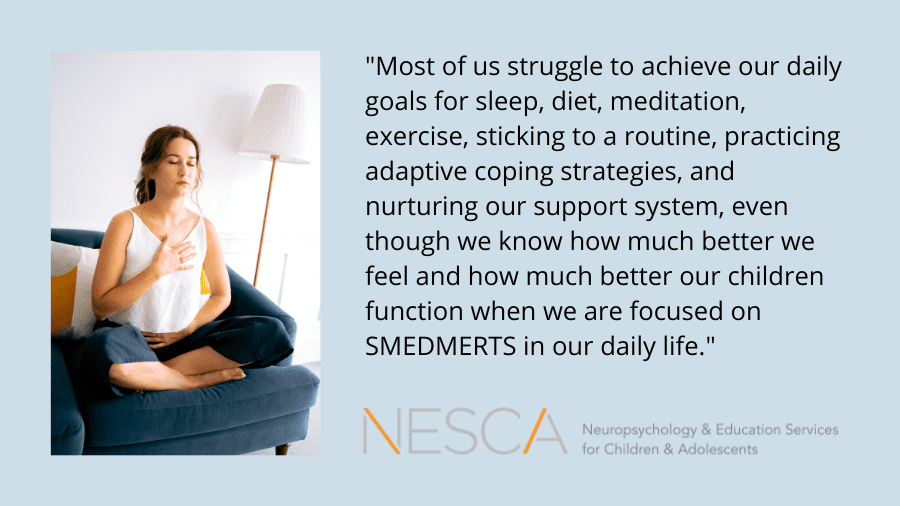
While attention to SMEDMERTS is important for all of us, especially in these stressful times, consistent focus on these lifestyle choices is particularly critical for the many children and adolescents who we see at NESCA presenting with anxiety, mood disorders, ADHD, and behavioral issues. Most of us struggle to achieve our daily goals for sleep, diet, meditation, exercise, sticking to a routine, practicing adaptive coping strategies, and nurturing our support system, even though we know how much better we feel and how much better our children function when we are focused on SMEDMERTS in our daily life. While the impact of medications and doctors on functioning is largely outside of our control, we can control our lifestyle choices, which are critical to the success of managing any mental health issue.

How can we help the children in our lives to embrace SMEDMERTS?

  • Modeling it for them. As Robert Fulgham said, “Don’t worry that your children never listen to you; worry that they are always watching you.”
  • Praising their efforts. Offer positive feedback, such as, “Great idea to get up early to go for a run,” or, “I like how you called a friend when you were upset to get some advice.”
  • Enlisting the help of a coach. NESCA offers real-life skills coaching, executive functioning coaching, and health coaching to help children, adolescents, and young adults build and maintain habits to support positive lifestyle choices.

Health coaching is available to parents of NESCA clients who are seeking support in developing positive health habits, such as exercise, diet, stress management, and meditation.

If you are interested in coaching services at NESCA to support your quest for SMEDMERTS, please contact Crystal Jean: cjean@nesca-newton.com or fill out our intake form at www.nesca-newton.com.


About the Author
NESCA Founder/Director Ann Helmus, Ph.D. is a licensed clinical neuropsychologist who has been practicing for almost 20 years. In 1996, she jointly founded the  Children’s Evaluation Center (CEC) in Newton, Massachusetts, serving as co-director there for almost ten years. During that time, CEC emerged as a leading regional center for the diagnosis and remediation of both learning disabilities and Autism Spectrum Disorders.

In September of 2007, Dr. Helmus established NESCA (Neuropsychology & Education Services for Children & Adolescents), a client and family-centered group of seasoned neuropsychologists and allied staff, many of whom she trained, striving to create and refine innovative clinical protocols and dedicated to setting new standards of care in the field.

Dr. Helmus specializes in the evaluation of children with learning disabilities, attention and executive function deficits and primary neurological disorders. In addition to assessing children, she also provides consultation and training to both public and private school systems. She frequently makes presentations to groups of parents, particularly on the topics of non-verbal learning disability and executive functioning.

To book an evaluation with one of NESCA’s many expert neuropsychologists, complete NESCA’s online intake form

Neuropsychology & Education Services for Children & Adolescents (NESCA) is a pediatric neuropsychology practice and integrative treatment center with offices in Newton and Plainville, Massachusetts, as well as Londonderry, New Hampshire. NESCA serves clients from preschool through young adulthood and their families. For more information, please email info@nesca-newton.com or call 617-658-9800.

Helping Your Anxious Child through COVID-19

By | NESCA Notes 2020


Almost a year into Covid-19, many of us can use this blog as a reminder when our children exhibit signs of anxiety from learning of new developments with the pandemic; friends, family or others testing positive for Covid-19; or returning to school. The guidance shared in this blog still holds true, nearly one year since many of us went into lockdown and schools shuttered. 


By Yvonne M. Asher, Ph.D. 
Pediatric Neuropsychologist

A recent New York Times article by Jessica Grose discusses ways to support your child, specifically helping them to feel less anxious, during the COVID-19 situation. Their “top 4” suggestions are great ones – validate their feelings, manage your own anxiety, aim for some kind of predictable routine and try mindfulness or progressive muscle relaxation activities.

The larger consideration in this case is this: anxiety, particularly in the current situation, is normal. We can label it with clinical words, give you our best clinical tools and recommend that you seek help (and please do!). At the same time, if we take a large step back, being anxious right now is exactly how we are meant to feel. We are social beings, designed to live in the community and support one another through face-to-face social interactions. When something threatens our safety, or the safety of our families, it is normal to respond with fear, worry and hypervigilance. Everyday interactions that would typically result in no response, like hearing someone nearby cough or sneeze, all of a sudden have become indicators of a threat. Even having others in close proximity to us is now a threat, meaning that the social communities in which we are supposed to thrive have now become potentially dangerous places. In this new environment, our bodies, well-attuned and primed to handle threats, are doing what they should do – they are putting us on “hyper-alert mode,” keeping us exceedingly sensitive to these threats so that we can avoid them and preserve our safety.

Children are in this mode, too, albeit with far fewer resources to help mitigate their fear and worry. As adults, we have far more lived experience with threats, anxiety, fear and worry, and we can use this experience to manage our responses to this novel situation. For children, this may be the first time they are struggling with persistent worry and fear. Or, they may have struggled to cope with other fears and worries for a long time, and this new stressor has overwhelmed their system. In either case, it is important to normalize fear and anxiety, in addition to the myriad of other emotions that children may be experiencing.

The key is balance. We have to balance validating and normalizing feelings with reinforcing unhealthy habits. What does that look like? One dimension to consider is time – validating and normalizing feelings is a short acknowledgement that the child is heard, understood and believed. On the other hand, repeatedly discussing the same questions or topics, engaging in persistent conversations about the threats and explaining “adult” information to children (especially dire predictions, long-term impacts, etc.) is not healthy. These behaviors may appear to decrease anxiety in the short-term, but over time, can be detrimental.

Another important consideration is space – focusing on what is happening in the present is important to help children process and understand the radical changes that are impacting their day-to-day lives. However, if you find that your conversations linger on the past or the future, try to shift back to the present. Your mind may be filled with regrets from the past (e.g., “I knew we should have stocked up on their favorite snack last time we were at the store”) or fears for the future (e.g., “My parents are elderly and at high risk”), and these thoughts are entirely normal. At the same time, when talking with children, it is important to try as much as possible to focus on the here and now. Of course, it is important to give children the space to express their fears for the future, and we can and should acknowledge and validate these fears. We can also, simultaneously, bring children’s focus back to the present and back to tangible, concrete things that they can do (e.g., “I know you are really worried about grandma, and it’s sad that we can’t see her right now. Everyone is working hard to keep her safe, and we are going to call and talk to her later today”).

For some children, advanced intellectual abilities may allow them to understand (at least, in some sense) a great deal of the information that is portrayed on the television and news media. However, it is important to remember that, while their cognitive abilities are years ahead of their peers, their emotional development is not. It may be necessary to closely monitor their online activity, as they may be seeking out information (which is a normal response to fears, especially fear of the unknown) without having the critical thinking abilities to understand the source or potential biases in the way the information is presented. On the other hand, some children may struggle to understand the situation, either because of their young age, learning disability or other developmental delays. If this describes your child, consider putting together a story, with pictures and words, to help them understand some basic information (e.g., why we can’t go to school right now, why we can’t go play with friends). This is often referred to as a “social story,” and clinicians at NESCA can help you create one specifically for your child.

Last, and most certainly not least, seek help and support for yourself, your child or anyone in your family who is struggling. While experiencing anxiety during these times is normal, when these thoughts and feelings are taking over your child’s daily life (or your own), it may be time to look for assistance. Many clinicians, including here at NESCA, are available via phone or videoconferencing, and we can assist with a range of concerns. Whether you want a brief consultation to help you respond to persistent questions from your child or whether your child has a pre-existing anxiety disorder that is exacerbated by these challenging times, we are here to help.


About Pediatric Neuropsychologist Dr. Yvonne Asher:

Dr. Yvonne M. Asher enjoys working with a wide range of children and teens, including those with autism spectrum disorder, developmental delays, learning disabilities, attention difficulties and executive functioning challenges. She often works with children whose complex profiles are not easily captured by a single label or diagnosis. She particularly enjoys working with young children and helping parents through their “first touch” with mental health care or developmental concerns.

Dr. Asher’s approach to assessment is gentle and supportive, and recognizes the importance of building rapport and trust. When working with young children, Dr. Asher incorporates play and “games” that allow children to complete standardized assessments in a fun and engaging environment.

Dr. Asher has extensive experience working in public, charter and religious schools, both as a classroom teacher and psychologist. She holds a master’s degree in education and continues to love working with educators. As a psychologist working in public schools, she gained invaluable experience with the IEP process from start to finish. She incorporates both her educational and psychological training when formulating recommendations to school teams.

Dr. Asher attended Swarthmore College and the Jewish Theological Seminary. She completed her doctoral degree at Suffolk University, where her dissertation looked at the impact of starting middle school on children’s social and emotional wellbeing. After graduating, she completed an intensive fellowship at the MGH Lurie Center for Autism, where she worked with a wide range of children, adolescents and young adults with autism and related disorders.


Neuropsychology & Education Services for Children & Adolescents (NESCA) is a pediatric neuropsychology practice and integrative treatment center with offices in Newton, Massachusetts, Plainville, Massachusetts, and Londonderry, New Hampshire, serving clients from preschool through young adulthood and their families. For more information, please email info@nesca-newton.com or call 617-658-9800.


To book an appointment with Dr. Yvonne Asher, please complete our Intake Form today. For more information about NESCA, please email info@nesca-newton.com or call 617-658-9800.


Skip to content