NESCA’s Newton, MA location has immediate availability for neuropsychological evaluations. Our MA clinicians specialize in the following evaluations: Neuropsychological; Autism; and Emotional and Psychological, as well as Academic Achievement and Learning Disability Testing.

Visit www.nesca-newton.com/intake for more information or to book an evaluation.

Tag

Transition Services Archives - Page 6 of 8 - NESCA

Subscribe to NESCA Notes

Transition Assessment: What is it anyway? How is it different from neuropsychological evaluation?

By | NESCA Notes 2020

By: Kelley Challen, Ed.M., CAS
Director of Transition Services; Assistant Director, NESCA

If you have a child who receives special education services or work in education, you are likely familiar with the Individuals with Disabilities Education Improvement Act of 2004 (IDEA 2004). This is the law that guarantees students with disabilities the right to free appropriate public education (FAPE) and that dictates that the purpose of special education and related services is to prepare students with disabilities for further education, employment, and independent living.

IDEA 2004 mandates that students have measurable postsecondary goals written in their individualized educational programs (IEPs), that describe the outcomes that a team expects for the student to achieve after exiting public education and that these goals must be “based upon age-appropriate transition assessments related to training, education, employment, and where appropriate, independent living skills.”[1] But, IDEA 2004 does not specifically define transition assessment.

Instead, the best and most commonly accepted definition for transition assessment comes from the Division on Career Development and Transition (DCDT). DCDT defines transition assessment as an “…ongoing process of collecting data on the individual’s needs, preferences, and interests as they relate to the demands of current and future working, educational, living, and personal and social environments.”[2]

Transition assessment can include formal testing, such as a standardized, published tests that compare students to others by age or grade or informal activities, such as interviewing or observing a student. Most students who are transition-aged (i.e., 14 or older in Massachusetts; 16 by federal law) have already had some assessments that will inform their transition planning, such as school evaluations, private evaluations, standardized academic testing, report cards, or even activities that happen within their guidance curriculum (e.g., assessment of strengths, learning style, personality type, career interests). But often, there will still be some testing needed to help better determine a student’s strengths and aptitudes, their preferences and interests for postsecondary adult life, and the gaps between their current knowledge and abilities and the requirements of the living, learning, and working environments in which they plan to function when they exit high school.

At NESCA, transition assessment is a highly individualized process that is designed to get a better sense of a student’s postsecondary living, learning, social, and vocational goals, to determine the strengths the student has that will help them reach those goals as well as the skills a student needs to develop to get there. While it is rare for two students to have the same assessment battery, transition assessment at NESCA often evaluates abilities, such as self-care, self-direction, self-advocacy, career interests, career aptitudes, communication, community use, functional academics, health and safety, domestic skills, leisure, readiness for college or other forms of postsecondary learning and training, transferrable work skills and readiness for employment. Once the student’s profile is understood, specific recommendations, aimed at readying that student for transition from high school to the next phase of life, are provided.

Often parents of transition-aged students are familiar with the term “neuropsychological evaluation“ and a student may have even had this type of private evaluation. But there can be some confusion regarding the difference between these two types of comprehensive testing. Neuropsychological evaluation focuses primarily on a student’s learning profile and the fit of that learner within their current academic setting. A good neuropsychological evaluation is a comprehensive assessment of a child’s functioning in many domains, including communication, visual-spatial ability, problem solving, memory, attention, social skills, and emotional status. The assessment of these functions is based upon information obtained from the child’s history, clinical observations, and testing results. Moreover, one of the most important aspects of a neuropsychological evaluation is the integration of all the information about a child into a meaningful profile of functioning that describes “The Whole Child.”

In contrast, a transition assessment evaluates the fit between a student and their future preferred learning, living, and employment activities and environments. While information from a neuropsychological evaluation about a student’s learning profile is greatly informative, a transition assessment gives equal weight to a student’s daily living skills, social skills, coping skills, pre-vocational skills, career interests and preferences, and self-advocacy skills. While transition assessments provide detailed recommendations related to current educational programming and transition services, a strong focus of transition assessment is an emphasis on what will be needed now, and in the near future, to assist a student in functioning, and, actually being successful and satisfied, in their postsecondary adult life.

For more information about transition assessment at NESCA, visit our transition services page and our transition FAQs.

[1] 34 CFR § 300.320(b)

[2] Division on Career Development and Transition (DCDT) of the Council for Exceptional Children, 1997, p. 70-71


About the Author:

Kelley Challen, Ed.M., CAS, is NESCA’s Director of Transition Services, overseeing planning, consultation, evaluation, coaching, case management, training and program development services. She is also the Assistant Director of NESCA, working under Dr. Ann Helmus to support day-to-day operations of the practice. Ms. Challen began facilitating programs for children and adolescents with special needs in 2004. After receiving her Master’s Degree and Certificate of Advanced Study in Risk and Prevention Counseling from Harvard Graduate School of Education, Ms. Challen spent several years at the MGH Aspire Program where she founded an array of social, life and career skill development programs for teens and young adults with Asperger’s Syndrome and related profiles. She additionally worked at the Northeast Arc as Program Director for the Spotlight Program, a drama-based social pragmatics program, serving youth with a wide range of diagnoses and collaborating with several school districts to design in-house social skills and transition programs. Ms. Challen is co-author of the chapter “Technologies to Support Interventions for Social- Emotional Intelligence, Self-Awareness, Personality Style, and Self-Regulation” for the book Technology Tools for Students with Autism. She is also a proud mother of two energetic boys, ages six and three. While Ms. Challen has special expertise in supporting students with Autism Spectrum Disorders, she provides support to individuals with a wide range of developmental and learning abilities, including students with complex medical needs.

Neuropsychology & Education Services for Children & Adolescents (NESCA) is a pediatric neuropsychology practice and integrative treatment center with offices in Newton, Massachusetts, Plainville, Massachusetts, and Londonderry, New Hampshire, serving clients from preschool through young adulthood and their families. For more information, please email info@nesca-newton.com or call 617-658-9800.

Transition Planning for Adulthood—It Starts at Birth

By | NESCA Notes 2019


By: Kelley Challen, Ed.M., CAS
Director of Transition Services; Transition Specialist

There are many transitions throughout a person’s life, but as a transition specialist working at a pediatric neuropsychology practice, my focus is most often on helping students who have struggled with learning, social and/or emotional difficulties to plan for and successfully navigate the transition from secondary school to whatever comes next in life (e.g., employment, transition program, community college, apprenticeship, etc.). I focus on helping young people envision their future selves and set short- and long-term goals for themselves—putting them into the driver’s seat for their own lives and helping them manage the risks and responsibilities that come with making choices for themselves.

When a family walks into my office for the first time, it is common for one parent or caretaker to worry aloud that they are starting transition planning for their child “too late.” I consistently respond that it is never too late to start planning and to begin transferring responsibility from one generation to the next. But today, I also want to emphasize that “it’s never too early” to start to plan for your child to be a more independent and competent adult—the best transition planning starts at birth.

Some common examples of transitions that start at a very early age that many parents and caregivers can relate to are: a child sleeping through the night for the first time unsupported, holding a cup and drinking without spilling, feeding oneself with a spoon, and/or riding a bicycle. Each of these activities is an example of a child building competence and independence while their parents simultaneously relinquish some amount of control. Often times, mistakes, messes and even pain are a natural part of the process.

From a young age, there are many skills that children can learn that will make a big difference for them later in life. Some examples include:

  • Picking out clothes for the next morning
  • Putting dirty clothes in a hamper
  • Loading the washing machine
  • Putting clean clothes away in drawers
  • Washing hands before eating, after using the bathroom and after playing outside
  • Setting the table (maybe not plates or glasses, but perhaps napkins, forks and spoons)
  • Carrying dishes to the counter and placing them next to the sink after dinner—or even in the dishwasher
  • Putting their own garbage in the trash
  • Collecting small trash bins to dump into a larger bin/bag on trash day
  • Helping to pack their own lunch
  • Helping to prep a meal (e.g., washing veggies, pouring ingredients, etc.)
  • Getting condiments from the refrigerator and putting them away after dinner
  • Getting a snack for self or a sibling from the refrigerator or pantry
  • Wiping down the table after a meal
  • Feeding/providing water for pets
  • Weeding
  • Raking leaves
  • Shoveling snow
  • Helping to get the mail
  • Brainstorming for/making a shopping list
  • Finding assigned items at the grocery store
  • Carrying light grocery bags
  • Helping to pack belongings for a family trip
  • Making gifts/cards for a celebration
  • Budgeting a few dollars to buy inexpensive but thoughtful gifts for family members

Some of these will apply to your child and some of them will not. And some of these may require adding time to your schedule, allowing a child to complete tasks at their own pace, or doing some household reorganization, allowing a child to access items necessary to complete tasks. Finally, a lot of deep breathing and patience—for both you and your child—will be required!

At any point in time, you can identify a task  you regularly do for your child and consider where there are pieces they can do for themselves. If your only role in the task is to prompt your child, consider whether there might be a low-technology tool (post-it, photograph) or high-technology tool (alarm, phone reminder) that could take the place of your prompt. If you are not sure how to make a change, it may be a good time to get help from a teacher, pediatrician, behavioral therapist, special educator, etc.

The important thing is that you are starting to think about where there is a potential for increasing competence, independence, confidence and self-esteem for your child. You are starting to plan for your own obsolescence in your child’s life, or at least in their carrying out every day self-care activities and chores. While that is a scary thing, it is also a beautiful and empowering thing!

*This blog was originally published in August, 2019.


If you are interested in working with a transition specialist at NESCA for consultation, planning or evaluation, please complete our online intake form: https://nesca-newton.com/intake-form/.


About the Author:

Kelley Challen, Ed.M., CAS, is NESCA’s Director of Transition Services, overseeing planning, consultation, evaluation, coaching, case management, training and program development services. Ms. Challen began facilitating programs for children and adolescents with special needs in 2004. After receiving her Master’s Degree and Certificate of Advanced Study in Risk and Prevention Counseling from Harvard Graduate School of Education, Ms. Challen spent several years at the MGH Aspire Program where she founded an array of social, life and career skill development programs for teens and young adults with Asperger’s Syndrome and related profiles. She additionally worked at the Northeast Arc as Program Director for the Spotlight Program, a drama-based social pragmatics program, serving youth with a wide range of diagnoses and collaborating with several school districts to design in-house social skills and transition programs. Ms. Challen is co-author of the chapter “Technologies to Support Interventions for Social- Emotional Intelligence, Self-Awareness, Personality Style, and Self-Regulation” for the book Technology Tools for Students with Autism. She is also a proud mother of two energetic boys, ages seven and eleven. While Ms. Challen has special expertise in supporting students with Autism Spectrum Disorders, she provides support to individuals with a wide range of developmental and learning abilities, including students with complex medical needs.

Neuropsychology & Education Services for Children & Adolescents (NESCA) is a pediatric neuropsychology practice and integrative treatment center with offices in Newton, Massachusetts, Plainville, Massachusetts, and Londonderry, New Hampshire, serving clients from preschool through young adulthood and their families. For more information, please email info@nesca-newton.com or call 617-658-9800.


Building Gratitude in our Kids

By | NESCA Notes 2020

By: Tabitha Monahan, M.A., CRC
NESCA Transition Specialist/Counselor

Would it be November without a blog post about gratitude? Gratitude feels both more important and harder to come by this year with the slew of events bombarding people’s personal lives and something different appearing what feels like every news cycle. But there must be something to all this gratitude if everyone from Forbes Magazine to Psychology Today is writing about it?

So what does the science say?

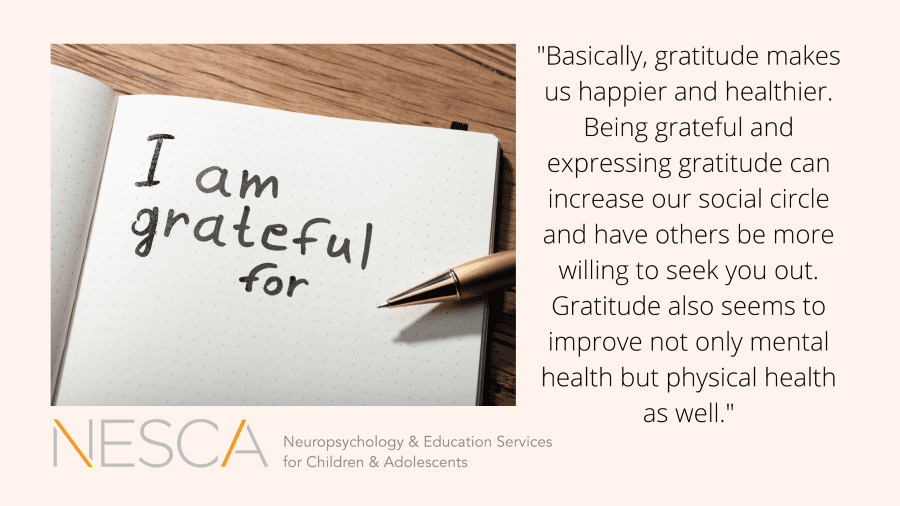
Basically, gratitude makes us happier and healthier. Being grateful and expressing gratitude can increase our social circle and have others be more willing to seek you out. Gratitude also seems to improve not only mental health but physical health as well. Studies show that grateful people take care of themselves better. They are more likely to exercise and more likely to follow up with medical personal. Studies show that writing in a gratitude journal before bed can even help you sleep better! (Morin, n.d.)

How can I help my child build gratitude?

Young people with disabilities, especially speech and language challenges, may have a hard time sharing their experiences at the end of the school day. Before my students left for the day, I would always ask them to go around the room and share one thing they enjoyed during their day. This way, no matter how challenging the day was, they ended it on a good note. Over time, the students began to look forward to sharing a positive experience from their day. Whether it was getting a compliment at their worksite or overcoming a challenge, they began to go looking for the positives.

Another wonderful way to build gratitude is to turn it into a scavenger hunt. Give each day a topic and share your gratitude topic at dinner. 

While we often think of a gratitude journal as something written, it doesn’t have to be. Have fun with it! Instead of writing down what you are thankful for today, take a picture with your phone or have your child make a drawing relating to the topic. Pinterest is full of great ideas, like the image below. Doing this for a month may turn you and your child a little more gleeful and find a brighter outlook on tomorrow.

Image Credit: Woman of Purpose (thepurposedwomanmag.com)

What are you grateful for today?


About the Author

Tabitha Monahan, M.A., CRC, is an experienced transition evaluator and vocational counselor. While she is well-versed in supporting a wide range of transition-aged youth, she is especially passionate and knowledgeable in helping clients and their families navigate the complex systems of adult services and benefits as well as medical and mental health systems. She is further adept in working individually with students of all abilities to empower self-advocacy and goal achievement.


To schedule an appointment with one of NESCA’s expert transition specialists or neuropsychologists, please complete our online intake form


Neuropsychology & Education Services for Children & Adolescents (NESCA) is a pediatric neuropsychology practice and integrative treatment center with offices in Newton and Plainville, Massachusetts, and Londonderry, New Hampshire, serving clients from preschool through young adulthood and their families. For more information, please email info@nesca-newton.com or call 617-658-9800.


Linking Strengths and Interests to College Majors and Careers: The MassHire Career Information System

By | NESCA Notes 2020

By: Kelley Challen, Ed.M., CAS
Director of Transition Services; Assistant Director, NESCA

Due to Covid-19, many schools are functioning in a hybrid or remote learning status, making access to school-based guidance counselors, college counselors and transition personnel more complicated. Consequently, I am working with an unusually high number of high school students and families to provide assistance with the college selection and admissions process this year. For these students and others, working with a private transition specialist or college consultant/coach provides the structure and consistent support needed to ensure the student is able to find colleges that will be a great match, highlight the student’s strengths as a college applicant and complete the application process efficiently. Most importantly, the added support reduces anxiety—which is a natural response to the college process as well as living through a pandemic.

There are so many factors to consider when choosing a college—size, religion, location, tuition and fees, availability of internships, academic support, etc.—and one of the most important differentiating factors is often the availability of majors that a student is interested in. As such, career exploration is a very important part of my work with college-bound students. There are certainly many online resources that are useful for career exploration—YouScience, O*NET OnLine, Naviance, Khan Academy, Dr. Kit, CareerOneStop, etc.—but my personal favorite site to help teenagers learn to use is MassHire Career Information System (Previously MassCIS; https://portal.masscis.intocareers.org/).

MassHire CIS is a portal that any individual, from middle school to adulthood, can access for free by logging in with their Massachusetts City or Town Name and their Zip Code. Once inside, users can complete assessments related to their interests, skills and values, preferred lifestyle and more. The site also allows students to link results from previously taken career assessments to information about occupations and occupation categories within MassHire CIS.

Using career interests, from assessments or just a self-reported interest (e.g., photographer, elementary school teacher, personal trainer), users can research occupations and find out everything from the tasks associated with the occupation, to helpful high school courses that relate to the job, and expected future wages and occupational outlook. Users can also watch videos to learn more about occupations.

Importantly, users can easily click from careers of interest to programs of study and ultimately to Massachusetts Schools or other US Colleges and Universities that offer majors leading to occupations of interest.

MassHire CIS is one of my favorite resources to share with teens, young adults and families as part of a college transition process—but also when students are building career awareness at other times or seeking a different path to employment. I hope that by spotlighting this in my blog, more families, educators and professionals will also explore and adopt this resource as a favorite!


About the Author:

Kelley Challen, Ed.M., CAS, is NESCA’s Director of Transition Services, overseeing planning, consultation, evaluation, coaching, case management, training and program development services. She is also the Assistant Director of NESCA, working under Dr. Ann Helmus to support day-to-day operations of the practice. Ms. Challen began facilitating programs for children and adolescents with special needs in 2004. After receiving her Master’s Degree and Certificate of Advanced Study in Risk and Prevention Counseling from Harvard Graduate School of Education, Ms. Challen spent several years at the MGH Aspire Program where she founded an array of social, life and career skill development programs for teens and young adults with Asperger’s Syndrome and related profiles. She additionally worked at the Northeast Arc as Program Director for the Spotlight Program, a drama-based social pragmatics program, serving youth with a wide range of diagnoses and collaborating with several school districts to design in-house social skills and transition programs. Ms. Challen is co-author of the chapter “Technologies to Support Interventions for Social- Emotional Intelligence, Self-Awareness, Personality Style, and Self-Regulation” for the book Technology Tools for Students with Autism. She is also a proud mother of two energetic boys, ages six and three. While Ms. Challen has special expertise in supporting students with Autism Spectrum Disorders, she provides support to individuals with a wide range of developmental and learning abilities, including students with complex medical needs.

Neuropsychology & Education Services for Children & Adolescents (NESCA) is a pediatric neuropsychology practice and integrative treatment center with offices in Newton, Massachusetts, Plainville, Massachusetts, and Londonderry, New Hampshire, serving clients from preschool through young adulthood and their families. For more information, please email info@nesca-newton.com or call 617-658-9800.
What Is A Representative Payee?

By | NESCA Notes 2020

By: Tabitha Monahan, M.A., CRC
Transition Specialist/Counselor

Your child has turned 18. The application for Supplemental Security Insurance (SSI) has been submitted and approved. You’ve been assigned to be the representative payee to manage the SSI funds. How can you still help your child gain money management skills while managing the responsibilities as required by the Social Security Administration (SSA)?

What is a Representative Payee?

Many individuals with disabilities can safely and successfully manage their finances without assistance. However, due to their disability’s nature, many individuals are unable to manage their finances without help. In response to individuals who need assistance to ensure their needs are being met through their benefits, the SSA created representative payees. A representative payee is a person or organization assigned by the SSA to be responsible for the benefits that a person receives from the SSA and ensures that the beneficiary’s needs, such as housing, food and medical care are met. A representative payee can be a family member, friend or another person. When the representative payee is an organization, there is often a fee (determined by the SSA), but when the payee is a friend or family member, the payee provides this service at no cost to the beneficiary. The representative payee will make a budget for the beneficiary to ensure basic needs are met and provide money for savings and personal spending if funds allow.

A representative payee is responsible for tracking and keeping detailed records of how the funds are spent and must provide those records to the SSA when asked. Many payees also need to fill out an annual reporting to the SSA detailing how the funds from the previous year were used. Recent changes in the law amended who needed to fill out such reports. Now, parents and spouses who are representative payees and live with the beneficiary no longer need to fill out the annual report. However, they do still need to keep detailed financial records.

How can I support my child’s financial literacy as their representative payee?

I have been a representative payee for individuals with disabilities for the vast majority of my career. In that role, I also worked to increase the individual’s financial literacy skills and increase their understanding of their financial situation. Having the individual involved in the process has innumerable benefits, the most basic of being the respect for their human rights. By having the individuals involved as much as they are capable and is healthy for them, much of the animosity and much of the paternalism of having another person control their finances, can be dissipated. Some individuals will still choose to have minimal involvement in their finances due to anxiety, comprehension or individual priorities. But most will want a say. By meeting your child where they are in their financial journey, you can build their confidence, independence and autonomy.

The first step I like to take in building an understanding around finances is helping the person comprehend where their money is going. Maybe that will be showing your child a bank statement. Perhaps it will be showing receipts. For many young people, the amount they receive in SSI seems like a lot of money. Helping them understand the value of the funds they receive can be one of the most challenging tasks.

Another activity I like to do with the beneficiaries I assist is asking them to create their budget. How would they like to see their money spent? What are their financial goals? Do they want to live on their own someday? How much do they want to set aside for savings for more significant expenses or purchases, like first, last and security deposit; a car; a vacation? Below is a very basic budgeting form I like to use as a starting point.

Beneficiary Budget Month Year
Income
SSI $783.00
MA State Supplement $114.39
Total Income: $897.39
Expense
Rent $265.00
Groceries $200.00
Transportation $55.00
Electricity $60.00
Cable $105.00
Cell Phone $75.00
Medication $15.00
Personal Spending $75.00
Savings $25.00
Total Spending: $875.00

Within the last few years, ABLE accounts have been getting a lot of press – and for good reason. For individuals who became disabled at birth or at a young age, an ABLE account is a wonderful way for the individual to save money for important needs and not have those assets affect the essential financial and healthcare benefits they need. The IRS recently updated the rules for ABLE accounts. In the resources below is an article from Disability Scoop with information about these updates.

One of the best ways to increase your child’s money management skills is to have them be responsible for portions of their money. They are many ways to do this, and it may take some trial and error to find the best way for your child. It is important to remember that you are not allowed to give the beneficiary direct access to the bank account as the representative payee. That means you cannot just hand over the debit card to your child. However, many companies offer programs that help young people (and adults) manage their money. I tend not to use the word “allowance” for adults when managing their money. Instead, I use words like “personal spending” or “Flex Money.” Whether I write a check to the individual for these funds or reload a prepaid debit card, giving the individuals the remaining money after necessities have been met gives them the freedom to make their own spending choices, whether good or bad. And yes, I have worked with individuals who were without personal spending money within days of receiving their excess funds for the month. Still, I have worked with individuals who have, over time, been able to build some savings and a greater understanding of money management. I have listed some in the resources, but these are not ones I have personally used, so please review and see which ones you think would work best for your family.

Another method that I find beyond useful to help build financial independence and assess current money management skills is to transfer the responsibility of paying a bill over to the individual. This should be a lower priority bill, like the cable bill, a streaming service or a cell phone bill. As time goes on and the person can pay the bill on time without prompts, increase the number of accounts the person is responsible for paying. As they build their financial independence, increase their personal spending to include funds for necessities, such as groceries and prescription copays. And remember, once a person has a representative payee, it does not mean that they must have one for life. Suppose your child is able to build the financial management skills necessary to manage their finances independently. In that case, a representative payee can be removed. If your child now has the skills to manage their own money, talk to one of your child’s providers. They can fill out a form to return this right to your child.

Have you been working with your child on money management skills? How have you fostered financial independence?


Resources:

Social Security Administration Representative Payee Webpage

Disability Scoop: IRS Issues Final Rules on ABLE Accounts

The Balance: The Best Debit Cards for Teens

Capital One MONEY Account

Dough Roller: Best Prepaid Debit Cards for Teens

FAQs for Beneficiaries that have Representative Payees


About the Author

Tabitha Monahan, M.A., CRC, is an experienced transition evaluator and vocational counselor. While she is well-versed in supporting a wide range of transition-aged youth, she is especially passionate and knowledgeable in helping clients and their families navigate the complex systems of adult services and benefits as well as medical and mental health systems. She is further adept in working individually with students of all abilities to empower self-advocacy and goal achievement.


To schedule an appointment with one of NESCA’s expert transition specialists or neuropsychologists, please complete our online intake form


Neuropsychology & Education Services for Children & Adolescents (NESCA) is a pediatric neuropsychology practice and integrative treatment center with offices in Newton and Plainville, Massachusetts, and Londonderry, New Hampshire, serving clients from preschool through young adulthood and their families. For more information, please email info@nesca-newton.com or call 617-658-9800.


Voting Support for Individuals with Disabilities

By | NESCA Notes 2020

By: Tabitha Monahan, M.A., CRC
Transition Specialist/Counselor

General Election season is upon us. The major-party national conventions are over, and the Massachusetts primary results are in.

About 20% of eligible voters have a disabilitybut only 49.3% of individuals with disabilities voted in 2018. And that was an 8.5% increase from previous years among this increasingly important voting bloc. Campaigns, such as the REV UP Campaign by the American Association of People with Disabilities (AAPD), have launched voter registration drives, championed for disability rights and policies to be part of the political conversation, and to increase awareness and action to remove barriers that make it challenging for individuals with disabilities to vote.

So how can we help our young people with disabilities exercise their right to vote? In Massachusetts, even individuals with guardianship maintain their right to vote unless the court documents specifically state otherwise. There are many ways to support individuals, but it starts with helping them register. Massachusetts residents can register to vote online, when obtaining or renewing a driver’s license or state ID, or at the local registrar of voters’ office. Notices from MassHealth and the DTA also include voter registration forms.

Absentee/mail-in ballots have been in the news more than ever due to the pandemic. Still, they have long been an excellent strategy for individuals with disabilities who would have difficulty voting in person. Absentee ballots are a great option for individuals who may have difficulty navigating the multiple steps in person or have a lower processing speed.

All citizens are also allowed to bring a person to help them while they are at the polls. Encourage your young person that many people require assistance at the polls, and it is completely normal to have the help available if they need it. Each polling location should also have at least one AutoMARK Voter Assist Terminal, which helps individuals with visual impairments vote independently.

No one wants their vote not to be counted due to errors filling out their ballot. People can request a sample ballot in advance from their local registrar of voters (the Secretary of State’s website can give you the address and phone number of your local registrar). Practicing filling out ballots in advance (even ballots from previous elections) can help a new voter become comfortable with the form and is great fine motor skill practice for those who may need it!

The Massachusetts Secretary of State also creates a voter information booklet for each election regarding the ballot initiatives. These red booklets can be found at many community locations and frequently include the local library, post office and city/town hall. These booklets offer information on what a yay or nay vote would mean and have information from each initiative’s proponents and opponents. Use that sample ballot as a starting point for the different types of elected positions.

Help your young adult find out what the different boards do and why there is an election for things such as town selectman or zoning board. Help your young adult find the websites for candidates running for office and review the candidates’ stances on issues. Ask what issues they want to learn more about and are important to them.

Most importantly, remind them that their voice counts. As many disability rights activists have said, “nothing about us without us.” Individuals with disabilities are greatly affected by the policy decisions that occur in government at all levels. Since many individuals with disabilities have frequently experienced disenfranchisement, there are numerous groups working tirelessly to lessen and remove these barriers. How have you helped your young adult exercise their right to vote?


About the Author

Tabitha Monahan, M.A., CRC, is an experienced transition evaluator and vocational counselor. While she is well-versed in supporting a wide range of transition-aged youth, she is especially passionate and knowledgeable in helping clients and their families navigate the complex systems of adult services and benefits as well as medical and mental health systems. She is further adept in working individually with students of all abilities to empower self-advocacy and goal achievement.


To schedule an appointment with one of NESCA’s expert transition specialists or neuropsychologists, please complete our online intake form


Neuropsychology & Education Services for Children & Adolescents (NESCA) is a pediatric neuropsychology practice and integrative treatment center with offices in Newton and Plainville, Massachusetts, and Londonderry, New Hampshire, serving clients from preschool through young adulthood and their families. For more information, please email info@nesca-newton.com or call 617-658-9800.


What In-person School Looks Like During COVID-19

By | NESCA Notes 2020

By: Tabitha Monahan, M.A., CRC
Transition Specialist/Counselor

Fall is approaching, and school is starting. As a student, I always knew summer was close to ending when Staples started their “Most Wonderful Time of the Year” commercial. The joy that parents and the community feel as fall approaches and another year of learning begins is understandably absent this year. Many parents, teachers and students are still unsure if they will be remote, in-person or both. All are too aware that even if students and teachers return to the school building, school will not look as it did in the fall of 2019. The comradery that our children experience through recess and interactive group work will be limited. Lunch will not be the boisterous room of students comparing who is in each class and what teachers are giving homework the first week.

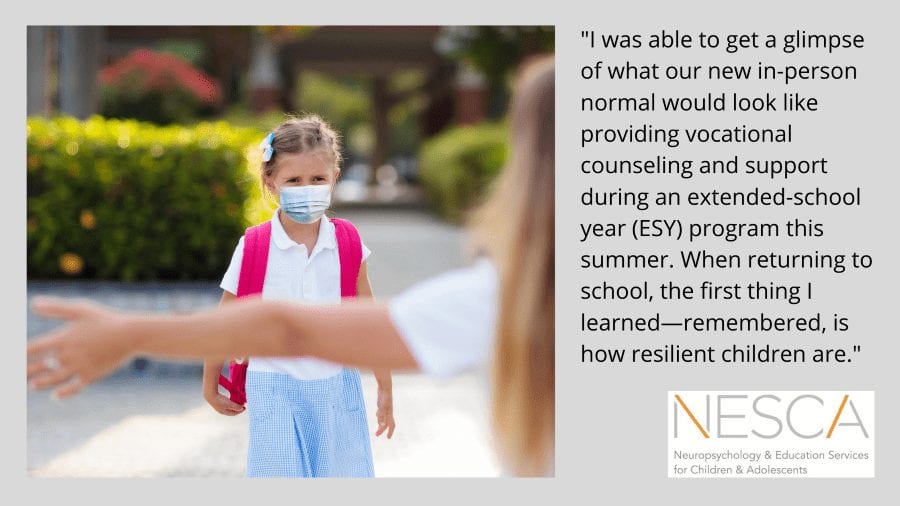
What can we expect then–especially our students who need the small in-person support they have received from their special education teachers, teaching assistants and related service providers? I was able to get a glimpse of what our new in-person normal would look like providing vocational counseling and support during an extended-school year (ESY) program this summer. When returning to school, the first thing I learned—remembered, is how resilient children are. Most students in the programs had very few issues with masks. For those who did, more frequent mask breaks and workarounds, such as face shields, greater distance between them and other students or neck scarves let them still participate in much needed in-person support. Hand-washing and sanitizer have become the norm, and staff and students had frequent opportunities to use both. Social Skills groups still occurred but were modified to continue to be possible. Community-based opportunities were limited, but again, teachers and service providers have long been accustomed to finding out of the box solutions for their students.

Yes, the first day was nerveracking. How were the students going to tolerate wearing a mask for hours on end? How were my co-workers and I going to wear a mask all day long? How was I going to get a drink safely while wearing a mask? But we did. Staff and students alike remained diligent with hand-washing, and the students were ready to learn. Teachers and teaching assistants (TAs) were available and came together for short periods to help students understand challenging tasks. Some of our children and students have behaviors or need activities of daily living (ADL) support that may have us more uneasy with their health and safety returning to in-person learning. Teachers and TAs were prepared for that, too. Whether it was a face shield with a mask, an extra set of clothes to change into or an additional layer of PPE, the student’s needs were met, and we all returned the next day.

Every district seems to have its own approach and plan. Still, in the end, each plan’s goal is the same: have every student continue to learn and prepare for life after high school and have each person return home safe and healthy.


About the Author

Tabitha Monahan, M.A., CRC, is an experienced transition evaluator and vocational counselor. While she is well-versed in supporting a wide range of transition-aged youth, she is especially passionate and knowledgeable in helping clients and their families navigate the complex systems of adult services and benefits as well as medical and mental health systems. She is further adept in working individually with students of all abilities to empower self-advocacy and goal achievement.


To schedule an appointment with one of NESCA’s expert transition specialists or neuropsychologists, please complete our online intake form


Neuropsychology & Education Services for Children & Adolescents (NESCA) is a pediatric neuropsychology practice and integrative treatment center with offices in Newton and Plainville, Massachusetts, and Londonderry, New Hampshire, serving clients from preschool through young adulthood and their families. For more information, please email info@nesca-newton.com or call 617-658-9800.


Processing Speed Deficits and College – Part 2 – Finding a Fit

By | NESCA Notes 2020

By: Kelley Challen, Ed.M., CAS
Director of Transition Services; Transition Specialist

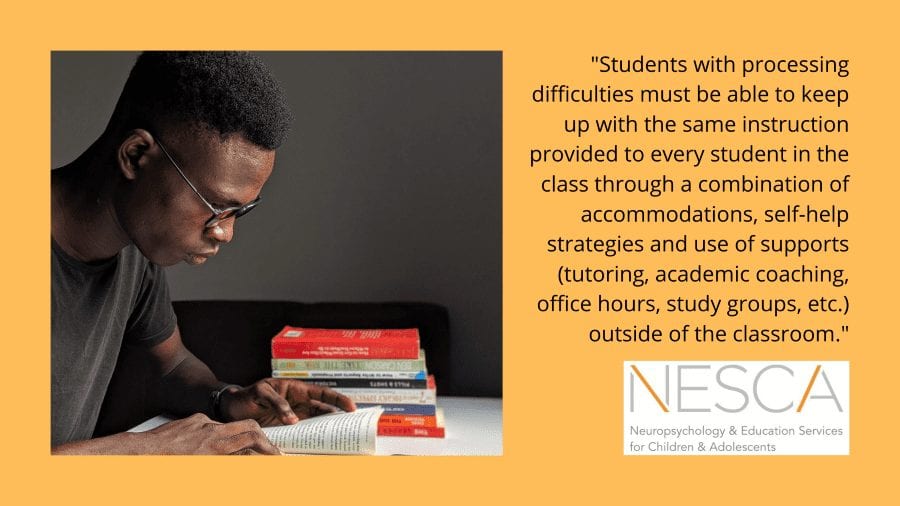
In my last blog, Processing Speed Deficits and College – Part 1 – The Dilemma, I discussed specialized instruction for students who have processing speed deficits in high school in comparison to the accommodations process in college. Below is a list of some of the accommodations and instructional modifications that are often afforded to students with processing speed deficits in high school, and if/how that support can be replicated in college as well as how hard a student may need to work to bridge gaps in support. One of the most important things to remember when reviewing this list is that modifications to the course of study or workload in a college course are typically not available in college. Students with processing difficulties must be able to keep up with the same instruction provided to every student in the class through a combination of accommodations, self-help strategies and use of supports (tutoring, academic coaching, office hours, study groups, etc.) outside of the classroom.

In the classroom

  • Reduced pace for instruction – High school educators may be used to heavily modifying their instruction (i.e., providing instruction at a slower pace, in manageable “chunks,” sometimes even with breaks between content) when they are teaching a class that includes students with reduced processing speeds. This is a typical methodology for many private special education schools and for special education classes in public schools. However, this is not the typical instructional style at a traditional college. With that said, there is great variety in the pacing of classes from one institution to another, and even from one teacher to another within the same institution. For students who have received specialized instruction in high school, it is important to consider the pace of available instruction and to sit in on college classes when considering this transition. Depending on the student’s learning profile, it may be necessary to seek out a college or support program that is specifically designed for students with learning disabilities or has had targeted programming for students with learning disabilities—especially those with processing speed deficits—for many years.
  • Copies of teacher notes or fill-in-the-blank notes – Note-taking is an important skill for life, and even students who receive accommodations to enhance their note-taking need to build skills for retaining instruction and oral direction. However, some students exit high school without note-taking skills. Upon request, colleges often have one or more ways that they can accommodate students who are unable to effectively take their own notes in class. Students may be able to get copies of teacher notes/slides, copies of notes taken by another designated student or professional note taker, recordings of class or opportunities to use other technologies in class, such as a Livescribe Smartpen. When note-taking is a challenge, it is important to understand what accommodations are typically available at a particular college, including what support might be provided for assistive technology training and usage.
  • Follow-up questions and review of learning – Students who have difficulty processing classroom learning in real-time are often provided lengthy opportunities to ask questions about materials outside of class and/or provided with copies of the teacher’s lecture materials and study guides for separate review. When thinking about college, easy access to course information and resources from outside of the classroom is an important consideration. While many universities and professors use learning management system (LMS) technologies like Blackboard, Canvas, Google Classroom, etc., there are still some professors who have not made the shift to using these systems for the majority of their coursework or student communication. Getting a sense of technology use is important if a student expects to preview and review course materials outside of the classroom (independently or with support). Understanding how easy it is to get ahold of professors outside of class (e.g., percentage of faculty who work full-time at the school, have offices, have office hours), and how to schedule brief times for individual communication with the instructor is also useful.

Managing assignments

  • Reduced writing – In high school, students who struggle with processing speed may be expected to complete fewer assignments or have longer deadlines than typical peers. In college, students are expected to complete the same number of assignments and to have all of their work for each course completed by the end of the semester. It is possible at some colleges to request extensions on assignments as an accommodation or on a case-by-case basis. However, extensions on assignments should be something that are needed as an exception rather than a rule or students may find themselves unable to keep up toward the end of a semester. Instead of extending deadlines, students who struggle with writing demands may benefit greatly by taking a reduced course load (i.e., fewer classes per semester) or by diversifying the types of classes they enroll in during one semester—for example, taking a kinesiology class at the same time as an English Composition class. If these types of accommodations are important, students will need to carefully understand a school’s policies on underloads as well as how much control/flexibility a student is able to have when managing their course of study.
  • Grading based on quality not quantity – Just as described above, it is important to remember that every student in a college course is expected to complete the same quantity of work and same course requirements. Both quality and quantity matter in college and for those reasons it is important to pick a school that is well suited for your pace and style of learning as well as a major that will enable you to fulfill course requirements using your learning strengths.
  • Support with reading fluency – Specialized instruction during K-12 education may have focused on helping a student to increase their reading pace. Reading intervention and readers are not typical in college. However, technology can be a lifesaver in supporting a student’s independent reading fluency. Students may benefit from audio books or from text-to-speech technology so that they can take in information in multiple modes and a faster pace. Practicing with technologies and understanding the related accommodations that will be available in college are important for continued reading success. Some high school students have additionally needed tutoring support because they learn best when discussing aloud content that they have read in a supportive setting—for those students, it has been important to seek out schools or learning disability programs that can provide this type of tutoring (a less common support) or to pay privately for tutoring in addition to college-based learning supports.

Testing

  • Extra time – This is one accommodation that is fairly common in both high school and college settings. One major change is that many high schools provided unlimited extra time to students, even those with no identified learning disabilities. In college, students will typically receive 50% or 100% extended time based on their needs as demonstrated in diagnostic testing. Good executive functioning can be helpful if you are a student who uses extra time on exams, because you may need to schedule your exams in a separate testing setting each time they occur.
  • Shorter length/Reduced writing requirements – As a college student, you are required to meet the same testing requirements as every student in your class. If you are accustomed to reduced writing requirements on tests, you will need to consider some of the other available accommodations (e.g., extra time, assistive technology, etc.) to successfully manage. You may also need support building your test taking strategies so that you can use your time most efficiently on tests.
  • Separate testing space – Taking a test in a reduced distraction environment, or possibly a private room, is another accommodation that is common in both high school and college. Similar to students who receive extra time on tests, there can be a high degree of planning and organization involved in scheduling one’s exams in a separate setting according to school guidelines. Students may want to inquire about the level of support that college personnel will provide to a student when they are first learning to organize and implement their testing accommodations.

Social and daily life

  • Two additional factors that may have been important in high school include Smaller school/class size and Similar peer cohort. Matriculating from a small homogenous class or school environment, where all of your peers have similar learning styles and accommodation needs, can be a shock. When researching and visiting schools, it will be extremely important to get a sense of who the other students on campus are, how common processing speed deficits are among students with learning disabilities on campus, how diverse the school is and how tolerant students generally are, etc. Sitting in on classes and taking part in accepted student days can be critical activities for students who are looking for a college that will meet them where they are at.

When students enroll with disability support services, they are often asked how their disability impacts their learning, what accommodations they were provided in high school, and what accommodations they think they will need. For students with processing speed deficits, it is critical to be able to answer these questions before beginning a college search and to find colleges that truly match their learning needs as well as their more general wishlist!


About the Author:

Kelley Challen, Ed.M., CAS, is NESCA’s Director of Transition Services, overseeing planning, consultation, evaluation, coaching, case management, training and program development services. She is also the Assistant Director of NESCA, working under Dr. Ann Helmus to support day-to-day operations of the practice. Ms. Challen began facilitating programs for children and adolescents with special needs in 2004. After receiving her Master’s Degree and Certificate of Advanced Study in Risk and Prevention Counseling from Harvard Graduate School of Education, Ms. Challen spent several years at the MGH Aspire Program where she founded an array of social, life and career skill development programs for teens and young adults with Asperger’s Syndrome and related profiles. She additionally worked at the Northeast Arc as Program Director for the Spotlight Program, a drama-based social pragmatics program, serving youth with a wide range of diagnoses and collaborating with several school districts to design in-house social skills and transition programs. Ms. Challen is co-author of the chapter “Technologies to Support Interventions for Social- Emotional Intelligence, Self-Awareness, Personality Style, and Self-Regulation” for the book Technology Tools for Students with Autism. She is also a proud mother of two energetic boys, ages six and three. While Ms. Challen has special expertise in supporting students with Autism Spectrum Disorders, she provides support to individuals with a wide range of developmental and learning abilities, including students with complex medical needs.

Neuropsychology & Education Services for Children & Adolescents (NESCA) is a pediatric neuropsychology practice and integrative treatment center with offices in Newton, Massachusetts, Plainville, Massachusetts, and Londonderry, New Hampshire, serving clients from preschool through young adulthood and their families. For more information, please email info@nesca-newton.com or call 617-658-9800.

Processing Speed Deficits and College – Part 1 – The Dilemma

By | NESCA Notes 2020

By: Kelley Challen, Ed.M., CAS
Director of Transition Services; Transition Specialist

By nature, transition specialists are generalists—professional who support students with a wide range of disabilities in moving toward an even wider range of learning and life outcomes. Working in Massachusetts, with an early background as a guidance counselor in a college preparatory high school, I often support students who are contemplating whether and when they should matriculate to a four-year college program. Many of these students experience processing speed deficits. This means that these students may be capable of reasoning at average or above average levels, and therefore being stimulated and actively engaged by college course content, but these students also need extra time to process visual and verbal information, to make sense of this information, and to produce output.

Landmark College in Putney, Vermont, assembled an assessment for parents and students—A Guide to Assessing College Readiness—that includes five areas considered essential for students with learning disabilities who want to succeed in a traditional college setting. These include academic skills, self-understanding, self-advocacy, executive function and motivation/confidence. Some of the academic items include being able to read up to 200 pages of college level text in a week, writing an organized 10-page paper that cites multiple sources, and being able to complete all of the steps of a long-term project in a timely manner. Within the assessment, it is carefully noted that this is not a diagnostic tool and is intended to inform discussion about the appropriate environment and supports that the student will need to achieve success and struggle less in college. So, when I recently received a question from a parent who was wondering if it actually mattered that her student was not able to read 100 pages in only a few days, the answer I provided was, “it depends.”

While there are many ways that we accommodate and modify instruction for students who have processing speed deficits during high school, some of these methods are easy to replicate across college environments and others are heavily dependent on the environment or only replicable with a good deal of external support provided by people and technologies. For example, in high school, students with significant processing speed deficits may be supported through accommodations, such as teachers reducing their pace of instruction, providing copies of instructional materials and/or fill-in-the-blank note-taking templates, actively following up with students to confirm their understanding of material, and actively assisting students in digesting complex reading materials. They may also receive modifications such as reducing the amount of work a student is expected to do per quarter or on a test and offering lighter or alternative reading. When all of these accommodations and modifications are added together, a student has a highly specialized high school experience and may be left with gaps in their academic, executive functioning and self-advocacy skills that need to be carefully bridged when the student aspires to participate in college learning.

While high school accommodations and modifications center on supporting a student to successfully make progress in school, accommodations at the college level focus exclusively on what a student needs to be able to access the instruction that is already available at that college. Rather than individually modifying the curriculum or work load in a college course, a student must be able to keep up with the same instruction provided to every student in the class and the same requirements as every student in the college through a combination of accommodations, self-help strategies and use of supports (tutoring, academic coaching, office hours, study groups, etc.) outside of the classroom. Accommodations are still very individualized, but educational programming is typically not. This makes the college search and selection process complex and important for students with processing speed deficits. Not every college that specializes in supporting students who face learning difficulties is a good choice for a student with slow processing speed. And not every student with a processing speed deficit has the same skills, or faces the exact same challenges, when navigating college.

Stay tuned for our next Transition Thursday blog where I will elaborate on some of the common modifications and accommodations provided to high school students with processing speed deficits and how to think critically about college selection, support and accommodation based on experience with those accommodations.


About the Author:

Kelley Challen, Ed.M., CAS, is NESCA’s Director of Transition Services, overseeing planning, consultation, evaluation, coaching, case management, training and program development services. She is also the Assistant Director of NESCA, working under Dr. Ann Helmus to support day-to-day operations of the practice. Ms. Challen began facilitating programs for children and adolescents with special needs in 2004. After receiving her Master’s Degree and Certificate of Advanced Study in Risk and Prevention Counseling from Harvard Graduate School of Education, Ms. Challen spent several years at the MGH Aspire Program where she founded an array of social, life and career skill development programs for teens and young adults with Asperger’s Syndrome and related profiles. She additionally worked at the Northeast Arc as Program Director for the Spotlight Program, a drama-based social pragmatics program, serving youth with a wide range of diagnoses and collaborating with several school districts to design in-house social skills and transition programs. Ms. Challen is co-author of the chapter “Technologies to Support Interventions for Social- Emotional Intelligence, Self-Awareness, Personality Style, and Self-Regulation” for the book Technology Tools for Students with Autism. She is also a proud mother of two energetic boys, ages six and three. While Ms. Challen has special expertise in supporting students with Autism Spectrum Disorders, she provides support to individuals with a wide range of developmental and learning abilities, including students with complex medical needs.

Neuropsychology & Education Services for Children & Adolescents (NESCA) is a pediatric neuropsychology practice and integrative treatment center with offices in Newton, Massachusetts, Plainville, Massachusetts, and Londonderry, New Hampshire, serving clients from preschool through young adulthood and their families. For more information, please email info@nesca-newton.com or call 617-658-9800.

Transition Planning Timelines for Students with Disabilities

By | NESCA Notes 2020

By: Kelley Challen, Ed.M., CAS
Director of Transition Services; Transition Specialist

When families come to NESCA for transition support, a common request is to work with a transition specialist to create a detailed step-by-step transition plan with action items and deadlines that will ensure their child makes a successful transition to postsecondary adulthood. As you can imagine, many hours are needed to create an appropriate plan individualized to the student—their goals and their needs—and this plan requires frequent updating as students progress toward adulthood, have new experiences, stumble at new hurdles and make developmental leaps. However, for families who are interested in creating an individualized transition timeline plan for their student at home, there are a number of readymade timelines and checklists that can be used as starting points. While I am presenting several options below, I would encourage picking the one that you like best and that fits your child best, and using that as a foundation for your planning. Please note that even though the resources below that have been assembled by agencies who specifically support individuals with autism and are therefore described as focusing on autism spectrum disorder (ASD), they may still be important for individuals with other disabilities to review.

Transition from School to Adult Life – Time Lines, by The Arc of Massachusetts, is a two-page brochure that includes bulleted timeline recommendations for students ages 13-22

A Resource Guide for Transition Aged Youth and Young Adults with Autism Spectrum Disorder (ASD), by the Autism Commission, is a 12-page pamphlet compiled to help families and individuals in the state of Massachusetts to better understand the resources available for students aged 14-22 with ASD. If viewing this pamphlet online, it is important to closely follow the page numbers. The Transition Timeline starts on page two and continues through page four.

Transitioning teens with autism spectrum disorders: Resources and timeline planning for adult living, by the Autism Consortium, is a 73-page guide intended to provide resources and information for parents and guardians of children with ASDs in Massachusetts. Pages 64-70 outline critical timelines related to education, guardianship, housing, postsecondary education, employment, healthcare, recreation and more for students ranging from age 11-22.

A Family Guide to Transition Services in Massachusetts, published by the Massachusetts Rehabilitation Commission (MRC) in collaboration with the Federation for Children with Special Needs (FCSN), is a 44-page guide intended to assist parents, students and professionals in understanding the requirements of transition services for all individuals with disabilities that are eligible for special education in Massachusetts. Pages 22-23 offer an easy-to-read timeline covering important steps for youth ages 14-18.

Important Transition Information Every Family Should Know: Transition Information Fact Sheets, by the Massachusetts Department of Developmental Services, is a 44-page compilation of fact sheets with important information for all families of individuals with developmental disabilities in Massachusetts. The fifth fact sheet, on page 9, is a simple but detailed visual timeline covering steps for students ages 14-22.

Turning 18 Checklist, by Autism Housing Pathways, is not a timeline! But it is a detailed and continually updated three-page document with a checklist of critical steps to take when a student with a disability turns 18 as well as a list of useful transition resources that correlate with the checklist. While the document was created by Autism Housing Pathways, the checklist is applicable for many individuals who are turning 18 and who may be seeking human service supports and disability-related benefits.


If you are interested in working with a transition specialist at NESCA for consultation, coaching, planning or evaluation, please complete our online intake form: https://nesca-newton.com/intake-form/.


About the Author:

Kelley Challen, Ed.M., CAS, is NESCA’s Director of Transition Services, overseeing planning, consultation, evaluation, coaching, case management, training and program development services. She is also the Assistant Director of NESCA, working under Dr. Ann Helmus to support day-to-day operations of the practice. Ms. Challen began facilitating programs for children and adolescents with special needs in 2004. After receiving her Master’s Degree and Certificate of Advanced Study in Risk and Prevention Counseling from Harvard Graduate School of Education, Ms. Challen spent several years at the MGH Aspire Program where she founded an array of social, life and career skill development programs for teens and young adults with Asperger’s Syndrome and related profiles. She additionally worked at the Northeast Arc as Program Director for the Spotlight Program, a drama-based social pragmatics program, serving youth with a wide range of diagnoses and collaborating with several school districts to design in-house social skills and transition programs. Ms. Challen is co-author of the chapter “Technologies to Support Interventions for Social- Emotional Intelligence, Self-Awareness, Personality Style, and Self-Regulation” for the book Technology Tools for Students with Autism. She is also a proud mother of two energetic boys, ages six and three. While Ms. Challen has special expertise in supporting students with Autism Spectrum Disorders, she provides support to individuals with a wide range of developmental and learning abilities, including students with complex medical needs.

Neuropsychology & Education Services for Children & Adolescents (NESCA) is a pediatric neuropsychology practice and integrative treatment center with offices in Newton, Massachusetts, Plainville, Massachusetts, and Londonderry, New Hampshire, serving clients from preschool through young adulthood and their families. For more information, please email info@nesca-newton.com or call 617-658-9800.

Skip to content