Real-life Skills Coaching Alert!

NESCA now has two Occupational Therapists offering in-person, community-based Real-life Skills Coaching in the Newton area. To learn more or book sessions, complete our Inquiry/Intake Form.

Tag

transition to adulthood Archives - Page 2 of 3 - NESCA

Subscribe to NESCA Notes

An Occupational Therapist’s Perspective – How AI Can Support Teens and Young Adults with Life Skills

By | Nesca Notes 2023

By: Lyndsay Wood, OTD, OTR/L
NESCA Transition Specialist & Occupational Therapist

Recently there has been a lot of talk in the media about artificial intelligence (AI) technology and the impact it will have on the world. With the recent development of ChatGPT and other AI technologies, the way we work, learn, and live may see some significant changes. While change can be difficult – and there are often many considerations to make before adopting a new technology system – ChatGPT is a useful tool that can support different aspects of life when used properly. Specifically, it may be a very helpful tool to support life- and transition-related skills for teens and young adults. Here are four ways that ChatGPT can support independence with real-life skills.

1.Meal Planning and Grocery Lists: Often meal planning can be daunting, and it heavily relies on strong executive functioning skills. To make this process easier, AI technology can be utilized. Simply tell ChatGPT that you would like a meal plan for the week (or any amount of time you desire), and it will create a specific meal plan and provide the grocery list if requested. It will also break down the nutritional value if requested. You can input dietary restrictions or any special considerations, and ChatGPT will create a plan in seconds. Below is an example of the prompt I provided and the response I received.

Prompt I input: Create a one-day vegan meal plan with a grocery list. Make sure it is high in protein.

Response from ChatGPT:

Breakfast:

  • Tofu Scramble with Spinach and Mushrooms
    1. 1 block of firm tofu
    2. 1 cup of spinach
    3. 1 cup of sliced mushrooms
    4. 1 tbsp of olive oil
    5. 1/4 tsp of turmeric
    6. Salt and pepper to taste
    7. 2 slices of whole grain toast

 Snack:

  • Apple and Almond Butter
    1. 1 apple
    2. 2 tbsp of almond butter

Lunch:

  • Quinoa and Black Bean Salad
    1. 1 cup of cooked quinoa
    2. 1/2 cup of black beans
    3. 1/2 cup of diced bell peppers
    4. 1/2 cup of diced tomatoes
    5. 1/4 cup of chopped cilantro
    6. 1/4 cup of diced red onion
    7. 1 tbsp of olive oil
    8. 1 tbsp of lime juice
    9. Salt and pepper to taste

 Snack:

  • Roasted Chickpeas
    1. 1 can of chickpeas
    2. 1 tbsp of olive oil
    3. 1 tsp of paprika
    4. 1/2 tsp of cumin
    5. Salt and pepper to taste

 Dinner:

  • Lentil and Vegetable Stir Fry
    1. 1 cup of cooked lentils
    2. 1 cup of mixed vegetables (broccoli, carrots, bell peppers, etc.)
    3. 1 tbsp of olive oil
    4. 1 tbsp of soy sauce
    5. 1/2 tsp of garlic powder
    6. Salt and pepper to taste
    7. 1 cup of brown rice

 Grocery List:

  • Tofu
  • Spinach
  • Mushrooms
  • Whole grain bread
  • Apple
  • Almond Butter
  • Quinoa
  • Black beans
  • Bell peppers
  • Tomatoes
  • Cilantro
  • Red onion
  • Olive oil
  • Lime juice
  • Chickpeas
  • Paprika
  • Cumin
  • Lentils
  • Mixed vegetables
  • Soy sauce
  • Garlic powder
  • Brown rice

This meal plan provides approximately 90 grams of protein, which is well above the recommended daily intake for most people.


2. Role Playing Social Scenarios: ChatGPT can create role playing scenarios to help teens and young adults navigate challenging or new social situations. This can help teens figure out what wording they may want to use and what someone may say in response to prepare for an interaction. Below is an example of a role play created by ChatGPT to practice social introductions.

Prompt I input: I am trying to make friends. What is a good way to introduce myself to a classmate? What might she say back? Can you create a role play?

Response from ChatGPT:

Role Play:

You: Hi there! My name is Jane. What’s your name?

Classmate: Hi, Jane! I’m Sarah.

You: Nice to meet you, Sarah! How’s your day going so far?

Classmate: It’s going pretty well, thanks for asking. How about you?

You: It’s going pretty good too. I’m excited to be in this class. What do you think about it so far?

Classmate: Yeah, me too! I’m really interested in the subject matter. What about you?

You: Same here! I think it’s going to be really interesting. Hey, do you want to grab lunch together sometime this week and chat more about the class?

Classmate: That sounds great! I would love to. How about Thursday?

You: Thursday works for me. Let’s plan on meeting in the cafeteria at noon?

Classmate: Perfect. I’ll see you then!

You: Great! Looking forward to it. See you on Thursday, Sarah.

Classmate: See you then, Jane!


3. Writing Professional Emails: Many teens and young adults struggle with composing professional emails. Determining what to say and making it professional can be very difficult for folks who struggle with social pragmatics, written language, anxiety, and executive functioning. When provided with a prompt, ChatGPT can help support this skill. Below is a sample email composed by ChatGPT to ask a professor for an extension on an assignment because the student has been sick.

Prompt I input: Write a professional email to my professor asking for extended time on a project because I am sick.

Response from ChatGPT:

Subject: Request for an Extension on Project Submission

Dear Professor [Name],

I am writing to request an extension on the project submission deadline, which is due on [date]. Unfortunately, I have been unwell for the past few days, and I have been unable to work on the project as planned. I am currently under medication and resting to recover fully.

I am aware that the project is a crucial part of our coursework, and I understand the importance of meeting the deadline. However, given my current health condition, I am finding it challenging to complete the project on time. I am hoping that you can grant me an extension of [number of days] days to submit the project.

I assure you that I will utilize the extended time to work diligently on the project and submit it as soon as possible. I am willing to accept any penalty that comes with the late submission, and I am committed to ensuring that the quality of my work is not compromised.

Thank you for considering my request. I appreciate your understanding and support during this challenging time. Please let me know if you require any further information or clarification.

Sincerely,

[Your Name]


4. Job Applications: ChatGPT can provide a significant amount of support around job applications. ChatGPT can create a resume template, provide cover letter examples, outline a cover letter, and create sample interview questions. Below is a sample outline created by ChatGPT for a cover letter to Starbucks.

Prompt I input: Create an outline for a cover letter to Starbucks

Response from ChatGPT:

Introduction

  • Briefly introduce yourself and express your interest in working for Starbucks

Relevant experience and skills

  • Highlight any previous experience or skills that would make you a good fit for the company
  • Mention any experience working in customer service or the food and beverage industry
  • Emphasize your ability to work in a fast-paced environment and handle multiple tasks at once

Passion for coffee and the Starbucks brand

  • Discuss your love for coffee and how it has influenced your desire to work for Starbucks
  • Mention any knowledge you have about the company’s values and mission

Availability and willingness to learn

  • State your availability to work and any flexibility in your schedule
  • Express your eagerness to learn and grow within the company

Closing

  • Thank the reader for considering your application and express your excitement for the opportunity to join the Starbucks team.

These four examples are just a few of the many ways that AI can help support our teens and young adults with real-life skills. As with anything that is computer-generated, it is important to teach our teens and young adults to review the output and modify information for their needs or to match their own voice. It is exciting to see how these methods will evolve and be utilized in the classroom to supplement and support learning and independence in the future.


Note: it is important to make sure to check school/company policies around AI prior to using the technology and to remember that AI is not human and therefore may not afford the “human touch” that helps with some activities.


About Lyndsay Wood, OTD, OTR/L

Lyndsay Wood, OTD, OTR/L, is an occupational therapist who focuses on helping students and young adults with disabilities to build meaningful skills in order to reach their goals. She has spent the majority of her career working in a private school for students with ASD. She has also spent some time working in an inpatient mental health setting. Lyndsay uses occupation-based interventions and strategies to develop life skills, executive functioning, and emotional regulation. While completely her doctoral degree at MGH Institute of Health Professions, Lyndsay worked with the Boston Center for Independent Living to evaluate transition age services. She uses the results from her research to deliver services in a way that is most beneficial for clients. Specifically, she focuses on hands-on, occupation-based learning that is tailored the client’s goals and interests.


To book coaching and transition services at NESCA, complete NESCA’s online intake form

NESCA is a pediatric neuropsychology practice and integrative treatment center with offices in Newton and Plainville, Massachusetts, Londonderry, New Hampshire, and Burlington, Vermont, serving clients from preschool through young adulthood and their families. For more information, please email info@nesca-newton.com or call 617-658-9800.

Low Motivation-based Procrastination: Tips for getting over the hurdle

By | NESCA Notes 2022

By: Lyndsay Wood, OTD, OTR/L
NESCA Transition Specialist & Occupational Therapist

Procrastination is affecting a lot of us these days. There is a wide variety of reasons that people put things off until the last minute. In a previous blog, I discussed tips for anxiety-based procrastination which you can read here. Today I would like to talk about procrastination related to low motivation.

Have you ever had a day where you cannot get off the couch, and you want to keep binge watching your favorite show? Or, maybe you have noticed your child cannot seem to get off TikTok to do their homework. These are all examples of procrastination as a result of low motivation.

It can be extremely challenging to find the motivation to do things we don’t want to, especially when it means transitioning away from the things that bring us joy. You may have noticed this getting worse as the weather turns colder and the sun sets earlier each day. Many people find that their mood and motivation hit a low during these fall and winter months. So, how do you overcome this feeling?

Here are five strategies to get over the procrastination hurdle when motivation is low.

1. Momentum Stairs – Do you remember learning about Newton’s Laws of Motion? The Law of Inertia says an object at rest will stay at rest, and an object in motion will stay in motion. Makes sense, right? If you have been sitting still and engaging in an activity you enjoy (I’m looking at you, Netflix), it can be extremely difficult to transition to the task you have been putting off.

Sometimes, the best thing to do is to start with an activity that is more enjoyable just so you can get moving. For example, if you need to write a paper, but you can’t get off the couch, build your momentum by making yourself a cup of tea. That gets you off the couch and away from the TV, and once you are up, maybe you complete a small chore that isn’t too difficult (watering your house plants, wiping the counter, etc.) then you can move on to start writing your paper.

To initiate that movement, it is easiest to start with something easy and work your way toward the task that you have been procrastinating. Some folks find it helpful to picture a set of stairs; the activity they enjoy is at the top and the uninteresting task is at the bottom. You must take small steps down the stairs to build momentum toward the activity at the bottom of the stairs.

2. Habit Stacking – Habit stacking is a great strategy to help build routines out of existing habits and overcome low motivation. Once a routine is in place, it takes a lot less energy and motivation to complete those regular activities since they have become automatic.

The principle behind this strategy is that you slowly add to existing habits until you have formed a routine. For example, let’s say you eat breakfast every morning, but have not been good about taking your vitamins. By habit stacking, you could start taking your vitamins every day as soon as you finish breakfast, thereby accomplishing two things much more easily than having to remember to take your vitamins separately later in the day.

It may be helpful to place your vitamins in your pantry so there is always a visual reminder when you are making breakfast. Stacking habits in this way can make it much easier to form new routines that help you get past low motivation and accomplish bigger goals.

3. Reduce Barriers – Another helpful strategy for low motivation is to reduce the barriers needed to start the activity. Sometimes it can feel overwhelming to think about cooking that homemade meal you have been wanting to try, or to deep clean an area of your house that you can never get to. That results in low motivation, and the best way to overcome it is to reduce any barriers to initiating the activity.

One suggestion is to take all the materials you will need to complete the task out the day or night before. That can help reduce the barriers to getting started when you are feeling tired later in the day. You could also create checklists for yourself to reduce the cognitive load for certain chores. For example, a house cleaning checklist. Follow this checklist each time you have to clean so that you do not need to use as much brain power. When you can reduce the barriers to starting an activity, it will be so much easier to get up the motivation to complete it.

4. Pairing – Try pairing an activity you must do with something you enjoy doing. When motivation is low, sometimes the only way we can get ourselves up and moving is by combining the activity we have been putting off with something enjoyable. The key to making an effective and lasting pair is to ensure you only engage in the specific fun activity while completing the unpreferred task.

For example, if one of your goals it to take a daily walk to improve your health, but you cannot find the motivation to do it each day, it might help to pair it with a new audiobook that you are really excited about. Only allow yourself to listen when you are walking because that will transform the walk itself into a reward, and you will likely stop dreading it.

5. Five-minute Max – The five-minute max strategy is excellent for low motivation – and it’s easy to accomplish. Set a five-minute timer and start the activity you have been putting off. Tell yourself that you can stop the activity after five minutes. More than likely, once you start, you will be able to keep going, but you have the option to stop after just five minutes. Knowing that you only have to work for five minutes can help when motivation is low and make a task seem a lot less exhausting.

There is no perfect strategy that works for everyone in every situation, but adding these strategies to your toolbox can help you experiment with which methods work best for you. See if you can find just one tool to help you in those moments when low motivation is impacting your ability to get moving.


About Lyndsay Wood, OTD, OTR/L

Lyndsay Wood, OTD, OTR/L, is an occupational therapist who focuses on helping students and young adults with disabilities to build meaningful skills in order to reach their goals. She has spent the majority of her career working in a private school for students with ASD. She has also spent some time working in an inpatient mental health setting. Lyndsay uses occupation-based interventions and strategies to develop life skills, executive functioning, and emotional regulation. While completely her doctoral degree at MGH Institute of Health Professions, Lyndsay worked with the Boston Center for Independent Living to evaluate transition age services. She uses the results from her research to deliver services in a way that is most beneficial for clients. Specifically, she focuses on hands-on, occupation-based learning that is tailored the client’s goals and interests.


To book coaching and transition services at NESCA, complete NESCA’s online intake form

Neuropsychology & Education Services for Children & Adolescents (NESCA) is a pediatric neuropsychology practice and integrative treatment center with offices in Newton and Plainville, Massachusetts, as well as Londonderry, New Hampshire. NESCA serves clients from preschool through young adulthood and their families. For more information, please email info@nesca-newton.com or call 617-658-9800.

Making the Most of Summer – Setting a Few Life Skill Goals (for College and Life in General after High School)

By | NESCA Notes 2022

By: Kelley Challen, Ed.M., CAS
Director of Transition Services; Transition Specialist, NESCA

Summer in the United States is in full swing. If you have teenagers, they may be working, completing driver’s education, visiting colleges, travelling, or even getting started with their college application this summer. No matter what your teenager is doing, this is great time to sit down and set a few “simple” life skill goals for the summer.

In 2020, I wrote a two-part blog series focused on eight life skills that are critical to build before college:

  1. Getting up “on time” each morning
  2. Washing, drying, and putting away laundry—including sheets
  3. Basic kitchen skills
  4. Using basic tools (e.g., screwdriver, hammer, measuring tape, etc.)
  5. Medication management
  6. Money management
  7. Routine exercise
  8. Using a calendar for scheduling

For teenagers in high school or heading off to college, these are great skills to begin tackling over the summer months. For example, getting up by a certain time is something that can be especially important to work on when consequences are low. For instance, it is hard to let a teen sleep in when they are going to miss an AP exam, but it can be easier to let them practice using an alarm (and possibly oversleeping) when they are going to a movie with a friend or attending a camp. Summer is a great time for teens to be able to experience natural consequences as they practice taking on new risks and responsibilities associated with some of the life skills above.

A challenge when working with, or parenting, teenagers who have a lot of skills to develop is figuring out where to start or how to gain “buy-in.” One of the ways that I like to work with students to set life skill goals is to have the student take a basic life skills inventory, such as the Casey Life Skills Toolkit, Life Skills Inventory, or Adolescent Autonomy Checklist. After a student rates their own skill levels, I ask them to review skills that they cannot already do and identify how important those skills are on a scale of 1 to 10. Then, we go through the list again, and I ask which skills they would like to learn in the next 2 months, 6 months, and year. Once the teenager has identified the importance of a skill and the desire to work on the skill in the near future, it is much easier to set short-term goals. We can work out a skill-building plan for the summer. including how much time to dedicate on a daily or weekly basis. We can also talk about the types of barriers or challenges that might get in the way of the teenager practicing these skills. Additionally, we can set expectations for how often the teen is going to report back to me on the skill so that there is built-in accountability, and the teen knows to expect the check-ins rather than feeling like someone is checking up on them.

Every teenager is different. If you are a parent wanting to help your child make the most of summer, you may find that you can go through the same process that I do to help your child set a few short-term goals. Other teenagers will be able to work on goals themselves—once they have gone through the exercise of setting them. And others, may benefit from having a coach who can build a relationship, support development of executive function and coping skills, and partner with the teen in making the most of summer. If you think your child would benefit from some coaching or an “expert” to work with them, we have a great team of professionals here at NESCA who are ready to help.

If you are interested in working with a transition specialist, executive function coach or real-life skills coach at NESCA for consultation, coaching, planning or evaluation, please complete our online intake form: https://nesca-newton.com/intake-form/.

About the Author
Kelley Challen, Ed.M., CAS, is NESCA’s Director of Transition Services, overseeing planning, consultation, evaluation, coaching, case management, training and program development services. Ms. Challen also provides expert witness testimony in legal proceedings related to special education. She is also the Assistant Director of NESCA, working under Dr. Ann Helmus to support day-to-day operations of the practice. Ms. Challen began facilitating programs for children and adolescents with special needs in 2004. After receiving her Master’s Degree and Certificate of Advanced Study in Risk and Prevention Counseling from Harvard Graduate School of Education, Ms. Challen spent several years at the MGH Aspire Program where she founded an array of social, life and career skill development programs for teens and young adults with Asperger’s Syndrome and related profiles. She additionally worked at the Northeast Arc as Program Director for the Spotlight Program, a drama-based social pragmatics program, serving youth with a wide range of diagnoses and collaborating with several school districts to design in-house social skills and transition programs. Ms. Challen is co-author of the chapter “Technologies to Support Interventions for Social- Emotional Intelligence, Self-Awareness, Personality Style, and Self-Regulation” for the book Technology Tools for Students with Autism. She is also a proud mother of two energetic boys, ages six and three. While Ms. Challen has special expertise in supporting students with Autism Spectrum Disorders, she provides support to individuals with a wide range of developmental and learning abilities, including students with complex medical needs.

Neuropsychology & Education Services for Children & Adolescents (NESCA) is a pediatric neuropsychology practice and integrative treatment center with offices in Newton, Massachusetts, Plainville, Massachusetts, and Londonderry, New Hampshire, serving clients from preschool through young adulthood and their families. For more information, please email info@nesca-newton.com, call 617-658-9800 or complete our online Intake Form.

Coping Strategies for Anxiety and Panic

By | NESCA Notes 2022

By: Lyndsay Wood, OTD, OTR/L
NESCA Transition Specialist & Occupational Therapist

Do you, your child or your loved one deal with frequent anxiety? Stress? Panic? Sometimes it may feel like you are spinning out of control. With so much going on in the world, in our own lives, and in our own head, it can feel like an impossible task to quiet the mind and calm the body. However, there are things we can do to regulate the nervous system, thereby relaxing the body and reducing the effects of anxiety. Below is a list of these strategies, but they are not one-size-fits all. Try each of them and see what works best for you or your loved one.

  • 5, 4, 3, 2, 1 Grounding Technique: This technique is helpful to ground yourself in the present moment. Often, we can get stuck in our own head, and our worries and fears spiral out of control. This strategy is helpful to pull yourself out of those thoughts and into the present moment. The procedure is as follows:
    • Identify five things you can see. Feel free to describe them. What color are they? What are their shapes?
    • Identify four things you can touch. Get up and actually touch them! How do they feel? Are they soft? Hard? Squishy? Wet?
    • Identify three things you can hear. Is there a car driving by? Are the noises loud or soft?
    • Name two things you can smell. Are the smells pleasant? Neutral? Familiar?
    • Finally, name one thing you can taste. Can you taste the remnants of dinner on your tongue? Perhaps you have a piece of candy nearby you want to put in your mouth and describe.

Hopefully, completing this technique helps break the anxiety spiral. Feel free to repeat it as many times as you need. You can try to identify new items and sensations each time.

    • Weighted blanket or deep pressure: Deep pressure activates the parasympathetic nervous system, which is responsible for relaxing your body. Therefore, if you are feeling anxious, try sitting with a weighted blanket. Alternatively, if you have a pet, put them on your lap. Both the pressure of their body and the act of petting them is great for relaxing. You could also try giving yourself a hand massage or tight hug.
    • Box breathing: This is a breathing technique that also activates the parasympathetic nervous system and relaxes the body. The steps of this technique are as follows:
      • Take a slow breath in through your nose (if possible) for four seconds
      • Hold that breath for four seconds
      • Slowly breathe out for four seconds
      • Hold your breath again for four seconds
      • Repeat this cycle three or four times
    • Funny videos: Sometimes it can be helpful to distract the mind with a funny video. Animal videos can be great! Or perhaps you have a favorite comedian that will always make you laugh.
  • Progressive Muscle Relaxation: This technique involves tightening different muscle groups and then letting them go. It helps to relax the body and reduce tension. You can find a guided YouTube video to walk you through the process, or you can also try it on your own by moving from head to toe, tightening different muscle groups. You may start by tightening all of the muscles in your face for 5-to-10 seconds as you inhale and relaxing the face muscles as you exhale. Give yourself 10-to-20 seconds to relax before moving on to the next muscle group.


About the Author

Lyndsay Wood, OTD, OTR/L, is an occupational therapist who focuses on helping students and young adults with disabilities to build meaningful skills in order to reach their goals. She has spent the majority of her career working in a private school for students with ASD. She has also spent some time working in an inpatient mental health setting. Lyndsay uses occupation-based interventions and strategies to develop life skills, executive functioning, and emotional regulation. While completely her doctoral degree at MGH Institute of Health Professions, Lyndsay worked with the Boston Center for Independent Living to evaluate transition age services. She uses the results from her research to deliver services in a way that is most beneficial for clients. Specifically, she focuses on hands-on, occupation-based learning that is tailored the client’s goals and interests.
 

To book coaching and transition services at NESCA, complete NESCA’s online intake form

Neuropsychology & Education Services for Children & Adolescents (NESCA) is a pediatric neuropsychology practice and integrative treatment center with offices in Newton and Plainville, Massachusetts, as well as Londonderry, New Hampshire. NESCA serves clients from preschool through young adulthood and their families. For more information, please email info@nesca-newton.com or call 617-658-9800.

Testing Outside the Box—Vocational Assessments for Nonverbal, Nonreading and/or Hard-to-Test Students

By | NESCA Notes 2022

By: Kelley Challen, Ed.M., CAS
Director of Transition Services; Transition Specialist, NESCA

My colleague Tabitha Monahan and I have dedicated several recent blog entries to vocational assessment—a vital tool for helping students to learn about career planning and employment and to set career goals for themselves. Previous blogs have included an overview of vocational assessment as well as an in depth look at career interest inventories, career aptitude testing, assessing work motivation and values and real-life experiences, such as informational interviews and job shadows.

However, many of the most “popular” or common tools for vocation assessment are intended for use with students who have functional reading abilities (i.e., basic reading skills at or above 5th grade levels). While there are many accommodations a skilled evaluator might use to help a wide range of students effectively access these tests, there are also students who receive special education services and cannot access these word-based and rating-based assessment tools. So, what tools can be used effectively with these students? How do we assess interests and aptitudes for students who are nonverbal, have reduced reading skills, or may provide unreliable responses to language-based testing methodologies? Below are a few of the methods that we find particularly useful at NESCA.

  • Picture-based Interest Inventories

Instead of using text-based items and rating scales, picture-based career interest inventories help individuals to express their occupational interests by selecting preferred pictures of people at work or people performing work-related tasks. Pictures are presented in sets of two, three, or more, and the student points to or circles the picture that seems most interesting. Based on the number and types of pictures selected, the test identifies work themes that are most appealing to the student. Evaluators can also look for themes among pictures selected, such as a student who selects a high number of pictures that have multiple people, computers, vehicles, outdoor activities, etc. Three popular picture-based assessments are the Picture Interest Career Survey (PICS) published by JIST, the Reading-Free Vocational Interest Inventory-Third Edition (RFVII-3) by Katherine Synatschk and Ralph Becker, and the Career Interest Inventory – Pictorial Version by Shasta Twenty-first Century Career Connections.

  • Video-based Interest Assessment

Video-based career interest assessments are more difficult to find but can be incredibly useful nonverbal tools for vocational evaluation and career planning. A tool that we use at NESCA is Your Employment Selections (YES), which is a CD-ROM-based reading-free job preference and career exploration program that has 120 videos of different jobs which are viewed and compared strategically in pairs. Through initial video-based trial, students indicate preferences, such as a desire to work indoors or outdoors, work alone or with coworkers, interact with the public or coworkers, and do light or heavy lifting work. These preferences are used to determine which subset of job videos the student will view. Traditional testing involves the student watching two videos and pointing to, or clicking on, the one they like more. However, the evaluator can work with a student who has limited verbal abilities to determine some of the features or tasks the student likes most, or dislikes most, within the specific job videos shown. While this video program is no longer available for retail, there are plenty of great career videos that can be used to carry out similar informal assessment on web sites, such as CareerOneStop, Dr. Kit, MassHire Career Information System, and even YouTube.

  • Functional Assessments and Observations

For all students, regardless of communication or self-determination skills, functional assessments and real-world observations play a vital role in career assessment and planning. For students who struggle with reading- and writing-based assessments, it can be important to have access to more hands-on standardized assessments of employment strengths and abilities. One such assessment tool is the Skills Assessment Module (SAM) published by Piney Mountain Press, which includes an auditory directions screen to determine how well a student can follow verbal directions and 12 work-related activities that simulate actual work aptitudes required in training and jobs (e.g., mail sort, ruler reading, assembling small parts, etc.). However, evaluators who do not have access to formal assessments can purchase or create pre-vocational and vocational kits for assessing and learning work skills and can carry out functional assessment of real or simulated work-related tasks in school, community, and work settings.

Observing students performing work-related behaviors and tasks is one of the most powerful evaluation tools that we have for determining strengths and needed areas for growth. If a student is performing vocational activities at school or has a volunteer or paid job during the week, that can be critical for an evaluator to observe. There are also protocols that can be used to formally assess students’ skills during observations, such as the Vocational Skills Assessment Protocol from The Assessment of Functional Living Skills (AFLS), and the Becker Work Adjustment Profile – Second Edition (BWAP-2).

  • Interviews and Parent/Educator Participation in Interest Inventories

While some transition-aged students may have trouble clearly expressing interests using words or inventories, all students have some way of communicating information to people who know them well. Transition and vocational assessments often require creativity and effort to gain informal, subjective, and anecdotal information from educators, parents, and other stakeholders who know the student well. It is useful to interview several people, asking questions about the student’s preferred leisure and school activities, areas of strength, preferences that need to be taken into account when planning for future employment, and specifically asking if there are any jobs that the interviewee is aware of that they think might be a good fit for the student in the future. Another technique is to use career interest inventories which are intended for self-report, such as the O*Net Interest Profiler (IP) or RIASEC, and ask parents or educators to fill out the inventory with what they believe the student’s preferences would be. Having a high level of correlation between parent report, educator report, and the student’s responses on picture-based or video-based testing can be extremely helpful in knowing where to focus career planning energy for the student.

Conducting vocational assessment, or any assessment, for this population of students—when tests are often not explicitly designed for them–is difficult. There are some tremendous tools specifically designed for testing students who are nonverbal or nonreaders, and there are many other assessment tools which can be made, modified, or used in nontraditional ways to gain a more complete picture of the student. The most important aspect of assessment is to choose the tools that are going to best suit the student.

For more information about vocational assessment and transition assessment at NESCA, visit our transition services page and our transition FAQs.


About the Author
Kelley Challen, Ed.M., CAS, is NESCA’s Director of Transition Services, overseeing planning, consultation, evaluation, coaching, case management, training and program development services. Ms. Challen also provides expert witness testimony in legal proceedings related to special education. She is also the Assistant Director of NESCA, working under Dr. Ann Helmus to support day-to-day operations of the practice. Ms. Challen began facilitating programs for children and adolescents with special needs in 2004. After receiving her Master’s Degree and Certificate of Advanced Study in Risk and Prevention Counseling from Harvard Graduate School of Education, Ms. Challen spent several years at the MGH Aspire Program where she founded an array of social, life and career skill development programs for teens and young adults with Asperger’s Syndrome and related profiles. She additionally worked at the Northeast Arc as Program Director for the Spotlight Program, a drama-based social pragmatics program, serving youth with a wide range of diagnoses and collaborating with several school districts to design in-house social skills and transition programs. Ms. Challen is co-author of the chapter “Technologies to Support Interventions for Social- Emotional Intelligence, Self-Awareness, Personality Style, and Self-Regulation” for the book Technology Tools for Students with Autism. She is also a proud mother of two energetic boys, ages six and three. While Ms. Challen has special expertise in supporting students with Autism Spectrum Disorders, she provides support to individuals with a wide range of developmental and learning abilities, including students with complex medical needs.


Neuropsychology & Education Services for Children & Adolescents (NESCA) is a pediatric neuropsychology practice and integrative treatment center with offices in Newton, Massachusetts, Plainville, Massachusetts, and Londonderry, New Hampshire, serving clients from preschool through young adulthood and their families. For more information, please email info@nesca-newton.com, call 617-658-9800 or complete our online Intake Form.

Transition Assessment: How to Prepare for the Team Meeting

By | NESCA Notes 2022

By: Kelley Challen, Ed.M., CAS
Director of Transition Services; Transition Specialist, NESCA

Every child who receives special education services in the United States is entitled to transition services—a coordinated set of activities that will facilitate the student’s preparation for postsecondary education and/or training, competitive employment, independent living, and community participation.[1] In order to provide these services, an IEP team has to first conduct “age-appropriate transition assessment.”[2] I have written about transition assessment in previous blogs, including Transition Assessment: What is it anyway? How is it different from neuropsychological evaluation? and Vocational Assessment and Transition Planning.

A challenge for students and families who are participating in transition assessment for the first time, is knowing how to prepare for team meetings where transition planning and services will be discussed. When you attend a team meeting after an occupational therapy evaluation or academic evaluation, you know that you are going to be discussing what occupational therapy services or academic instruction your child may need as part of their IEP process. However, when a student has participated in transition assessment, the team will be discussing a whole variety of activities (e.g., regular and specialized instruction, related services, community experiences, linkage to adult human service agencies) that the student will need to participate in as the student is preparing for adulthood. Some transition assessment reports contain dozens of recommendations for comprehensive planning. Recommendations may include activities that you are used to discussing with your team, such as instruction and services for a current IEP period, but recommendations may also include other activities that should occur outside of school with support from a parent or community member or actions that may need to occur at a later date. To make the most of your team meeting, it is helpful to do a little bit of homework and preparation after you receive your transition assessment report.

As discussed in previous blogs, if the student is going to be part of the team meeting (which they should be), then the student should have the opportunity to discuss the assessment results with the evaluator or another trusted adult. If your school district conducted the transition assessment, ask when and how they are going to review the results with the student prior to the meeting. If you obtained an independent or private evaluation, ask if you can schedule a student feedback meeting with that evaluator prior to the student’s team meeting. Students need to be aware of the findings and the recommendations that are being made, and they need to be prepared to actively participate in discussion about the results. Whether a student supports or disagrees with recommendations from a transition assessment can have a large impact on changes that are made, or not made, to the IEP.

In addition to student preparation, all team members should be prepared to discuss the assessment recommendations in a planful and organized manner. As a parent, it is helpful to read each recommendation in the report and consider the following questions:

  • Is this a skill or activity that you can reasonably tackle at home this year or in coming years? Do you need any training or consultation to be able to support the student?
  • Is this a skill or activity that would be best supported by a community provider rather than a parent, family member, or school staff?
  • Is this a skill or piece of knowledge that the student must attain this academic year in order to make progress toward their long-term goals? Do they need specialized instruction or related services to learn the skills or gain this knowledge?
  • Is this a skill, piece of knowledge, or service that needs to be focused on at a later time, but documented somewhere so that the team does not forget the recommendation?

It can be helpful to put together an abbreviated list of the goals, objectives, or services that you know your child will need this school year based on the assessment. Alternatively, some families find it useful to create a table or grid to organize transition planning activities. Here is one possible presentation that a family might use to prepare for a team meeting.


  Parent Community Providers School/IEP
Education/Training ·   Tour three colleges

·   Attend summer program on college campus

·   Counseling on enrollment process for postsecondary educational programs with Pre-Employment Transition Service (Pre-ETS) provider ·   Update postsecondary goals

·   Instruction of Study Skills, including notetaking

·   Assistive technology consultation

·   Personal Finance course

·   Sexual Health Instruction

Employment ·   Create first student resume

·   Set up informational interview with family friend who works as an accountant

·   Self-advocacy counseling with Pre-ETS provider ·   Help student obtain work permit

·   Support student in applying for paid part-time work

Independent Living ·   Review family health history

·   Teach student to complete medical history paperwork

·   Prepare questions with student ahead of medical appointments

·   Assist student in opening checking account

·   Include student in home maintenance activities

·   Individual counseling


·   Instruction in tracking sleep hygiene, diet, and exercise activities

·   Assistive technology consultation for health habits

Community Engagement ·   Support student in learning to carry out personal shopping activities ·   Social skills group with insurance-based provider

·   Study for driver’s permit test with Transition to Adulthood Program (TAP) provider

·   Travel orientation with local public transit authority

·   Make referral to Vocational Rehabilitation (VR) service provider

·   Invite VR service provider to team meeting with parent & student consent


It is also helpful to consider how the information from the transition assessment can flow through the IEP document. Information learned about the student’s postsecondary goals (i.e., the student’s goals for their life after high school) must be documented in the IEP and used to guide IEP development. Portions of the assessment may also be included as key evaluation results and current performance data, may inform how the team considers various federal and state special factors such as the students need for assistive technology or more functional means of communication, may suggest linkages that are needed with state resources and adult human service agencies, and may inform other aspects of the IEP. It is important to think about each section of your child’s IEP and how the assessment results might impact the team’s discussion of that section.

Many schools and families are familiar with transition assessment services at NESCA but do not realize that our transition specialists will consult with students, parents, and teams to plan for transition assessments, review assessments that have been conducted by other clinicians, or support the team meeting process. For more information about transition planning, consultation, and assessment services at NESCA, visit our transition services page and our transition FAQs.

[1] https://sites.ed.gov/idea/regs/b/a/300.43

[2] https://sites.ed.gov/idea/regs/b/d/300.320/b


About the Author
Kelley Challen, Ed.M., CAS, is NESCA’s Director of Transition Services, overseeing planning, consultation, evaluation, coaching, case management, training and program development services. Ms. Challen also provides expert witness testimony in legal proceedings related to special education. She is also the Assistant Director of NESCA, working under Dr. Ann Helmus to support day-to-day operations of the practice. Ms. Challen began facilitating programs for children and adolescents with special needs in 2004. After receiving her Master’s Degree and Certificate of Advanced Study in Risk and Prevention Counseling from Harvard Graduate School of Education, Ms. Challen spent several years at the MGH Aspire Program where she founded an array of social, life and career skill development programs for teens and young adults with Asperger’s Syndrome and related profiles. She additionally worked at the Northeast Arc as Program Director for the Spotlight Program, a drama-based social pragmatics program, serving youth with a wide range of diagnoses and collaborating with several school districts to design in-house social skills and transition programs. Ms. Challen is co-author of the chapter “Technologies to Support Interventions for Social- Emotional Intelligence, Self-Awareness, Personality Style, and Self-Regulation” for the book Technology Tools for Students with Autism. She is also a proud mother of two energetic boys, ages six and three. While Ms. Challen has special expertise in supporting students with Autism Spectrum Disorders, she provides support to individuals with a wide range of developmental and learning abilities, including students with complex medical needs.


Neuropsychology & Education Services for Children & Adolescents (NESCA) is a pediatric neuropsychology practice and integrative treatment center with offices in Newton, Massachusetts, Plainville, Massachusetts, and Londonderry, New Hampshire, serving clients from preschool through young adulthood and their families. For more information, please email info@nesca-newton.com, call 617-658-9800 or complete our online Intake Form.

Transition Planning: The Important Difference Between Postsecondary Goals and Annual Goals

By | NESCA Notes 2022

By: Kelley Challen, Ed.M., CAS
Director of Transition Services; Transition Specialist, NESCA

One of the most important aspects of transition planning for students with individual education programs (IEPs)—and for every student—is development of postsecondary goals. These goals are often described synonymously as the student’s postsecondary vision: the outcomes that the student and their IEP team expects the student to achieve after exiting public education. Legally, every IEP in the country needs to include explicit postsecondary goals in the areas of education or training, employment, and independent living, when appropriate. In Massachusetts, students need to have goals for Independent Living as well as Community Engagement. Because this topic is so important, I previously wrote a blog describing the importance of measurable postsecondary goals including a formula for writing such goals.

But, two years later, I am still finding that this is a misunderstood aspect of the IEP process, particularly here in Massachusetts. This is in some ways because our state IEP was not designed with transition planning or student-centered planning at the foundation. Currently, when you read an IEP from Massachusetts, there is only one section of the IEP used for describing the Vision Statement for the student. For students under the age of 14, this section is typically used to describe what the parents and team hope and dream for the student over the next 1-to-5-year period. But then, no later than when the student turns 14, we use the same section of the IEP to write out the student’s vision statement for after high school, and that statement legally needs to reflect the student’s preferences and interests and the student’s desired outcomes (i.e., postsecondary goals) for adult independent living and community engagement, work, and learning or training environments. For reference, this is the language currently in the Massachusetts IEP.

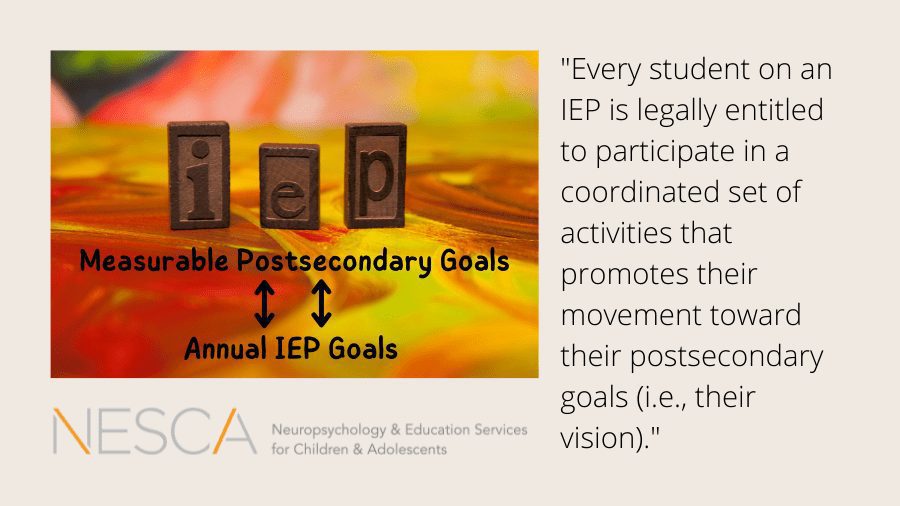
This shift is confusing! Parents are used to coming to IEP meetings ready to share their visions for their children, and students are often unprepared to share their goals for life after high school. But this shift is also absolutely critical for ensuring that students receive appropriate transition services. This is because every student on an IEP is legally entitled to participate in a coordinated set of activities that promotes their movement toward their postsecondary goals (i.e., their vision). These activities can include instruction, related services, community experiences, development of employment and post-school living objectives, and acquisition of daily living skills and functional vocational evaluation.[1] The only way a student can receive appropriate transition services, and an appropriately calibrated and coordinated set of transition activities, is if we clearly identify and define appropriate postsecondary (i.e., post-high school) goals for the student. And, these need to be listed out at the start of the IEP. In Massachusetts, these need to be listed in the vision statement.

Nevertheless, once we have done the important work of defining the student’s postsecondary goals or vision (which always involves transition assessment), then we have more important work to do. We have to make sure that the IEP that is developed includes necessary annual IEP goals, and related services, that will effectively support the student in making progress toward their postsecondary goals. We need to carefully crosswalk between each of the postsecondary goals set for the student and the annual goals we are developing. It is vital to make sure that there is at least one annual goal (or objective/benchmark within an annual goal) that addresses each of the student’s measurable postsecondary goals. We are very good at making sure that each of the services a student receives relates to the annual goals a student is working on. But we rarely pay attention to whether each of the student’s measurable postsecondary goals (i.e., each of the goals listed in the student’s vision statements) is supported by an annual goal. Annual goals for transition-aged students need to be determined from two sources: the student’s disability-related needs AND the student’s measurable postsecondary goals. Annual goals and coursework for a student with autism and language-based issues should be different depending on whether the student intends to be an artist or a veterinarian technician. Goals should be different for a student who intends to be a licensed driver and a student who intends to use door-to-door van transportation. In all cases, the team needs to annually discuss what skills the student needs to build this year in order to be able to attain their postsecondary goals in the future. The team needs to make sure that each postsecondary goal that the student has is supported by the student’s annual goals. If this is not explicitly discussed at the team meeting, we are not effectively planning for the student—and we are not effectively supporting students in being able to plan for themselves.

For more information about postsecondary goals and annual IEP goals in Massachusetts, check out Technical Assistance Advisory SPED 2013-1: Postsecondary Goals and Annual IEP Goals in the Transition Planning Process from MA DESE: http://www.doe.mass.edu/sped/advisories/13_1ta.html


[1] https://sites.ed.gov/idea/regs/b/a/300.43


About the Author
Kelley Challen, Ed.M., CAS, is NESCA’s Director of Transition Services, overseeing planning, consultation, evaluation, coaching, case management, training and program development services. Ms. Challen also provides expert witness testimony in legal proceedings related to special education. She is also the Assistant Director of NESCA, working under Dr. Ann Helmus to support day-to-day operations of the practice. Ms. Challen began facilitating programs for children and adolescents with special needs in 2004. After receiving her Master’s Degree and Certificate of Advanced Study in Risk and Prevention Counseling from Harvard Graduate School of Education, Ms. Challen spent several years at the MGH Aspire Program where she founded an array of social, life and career skill development programs for teens and young adults with Asperger’s Syndrome and related profiles. She additionally worked at the Northeast Arc as Program Director for the Spotlight Program, a drama-based social pragmatics program, serving youth with a wide range of diagnoses and collaborating with several school districts to design in-house social skills and transition programs. Ms. Challen is co-author of the chapter “Technologies to Support Interventions for Social- Emotional Intelligence, Self-Awareness, Personality Style, and Self-Regulation” for the book Technology Tools for Students with Autism. She is also a proud mother of two energetic boys, ages six and three. While Ms. Challen has special expertise in supporting students with Autism Spectrum Disorders, she provides support to individuals with a wide range of developmental and learning abilities, including students with complex medical needs.


Neuropsychology & Education Services for Children & Adolescents (NESCA) is a pediatric neuropsychology practice and integrative treatment center with offices in Newton, Massachusetts, Plainville, Massachusetts, and Londonderry, New Hampshire, serving clients from preschool through young adulthood and their families. For more information, please email info@nesca-newton.com, call 617-658-9800 or complete our online Intake Form.

Anxiety-based Procrastination: Tips for Getting over the Hurdle

By | NESCA Notes 2022

By: Lyndsay Wood, OTD, OTR/L
NESCA Transition Specialist & Occupational Therapist

Despite our best efforts, procrastination happens. There are many reasons that you may be putting off that large paper, important phone call or those dishes that are stacking up. You may not have the motivation, you may be tired, you may have more fun plans, or maybe it makes you feel anxious. In fact, one of the top reasons people procrastinate is anxiety. Anxiety rates have increased since the start of the COVID pandemic in 2020, and tasks that previously felt easy can now be daunting to think about. It is important to both treat yourself with kindness AND build up your toolbox so that you can tackle the day ahead. Below is a list of nine tips on getting over the procrastination hurdle when anxiety is taking over.

  1. Five minute max – For this strategy, set a five-minute timer and start the activity you have been putting off. Tell yourself that you can stop the activity after five minutes. More than likely, once you start, you will be able to keep going, but you have the option to stop after just five minutes. This strategy helps with perfectionism and all-or-none thinking that can stop you from starting your tasks.
  2. Task breakdown – Big tasks can often feel overwhelming, so breaking your big project, chore, etc., into small steps can help you get going. Tell yourself you will complete step one today and move on to step two tomorrow.
  3. Seek help – Take a step back. Do you have the skills to complete this task? Is there someone you could ask for help if needed? Do not be afraid to seek the help of others to get started!
  4. Reduce the standard – Identify one task that you would be less likely to avoid if you make it easier. For example, have you been putting off exercise because you are worried about going to the gym? Start with a 10-minute walk and build up to a longer exercise period once you are ready. This method is especially helpful to combat an all-or-none mindset.
  5. Notice negative predictions – Be aware of your thoughts and how they can impact, or even control, your actions. Are you making a negative predication about the outcome? If so, it can be helpful to go through the following questions in your mind to reframe your thinking:
    1. What is the worst outcome?
    2. What is the best outcome?
    3. What is the most realistic outcome?
    4. What might I learn if I am willing to take a risk?
  6. Recognize your strengths and challenges – If you find initiating, planning or sequencing tasks difficult when compared to your other skills, don’t misattribute procrastination to laziness or poor motivation. Mislabeling yourself as lazy can lead to further procrastination and decrease self-confidence. You may instead decide to seek extra support or tools to develop your executive function skills.
  7. Visualize – Visualize the finished product AND the feeling associated with completing the task. It is easier to start a task if you feel like you have already succeeded at it.
  8. Accomplishment journal – Keep a running list of accomplishments (even small ones) and check back in to boost your self-confidence for the tasks ahead. It is much easier to start a task when you are in a positive head space and see that you are capable of meeting your goals.
  9. Treat yourself with small rewards – Sometimes a small reward can help you get over a big scary hump. Perhaps after scheduling all of the health care appointments you have been putting off, you sit down and watch the movie you have been wanting to see.

There is no perfect strategy that works for everyone in every situation, but add these strategies to your toolbox and test them out. See if you can find just one tool to help you in those moments when anxiety is impacting your ability to get moving. You’ve got this!


About Lyndsay Wood, OTD, OTR/L

Lyndsay Wood, OTD, OTR/L, is an occupational therapist who focuses on helping students and young adults with disabilities to build meaningful skills in order to reach their goals. She has spent the majority of her career working in a private school for students with ASD. She has also spent some time working in an inpatient mental health setting. Lyndsay uses occupation-based interventions and strategies to develop life skills, executive functioning, and emotional regulation. While completely her doctoral degree at MGH Institute of Health Professions, Lyndsay worked with the Boston Center for Independent Living to evaluate transition age services. She uses the results from her research to deliver services in a way that is most beneficial for clients. Specifically, she focuses on hands-on, occupation-based learning that is tailored the client’s goals and interests.


To book coaching and transition services at NESCA, complete NESCA’s online intake form

Neuropsychology & Education Services for Children & Adolescents (NESCA) is a pediatric neuropsychology practice and integrative treatment center with offices in Newton and Plainville, Massachusetts, as well as Londonderry, New Hampshire. NESCA serves clients from preschool through young adulthood and their families. For more information, please email info@nesca-newton.com or call 617-658-9800.

Meet NESCA Transition Specialist & Occupational Therapist Lyndsay Wood, OTD, OTR/L

By | NESCA Notes 2022

By: Jane Hauser
Director of Marketing & Outreach

NESCA is thrilled to have welcomed a new Occupational Therapist who is serving as a Transition Specialist on the Transition Services Team. Learn more about Lyndsay Wood, OTD, OTR/L, in my interview with her below.

How did you become interested in Occupational Therapy, specifically for transition-aged students?

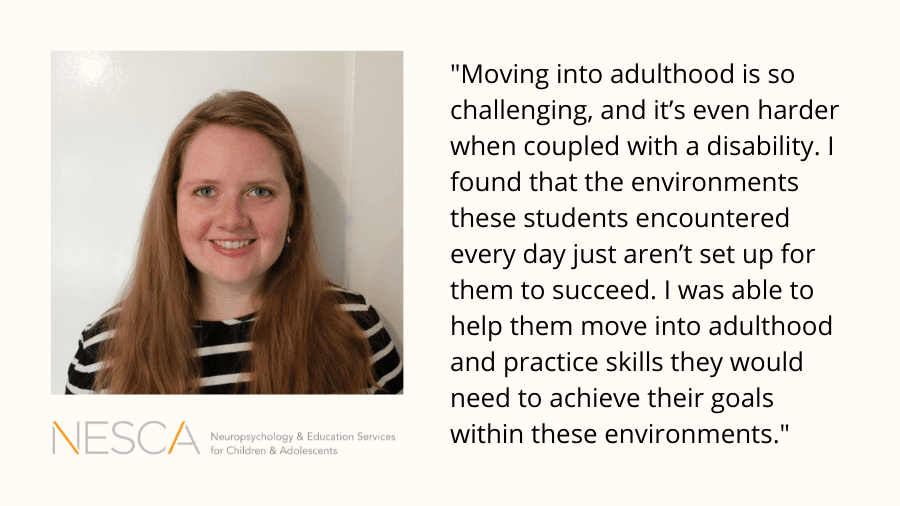
Right after college, I worked in an assisted living center in an administrative role. I got to know the Occupational Therapist (OT) there, who was amazing at what she did. She helped people with the skills they needed to do on a daily basis. I asked to shadow her so I could learn more about the profession and what kind of skills she was teaching the residents to do. Energized by what I learned, I then became a Teaching Assistant (TA) in the CASE Collaborative’s high school program. This is where I started to learn about the needs of transition-aged students and how Occupational Therapy played a role in that area. Again, I was fortunate to learn so much from another talented OT, particularly around the importance of transition, with our students who are often underserved on that front. Moving into adulthood is so challenging, and it’s even harder when coupled with a disability. I found that the environments these students encountered every day just aren’t set up for them to succeed. I was able to help them move into adulthood and practice skills they would need to achieve their goals within these environments.

What made you realize that you wanted to work as a Transition Specialist?

I had already developed a passion for working with transition-aged students in the school setting both during my time as a TA and as an occupational therapist at The League School of Greater Boston. I loved working with the students on life skills, emotional regulation, and executive functioning. I found that I most enjoyed working with the students on hands-on, real-life learning. It seemed to be the most important and most effective way that, as an OT, I could help young adults and teens become more self-determined and thrive. They were able to see what they were able to do, and that was exciting!

Why did you join NESCA?

I loved working with students, but I wanted the opportunity to work with transition-aged youth out in the community. It’s often really difficult for this group to generalize what they learn in the school setting to the experiences they face in the community or even at home. I wanted to help them do just that.

I was thrilled to learn that NESCA offers Transition and Coaching services since I didn’t know anything like that existed outside of an academic setting. I initially joined NESCA as an Occupational Therapist; Executive Function and Real-life Skills Coach on a per diem basis during the summer of 2021. I got to take the skills our teens and young adults learn in school and tailor them to be put into place in the community in a hands-on way. We’re able to teach clients skills like grocery shopping, using the subway or Uber to get to where they need to go, making a deposit at the bank and any other skills they may need to succeed in real life. Having recently moved into a full-time Occupational Therapist; Transition Specialist position here, I look forward to doing much more of these kinds of activities!

What is the most rewarding part of what you do?

The most rewarding aspect of what I do is when I actually get to see the client perform the skill(s) that they have had a hard time with and that they have been working toward for so long. Watching them accomplish their goal is so gratifying. When you see that success, it’s a wonderful feeling!

I also love that I am able to do what I do – not only within the walls of a classroom or school – but in the outside world. I always wanted my students to practice the skills that we were working on in the school environment out in the real world so I knew they would be prepared for experiences they were likely to face in their daily lives. This could be anything from placing an order at Starbucks, riding the bus or refilling a prescription. I get to do that with them here at NESCA…and so much more.

What’s your specialty area? Who do you most enjoy working with?

My passion is working with those who are on their way to adulthood. I am definitely where I want to be with the transition-aged youth and young adults! When working with teens, you get to see them prosper and make monumental changes that can help them build a high quality of life, allowing them to be successful and happy for a greater portion of their lifespan.

I really enjoy working with a wide population of clients, including those with mental health challenges, Autism Spectrum Disorders (ASD) and Attention-Deficit/Hyperactivity Disorder (ADHD). I especially find it rewarding to work with young adults with mental health issues, such as anxiety or depression, to help manage those challenges and lead a fulfilling life.

Tell us a little about yourself. What do you like to do in your spare time?

I grew up in Acton, Massachusetts, and I’m a big outdoors person. I like to spend most weekends in Vermont or New Hampshire, exploring new places to hike. I also enjoy skiing, kayaking and most other outdoor activities. I also like to read, play weekly board games and dance when I get the chance!


About Lyndsay Wood, OTD, OTR/L

Lyndsay Wood, OTD, OTR/L, is an occupational therapist who focuses on helping students and young adults with disabilities to build meaningful skills in order to reach their goals. She has spent the majority of her career working in a private school for students with ASD. She has also spent some time working in an inpatient mental health setting. Lyndsay uses occupation-based interventions and strategies to develop life skills, executive functioning, and emotional regulation. While completely her doctoral degree at MGH Institute of Health Professions, Lyndsay worked with the Boston Center for Independent Living to evaluate transition age services. She uses the results from her research to deliver services in a way that is most beneficial for clients. Specifically, she focuses on hands-on, occupation-based learning that is tailored the client’s goals and interests.


To book coaching and transition services at NESCA, complete NESCA’s online intake form

Neuropsychology & Education Services for Children & Adolescents (NESCA) is a pediatric neuropsychology practice and integrative treatment center with offices in Newton and Plainville, Massachusetts, as well as Londonderry, New Hampshire. NESCA serves clients from preschool through young adulthood and their families. For more information, please email info@nesca-newton.com or call 617-658-9800.

Assessing Work Motivation and Values

By | NESCA Notes 2021

By: Kelley Challen, Ed.M., CAS
Director of Transition Services; Transition Specialist, NESCA

Over the past few months, my colleague Tabitha Monahan and I have dedicated several of our blog entries to vocational assessment as a critical tool for helping students learn about employment and set career goals for themselves. Previous blogs have provided an overview of vocational assessment as well as an in depth look at career interest inventories, vocational aptitude testing, and real-life experiences, such as informational interviews and job shadows. However, there is another type of vocational assessment that we have not yet discussed that can be an invaluable tool for helping students to learn about their “vocational selves” and ultimately choosing occupations that are a good fit—a work motivation or work value assessment.

Work motivations or values are the qualities, principles, or standards that really matter to a person as a worker. Essentially, if you are going to get out of bed every day and go to a job, what are the characteristics that your job needs to have in order for you to feel that going to work is worthwhile? Certainly, money can be an important characteristic of a job, but is that more important to you than helping others, creativity, or recognition? Each of us has a different set of values that will drive us to make choices and take action in our lives, and having an occupation that satisfies those values is just as important as having a job that aligns with our interests and skills.

Similar to career interest inventories, work motivation and value assessments come in many shapes and sizes, some formal (e.g., lengthy and standardized) and some informal (e.g., short checklists or rating scales). Also, similar to career interest inventories, it can be helpful to administer or self-administer more than one of these assessment tools to get a sense of how clear one’s work motivations and values are (i.e., how often an individual responds to assessments with a similar pattern of expressed values). Additionally, it is recommended that students not just take assessments, but that educators and career counselors engage students in qualitative conversations about their results so that students have the opportunity to clarify their values as well as more quantitative exercises, such as comparing work values with career interests.

While there are many different work motivation and value classification systems, I’m choosing to highlight the four work motive categories and eight value constructs from one of my favorite assessment tools, the Work Motivation Scale below.

Fulfillment Motives: The need for work that provides the individual with opportunities to reach their maximum potential. Creativity, curiosity, foresight, and competence are attributes that are often observed in individuals with high fulfillment motives. Fulfillment motives are comprised of the following work value constructs:

  • Success Orientation: Individuals scoring high on this construct are motivated toward accomplishing career goals and reaching their full potential through their work. Passionate about their work, they are willing to endure periods of hardship to be successful.
  • Mission Orientation: Individuals scoring high on this construct are oriented toward seeing the big picture and tend to be less concerned with details. Goal directed, they recognize how their current work fits into and contributes to the overall direction of the organization.

Self-Esteem Motives: The need for achievement, responsibility, and challenging and meaningful work tasks. Links between leadership and achievement are usually present for individuals with high self-esteem motives. Self-esteem motives are comprised of the following work value constructs:

  • Managing Others: Individuals scoring high on this construct value opportunities to direct and supervise the work of others. They willingly take responsibility for worker  performance and the productivity of a work unit, department, or work function.
  • Task Orientation: Individuals scoring high on this construct are oriented toward completing tasks. Planning their work, making the most of resources, and maintaining their focus are important to them. They may hesitate to perform functions outside of those tied to a specific job description.

Affiliation Motives: The need for the acceptance and support of coworkers and supervisors. Cooperation and collaboration toward meeting work goals are sought by individuals with high affiliation motives. Affiliation motives are comprised of the following work value constructs:

  • Supervisor Relations: Individuals scoring high on this construct feel that cooperating with and relating to their supervisor are important. They strive to meet their supervisor’s expectations and highly appreciate their supervisor’s recognition and support.
  • Coworker Relations: Individuals scoring high on this construct feel that relating to peers is important. They prefer to be actively involved in employee related organizations at work and outside of work. They highly value collaboration and teamwork.

Survival and Safety Motives: The need for employment with an adequate livable wage and a safe and secure work environment. The need for favorable benefits packages is also valued by individuals with high survival and safety motives. Survival and safety motives are comprised of the following work value constructs:

  • Working Conditions: Individuals scoring high on this construct believe that a good work environment and creature comforts (climate control, privacy, adequate lighting) are important. They value having the materials, equipment, and resources to do their work effectively and efficiently.
  • Earnings and Benefits: Individuals scoring high on this construct value salary, raises, health insurance plans, pensions, and retirement planning. Vacation, sick leave, personal days, and family leave policy are important considerations in their employment choices as well.

Definitions provided by/taken from the Work Motivation Scale Administrator’s Guide.

Understanding which of these constructs and categories matter most to a student, and a student understanding this about themselves, can have a huge impact on helping a young person to find fulfilling work.

To read more about vocational assessment, check out the following blog entries:

For more information about vocation assessment and transition assessment at NESCA, visit our transition services page and our transition FAQs.


About the Author
Kelley Challen, Ed.M., CAS, is NESCA’s Director of Transition Services, overseeing planning, consultation, evaluation, coaching, case management, training and program development services. Ms. Challen also provides expert witness testimony in legal proceedings related to special education. She is also the Assistant Director of NESCA, working under Dr. Ann Helmus to support day-to-day operations of the practice. Ms. Challen began facilitating programs for children and adolescents with special needs in 2004. After receiving her Master’s Degree and Certificate of Advanced Study in Risk and Prevention Counseling from Harvard Graduate School of Education, Ms. Challen spent several years at the MGH Aspire Program where she founded an array of social, life and career skill development programs for teens and young adults with Asperger’s Syndrome and related profiles. She additionally worked at the Northeast Arc as Program Director for the Spotlight Program, a drama-based social pragmatics program, serving youth with a wide range of diagnoses and collaborating with several school districts to design in-house social skills and transition programs. Ms. Challen is co-author of the chapter “Technologies to Support Interventions for Social- Emotional Intelligence, Self-Awareness, Personality Style, and Self-Regulation” for the book Technology Tools for Students with Autism. She is also a proud mother of two energetic boys, ages six and three. While Ms. Challen has special expertise in supporting students with Autism Spectrum Disorders, she provides support to individuals with a wide range of developmental and learning abilities, including students with complex medical needs.


Neuropsychology & Education Services for Children & Adolescents (NESCA) is a pediatric neuropsychology practice and integrative treatment center with offices in Newton, Massachusetts, Plainville, Massachusetts, and Londonderry, New Hampshire, serving clients from preschool through young adulthood and their families. For more information, please email info@nesca-newton.com, call 617-658-9800 or complete our online Intake Form.

Skip to content