Tag

written expression Archives - NESCA

Subscribe to NESCA Notes

student writing in a notebook and quote by Olivia Rogers, SLP

Why Speech-Language Pathologists Are Uniquely Equipped to Support Written Language

By | NESCA Notes 2026

student writing in a notebook and quote by Olivia Rogers, SLPBy Olivia Rogers, MA, CCC-SLP
Speech-Language Pathologist, NESCA

Written language refers to the system of communication that involves the use of written symbols to represent language, and it encompasses skills such as fluent word recognition, reading comprehension, written spelling, and written expression. It is one of the most complex academic skills students are asked to master. It requires vocabulary, grammar, organization, working memory, attention, reading skills, and the ability to translate ideas into structured sentences and paragraphs.

Because written expression sits at the intersection of language, literacy, and executive functioning, Speech-Language Pathologists (SLPs) are uniquely positioned to support it. At NESCA, speech language pathologists bring specialized training – including EmPOWER, Brain Frames, and The Orton-Gillingham Approach – that allows them to address writing and reading comprehension in a comprehensive, structured, and functional way.

Written Language Is… Language
Writing is not just handwriting or spelling. At its core, writing is language expressed on paper. Students must generate ideas and vocabulary, use grammar and sentence structure, organize thoughts into narratives or explanations, maintain cohesion across sentences, and consider audience and purpose.

Reading is not just decoding words on a page. True, reading happens when a child understands, connects, and makes meaning from what they read. Comprehension – linking new information to background knowledge, vocabulary, and language skills – is what transforms word calling into real literacy.

These are core areas of SLP expertise. SLPs are trained to analyze how language breaks down,  whether at the word, sentence, or discourse level, and to teach skills explicitly and systematically.

The Executive Function Connection
As discussed in last week’s blog, writing and reading are executive functioning tasks. When writing, students must plan what to say, hold ideas in working memory, organize information, initiate writing, and revise and edit. When reading, students exercise their working memory, inhibition, and metacognitive skills.

NESCA SLPs use the EmPOWER and Brain Frames approaches to make these invisible thinking processes visible. EmPOWER supports students in navigating “how” to bring the writing process from start to finish. Brain Frames provide visual scaffolds that help students map ideas before writing, organize paragraphs, and understand the structure of different text types.

Structured Literacy Strengthens Writing
Strong writing depends on strong reading and spelling skills. NESCA SLPs, trained in Orton-Gillingham, also bring a structured literacy lens to written language intervention through explicit teaching of phonology, morphology, and spelling patterns – all while integrating reading and writing instruction systematically.

SLPs Bridge Ideas and Expression
Many students know what they want to say but cannot translate it into written form. SLPs help students expand sentences, develop narrative and expository structure, use academic vocabulary, improve cohesion and clarity, verbalize ideas before writing, and revise language for precision.  Because SLPs focus on communication, written language therapy is functional and meaningful. Intervention often targets classroom assignments, essays and projects, note-taking, digital communication, and self-advocacy writing so that strategies learned transfer directly to school demands. SLPs brings a functional, real-world approach to written language.

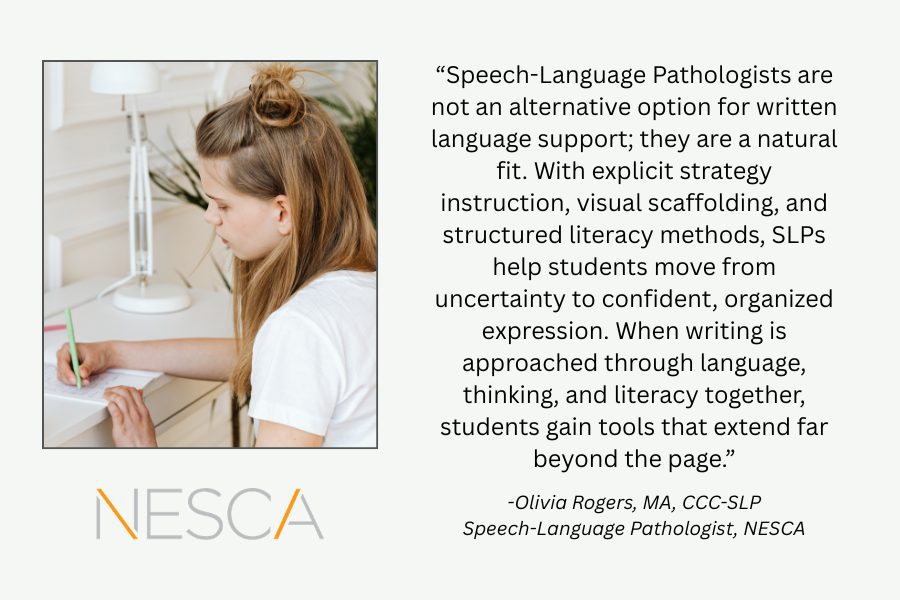
Speech-Language Pathologists are not an alternative option for written language support; they are a natural fit. With explicit strategy instruction, visual scaffolding, and structured literacy methods, SLPs help students move from uncertainty to confident, organized expression. When writing is approached through language, thinking, and literacy together, students gain tools that extend far beyond the page.

The NESCA Difference
NESCA SLPs combine deep knowledge of language development with specialized training in executive functioning and structured literacy. Our intervention addresses how students think, understand language, read and spell, and express ideas in writing.


At NESCA, we use evidence-based strategy to target written language. Our clinicians use a comprehensive approach to treat the systems of learning as integrative, helping students develop valuable skills they can use in and out of the classroom!  For more information on written language support at NESCA, please complete our online Intake Form or email me directly at orogers@nesca-newton.com.


About the AuthorOlivia Rogers

Olivia Rogers is a licensed speech-language pathologist with experience in pediatric clinics and public schools, working with children from age 2 through young adulthood across a range of communication challenges. With a special interest in the connection between oral language and literacy, Ms. Rogers is trained in the Orton-Gillingham method and the Brain Frames program, supporting students in language comprehension, expression, and written organization. She is dedicated to making therapy engaging and personalized for each child.


To learn more about NESCA’s Speech and Language Services or schedule appointments, complete our online Intake Form or email orogers@nesca-newton.com.


NESCA is a pediatric neuropsychology and related services practice with offices in Newton, Plainville, and Hingham, Massachusetts; Londonderry, New Hampshire; and Coral Gables, Florida, serving clients from infancy through young adulthood and their families. For more information, please email info@nesca-newton.com or call 617-658-9800.


Image of a middle schooler writing and a quote about summer intensive therapy by Dr. Ann Helmus about summer intensive therapy

Supercharge Communication Skills This Summer: The Case for Intensive Speech & Language Therapy

By | NESCA Notes 2025

Image of a middle schooler writing and a quote about summer intensive therapy by Dr. Ann Helmus about summer intensive therapyBy Ann Helmus, Ph.D.
Founder & Director, NESCA

For many students, summer is a much-needed break from the pressures of the long school year. But it’s also a unique opportunity to make powerful strides in speech and language development—far more than is often possible with weekly sessions during the academic year.

At NESCA, we offer intensive summer therapy that targets both verbal communication (such as listening comprehension, expressive language, and social communication) and written expression, an area where many students struggle.

Here’s why summer intensives can be especially effective:

  1. More Frequent Sessions = Greater Momentum
    When sessions are scheduled every other day (rather than once a week), skills are reinforced more consistently. Students retain strategies better, build habits faster, and make visible progress over a shorter period of time.
  2. Longer Sessions Allow for Deeper Work
    Without the time constraints of school-day schedules, therapy sessions can go beyond the traditional one-hour format. This gives students and therapists time to dig into more complex language tasks, problem-solve in real time, and practice generalizing skills across different contexts.
  3. Less Time Lost Re-Orienting
    With weekly sessions, valuable time is often spent reviewing what was last covered. Frequent summer sessions minimize this start-up time and allow therapy to pick up right where it left off—keeping the focus on forward movement.
  4. Fewer Distractions, Better Focus
    The relaxed pace of summer means students are often more receptive to learning. Without competing demands like homework, tests, and extracurriculars, they can be more focused and emotionally available for therapeutic work.
  5. Support for Written Expression with Proven Methods
    Our speech-language pathologist is trained in the EmPOWER method, a structured approach to teaching written expression. EmPOWER helps students organize their thoughts, clarify their ideas, and express themselves in writing with greater clarity and confidence—skills that are essential for success in school and beyond.
  6. A Stronger Start to the School Year
    Students who make gains in the summer enter the fall with more confidence, stronger foundational skills, and better self-awareness as communicators and learners.

If your child struggles with speaking, listening, or writing, summer can be the perfect time to make meaningful gains that will carry over into the school year. Intensive speech and language therapy can provide just the boost they need.

To explore next steps with NESCA’s Speech and Language Pathologists, fill out our Inquiry/Intake Form or visit our Speech and Language Evaluation and Therapy page. Our team will be in touch with you shortly to provide more information or set up a schedule of sessions that work with your family’s summer plans.


About the Author

NESCA Founder and Director Ann Helmus, Ph.D., is a licensed clinical neuropsychologist who has beenAnn Helmus headshot practicing neuropsychology for 35 years and has been director of NESCA’s Neuropsychology practice for nearly three decades, continuously training and mentoring  neuropsychologists to meet the highest professional standards.

To book a neuropsychological evaluation at NESCA, complete NESCA’s online intake form

NESCA is a pediatric neuropsychology practice and integrative treatment center with offices in Newton, Plainville, and Hingham, Massachusetts; Londonderry, New Hampshire; the greater Burlington, Vermont region; and Brooklyn, New York (coaching services only) serving clients from infancy through young adulthood and their families. For more information, please email info@nesca-newton.com or call 617-658-9800.

When the Struggle with Writing is Real

By | NESCA Notes 2022

By: Alissa Talamo, PhD
Pediatric Neuropsychologist, NESCA

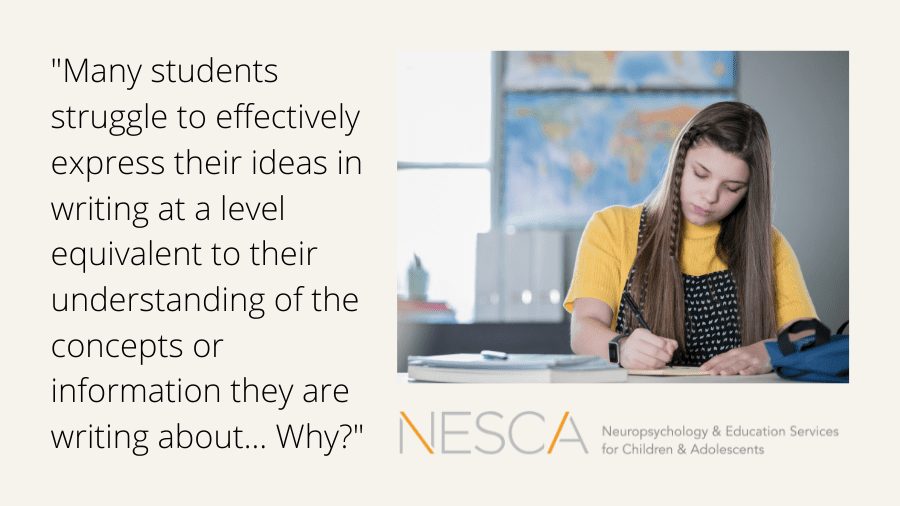
Many students struggle to effectively express their ideas in writing at a level equivalent to their understanding of the concepts or information they are writing about… Why?

There are many reasons a student may struggle with academic (expository) writing. Such writing requires a student to evaluate evidence, expand upon ideas, and demonstrate knowledge in a clear and concise way. In order to write effectively, a student must access and implement several higher order processes simultaneously, including but not limited to:

  • thinking
  • organization of ideas
  • retrieval of needed information
  • being able to remember an idea long enough to write it down…

while at the same time, the student also needs to think about writing mechanics (e.g., handwriting, spelling, punctuation).

All of these sub-components need to be pulled together for a student to create a well-written product. As a result, students often avoid writing or write only the minimal amount necessary.

Students with both language-based learning disabilities (LBLD) and AD/HD are at particular risk to struggle, as student with LBLD often have difficulty with word retrieval, syntax, and spelling to name a few, while students diagnosed with AD/HD inherently struggle with task initiation, planning, distractibility, and are vulnerable to reduced handwriting skills and careless errors.

In order to support all students, we need to help them develop more efficient skills. Research has shown that students can be taught to organize their language and ideas. Graphic organizers are an example of an organizational strategy. Some well-researched and effective programs include “Brain Frames,” a set of six graphical patterns that students draw to organize their language and ideas (www.architectsforlearning.com) and “Thinking Maps,” a set of eight visual patterns that correlate to specific cognitive processes (www.thinkingmaps.com). Another benefit of the graphic organizers is that the skills learned can be applied to more than just writing, but as writing is a critical skill necessary for school success as well as in the workforce, it is important that we help our students develop these skills and recognize that they do have the ability to demonstrate their knowledge in written form.

If your child is having difficulty with writing, let us know by completing our online Intake Form.

Resources used for this blog include:

  • Architectsforlearning.com
  • Thinkingmaps.com
  • PBS.org
  • adlit.org


About the Author

With NESCA since its inception in 2007, Dr. Talamo had previously practiced for many years as a child and adolescent clinical psychologist before completing postdoctoral re-training in pediatric neuropsychology at the Children’s Evaluation Center.

After receiving her undergraduate degree from Columbia University, Dr. Talamo earned her doctorate in clinical health psychology from Ferkauf Graduate School of Psychology and the Albert Einstein College of Medicine at Yeshiva University.

She has given a number of presentations, most recently on “How to Recognize a Struggling Reader,” “Supporting Students with Working Memory Limitations,” (with Bonnie Singer, Ph.D., CCC-SLP of Architects for Learning), and “Executive Function in Elementary and Middle School Students.”

Dr. Talamo specializes in working with children and adolescents with language-based learning disabilities including dyslexia, attentional disorders, and emotional issues. She is also interested in working with highly gifted children.

Her professional memberships include MAGE (Massachusetts Association for Gifted Education), IDA (International Dyslexia Association), MABIDA (the Massachusetts division of IDA) and MNS (the Massachusetts Neuropsychological Society).

She is the mother of one teenage girl.


To book a consultation with Dr. Talamo or one of our many other expert neuropsychologists, complete NESCA’s online intake form.

Neuropsychology & Education Services for Children & Adolescents (NESCA) is a pediatric neuropsychology practice and integrative treatment center with offices in Newton, Massachusetts, Plainville, Massachusetts, and Londonderry, New Hampshire, serving clients from preschool through young adulthood and their families. For more information, please email info@nesca-newton.com or call 617-658-9800.

Skip to content