By: Sean Hyde O’Brien, Psy.D., ABPdN
Pediatric Neuropsychologist, NESCA
As the husband of a pediatric audiologist, I often hear stories of children referred for audiological evaluations that end up having normal hearing but are thought to have other conditions that fall within the purview of neuropsychology, including Language Disorder, Autism Spectrum Disorder, Intellectual Disability, and Attention-Deficit/Hyperactivity Disorder. It made me think about the way that children typically referred for neuropsychological evaluations can be potentially impacted by hearing loss, particularly in terms of their cognitive, academic, and social-emotional functioning. Review of the literature indicates the following:
- Language Acquisition and Communication:
Children with hearing loss may experience delays in development of communication skills including speech articulation and receptive-expressive language. This can make it difficult to for children to understand instructions, participate in discussions, and express ideas.
- Literacy Skills:
Development of reading and writing skills are closely tied to language abilities. Hearing loss can lead to difficulties in phonological awareness, decoding, and comprehension, resulting in lower literacy achievement in children with otherwise intact cognitive profiles.
- Executive Functioning:
Hearing loss may affect executive functioning skills such as attention, organization, and task completion due to difficulties in following multi-step instructions or classroom routines.
- Cognitive Load:
Increased effort required to listen and comprehend spoken information can lead to cognitive fatigue, reducing the capacity for learning and retention.
- Classroom Engagement:
Students with hearing loss may struggle to follow lessons, especially in environments with significant background noise or when teachers are not facing the class. They may miss important information, instructions, or peer interactions, leading to reduced participation and engagement.
- Academic Achievement:
Studies have shown that children with hearing loss are at greater risk for lower academic achievement, particularly in subjects that rely heavily on verbal instruction and interaction (language arts, social studies, etc.).
- Access to Curriculum:
Without appropriate accommodations (e.g., hearing assistive technology, preferential seating, captioning, sign language support), students may not have equitable access to curriculum content.
- Social-Emotional Functioning:
Finally, hearing loss can contribute to feelings of social isolation, frustration, and decreased self-esteem if communication barriers lead to difficulties in making friends or participating in group activities.
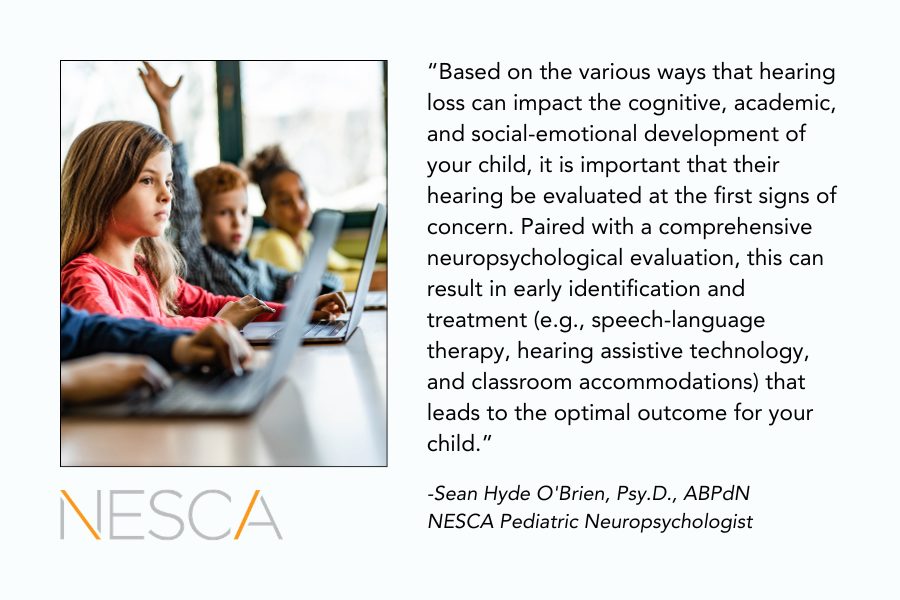
Based on the various ways that hearing loss can impact the cognitive, academic, and social-emotional development of your child, it is important that their hearing be evaluated at the first signs of concern. Paired with a comprehensive neuropsychological evaluation, this can result in early identification and treatment (e.g., speech-language therapy, hearing assistive technology, and classroom accommodations) that leads to the optimal outcome for your child.
For more information, please visit the American Speech-Language-Hearing Association (ASHA) website at https://www.asha.org/public/hearing/effects-of-hearing-loss-on-development/
About the Author
Dr. Sean O’Brien has been providing comprehensive neuropsychological evaluations in the Greater Boston area since 2006. He specializes in the assessment of children and adolescents who present with a wide range of developmental conditions, such as Attention-Deficit/Hyperactivity Disorder, Specific Learning Disorder (reading, writing, math), Intellectual Disability, and Autism Spectrum Disorder; as well as children whose cognitive functioning has been impacted by medical, psychiatric, and genetic conditions. He also has extensive experience working with children who were adopted both domestically and internationally.
To schedule an appointment with one of NESCA’s neuropsychologists, please complete our online intake form.
NESCA is a pediatric neuropsychology practice and integrative treatment center with offices in Newton, Plainville, and Hingham, Massachusetts; Londonderry, New Hampshire; the greater Burlington, Vermont region; and Coral Gables, Florida, serving clients from infancy through young adulthood and their families. For more information, please email info@nesca-newton.com or call 617-658-9800.