NESCA’s Newton, MA location has immediate availability for neuropsychological evaluations. Our MA clinicians specialize in the following evaluations: Neuropsychological; Autism; and Emotional and Psychological, as well as Academic Achievement and Learning Disability Testing.

Visit www.nesca-newton.com/intake for more information or to book an evaluation.

All Posts By

Subscribe to NESCA Notes

Is It Sensory? Or Is It Behavior?

By | NESCA Notes 2021

By: Julie Robinson, OT
Director of Clinical Services; Occupational Therapist, NESCA

As parents or other caregivers of children with special needs, we can often find ourselves confused between what is a sensory response and what is behavior. Although this is often a complex question, and one without a straightforward answer, there are some tools of the trade that OTs use to help us determine just what is going on with these children. What makes this so complex is that each child is an individual, with their own unique ways of responding to sensory stimuli, to social interactions, and when out in varied settings in their community or with family. Children may also present differently from minute to minute or day to day, depending on sleep, hunger, and fluctuations in mood. But we can often look closely for patterns that may help to guide us in finding the answers.

When working with a child who seems to be in a meltdown, one of the best things you can do is take a quick scan of the environment. Is there a loud or distracting sound in the background? Did someone touch the child unexpectedly? Is the overall environment too busy and overstimulating, such as at party or a restaurant? Sometimes just naming or removing the stimuli, if possible, is enough to help get things back under control. If you know a triggering situation might arise that provokes a meltdown, see if you can give the child a warning and a plan of where to go for comfort. “We will be having a fire drill in 10 minutes, so when it happens you can hold _____’s hand, or we can get you some headphones to cover your ears to make you more comfortable” is one example. Find something soothing from a sensory perspective to help the child settle: a quiet corner with books, some tactile play or fidgets, calming music, a tight squeeze ( but only if tolerated and given permission to do so ). If you know you are entering a highly stimulating environment, it may be best to go in for short periods, with frequent breaks built in for your child every 10 minutes or so to take a walk, use the bathroom, or get a drink.

If you do not see something sensory in your environment creating the discomfort or the meltdown, then behavior and emotions are more likely at play. You child may feel confused about a social interaction, about expectations, or what may be coming next in a transition. Your child may feel a lack of confidence or anxiety in a situation, that although may be seemingly simple and straight forward to you, may not to him or to her. An academic task may feel misunderstood, and not knowing how to start can result in a meltdown for many of our children.

When you see that the child you are caring for is beginning to ramp up, that is the best time to intervene. Once a meltdown has begun, language processing will be limited, and the child may not be reachable for a period of time in order to settle down. The best thing you can do in those moments, is to help the child to stop. I often use a stop sign to hold up in my therapy sessions, that cues the child to take a quick break from interacting with me when I see things starting to spin out of control. I limit my language, provide a calming sensory activity, then we can talk about the upset once I have the child back in my court.

Here are some things to think about and questions you might ask yourself to help guide your interactions and expectations when you, as the adult, are confused about whether this is sensory or behavior:

  1. What are the undesirable behaviors that my child observes when he or she is upset or uncomfortable? Are they different when there is sensory discomfort, in comparison to when he or she is upset with a person or a demand? Notice quality of voice, bodily tension, inability to stay still or focused, aggression, flight or an attempt to get away, shutdown or inability to interact. You may start to see patterns in behavior when you look at them in relation to a sensory event or something that is more emotionally-laden.
  2. What occurred just before this behavior appeared? Was there a sensory distraction or discomfort or was he or she upset with a person or a demand?
  3. How did the child behave during this episode?
  4. How did adults or peers interact with my child during the episode? Did it calm the child, or make him or her more agitated?
  5. List sensations that may have triggered a meltdown: tactile, auditory, visual, smell, taste, movement. Were they loud, distracting, uncomfortable? Was the child in a space that may have been too small or too large? Was the child able to get away from the uncomfortable stimuli, or did he or she feel stuck in the moment?

It will be beneficial for team members to share information and write these things down, perhaps in a format of a journal, so that the team can work together to uncover the patterns, find strategies that are successful, and provide consistency across the board. We all know consistency for these children is one of the most effective tools for learning, and although it may take some extra work up front for caregivers, the pay off on the other side is often so rewarding that it is worth the effort.

If you would like to explore this topic further with NESCA OT Julie Robinson, join us for a free webinar on this topic on September 13, 2021 at 10:30 am ET. Register in advance for this webinar at:

https://nesca-newton.zoom.us/webinar/register/WN_-edHNIwkRBKnjk0gq6-bUw


About the Author

Julie Robinson is an occupational therapist with over 25 years of experience as a clinician. The work Julie does is integral to human development, wellness and a solid family unit. She particularly enjoys supporting families through the process of adoption and in working with children who are victims of trauma. Julie has extensive experience working with children diagnosed with an Autism Spectrum Disorder (ASD), or who have learning or emotional disabilities. She provides services that address Sensory Processing Disorder (SPD) and self-regulation challenges, as well as development of motor and executive functioning skills.

To book an appointment or to learn more about NESCA’s Occupational Therapy Services or other clinical therapies, please fill out our online Intake Form, email info@nesca-newton.com or call 617-658-9800.


Neuropsychology & Education Services for Children & Adolescents (NESCA) is a pediatric neuropsychology practice and integrative treatment center with offices in Newton, Massachusetts, Plainville, Massachusetts, and Londonderry, New Hampshire, serving clients from preschool through young adulthood and their families. For more information, please email info@nesca-newton.com or call 617-658-9800.


ADHD: Setting Up A Successful Environment

By | NESCA Notes 2020

Co-authored by: Lauren Zeitler, MSOT, OTR/L, NESCA Occupational Therapist; Feeding Specialist, and Lindsay Delling, OTS, Occupational Therapy Graduate Student

Before any assessments, treatment planning, or suggestions of adaptations take place, we must first understand what attention-deficit/hyperactivity disorder (ADHD) in childhood means, and how it may present and affect each individual child. The American Psychiatric Association defines ADHD as one of the most common neurodevelopmental disorders affecting children, with symptoms including, “inattention (not being able to keep focus), hyperactivity (excess movement that is not fitting to the setting) and impulsivity (hasty acts that occur in the moment without thought)” (2017). There are three different types of ADHD: inattentive type, hyperactive/impulsive type, or combined type, that come with specific criteria within each to provide a diagnosis. While some symptoms of ADHD are common amongst young children, such as difficulty sitting still or limited attention spans, the difference in children with ADHD is the inability to control it without external forces providing regulation for them. This blog post will outline the sensory systems and will provide environmental suggestions and adaptations for children with ADHD to help them succeed and increase focus!

It is estimated that 8.4% of children have ADHD; so, that being said, what can we as occupational therapists recommend to enhance attention and regulatory strategies in children with ADHD using the sensory systems as a guide?

  1. Touch – Children with ADHD may actually scientifically benefit from utilizing fidget toys to increase their attention to a task. This thought process comes from the fact that using a fidget toy, such as a fidget spinner or some putty, allows children to exert some energy while also keeping their hands busy. This then makes them more likely to attend to another task, such as listening to a teacher speak, because they have sustained alertness while working with the fidget toy and can therefore sustain attention to the overarching task. We have seen this in most people on a smaller scale as they twirl their hair or tap a pen while attending to a task; they are essentially using these items as fidget toys to enhance their alertness and sustain attention to the task at hand (CHADD, 2021). The same can be said for a wiggle seat cushion or chair to promote seated movement so the child can gain that sensory input of movement, while staying seated and attending to the task.
  2. Sight – Because children with ADHD exhibit hyperactive tendencies, this means that they are likely hypersensitive to lighting and types of lighting within environments, such as fluorescent lighting which is prevalent in many school systems. Providing children with ADHD breaks from this harsh light and allowing time for their eyes to relax is a great way to promote improved attention throughout the school day. Hypersensitivity in sight is also important to be aware of regarding any schoolwork a child may be doing. If there is a lot going on within the page, a child with ADHD can become easily overwhelmed and may be quick to abandon the activity due to overstimulation. Covering portions of the page so that the child can only see one activity at time may be helpful in keeping them focused and on track and will likely decrease frustration.
  3. Hearing – Due to the hypersensitive nature of children with ADHD, sounds can be very distracting for them when they are trying to focus on a task. One solution would, of course, be to find a quiet space for them to complete schoolwork and other activities. This, however, may not always be readily available or even an option. In that case, providing these children with other adaptations, such as noise cancelling headphones, while they complete their work or even just frequent noise breaks and allowing them to take a walk or play with a preferred item can be great alternatives in promoting sustained attention in a noisy environment!
  4. Smell – Just like the other senses, certain smells can also become overwhelming and even distracting for some children with ADHD. This can happen for many reasons, such as smells of food reminding them how hungry they are at school, smells that make them think of a certain memory that promotes daydreaming, or even simply gross smells that the child cannot seem to get their mind off of. To promote sustained attention and a calming effect with children with ADHD, essential oils can be a good option to trial! While they are not scientifically proven to directly help with symptoms of ADHD, they are proven to ease anxiety and stress, which can occur with ADHD. Scents such as lavender, vetiver, and chamomile are known for their stress-relieving abilities that promote relaxation and serenity within the body.
  5. Taste – Snacks…a fun way to wrap up this post! Similar to fidget toys, crunchy snacks can also provide attention-enhancing qualities when eaten during a time where sustained attention is necessary. The child will be focused on the task of chewing the crunchy item, such as carrot sticks, an apple, or some chips, and will therefore be present in the moment and better able to attend to the task going on around them. This strategy can be used in a variety of settings where eating is appropriate – school, home, tutoring, etc. And, it’s a fun contribution to the repertoire of strategies to enhance attention and self-regulation strategies!

As always, we recommend reaching out to your occupational therapist or getting an occupational therapy evaluation. Contact NESCA’s Director of Clinical Services Julie Robinson, OT, to learn more at: jrobinson@nesca-newton.com.

References

https://chadd.org/adhd-weekly/fidget-toys-and-adhd-still-paying-attention/#:~:text=Putty%2C%20squeeze%20toys%2C%20fidget%20cubes,classroom%20without%20becoming%20a%20distraction.

https://www.psychiatry.org/patients-families/adhd/what-is-adhd


Lauren Zeitler is a licensed Occupational Therapist in Massachusetts, specializing in pediatric occupational and feeding therapy. Ms. Zeitler joined NESCA full-time in the fall of 2020 to offer occupational therapy assessment and treatment for children of all ages, as well as to work in conjunction with Abigael Gray, MS, CCC-SLP, on the feeding team.


Lindsay Delling is a graduate student at Regis College working toward obtaining her master’s degree in occupational therapy. She previously completed fieldwork at Spaulding Rehabilitation Hospital in Charlestown and many school-based settings before coming to finish her fieldwork with NESCA. Prior to graduate school, Lindsay worked with children with disabilities in the Boston Public School system, as well as in a special education preschool setting in her hometown. Lindsay is open to working with many different populations once she completes her degree.


Neuropsychology & Education Services for Children & Adolescents (NESCA) is a pediatric neuropsychology practice and integrative treatment center with offices in Newton, Massachusetts, Plainville, Massachusetts, and Londonderry, New Hampshire, serving clients from preschool through young adulthood and their families. For more information, please email info@nesca-newton.com or call 617-658-9800.


Summer is Here, but There are Still Chores to Do – The Importance of Chores in a Child’s Development

By | NESCA Notes 2021

By Dot Lucci, M.Ed., CAGS
Director of Consultation and Psychoeducational Services, NESCA

What a year it’s been! Hopefully with the pandemic restrictions lifted and the start of summer, we are all breathing a sigh of relief. I’m certainly looking forward to traveling, seeing relatives and getting out without masks. The pandemic upturned our lives in so many ways, but now that there is a “sense of normalcy” returning, we may be tempted to kick back and really relax this summer. However, I would caution that in kicking back and relaxing, there are still chores that need to be done. So, why not include your children in taking ownership and helping out around the house? There is research that states that toddlers who are taught to “help out” around the house continue to help out as they age. Many children in indigenous communities grow up asking to help or just help out because it is needed. Wouldn’t it be nice if that were the case in the United States?

Jim Fay, co-founder of the Love and Logic parenting website, says that all of us need to feel needed and know we are making a contribution to those around us or to our world at large – even kids. In many families, chores are a tradition, but in others they have fallen by the wayside. Many upper and middle class families have hired household help, so the need to do chores isn’t as great, and fighting with children to do chores doesn’t seem worth it. Let’s face it, no one likes to do chores, but they have to get done. Psychologist Roger McIntire, author of Raising Good Kids in Tough Times, says, “A child has to have some responsibilities.” The family is a community, and everyone should chip in and help out. Helping out with family responsibilities and doing one’s own personal responsibilities are useful and necessary skills for a child’s development. The American Academy of Child and Adolescent Psychiatry states that, “there are benefits to including chores in a child’s routine as early as age 3. Children who do chores may exhibit higher self-esteem, be more responsible, and be better equipped to deal with frustration, adversity, and delayed gratification. These skills can lead to greater success in school, work, and relationships.” Research also shows that children who grow up contributing to the family responsibilities grow up to be adults who work well in collaborative groups and have a “can-do” attitude.

Helping kids learn that they have to do chores and that they are a part of life teaches them that it’s not just about me and what I need at this moment, but that I’m part of a system. I’m part of a family (I set the table). I’m part of my class at school (I clean up after an art project). I’m part of my sports team (I carry the bat/ball bag). I’m part of the workplace (I do my part). Humans crave a sense of belonging and connection, and helping others out and doing work for the good of the whole helps us understand why connection is important. The more we can do to foster this in our kids, the better off they will be as adults. Chores are a form of selflessness and help children develop a sense of responsibility and awareness of the needs of others. They begin to recognize that when they pick up, they can find their toys and they are grateful for the small things. Parents show gratitude when children do chores. Praise is good! Children feel appreciated and connected, and gratitude helps wire our brains to notice more things to feel thankful for, leading us to feel better overall.

Chores are powerful teachers. They help a child develop a greater sense of responsibility and awareness of the needs of others, and they also contribute to a child’s social and emotional well-being. Chores help children believe that they are competent and capable and help them develop greater self-esteem. Doing chores can also help children learn problem solving skills as well as the consequences of not doing their chores (i.e., not putting your baseball shirt in the laundry so it’s dirty for the next game). Chores are an excellent teacher of life skills. Knowing how to set the table, walk the dog, pick up toys, do laundry, prepare a meal, sweep/vacuum the floor, change a vacuum cleaner bag, etc., all help prepare a child for the responsibilities of adulthood. More involved tasks (i.e., cleaning out the garage) can be used in the development a child’s executive functioning skills, prompting them (perhaps with parent assistance) to figure out how to tackle the task in the most efficient, most systematic manner. And they learn about solutions that may be applied to a host of other life responsibilities.

Being a part of a family and taking responsibility for oneself and contributing to the family by doing chores is a powerful gift to give to children, even if they may not do the chores perfectly, may need to be reminded to do them, or grumble while they are doing them. It’s okay. Over time, these will lessen. Stay with it and help your child recognize and understand that life is work, and they have to be a part of the work of life.

If you aren’t having your child do chores now, consider it while the summer is here. It will help them out in many ways in the long run, helping them to be better functioning and more capable adults. If you need help figuring out which chores are age-appropriate, there are many lists online offering ideas and ways to assist in helping children do chores without too much complaining!

References

https://www.aacap.org/AACAP/Families_and_Youth/Facts_for_Families/FFF-Guide/Chores_and_Children-125.aspx

https://www.loveandlogic.com

https://www.nytimes.com/2018/08/18/opinion/sunday/children-chores-parenting.html


About the Author

NESCA’s Director of Consultation and Psychoeducational Services Dot Lucci has been active in the fields of education, psychology, research and academia for over 30 years. She is a national consultant and speaker on program design and the inclusion of children and adolescents with special needs, especially those diagnosed with Autism Spectrum Disorder (ASD). Prior to joining NESCA, Ms. Lucci was the Principal of the Partners Program/EDCO Collaborative and previously the Program Director and Director of Consultation at MGH/Aspire for 13 years, where she built child, teen and young adult programs and established the 3-Ss (self-awareness, social competency and stress management) as the programming backbone. She also served as director of the Autism Support Center. Ms. Lucci was previously an elementary classroom teacher, special educator, researcher, school psychologist, college professor and director of public schools, a private special education school and an education collaborative.

Ms. Lucci directs NESCA’s consultation services to public and private schools, colleges and universities, businesses and community agencies. She also provides psychoeducational counseling directly to students and parents. Ms. Lucci’s clinical interests include mind-body practices, positive psychology, and the use of technology and biofeedback devices in the instruction of social and emotional learning, especially as they apply to neurodiverse individuals.


To book a consultation with Ms. Lucci or one of our many expert neuropsychologists, complete NESCA’s online intake form. Indicate whether you are seeking an “evaluation” or “consultation” and your preferred clinician/consultant in the referral line.


Neuropsychology & Education Services for Children & Adolescents (NESCA) is a pediatric neuropsychology practice and integrative treatment center with offices in Newton, Massachusetts, Plainville, Massachusetts, and Londonderry, New Hampshire, serving clients from preschool through young adulthood and their families. For more information, please email info@nesca-newton.com or call 617-658-9800.


The Joys of Career Counseling

By | NESCA Notes 2021

By: Tabitha Monahan, M.A., CRC
NESCA Transition Specialist/Counselor

One of my favorite parts of being a Certified Rehabilitation Counselor is career counseling. In an ideal world, work is not just a paycheck. It’s another way for people to find joy and connect to the world and their community in a way that makes sense for them. Whether it is being a young person creating a lemonade stand, going around town to shovel people’s driveways, or getting that first real feel of a work environment and learning the social dynamics of having coworkers and a boss, those early jobs can help a person figure out what they don’t want to do and bring them closer to finding that right job. There is nothing more rewarding than when I get that email from one of my career counseling clients that they rocked their interview and were offered the job.

I’m looking forward to spending the next few months talking about career counseling and the career search process for individuals with disabilities. Career counseling and exploration are a vital part of every teenager and young adult’s life. This is especially true for students with disabilities who are struggling to figure out their next steps. As NESCA’s Director of Transition Services Kelley Challen, Ed.M., CAS, wrote in her last blog, employment in the high school years is an evidence-based method of having better postsecondary outcomes in both college and the workforce.

Career exploration is nothing new. But exploration starts a lot earlier than we think. We have all seen pictures of the first and last day of school that include a board with the student’s favorite color and what they want to do when they grow up. The answers to those questions change over time. If I had the job that I wanted when I was in 5th grade, I would be a zoologist right now! My future dislike of biology notwithstanding, I love the career that I ended up choosing. Still, it is not a career I ever would have thought of when I went off to college.

As we go back to a different world than before the pandemic, we will have to relook at what career exploration means. By the nature of the pandemic, there were lost opportunities for students and young adults to have looked at and tried different careers. So, what can we do instead? One of the best silver linings to come out of the pandemic is the number of YouTube videos and free resources that became available. If a student has never heard of or seen a career, how can they know if they like it or not? So, whether your child is 10, 18, or 25, if they are looking for a new job or a new area to find joy, the first place to start is exploration.

Throughout my summer blog series, I look forward to sharing more about career exploration with the following topics:

  • Career Counseling Services at NESCA
  • Interest Inventories and the benefit of informal career assessments
  • The benefit of informational and practice interviews


About the Author

Tabitha Monahan, M.A., CRC, is an experienced transition evaluator and vocational counselor. While she is well-versed in supporting a wide range of transition-aged youth, she is especially passionate and knowledgeable in helping clients and their families navigate the complex systems of adult services and benefits as well as medical and mental health systems. She is further adept in working individually with students of all abilities to empower self-advocacy and goal achievement.


To schedule an appointment with one of NESCA’s expert transition specialists or neuropsychologists, please complete our online intake form


Neuropsychology & Education Services for Children & Adolescents (NESCA) is a pediatric neuropsychology practice and integrative treatment center with offices in Newton and Plainville, Massachusetts, and Londonderry, New Hampshire, serving clients from preschool through young adulthood and their families. For more information, please email info@nesca-newton.com or call 617-658-9800.


Dealing with End of the School Year Uncertainty

By | NESCA Notes 2021

By: Angela Currie, Ph.D.
Pediatric Neuropsychologist, NESCA
Director of Training and New Hampshire Operations

The end of the school year can bring a lot of emotions, such as excitement for summer activities, sadness about closing relationships, and anxiety related to change. Often, children are experiencing these mixed emotions without truly understanding them. The end of this particular school year may bring some unique emotions, as it is the second consecutive ending that “looks different,” be it because students were remote for all or some of the year, class parties and field days are not happening, or children cannot give their teacher an end of the year hug. The loss of such traditions may cause kids to feel a lack of closure. Further, this transition is happening at a time when the world is starting to change again. While the loosening of restrictions and return to a semblance of “normal” may be positive for most, children may not know how to cope with all of this simultaneous change.

Here are some tips for things that adults can do to help children cope with what may be a difficult or uncertain end to the current school year:

  • Watch for signs that your child may be struggling with this transition. This may include new sleep difficulties, low frustration tolerance, heightened emotions, meltdowns, reduced appetite, loss of interest, etc.
  • Talk about their feelings related to the end of the year in an open and responsive manner, validating their emotions (e.g., “I can see why that would make you feel sad,” rather than accidentally dismissing them (e.g., “Don’t worry.”).
  • Help provide some closure with their teacher, such as writing a card or letter about what they enjoyed, learned, or overcame together this year.
  • Using artwork or journaling, help your child reflect on their development, accomplishments, and experiences this past year.
  • Create a plan for how they can stay in touch with friends over the summer and schedule some specific playdates or events to reduce worry about losing touch.
  • Maintain your basic schedule, such as morning and bedtime routines.
  • To reduce worry related to uncertainty, provide some age-appropriate opportunities to feel a sense of control, such as allowing your child to design a new daily schedule for “home days,” choose individual or family activities, etc.

The end of any school year provides a great opportunity to teach children about transition and change. We can teach them that it is okay to celebrate their accomplishment while also simultaneously feeling discomfort about what is to come and sadness about saying goodbye. Particularly during a year that has been marked by adversity, learning how to recognize, “sit with,” and manage these mixed emotions will help to build resiliency for the future.


About the Author

Dr. Angela Currie is a pediatric neuropsychologist at NESCA. She conducts neuropsychological and psychological evaluations out of our Londonderry, NH office. She specializes in the evaluation of anxious children and teens, working to tease apart the various factors lending to their stress, such as underlying learning, attentional, or emotional challenges. She particularly enjoys working with the seemingly “unmotivated” child, as well as children who have “flown under the radar” for years due to their desire to succeed.


To book an evaluation with Dr. Currie or one of our many other expert neuropsychologists, complete NESCA’s online intake form. Indicate whether you are seeking an “evaluation” or “consultation” and your preferred clinician in the referral line.


Neuropsychology & Education Services for Children & Adolescents (NESCA) is a pediatric neuropsychology practice and integrative treatment center with offices in Londonderry, NH, Plainville, MA, and Newton, MA serving clients from preschool through young adulthood and their families. For more information, please email info@nesca-newton.com or call (603) 818-8526.

Put Me In, Coach!

By | NESCA Notes 2021


Coaching Services at NESCA

For students and young adults with social, emotional, organizational and/or learning differences, hands-on instruction in real-world environments is a critical means of developing skills for postsecondary living, learning and working. NESCA is pleased to offer individualized home-, community-,and office-based coaching services as well as remote coaching services, delivered by a team of seasoned Occupational Therapists (OTs), Vocational Counselors and Transition Specialists to support the needs of transition-age youth.


Meet the Coaches


Sophie Bellenis, OTD, OTR/L

Dr. Sophie Bellenis is Licensed Occupational Therapist in Massachusetts, specializing in pediatrics and occupational therapy, including school-based service delivery. Dr. Bellenis has expertise in working with tweens, teens, and young adults with a wide range of social, emotional, and developmental needs. She joined NESCA full-time in the fall of 2019 in order to oversee the Real-life Skills Coaching program as well as to carry out transition assessment, occupational therapy assessment and treatment services. One of the keys to Dr. Bellenis’ success coaching students and young adults is her ability to form a meaningful relationship with each client and use that relationship to motivate lasting change.


Aubrey Matthews, OTD, OTR/L

Aubrey Matthews, OTD, OTR/L, is an occupational therapist who has focused most of her career on mental health and skill building for adolescents and young adults. She currently works full-time at a behavioral health hospital, splitting her time between the inpatient adolescent unit and the young adult intensive outpatient program. Aubrey tends to focus on building emotional regulation, executive function, and social skills through occupation-based strategies. Aubrey’s doctoral research at the MGH Institute of Health Professions focused on using LEGO therapy to build social skills at a pro-bono pediatric program, and she uses many of these creative strategies to increase client motivation and success.


Jasmine Badamo, MA

Jasmine is an executive function coach, and a New York State Certified ENL and Special Education teacher. She earned her bachelor’s degree in Biological Sciences from Cornell University and her masters degree in TESOL from CUNY Hunter College. She has over 10 years of teaching experience across three countries, and has worked with students ranging in age from 7 years to adults.
Her work focuses on creating individualized supports based on the specific needs and strengths of each client, and supporting the development of metacognition, executive function skills, and independence. Building an authentic connection with clients is a top priority, as this allows her to provide the best supports possible.


Lyndsay Wood, OTD, OTR/L

Lyndsay Wood, OTD, OTR/L, is an occupational therapist who focuses on helping students and young adults with disabilities to build meaningful skills in order to reach their goals. She has spent the majority of her career working in a private school for students with ASD and related social, emotional and executive functioning challenges. She has also spent some time working in an inpatient mental health setting. Lyndsay uses occupation-based interventions and strategies to develop life skills, executive functioning, and emotional regulation. While completing her doctoral degree at MGH Institute of Health Professions, Lyndsay worked with the Boston Center for Independent Living to evaluate transition-age services. She uses the results from her research to deliver services in a way that is most beneficial for clients. Specifically, she focuses on hands-on, occupation-based learning that is tailored to the client’s goals and interests.



Visit our website for more information about NESCA’s Coaching Services or complete our online Intake Form

Executive Function Tips: The Google Drive

By | NESCA Notes 2021

By: Sophie Bellenis, OTD, OTR/L
Occupational Therapist; Real-life Skills Program Manager and Coach, NESCA

As we slowly start to emerge from lockdown measures, social distancing guidelines, and living life through the screen, there are few lessons that we have learned that still hold importance and should maintain their place in our lives. When it comes to executive function, a lesson that sticks with me is the need for digital organization and functional systems that help us stay in control. One tool that students often use every day, but very rarely receive direct instruction in, is the Google Drive. I have found that students often do not fully understand the concept of an online drive, including how this differs from saving a document to a hard drive, or why it is important to have folders and systems in place.

Now that students often have email address that they set up early (some parents reserve email addresses long before their children can use them!), and stay with them long-term, there is a risk of Google Drive quickly becoming unmanageable or filled with unnecessary documents. Once the drive becomes cluttered, many students are unable to reign it back in and put systems into place. Below, find some tips for how to help students use the Google Drive as a tool to promote digital organization, as opposed to a landing spot for any new download, file, or assignment.

Tips

  • Set up folders. Through high school and often beyond, our students live their lives on a September through August calendar. They see September as the beginning of a year and often think of time in terms of grade level, as opposed to biological age or calendar year. Starting in either kindergarten or first grade, students should have a folder for any academic work from each grade. By setting up this system early, students start to build the habit of saving documents to the correct place. It can also be helpful to have folders for extracurricular activities, such as Boy Scouts, Math Tutoring, Club Soccer, or simply Personal Work.
  • Set up subfolders. Once students start taking multiple classes at a time, there is a need to further organize. Starting in fourth or fifth grade, many students switch classrooms to see different teachers for their core subjects. As soon as this starts, add folders for each subject, such as Math, Science, History, and ELA.
  • Name documents purposefully. Some of the students I work with spend longer trying to find their assignments than they do working on the assignment itself. This is often because folders are not set up, but also because students often do not remember what they named an assignment. Teach your children to name their files in a fashion that they can quickly find again. Examples include: year_subject_assignment (20/21_math_knowledge check1), teacher name_year_assignment (Smith_20/21_WWII Article), or teacher name_assignment (Jones_Mockingbird Essay).
  • Set up an end of year clean out. At the end of each school year, take the time to sit with your student and clear their drive of clutter. Many students will only want to save a few important assignments or essays from each school year. That being said, make sure they do not delete important resources! This sets them up for success when they jump back into school in the fall.
  • Review the hard drive. Teaching our students which documents should be saved to a hard drive or printed out and saved as a hard copy is hugely helpful. Even reviewing the difference between a hard drive and an online drive helps provide valuable information. Many of us were introduced to computers when saving to the hard drive was the only option. Once an online drive was introduced, we naturally knew the difference. This is not the case for current students. For most of their academic lives, there have been two options or places to save their assignments, and it can be hard to define the differences between the two.


About the Author
Sophie Bellenis is a Licensed Occupational Therapist in Massachusetts, specializing in educational OT and functional life skills development. Bellenis joined NESCA in the fall of 2017 to offer community-based skills coaching services as a part of the Real-life Skills Program within NESCA’s Transition Services team. Bellenis graduated from the MGH Institute of Health Professions with a Doctorate in Occupational Therapy, with a focus on pediatrics and international program evaluation. She is a member of the American Occupational Therapy Association, as well as the World Federation of Occupational Therapists. Having spent years delivering direct services at the elementary, middle school and high school levels, Bellenis has extensive background with school-based occupational therapy services.  She believes that individual sensory needs and visual skills must be taken into account to create comprehensive educational programming.


To book an appointment or to learn more about NESCA’s Occupational Therapy Services, please fill out our online Intake Form, email info@nesca-newton.com or call 617-658-9800.


Neuropsychology & Education Services for Children & Adolescents (NESCA) is a pediatric neuropsychology practice and integrative treatment center with offices in Newton, Massachusetts, Plainville, Massachusetts, and Londonderry, New Hampshire, serving clients from preschool through young adulthood and their families. For more information, please email info@nesca-newton.com or call 617-658-9800.


Understanding Empathy

By | NESCA Notes 2020

By:  Stephanie Monaghan-Blout, Psy.D.
Pediatric Neuropsychologist

Our children are growing up in a social environment that is too often flavored by fear; fear of inexplicable violence, fear of people who look different than us, whose politics are contrary to what we hold dear, people who seem to despise us as much as we discount them. At the same time, we are realizing that in order to help our children learn, we must pay attention to their emotional and social states as well as their intellectual development.

In the context of these paradoxes, the concept of empathy has become a topic of considerable interest. The fact of the matter is that empathy may be at play in the divisiveness of our communities as well as in the efforts to include all children in our schools. Empathy is critical in forming close and supportive relationships, but at the same time, it is also responsible for a built-in bias toward people with whom one feels a connection. Further, being empathetic towards others does not ensure that one will follow that feeling of concern with acts of kindness. Finally, too much empathy for those in pain is very painful and can cause the empathizer to pull back or avoid the situation or person  in order to protect themselves. The research of the past 15 years has deepened our understanding of empathy and has helped to explain some of these contradictions. In an article in the Scientific American (December 13, 2017), Science Writer Lydia Denworth summarized the general consensus of the scientific community to describe three different but interactive aspects of empathy:

  • Emotional empathy refers to the experience of sharing one’s feelings and matching that person’s behavioral states; for example, feeling afraid when watching a movie in which someone is being attacked by a lion. This form of empathy is a biological response that is seen in a variety of animals as well as children as young as one year old.
  • Cognitive empathy is the capacity to think about and understand other people’s feelings. It is often referred to as perspective taking or theory of mind. While aspects of this ability can be seen in very young children, it is not fully developed until adulthood.
  • Empathetic concern, or compassion is the feeling of concern that motivates one to help in some way. This capacity can also be seen in young children.

True empathy requires the engagement of all three capacities. Consider, for instance, the experience of many people on the Autism Spectrum. They may be fully capable of feeling emotional empathy; in fact, they are often overwhelmed by the sharing of pain. However, they struggle with the cognitive task of  perspective taking, or appreciating that the other person may not see things in the same way that they do. On the other hand, people with antisocial tendencies may be very good at understanding how someone feels, but do not have any interest in helping them. Finally, it is extremely difficult for people who live in a homogeneous cultural area to be able to extend the same kind of care and consideration to others who look and sound different and whose views may run counter to their own.

Gwen DeWar is a biological anthropologist who edits the Parenting Science website. In one of her articles, she describes 10 steps parents can take to encourage the development of empathy in their children. These include tasks such as, providing the support needed to develop strong self-regulation skills, the modeling of empathic behavior, the avoidance of reward or punishment in favor of thinking through the impact of one’s actions on others, the fostering of cognitive empathy through literature and role-playing, and the education of children to avoid the “empathy gap” that occurs when people forget what it is like to be in the grip of pain, discomfort or fear. It is worth reading.

About the Author:

Formerly an adolescent and family therapist, Dr. Stephanie Monaghan-Blout is a senior clinician who joined NESCA at its inception in 2007. Dr. Monaghan-Blout specializes in the assessment of clients with complex learning and emotional issues. She is proficient in the administration of psychological (projective) tests, as well as in neuropsychological testing. Her responsibilities at NESCA also include acting as Clinical Coordinator, overseeing psycho-educational and therapeutic services. She has a particular interest in working with adopted children and their families, as well as those impacted by traumatic experiences. She is a member of the Trauma and Learning Policy Initiative (TLPI) associated with Massachusetts Advocates for Children and the Harvard Law Clinic, and is working with that group on an interdisciplinary guide to trauma sensitive evaluations.

To book an evaluation with Dr. Monaghan-Blout or one of our many other expert neuropsychologists and transition specialists, complete NESCA’s online intake form.

Neuropsychology & Education Services for Children & Adolescents (NESCA) is a pediatric neuropsychology practice and integrative treatment center with offices in Newton, Massachusetts, Plainville, Massachusetts, and Londonderry, New Hampshire, serving clients from preschool through young adulthood and their families. For more information, please email info@nesca-newton.com or call 617-658-9800.

Why Work Matters for Teens

By | NESCA Notes 2021

By: Kelley Challen, Ed.M., CAS
Director of Transition Services; Transition Specialist, NESCA

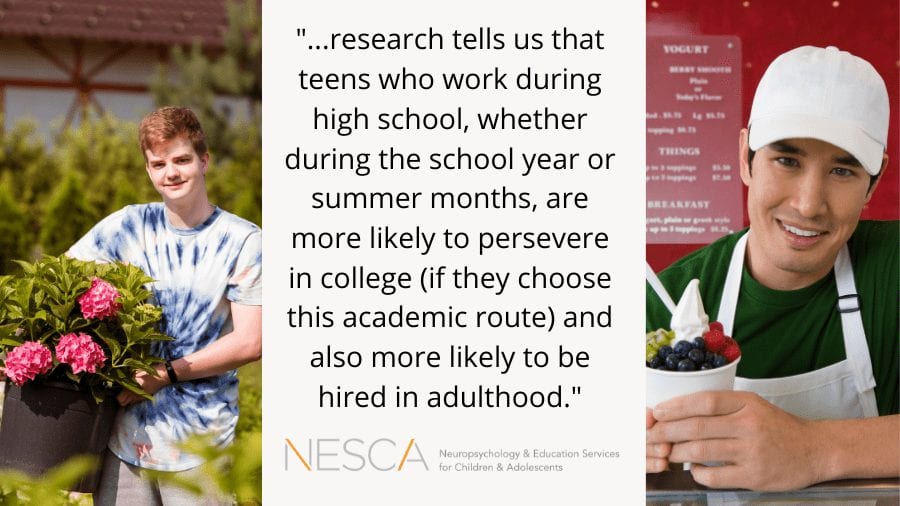
“The share of teens participating in the labor force peaked 40 years ago and has declined ever since.”[1] There are many reasons why employment rates among teens ages 16-19 have declined, such as increased schoolwork and graduations requirements, summer program and extracurricular opportunities, and work competition. Now, roughly only one-third of youth in this age range are part of the workforce. But research tells us that teens who work during high school, whether during the school year or summer months, are more likely to persevere in college (if they choose this academic route) and also more likely to be hired in adulthood. For teenagers with disabilities, a population of young people who face a high risk for unemployment in adulthood, work experience in high school is even more critical.

Some of the benefits of paid employment for all students include:

  1. A new sense of identity—as a worker
  2. Learning workplace norms and expectations
  3. Developing important executive functioning skills, like time and task management
  4. Building social skills by collaborating and negotiating with other workers and/or customers
  5. Improving self-awareness through receiving coworker and employer feedback
  6. Reading a paycheck and learning to manage earned money
  7. Starting to identify learning and career goals (“I never want to do this again, so I am going to need to get a degree or some training.”) and/or gaining experience in a field of interest

Even failed work experiences—and failed application processes—are extremely valuable tools for learning the above skills as well as building coping and problem-solving skills.

And since it is almost summer and teenagers are finishing, or have finished, their classes for the school year, this is a great time to make a plan for summer employment. Teens can look in traditional places such as grocery stores, retailers, and fast-food restaurants, or may want to pursue something non-traditional like doing yard work, dog walking/pet sitting, cleaning/detailing, or odd jobs for family friends and neighbors. Those 18 and over with driver’s licenses may enjoy the flexibility of working with a delivery service like Instacart or Uber Eats.

Because work—whether a summer, part-time, traditional or non-traditional job—is such a critical aspect of transition planning, NESCA has authored many blogs related to career assessment, career planning, and career counseling. Some of these include:

We hope you will enjoy reading these blogs. More importantly, we hope you will help teenagers in your life get out there and work!

Reference:

[1] https://www.cnbc.com/2019/10/06/why-so-few-teenagers-have-jobs-anymore.html


About the Author
Kelley Challen, Ed.M., CAS, is NESCA’s Director of Transition Services, overseeing planning, consultation, evaluation, coaching, case management, training and program development services. Ms. Challen also provides expert witness testimony in legal proceedings related to special education. She is also the Assistant Director of NESCA, working under Dr. Ann Helmus to support day-to-day operations of the practice. Ms. Challen began facilitating programs for children and adolescents with special needs in 2004. After receiving her Master’s Degree and Certificate of Advanced Study in Risk and Prevention Counseling from Harvard Graduate School of Education, Ms. Challen spent several years at the MGH Aspire Program where she founded an array of social, life and career skill development programs for teens and young adults with Asperger’s Syndrome and related profiles. She additionally worked at the Northeast Arc as Program Director for the Spotlight Program, a drama-based social pragmatics program, serving youth with a wide range of diagnoses and collaborating with several school districts to design in-house social skills and transition programs. Ms. Challen is co-author of the chapter “Technologies to Support Interventions for Social- Emotional Intelligence, Self-Awareness, Personality Style, and Self-Regulation” for the book Technology Tools for Students with Autism. She is also a proud mother of two energetic boys, ages six and three. While Ms. Challen has special expertise in supporting students with Autism Spectrum Disorders, she provides support to individuals with a wide range of developmental and learning abilities, including students with complex medical needs.


Neuropsychology & Education Services for Children & Adolescents (NESCA) is a pediatric neuropsychology practice and integrative treatment center with offices in Newton, Massachusetts, Plainville, Massachusetts, and Londonderry, New Hampshire, serving clients from preschool through young adulthood and their families. For more information, please email info@nesca-newton.com, call 617-658-9800 or complete our online Intake Form.

Skip to content