NESCA’s Newton, MA location has immediate availability for neuropsychological evaluations. Our MA clinicians specialize in the following evaluations: Neuropsychological; Autism; and Emotional and Psychological, as well as Academic Achievement and Learning Disability Testing.

Visit www.nesca-newton.com/intake for more information or to book an evaluation.

Subscribe to NESCA Notes

Why Taking Competency Tests, like the MCAS, can be Critical for Transition and College Planning

By | NESCA Notes 2021

By: Kelley Challen, Ed.M., CAS
Director of Transition Services; Transition Specialist, NESCA

Most states require some form of competency testing for students, particularly students who will graduate with a state standard diploma. But in the past year, standardized competency testing has become more complicated, if not impossible, to carry out.

In Massachusetts, graduation requirements have been altered for several grades of students. Students graduating in 2021-2023 are being offered alternative options for meeting state competency determination in one or more of the required subject areas (e.g., science and technology/engineering, mathematics, English Language Arts). For more details about those alternatives, see MA Graduation Requirements and Related Guidance on the Massachusetts Department of Elementary and Secondary Education (DESE) website.

The opportunity for students in the Class of 2022 to graduate without ever sitting for 10th grade MCAS is something that many students, parents, and teachers are excited about. While I understand, and even agree with, criticisms of standardized testing, there are also many reasons that I am disappointed for the students who are missing out on the opportunity to sit for this testing. These students, especially those with disabilities, are missing out on a vital transition planning activity.

Preparing for, and sitting for, (and coping with,) high stakes tests is an important part of life. Whether you pass or fail, being able to show up and perform your best in a high-pressure situation is a valuable life skill. Moreover, being able to demonstrate competency in a test situation is a reasonable and necessary college and career skill.

Additionally, standardized tests like MCAS provide objective feedback regarding the student’s level of achievement with high school material. Grades can be tremendously subjective, and are highly dependent on the teachers and types of classes that the student is exposed to during high school. In contrast, students participating in honors, college prep, and functional math classes all sit for the same standardized math tests. This is especially important when students in all three of those classes are interested in heading off to college after high school, and when we want to get a sense of their readiness for handling college coursework. Generally, students who do not earn passing scores (i.e., students who score in the “Needs Improvement” or “Partially Meeting Expectations” categories) on the MCAS, especially by 12th grade, will struggle with college placement exams, such as the Accuplacer, and may end up needing to take remedial coursework at the start of college. Students have a right to know how ready they are for the academic rigors of college as they are making their college plans, and standardized testing results can be helpful information (although they are by no means the whole picture).

With the new competency determination options, many students in Massachusetts view sitting for MCAS as something that is only worth doing if they are possible candidates for the John and Abigail Adams Scholarship (a merit-based state scholarship program). However, I hope students will also consider the other positive reasons I have listed above when deciding whether to sit for the test. For college-bound students who do choose not to sit for MCAS, I strongly recommend sitting for other standardized exams during high school, such as SAT, ACT, Accuplacer, etc. These experiences are important opportunities to build confidence in high stakes situations, to assess college readiness skills, and to identify skill gaps that may need shoring up.

Certainly, there are many legitimate concerns about standardized test contents and validity, including significant equity issues. I also believe that competency tests and college placement tests provide important information for many college-bound students. They are one metric, among many, that are worth having for transition and college planning.


About the Author
Kelley Challen, Ed.M., CAS, is NESCA’s Director of Transition Services, overseeing planning, consultation, evaluation, coaching, case management, training and program development services. Ms. Challen also provides expert witness testimony in legal proceedings related to special education. She is also the Assistant Director of NESCA, working under Dr. Ann Helmus to support day-to-day operations of the practice. Ms. Challen began facilitating programs for children and adolescents with special needs in 2004. After receiving her Master’s Degree and Certificate of Advanced Study in Risk and Prevention Counseling from Harvard Graduate School of Education, Ms. Challen spent several years at the MGH Aspire Program where she founded an array of social, life and career skill development programs for teens and young adults with Asperger’s Syndrome and related profiles. She additionally worked at the Northeast Arc as Program Director for the Spotlight Program, a drama-based social pragmatics program, serving youth with a wide range of diagnoses and collaborating with several school districts to design in-house social skills and transition programs. Ms. Challen is co-author of the chapter “Technologies to Support Interventions for Social- Emotional Intelligence, Self-Awareness, Personality Style, and Self-Regulation” for the book Technology Tools for Students with Autism. She is also a proud mother of two energetic boys, ages six and three. While Ms. Challen has special expertise in supporting students with Autism Spectrum Disorders, she provides support to individuals with a wide range of developmental and learning abilities, including students with complex medical needs.


Neuropsychology & Education Services for Children & Adolescents (NESCA) is a pediatric neuropsychology practice and integrative treatment center with offices in Newton, Massachusetts, Plainville, Massachusetts, and Londonderry, New Hampshire, serving clients from preschool through young adulthood and their families. For more information, please email info@nesca-newton.com or call 617-658-9800.

Cyberbullying and Autism Spectrum Disorders

By | NESCA Notes 2021

By Yvonne M. Asher, Ph.D. 
Pediatric Neuropsychologist

I recently had the opportunity to attend a webinar by Justin Patchin, Ph.D., one of the foremost cyberbullying researchers. I have used his work myself in designing both my master’s thesis and doctoral dissertation research, so it was wonderful to hear him speak. He began with a story about his childhood and some of the rules he was taught – don’t meet up with strangers that you meet online, don’t get into anyone’s car if you don’t know them well – lessons I was also taught as a child. These are the kind of rules that individuals with Autism Spectrum Disorders (ASD) often crave – black and white, clear, no middle ground. The online world, he argued, does not allow for such stark and rigid rules. Rather, he says, it calls for “guidelines.” Working with children with ASD, when I hear “guidelines,” I think, “grey,” “fuzzy,” and “it depends.” These can be some of the toughest situations for an individual who is not neurotypical.

I think he’s right. The online world is fast, fluid, ever-changing, and highly dependent on specific circumstances. It calls for the kind of flexible thinking and evaluation of context that kids with ASD are so often challenged by. Yet, as the adults parenting, educating, and supporting these young people, these are exactly the skills that they need. The online world is not going anywhere anytime soon, and it is not likely to slow down either.

Cyberbullying is one of the difficult online phenomena to manage, as youth who are bullied online are most frequently also bullied in “real life,” usually at school. The bullies are often peers they know and must see on a regular basis. For children with social challenges, navigating bullying that is occurring across settings is an especially difficult task. And the solution is not to take away technology. Now more than ever, children need access to technology for homework, classwork, enjoyable peer activities, and hobbies. Where does that leave us?

Unfortunately, Dr. Patchin did not give any practical advice for how to support individuals with autism around cyberbullying. I think that one important starting point is to help these individuals learn to check in with themselves. Time and time again, I hear from students, “I’m not really sure what was going on, but I think they were being mean.” (In fact, I hear this from children who are decidedly not on the autism spectrum, especially when bullying is occurring by older peers.) Bullying is hurtful (intentionally so), and recognizing that hurt is an important first step. Once children and adolescents identify that something is hurtful, adults can help and support them in navigating through the situation.

Whether bullying, cyberbullying, or a misunderstanding, it is important for adults to listen carefully when children come to us with social concerns. In addition, we must have a solid understanding of the online world in which students are living, learning, and engaging. Social media shifts rapidly, with new platforms becoming wildly popular in a matter of weeks. Working with youth requires us to keep as current as we can, making certain that we understand the “ins and outs” of each platform. It is also incumbent upon us to ensure that all children and adolescents (not just those with an autism diagnosis) learn guidelines that will allow them to safely make their way through a constantly evolving world of platforms, apps, and services. Safety online is as critical as safety in person.


About the Author

Dr. Yvonne M. Asher enjoys working with a wide range of children and teens, including those with autism spectrum disorder, developmental delays, learning disabilities, attention difficulties and executive functioning challenges. She often works with children whose complex profiles are not easily captured by a single label or diagnosis. She particularly enjoys working with young children and helping parents through their “first touch” with mental health care or developmental concerns.

Dr. Asher’s approach to assessment is gentle and supportive, and recognizes the importance of building rapport and trust. When working with young children, Dr. Asher incorporates play and “games” that allow children to complete standardized assessments in a fun and engaging environment.

Dr. Asher has extensive experience working in public, charter and religious schools, both as a classroom teacher and psychologist. She holds a master’s degree in education and continues to love working with educators. As a psychologist working in public schools, she gained invaluable experience with the IEP process from start to finish. She incorporates both her educational and psychological training when formulating recommendations to school teams.

Dr. Asher attended Swarthmore College and the Jewish Theological Seminary. She completed her doctoral degree at Suffolk University, where her dissertation looked at the impact of starting middle school on children’s social and emotional wellbeing. After graduating, she completed an intensive fellowship at the MGH Lurie Center for Autism, where she worked with a wide range of children, adolescents and young adults with autism and related disorders.


Neuropsychology & Education Services for Children & Adolescents (NESCA) is a pediatric neuropsychology practice and integrative treatment center with offices in Newton, Massachusetts, Plainville, Massachusetts, and Londonderry, New Hampshire, serving clients from preschool through young adulthood and their families. For more information, please email info@nesca-newton.com or call 617-658-9800.


To book an appointment with Dr. Yvonne Asher, please complete our Intake Form today. For more information about NESCA, please email info@nesca-newton.com or call 617-658-9800.


Learning to Ride a Bike: A Rite of Passage

By | NESCA Notes 2021

By: Jessica Hanna MS, OTR/L
Occupational Therapist, NESCA

If there is one positive takeaway from the COVID-19 pandemic, it’s the ever-growing love for being outdoors. It’s spring, the flowers are blooming, the sun is out, and the air is light. Everything in our body is telling us to go outside and play.

For many kids with and without disabilities, bike riding is meaningful, liberating, and a rite of passage. Close your eyes and try to remember the first time you rode a two-wheel bike. Can you remember the color of your bike? The smell in the air? The complete joy it brought you? That was the day we all felt a bit more confident and like we grew a bit taller.

So how do we help our children achieve this meaningful occupation? The days of running behind our children while holding onto their bike seat, telling them to pedal, not to stop, and hoping for the best and that they will forgive us when we let go (when we clearly promised we would not let go!) should be far behind us. But are they?

A lot goes into learning how to ride a bike, so do not let your child give up so soon when it takes more than a couple of days, weeks, or months to get it right. Consider the following skills that are addressed in learning to ride a bike:

  • Attention and concentration
  • Bilateral coordination
  • Balance
  • Body awareness
  • Core strength
  • Hand-eye coordination
  • Motor planning
  • Postural stability
  • Sensory processing
  • Upper and lower extremity strength
  • Visual scanning

Children as young as five years of age will begin to acquire and develop the skills needed to ride a two-wheel bike, and still others may not feel ready until they are pre-teens or even into adulthood.

Before getting started, here are a couple things to consider regarding the equipment involved in learning how to ride a bike:

  • Bike – The height of the bike is a crucial element to success when learning how to ride. When seated on the bike, your child’s feet should be firmly planted on the ground. The bike seat may appear too low and the bike too small; however, this technique enables movement security, engages proper core and postural stability, and increases confidence.
  • Braking System – Be sure to learn the difference between hand brakes vs. coaster brakes (using feet to backpedal). Both braking systems have pros and cons. Hand brakes are a personal favorite. They are more flexible to position, offer better control, but require adequate hand strength and coordination to manipulate. Coaster brakes (using your feet to pedal backward to brake) use an intuitive motor planning motion for children. When you pedal forward, you go; when pedaling backward, you stop. They are helpful for children who lack the hand strength skills to wrap and squeeze their hands around a hand brake; however, they provide awkward foot positioning and the constant tendency to backpedal.
  • Helmet – Safety, Safety, Safety! When handling a bike for any occasion (i.e., walking a bike, doing balance drills on a bike, or riding a bike), it should become an automatic habit to wear a helmet. Your child should be in charge of putting on and taking off their helmet independently. There is nothing more important than wearing a helmet that fits correctly with fasteners that can be easily manipulated. When choosing a helmet, be cognizant of the type of fastener/clasp it comes with and if your child has the fine motor skills to adjust it (this skill could take time to learn).If you are unsure if your child’s helmet is a good fit, any cycling store will be more than pleased to assist in finding your child the most appropriate size. 
  • Pedals – When learning to ride for the first time, the removal of pedals should be highly considered. It provides the opportunity to address balance, core, and postural stability for both younger and older children while also increasing movement security.
  • Training Bike – Which is best…balance bikes vs. training wheels? Balance bikes are light in weight and can be introduced to children at a much younger age than a pedal bike. They promote core strength and increase motor planning, sequencing, and balance training skills, making the transition from a balance bike to a two-wheel pedal bike more fluid and easier to manage. Training wheels promote ease in learning motor planning techniques to push on pedals while providing assisted balance. It’s important to note that removing the balance component can be disadvantageous when transitioning from training wheels to a two-wheel pedal bike.

Overall, the literature supports the observation that, for children with and without disabilities, learning to ride a bike is a popular activity that increases confidence, provides opportunities for shared recreation with families and peers, and promotes social inclusion (Dunford, Bannigan, Rathmell (2016).

Several of the many clinical diagnoses of children who can ride a bike follow here; however, this list is certainly not inclusive of the many other diagnoses that do not preclude children from bike riding:

  • ADHD
  • Anxiety
  • Autism Spectrum Disorder
  • Cerebral Palsy
  • Developmental Coordination Disorder
  • General learning disability
  • Hearing impairment
  • No diagnosis

The art of bike riding can be broken down into various steps, from learning how to use the kickstand to the act of pedaling. Each step deserves attention, because through repetition and practice, confidence is achieved.

If using these tips feels difficult or is not helping your child with the level of focus and skill they need to successfully achieve their goal to use a bike, we recommend reaching out to your occupational therapist or getting an occupational therapy evaluation. If in-person direct services continue to be a concern, biking riding skills can be offered via telehealth from the comfort of  your home. Jessica offers successful biking riding drills and adaptive home exercise plans through telehealth that address the skills required to learn to ride a bike. Contact NESCA’s Director of Clinical Services Julie Robinson, OT, to learn more at: jrobinson@nesca-newton.com.


References
Dunford, Bannigan, Rathmell (2016) Learning to ride a bike: Developing a therapeutic intervention. Children Young People & Families Occupational Therapy Journal 20(1) 10-18


About the Author

Jessica Hanna has over 10 years of pediatric OT experience in conducting assessments and providing treatment of children and adolescents with a broad range of challenges and disabilities, including autism spectrum disorders, sensory processing disorders, visual impairments, cerebral palsy, executive function deficits and developmental disorders of motor function. Prior to joining NESCA, Jessica trained and worked in a variety of settings, including inpatient and outpatient hospital settings, private practice, schools and homes. She has served on interdisciplinary treatment teams and worked closely with schools, medical staff and other service providers in coordinating care. In addition, Jessica provided occupational therapy services at Perkins School for the Blind and Spaulding Rehabilitation Hospital pediatric inpatient unit, where she conducted comprehensive evaluations and interventions for children with a broad range of presentations.


To book an appointment or to learn more about NESCA’s Occupational Therapy Services, please fill out our online Intake Form, email info@nesca-newton.com or call 617-658-9800.


Neuropsychology & Education Services for Children & Adolescents (NESCA) is a pediatric neuropsychology practice and integrative treatment center with offices in Newton, Massachusetts, Plainville, Massachusetts, and Londonderry, New Hampshire, serving clients from preschool through young adulthood and their families. For more information, please email info@nesca-newton.com or call 617-658-9800.


Daily Journaling While Social Distancing

By | NESCA Notes 2020

By Dot Lucci, M.Ed., CAGS
Director of Consultation and Psychoeducational Services, NESCA

*This post was originally published almost a year ago. While we slowly start to emerge from our quarantine and begin to safely re-engage in some of the activities and duties from our pre-pandemic lives, it is important to remember to participate in activities to better ourselves and others on a daily basis.

This is such a unique time that we are living in, but one day it will be a distant memory. Get a special journal book, make it from scratch or create one online. It will give you something to look back on and remember how you achieved something every day, smiled and made it through a very surreal time in history. Keep your journal to share with future generations. While we are practicing social distancing or being asked to stay home, challenge yourself to do something out of every category below on a daily basis. Do something for your brain, your mental health, your body, your home, your community, your creativity, your family, the environment and your friends/neighbors. Adults and kids can do this.


While Physically Distancing, Do Something For:

Your Brain

❏     Do a puzzle

❏     Listen to a podcast

❏     Tour a Virtual Museum

❏     READ

❏     Challenge yourself with a game, crossword puzzle, Sudoku, etc.

Your Mental Health

❏     Try a meditation app, like “stop, breathe, think” or www.calm.com

❏     Find an example of someone giving back or helping others

❏     Laugh out loud at least twice a day, tell a joke, watch a funny movie

❏     Turn off the news

❏     Record how you are feeling using the Yale Mood Meter

Your Body

❏     Take a walk, go for a run, ride a bike

❏     Create a dance play list and dance, dance, dance – We Are Family!

❏     GoNoodle Indoor Recess

❏     YouTube: workouts, yoga or dance

Your Home

❏     Do a chore – vacuum, dishes, laundry

❏     Clean your room

❏     Put your things away

Your Creativity

❏     Learn something new

❏     Draw/paint

❏     Build with LEGO

❏     Learn Calligraphy or Hand Lettering

❏     Play an instrument

❏     Search Pinterest for “DIY” or “upcycle”

Your Community

❏     Follow CDC Guidelines – stay home and wash your hands

❏     Go through clothing and toys to donate

❏     Check out your community website for what is needed

❏     Make cards to send to a local nursing home, nurses, doctors

The Earth

❏     Go for walks and enjoy nature

❏     Plant something

❏     Pick up litter – wear gloves

❏     Find another use for something before you recycle it

Family, Friends, Neighbors

❏     Stay in touch with each other

❏     Connect on FaceTime calls

❏     Have dinners together over FaceTime, Skype, Zoom

❏     Call people instead of text, write a letter, draw a picture

❏     Make a photo book of memories with a service like shutterfly

❏     Cook something for your family, neighbors

❏     Ask if someone needs help


About the Author

NESCA’s Director of Consultation and Psychoeducational Services Dot Lucci has been active in the fields of education, psychology, research and academia for over 30 years. She is a national consultant and speaker on program design and the inclusion of children and adolescents with special needs, especially those diagnosed with Autism Spectrum Disorder (ASD). Prior to joining NESCA, Ms. Lucci was the Principal of the Partners Program/EDCO Collaborative and previously the Program Director and Director of Consultation at MGH/Aspire for 13 years, where she built child, teen and young adult programs and established the 3-Ss (self-awareness, social competency and stress management) as the programming backbone. She also served as director of the Autism Support Center. Ms. Lucci was previously an elementary classroom teacher, special educator, researcher, school psychologist, college professor and director of public schools, a private special education school and an education collaborative.

Ms. Lucci directs NESCA’s consultation services to public and private schools, colleges and universities, businesses and community agencies. She also provides psychoeducational counseling directly to students and parents. Ms. Lucci’s clinical interests include mind-body practices, positive psychology, and the use of technology and biofeedback devices in the instruction of social and emotional learning, especially as they apply to neurodiverse individuals.


To book a consultation with Ms. Lucci or one of our many expert neuropsychologists, complete NESCA’s online intake form. Indicate whether you are seeking an “evaluation” or “consultation” and your preferred clinician/consultant in the referral line.


Neuropsychology & Education Services for Children & Adolescents (NESCA) is a pediatric neuropsychology practice and integrative treatment center with offices in Newton, Massachusetts, Plainville, Massachusetts, and Londonderry, New Hampshire, serving clients from preschool through young adulthood and their families. For more information, please email info@nesca-newton.com or call 617-658-9800.


Diplomas, Graduation Dates and IEP Transition Services Revisited

By | NESCA Notes 2021

By: Kelley Challen, Ed.M., CAS
Director of Transition Services; Assistant Director, NESCA

Three years ago, on March 26, 2019, the Massachusetts Department of Elementary and Secondary Education (DESE) sent out an important administrative advisory regarding transition services and graduating with a high school diploma (Administrative Advisory SPED 2018-2: Secondary Transition Services and Graduation with a High School Diploma). At the time, I wrote a blog about the advisory, wanting to bring attention to the much-needed guidance clarifying when and how students with IEPs (Individualized Education Programs) should be issued a high school diploma.

Today, more than a year into the COVID-19 pandemic, seems like a very important time to revisit what it means for a student on an IEP to be ready to graduate high school with a diploma this June. Given the lengthy school shutdown in Spring 2020—followed by ongoing limitations in social contact, community engagement, employment opportunities, and more—many students and their families are questioning whether they are ready for graduation. In fact, I sat in a team meeting last week where a special educator asked an adult student whether they would like to take their diploma or “refuse” their diploma in June. [This phrasing, “refusing” or “rejecting” a diploma, is often used but is inaccurate as a student is not refusing to take their diploma. Rather, the team is instead delaying or deferring graduation in certain circumstances.]

As a parent and professional regularly involved in the IEP process, a comfort throughout this pandemic is that while education has been reinvented several times, and community safety and engagement is highly variable, special education laws (including the Individuals with Disabilities Education Act of 2004, which outlines the requirement for school districts to provide transition services) remain the same. The decision for a student receiving special education services to take a diploma, or defer taking a diploma, continues to be based primarily on the same variables:

  1. Meeting local graduation requirements;
  2. Passing the state Competency Determination (CD); and
  3. Receiving Free and Appropriate Public Education (FAPE) that includes secondary transition services based on age-appropriate transition assessment.

Prior to COVID-19, passing the state CD in Massachusetts typically involved passing on-demand tests in English Language Arts (ELA), Mathematics and Science or successfully completing an alternate assessment competency portfolio. For students who have an anticipated graduation date prior to October 1, 2021 (as noted in their most recent signed IEP), something that has changed during the pandemic is that there are now Modified CD requirements that allow for CD in ELA and mathematics to be awarded upon district certification that the student earned full credit for a relevant course aligned to the curriculum framework in the subject matter and demonstrated competency in that subject. A similar Modified CD requirement for science is also available for students graduating in classes of 2021-2023. Therefore, a student who did not pass on-demand MCAS testing in 2019 may be eligible to graduate with a diploma using the Modified CD requirements.

However, as students, their parents, and their education teams ponder June 2021 graduation dates, it is important to keep focus on the same variables that we have always used for considering whether a student is ready to accept a local diploma. Here are some questions that may help when considering these variables.

  1. Has the student met all local graduation requirements? Did they complete the core courses required by the district? Or, were they given credit for courses/activities that varied greatly from courses that general education students completed? What about attendance requirements? Did the student stop attending classes or have a significantly lower rate of attendance than general education peers in the past year? Did the student meet requirements for community service hours or a capstone project if those were required of general education students?
  2. Did the student pass the state Competency Determination? Did the student have the opportunity to participate in MCAS on-demand testing? If they did not, did the student have a track record of passing MCAS tests? Was the student scheduled to graduate this June or did someone from the school district propose changing the student’s graduation date to take advantage of the Modified CD requirements currently being used by the department of education due to COVID-19?
  3. Did the student receive FAPE including secondary transition services based on age-appropriate transition assessment while in high school? Is there a Transition Planning Form (28M/9) that the team has been updating annually? Are there appropriate measurable postsecondary goals in the student’s IEP vision statement that are based on transition assessment (PLEASE remember that interview is an important assessment tool for many students)? Was the student’s voice part of team meetings where transition services were discussed? Does the student’s IEP have measurable goals that will reasonably help the student to progress toward their IEP vision statement? Has the student made effective progress on the goals outlined in the IEP over the past year? Has the student been able to engage in transition services that were described in the IEP? Was the student’s graduation date supposed to be this June or was it “TBD”? And, if appropriate, was a representative of an adult human service agency (e.g., Department of Mental Health, Department of Developmental Services, Massachusetts Rehabilitation Commission, Massachusetts Commission for the Blind, Massachusetts Commission for the Deaf and Hard of Hearing) involved in one or more IEP meetings?

Having missed out on school and community-based activities in the past year can create an immediate concern that a student needs to hang on to their special education protections and should not graduate this June. But the truth is that the pandemic created opportunities for students to generalize skills and practice functional skills, and some students are more ready than ever to move on from special education. And, as I stated in my previous blog, there is no universal set of skills or level of knowledge that deems a student on an IEP “ready” to graduate. In fact, students on IEPs, just as with mainstream students, graduate all the time without being ready for many adult activities (e.g., apartment hunting, changing jobs, applying for a bank loan, comparing health insurance plans).

When you are considering whether the student has received FAPE, it is important to remember that every student missed some typical high school planning steps over the past year. When school buildings closed down and community engagement came to a halt, educators and special educators had to pivot many times. Transition planning steps may have been missed or services may not have been delivered in originally anticipated ways without any clear fault or person to blame. If a student’s progress towards their measurable postsecondary goals was substantially halted, this might be important for the team to discuss. But there are many circumstances where students continued to make progress in spite of the missed opportunities. Perhaps the pandemic even created new opportunities for progress that would not typically be available until a student exits high school (e.g., a paid job, increased self-direction through participation in remote learning, easier access to pre-employment transition services, increased communication with peers through technology, etc.).

Regardless, as you are thinking about graduation, please remember that the most important question to ask is not, “Is my child/student ready to graduate?” Instead, the critical question to ask when a student approaches their graduation date is, “Has the student received a Free and Appropriate Public Education (FAPE)?” If the answer is “yes,” it is vital to give the student the opportunity to step into adult postsecondary life and begin applying the skills they have learned through their education and special education. Although the pandemic has created a lot of anxiety and uncertainty, let’s not fall victim to a pattern of rejecting IEPs (essentially rejecting/refusing diplomas) out of fear.

If you are interested in working with a transition specialist at NESCA for consultation, planning, or evaluation, please complete our online intake form: https://nesca-newton.com/intake-form/.

Resources:

Transition Resources and Advisories from MA Department of Elementary and Secondary Education:

While this blog includes some specific content that applies only to families of students in IEPs in Massachusetts, the requirement to deliver transition services for students on IEP is a federal mandate and impacts graduation in all states.


About the Author
Kelley Challen, Ed.M., CAS, is NESCA’s Director of Transition Services, overseeing planning, consultation, evaluation, coaching, case management, training and program development services. Ms. Challen also provides expert witness testimony in legal proceedings related to special education. She is also the Assistant Director of NESCA, working under Dr. Ann Helmus to support day-to-day operations of the practice. Ms. Challen began facilitating programs for children and adolescents with special needs in 2004. After receiving her Master’s Degree and Certificate of Advanced Study in Risk and Prevention Counseling from Harvard Graduate School of Education, Ms. Challen spent several years at the MGH Aspire Program where she founded an array of social, life and career skill development programs for teens and young adults with Asperger’s Syndrome and related profiles. She additionally worked at the Northeast Arc as Program Director for the Spotlight Program, a drama-based social pragmatics program, serving youth with a wide range of diagnoses and collaborating with several school districts to design in-house social skills and transition programs. Ms. Challen is co-author of the chapter “Technologies to Support Interventions for Social- Emotional Intelligence, Self-Awareness, Personality Style, and Self-Regulation” for the book Technology Tools for Students with Autism. She is also a proud mother of two energetic boys, ages six and three. While Ms. Challen has special expertise in supporting students with Autism Spectrum Disorders, she provides support to individuals with a wide range of developmental and learning abilities, including students with complex medical needs.


Neuropsychology & Education Services for Children & Adolescents (NESCA) is a pediatric neuropsychology practice and integrative treatment center with offices in Newton, Massachusetts, Plainville, Massachusetts, and Londonderry, New Hampshire, serving clients from preschool through young adulthood and their families. For more information, please email info@nesca-newton.com or call 617-658-9800.

Counseling/Therapy: So Many Types and Approaches…Which One Should I Choose?

By | NESCA Notes 2021

By Dot Lucci, M.Ed., CAGS
Director of Consultation and Psychoeducational Services, NESCA

Many adults, teens and children struggle with a myriad of challenges from everyday stressors, feelings of worthlessness and insecurities to official diagnoses of anxiety, depression, PTSD, eating disorders, OCD, addiction, and more. Deciding how to grow and change and alleviate the pain and suffering can be daunting. There are so many different ways to address psychological pain. Psychological, medical, behavioral, psychopharmacological, complementary (e.g., acupuncture), and educational treatments, among others, are possible choices and can assist in lessening an individual’s anguish. How do I decide which one(s) to try? Usually, treatment involves more than one of these, so the decisions may not be as difficult as you think. The first step is recognizing that you, your child, your marriage or family needs help and taking a step to get help.

Psychological treatments include many options: psychotherapy (i.e., “talk therapy or insight-based therapy”), psychoeducational counseling, biofeedback, social training, behavior therapy, mindfulness, stress management, anger management and so many more. Therapy can be individual, group, family or couples work, and there is no single approach that works for everyone. It often depends on the referral question and complaint. Counseling is typically provided by a psychologist, social worker, mental health counselor, marriage and family counselor, expressive therapist, psychiatrist and/or psychiatric nurse. Many factors go into making psychological treatment decisions (i.e., referring question/complaint, cost, location, approach, etc.). When it comes to therapy, it is most important to have “goodness of fit” between the clinician and the client. The client needs to have a connection with and feel valued, supported and understood by their practitioner. This allows whatever treatment approach or method to be more readily accepted by the client.

Reviewing the differences between treatment approaches may help with the decision-making process beyond “the goodness of fit.” Psychotherapy involves talking with a clinician to address emotional, psychological and behavioral challenges that can be both conscious and unconscious. The client’s past experiences, perceptions and history may play an important role in psychotherapy. The client “tells a story” that helps the clinician understand their life experiences through their eyes, therefore allowing treatment to be tailored to that client’s personal experience. By working through one’s thoughts, past experiences and stressors with a caring clinician, the client is able to gain insight and perspective, reduce symptoms, change behavior, learn strategies to lighten the load and improve quality of life. Often psychotherapy is long-term and involves good communication/language skills as well as higher level of thinking, often abstractly, and insight capacity.

Psychoeducational treatment is somewhat different than psychotherapy. Education is central to treatment and is a more directive approach. It can have very specific goals and may be short-term. The past is not actively addressed; rather, the purpose is to teach the client to acknowledge, accept and understand their disability and/or mental health condition and provide ways to support growth, change and meet goals. Psychoeducational treatment can be provided to individuals, groups, families, couples, employers and others and may include reading informational text, video analysis, homework, data collection, biofeedback, journal writing and more.

Some of the goals of both treatment approaches may be to:

  • connect how thoughts, feelings and behavior are intertwined;
  • improve coping and problem-solving skills to better deal with life’s stressors;
  • increase positive self-regard; and
  • recognize and better deal with strong emotions.

Many clinicians have training in specific techniques and some use a combination of approaches and philosophies. Psychotherapy typically falls into broad categories: Psychoanalysis and psychodynamic, Behavior Therapy, Cognitive Therapy, Humanistic Therapy and Integrative or Holistic Therapy.  Sometimes a specific approach may be the best method of choice given a specific condition or specific goal of the client. Some techniques have been researched on large samples of people and proven to yield positive results with certain diagnoses; while others are newer, less researched (yet are still effective).

In determining what technique is most appropriate, consider the age, diagnosis, goal of treatment, efficacy of the treatment, as well as the personality, cognitive and language capacity, cultural/family background, location, cost, etc. Many treatment approaches share common techniques, but some techniques are better suited with certain conditions/diagnoses. There are upwards of 100 different types of psychotherapeutic approaches, so knowing which one works with what conditions, resonates with you as the client and can meet the needs/goals.

Another option is online treatment. In recent years, many in-person practices and newer standalone online treatment options have emerged. Often these are for mild depression and anxiety. As you search out any treatment, ask for references and reviews and assess treatment efficacy. Some online sites include Talkspace, TeenCounsleing and more. There are also online apps to help with stress management, anxiety, depression and more, such as Moodfit, HeadSpace for Kids, MindShift, Inner Balance, and so many more. Needless to say, online therapy and apps are not the same as in-person therapy but may augment and be helpful in some situations.

Many clients at NESCA present with learning differences, anxiety, OCD, depression, trauma, addiction, ASD, and more. The following partial list includes just some of the treatment approaches recommended by many of NESCA’s neuropsychologists. At NESCA, we currently offer a psychoeducational approach to psychological treatment and short-term pandemic related issues of anxiety and depression. If interested in learning more, please visit: https://nesca-newton.com/integrativetherapeutic/.

  • Acceptance and Commitment Therapy (ACT)
  • Attachment-based Therapy
  • Animal-assisted Therapy
  • Bibliotherapy
  • Biofeedback
  • Cognitive Behavior Therapy (CBT)
  • Dialectic Behavior Therapy (DBT)
  • Exposure & Response Prevention (ERP) Therapy
  • Expressive Therapy (art, music, drama, etc.)
  • Family Systems Therapy
  • Hypnotherapy
  • Mindfulness-Based Cognitive Therapy (MBCT)
  • Motivational Interviewing
  • Narrative Therapy
  • Positive Psychology
  • Parent-Child Interaction Therapy (PCIT)
  • Play Therapy
  • Psychoeducational Counseling
  • Trauma-Focused Cognitive Behavioral Therapy

Additional information about treatment approaches can be found at: https://www.psychologytoday.com/us/types-of-therapy.

https://www.nami.org/learn-more/treatment/psychotherapy

https://apa.org/topics/psychotehrpay/approaches

https://talkspace.com/blog/different-types-therapy-psychotherapy-best/

https://verywellmind.com


About the Author

NESCA’s Director of Consultation and Psychoeducational Services Dot Lucci has been active in the fields of education, psychology, research and academia for over 30 years. She is a national consultant and speaker on program design and the inclusion of children and adolescents with special needs, especially those diagnosed with Autism Spectrum Disorder (ASD). Prior to joining NESCA, Ms. Lucci was the Principal of the Partners Program/EDCO Collaborative and previously the Program Director and Director of Consultation at MGH/Aspire for 13 years, where she built child, teen and young adult programs and established the 3-Ss (self-awareness, social competency and stress management) as the programming backbone. She also served as director of the Autism Support Center. Ms. Lucci was previously an elementary classroom teacher, special educator, researcher, school psychologist, college professor and director of public schools, a private special education school and an education collaborative.

Ms. Lucci directs NESCA’s consultation services to public and private schools, colleges and universities, businesses and community agencies. She also provides psychoeducational counseling directly to students and parents. Ms. Lucci’s clinical interests include mind-body practices, positive psychology, and the use of technology and biofeedback devices in the instruction of social and emotional learning, especially as they apply to neurodiverse individuals.


To book a consultation with Ms. Lucci or one of our many expert neuropsychologists, complete NESCA’s online intake form. Indicate whether you are seeking an “evaluation” or “consultation” and your preferred clinician/consultant in the referral line.


Neuropsychology & Education Services for Children & Adolescents (NESCA) is a pediatric neuropsychology practice and integrative treatment center with offices in Newton, Massachusetts, Plainville, Massachusetts, and Londonderry, New Hampshire, serving clients from preschool through young adulthood and their families. For more information, please email info@nesca-newton.com or call 617-658-9800.


Executive Function Tools: Natural Consequences

By | NESCA Notes 2021

By: Sophie Bellenis, OTD, OTR/L
Occupational Therapist; Real-life Skills Program Manager and Coach, NESCA

In my last blog that focused on executive function tools, I delved into the benefits of using and committing to a digital calendar. The calendar is a concrete tool that can be directly taught to students using traditional methods. Less concrete, but in many ways equally useful, is this next executive function tool – the natural consequence.

When most people think of natural consequences, they think of younger children refusing to do things like eat a meal that their caregiver prepared or put on a coat when it is cold outside. If a child refuses their dinner, the natural consequence is hunger. If a child refuses to wear their coat, the natural consequence is feeling cold. These are consequences that will happen without parents or caregivers explicitly providing a consequence. When it comes to executive function mishaps, the natural consequence is often the need to independently deal with the fallout.

Many of the students I serve directly need scaffolded executive function support with direct instruction and specific opportunities for practice. I am not advocating for removing these services or throwing these students to the proverbial wolves. What I am advocating for is using mistakes or lapses in executive function skill as learning opportunities, as opposed to absolving our students from all responsibility and continuously jumping in to save the day. To demonstrate this difference, here are a few examples of ways I have seen parents successfully use natural consequences as a tool to teach executive function.

Case Studies

  1. Amber is a student who has had consistent difficulty organizing her time after school. While she attends many different afterschool activities, such as recycling club and track, she is often late to practice or misses important changes to the schedule. To help Amber, her parents set up a calendar with notifications and reminders that appear on her phone and her computer directly after school. Recently, Amber started driving lessons with the local driving school. A few weeks ago, Amber had a conversation with her mother in the morning about the fact that she would be picked up for a lesson 10 minutes after the end of the school day. Amber’s notification on her phone went off 15 minutes before the lesson, and she received a pop-up on her computer screen 30 minutes before the end of the school day. Despite these reminders, Amber hopped onto the bus at the end of the day. While this was an honest mistake, Amber was not using her tools or the time management strategies that she has been taught and is expected to use. Amber’s parents decided that as a natural consequence, Amber would need to deal with fixing her mistake. They were there to support her as she called the driving school, apologized to the instructor, and rescheduled her appointment. If she was not willing to take these steps, another natural consequence would have been a delay in getting her license. This caused some heightened anxiety for Amber, but with encouragement from her parents, she practiced the phone call out loud and looked through her calendar to see where she had availability for a make-up appointment. Amber’s parents could have easily called the driving school and fixed these problems for her; however, Amber would have missed out on an opportunity to practice problem solving.
  2. Another student who benefited from natural consequences is Albert. Albert’s parents hired a tutor to meet with him over Zoom twice per week to prepare for the SATs. He was expected to meet with his tutor, Barry, two times per week to start building up his skills. Unfortunately, despite frequent reminders and systems being put in place, Albert often missed or was late to these meetings as he was distracted by playing video games. When Albert’s parents started to receive charges for missed appointments from Barry’s company, they thought carefully about how to impress on Albert the importance of using his strategies and making it to his appointments. Eventually, Albert’s parents informed him that if he missed another session, he would be responsible for the late fee, as the charge was an inevitable consequence. When Albert eventually missed another session, his father drove him to the bank and helped him withdraw the money from his own savings account to pay his parents for the missed session. Unsurprisingly, this was hugely frustrating to Albert in the moment; however, his meetings with Barry became a priority and Albert quickly started making it to tutoring on time. After experiencing the natural consequence himself, Albert began to change his actions.

Both of these examples led to increased buy-in from the adolescents who were actively working on building up their executive functioning skills. As they started to participate in problem solving after they made a mistake, they were more aware of the work that their parents had typically been doing for them. Some language that can be productive includes:

  • “I know it was a mistake and now we just need to figure out how to fix it. What do you think we should do?”
  • “What are the next steps you need to take to solve this problem?”
  • “I can tell you what I think we should do, but I would love to hear your ideas first. Where would you start?”

As adolescents forge toward young adulthood, they will inevitably make mistakes, miss appointments, arrive late, and misplace some of their belongings. If we are constantly picking up the pieces, then they are missing out on the opportunity to learn how to solve their own problems and build an understanding of the consequences.


About the Author
Sophie Bellenis is a Licensed Occupational Therapist in Massachusetts, specializing in educational OT and functional life skills development. Bellenis joined NESCA in the fall of 2017 to offer community-based skills coaching services as a part of the Real-life Skills Program within NESCA’s Transition Services team. Bellenis graduated from the MGH Institute of Health Professions with a Doctorate in Occupational Therapy, with a focus on pediatrics and international program evaluation. She is a member of the American Occupational Therapy Association, as well as the World Federation of Occupational Therapists. Having spent years delivering direct services at the elementary, middle school and high school levels, Bellenis has extensive background with school-based occupational therapy services.  She believes that individual sensory needs and visual skills must be taken into account to create comprehensive educational programming.


To book an appointment or to learn more about NESCA’s Occupational Therapy Services, please fill out our online Intake Form, email info@nesca-newton.com or call 617-658-9800.


Neuropsychology & Education Services for Children & Adolescents (NESCA) is a pediatric neuropsychology practice and integrative treatment center with offices in Newton, Massachusetts, Plainville, Massachusetts, and Londonderry, New Hampshire, serving clients from preschool through young adulthood and their families. For more information, please email info@nesca-newton.com or call 617-658-9800.


Looking for Answers? Ask the Right Questions.

By | NESCA Notes 2021

By: Ann Helmus, Ph.D.
NESCA Founder/Director; Clinical Neuropsychologist

Many parents have met with me concerned that, “We had a full evaluation and got a lot of scores and a diagnosis but we still don’t understand why our child has this problem and what we can do about it.” This outcome can be avoided if parents and the evaluator are both clear on why the child is being evaluated, have laid out specific questions to be answered and what kinds of recommendations are being sought. Determining the referral question(s) should be a key goal of the intake session.

During the intake meeting, the evaluator can help the parent to shape their concerns into a specific referral question that can be addressed effectively through the process of neuropsychological evaluation. The evaluator can manage parental expectations in this process so there is not disappointment with evaluation results that don’t answer the parents’ questions. For example, I’ve had parents request an evaluation because they want to know if their fifth grader will get into Harvard or their child with high-functioning ASD (autism spectrum disorder) will get married. These questions can’t be addressed through a neuropsychological evaluation, but they can be re-worked into answerable questions. A neuropsychological evaluation can tell us if a child’s cognitive and academic skills are in the range of students who attend the most competitive colleges. However, there are many other factors that influence the college acceptance process. In this case, the referral question might be revised into “assess the child’s potential for academic success in a rigorous academic setting.” Similarly, it is beyond the scope of a neuropsychologist to determine if anyone will get married, but through the evaluation process we can assess the child’s current social and emotional functioning and offer some predictions about their likely developmental trajectory in the social domain.

While the previous examples of referral questions are too broad or abstract, I am also often confronted with referral questions that are too narrow, such as, “Does this child have ADHD?”.  In this case, I would work with the parents to reframe the referral question to, “Why does this child appear to have difficulty paying attention in school?” This referral question recognizes the fact that there are many reasons that a child may have difficulty concentrating or appear distractible – ADHD being only one of the possibilities.

When I train neuropsychologists, I emphasize the importance of understanding “Why now?”. What is it that motivated the parent or school team to seek evaluation at this point in time as they work to frame the referral question with parents? Common reasons include: concern about how the child will manage an upcoming transition (e.g., to middle school), sudden appearance of a problem, obvious widening of the gap between a child and peers, inability to meet increased developmental demands, lack of response to interventions, change in emotional status, or deterioration in academic performance.

It is extremely helpful when parents and/or school teams prepare for the intake meeting by brainstorming what they are seeking from the evaluation, questions they hope will be answered, issues to be assessed, and specific guidance that is being requested. The evaluator can then work with the parents or school team to fashion these into a referral question that is specific and relevant to the child so that all parties are “on the same page” as they undertake the evaluation process.


About the Author
NESCA Founder/Director Ann Helmus, Ph.D. is a licensed clinical neuropsychologist who has been practicing for almost 20 years. In 1996, she jointly founded the  Children’s Evaluation Center (CEC) in Newton, Massachusetts, serving as co-director there for almost ten years. During that time, CEC emerged as a leading regional center for the diagnosis and remediation of both learning disabilities and Autism Spectrum Disorders.

In September of 2007, Dr. Helmus established NESCA (Neuropsychology & Education Services for Children & Adolescents), a client and family-centered group of seasoned neuropsychologists and allied staff, many of whom she trained, striving to create and refine innovative clinical protocols and dedicated to setting new standards of care in the field.

Dr. Helmus specializes in the evaluation of children with learning disabilities, attention and executive function deficits and primary neurological disorders. In addition to assessing children, she also provides consultation and training to both public and private school systems. She frequently makes presentations to groups of parents, particularly on the topics of non-verbal learning disability and executive functioning.

To book an evaluation with Dr. Helmus, NESCA Founder and Director, or one of our many other expert neuropsychologists or therapists, complete NESCA’s online intake form

Neuropsychology & Education Services for Children & Adolescents (NESCA) is a pediatric neuropsychology practice and integrative treatment center with offices in Newton and Plainville, Massachusetts, as well as Londonderry, New Hampshire. NESCA serves clients from preschool through young adulthood and their families. For more information, please email info@nesca-newton.com or call 617-658-9800.

Resilience, Covid and College Admissions

By | NESCA Notes 2021

By: Tabitha Monahan, M.A., CRC
NESCA Transition Specialist/Counselor

It’s been a year since schools across the nation closed their doors and moved education to the world wide web. Teachers, many of whom have never received training to teach in a virtual format, were now providing lessons remotely. The challenges of teaching remotely highlighted many of the disparities that affect our students. Students did not always have the technology or literal bandwidth to learn from home. Students with learning differences and disabilities faced even more challenges in receiving their support in a format not conducive to their needs. However, there were some silver linings. Students had more opportunities to practice executive function skills and become more familiar with software programs outside of video games, social media and YouTube videos.

As students – and, well, all of us – adjusted to the pandemic and what that meant for our daily lives, mental health concerns increased. Faced with uncertainty, constant changes and fear, anxiety, stress and depression increased among students. In response, they built coping skills.  Not all coping mechanisms are positive, but our kids survived this past year. As we work our way back to some semblance of normalcy, what does that mean for our students who were planning to move on to postsecondary education? Extracurricular activities are considered a relatively important part of the admissions process, but those weren’t available last spring and are barely available now. What should colleges use instead to find students that would be a good fit?

Resilience.

Resilience, the ability to adjust and adapt to changes and adversity, is an important factor necessary to reach goals, especially once a person faces a challenge. We encourage students to build resilience by setting high expectations of them and assisting them in creating challenging goals. We help students process what to do when they reach a roadblock. As students build coping skills and learning strategies, they are building resilience. How does resilience help in college? College is a different environment than high school. Many students experience challenges as they adjust to their newfound freedom and responsibilities. Students now find themselves responsible for scheduling their classes, getting to those classes and figuring out how to manage their schedules.

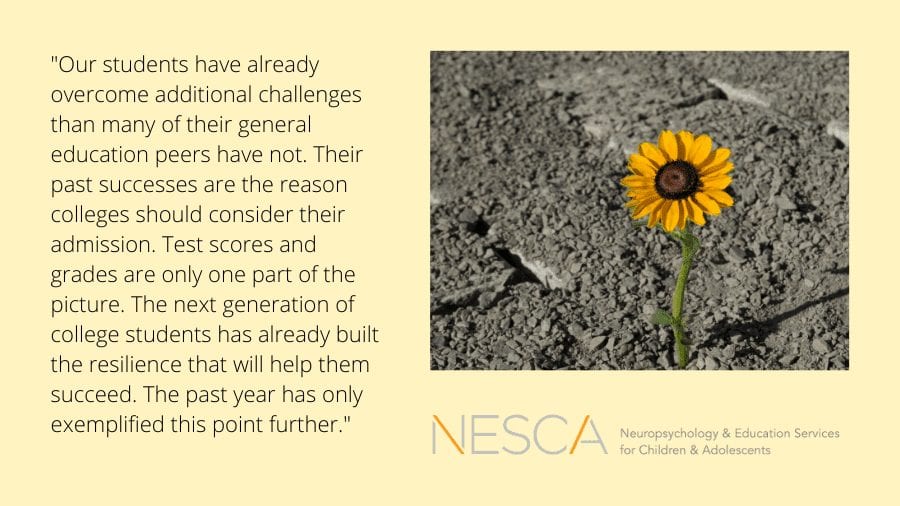
As colleges receive applications in a year unlike any in recent history, students may want to consider how they can show the colleges how they persevered. Matthew Pietrafetta of Academic Approach suggests students use the college admission essay as an opportunity to present the college with their stories that demonstrate how they became more resilient. Recommendations may also provide another factor for colleges to consider. Teachers and counselors understand the challenges that the student experienced and can share how they overcame adversity. Our students have already overcome additional challenges than many of their general education peers have not. Their past successes are the reason colleges should consider their admission. Test scores and grades are only one part of the picture. The next generation of college students has already built the resilience that will help them succeed. The past year has only exemplified this point further. Our students have proven that they can adapt and meet whatever challenges come their way. What a better way to prove to the colleges that they have what it takes?

Sources:

https://www.ncbi.nlm.nih.gov/pmc/articles/PMC7473764/

https://admissions.usf.edu/blog/do-extracurriculars-matter-in-the-college-admissions-process

https://www.insidehighered.com/admissions/views/2021/02/16/covid-19-era-college-admissions-officers-should-pay-attention-resilience?fbclid=IwAR3MNIb9ABfUJgVMZnyuJqKoF0HhBsOmYTB_ms4JZUbExvG9G_BbDUOn-gw


About the Author

Tabitha Monahan, M.A., CRC, is an experienced transition evaluator and vocational counselor. While she is well-versed in supporting a wide range of transition-aged youth, she is especially passionate and knowledgeable in helping clients and their families navigate the complex systems of adult services and benefits as well as medical and mental health systems. She is further adept in working individually with students of all abilities to empower self-advocacy and goal achievement.


To schedule an appointment with one of NESCA’s expert transition specialists or neuropsychologists, please complete our online intake form


Neuropsychology & Education Services for Children & Adolescents (NESCA) is a pediatric neuropsychology practice and integrative treatment center with offices in Newton and Plainville, Massachusetts, and Londonderry, New Hampshire, serving clients from preschool through young adulthood and their families. For more information, please email info@nesca-newton.com or call 617-658-9800.


Autism Awareness Month

By | NESCA Notes 2021

By Dot Lucci, M.Ed., CAGS
Director of Consultation and Psychoeducational Services, NESCA

So what? What does it really mean to have an awareness month and a designated day? April is Autism Awareness month, and this year April 2 was World Autism Awareness Day, established by the United Nations (UN) in 2008. In general, these designations are meant to bring awareness to ”causes.” You will see a lot of blue in April as blue is the color of autism spectrum disorder (ASD) awareness. There will likely be many federal, state and local municipal buildings, private homes, as well as national and international monuments bathed in blue lights. People will wear blue, there will be blue autism products to buy, and our air waves will be flooded with autism awareness commercials. In a typical year, many commemorative and educational events would be held. It is usually a time of celebration for people with autism as well as their families and friends everywhere. For instance, in pre-pandemic years, sports teams, movie theatres, museums, Broadway and other venues would host ASD-friendly days. Autism Speaks has its “Light it Up Blue” initiative and is celebrating this year specifically with its #LightUpWithKindness campaign. The United Nations (UN) has a different theme every year, and this year’s theme is The Transition to Adulthood.

When the United Nations established April 2 as Autism Awareness Day, it had high hopes.

In 2008, the Convention on the Rights of Persons with Disabilities entered into force, reaffirming the fundamental principle of universal human rights for all. Its purpose is to promote, protect and ensure the full and equal enjoyment of all human rights and fundamental freedoms by all persons with disabilities, and to promote respect for their inherent dignity. It is a vital tool to foster an inclusive and caring society for all and to ensure that all children and adults with autism can lead full and meaningful lives.”

Well said…but far from the reality of many individuals with autism and their families. If only our schools, communities and societies were as inclusive, respectful and welcoming as this statement. If it were today’s reality, many people diagnosed with ASD and their families wouldn’t have to struggle as much as they do on a day to day basis with stigmatization, discrimination and a lack of respect and inclusive opportunities.

Autism is a lifelong neurological condition that originates in childhood, and its presentation changes over time. Autism is a spectrum with social, communication, sensory and behavioral differences manifested uniquely in each individual. While we have come a long way in understanding autism, recognizing the breadth and diversity of those with it; embracing their talents, unique abilities and strengths; and addressing the day to day challenges that autistic people face. The UN’s vision is still far from a reality, and there is still much work to do.

It is my hope that during Autism Awareness Month, you become more aware. If you support the “cause” and buy a shirt, bracelet or puzzle piece and shine a blue light on your porch, that’s great – spread the word.  Take the Autism Speaks #LightUpWithKindness” campaign to heart do something to create a world that is kinder, gentler, more respectful and inclusive of autistic people with autism. Watch a movie about ASD, read a book by an autistic author, take the time to educate yourself and your children. If your child has autism, educate your child’s classmates, neighbors, family members and community members. If a child with autism is in your child’s class or school, connect with them and their parents. You are modeling for your own kids and those around you, so spread kindness, acceptance and inclusiveness. If you are an employer, connect with your local school district and offer to partner with them to provide internships for transition-aged youth with autism and maybe even hire them as employees! While this is a financially challenging time for so many, if you do have the means, donate and give to an ASD agency (whether it be locally-, nationally-, medically- or research-based, etc.) – whatever brings you joy. Donate your time at an autism support center.  There are so many ways to recognize Autism Awareness Month that go beyond the color blue – choose something that resonates with you and be the light! Be the light that goes beyond Autism Awareness to Autism Action, Autism Acceptance, Autism Access and Autism Advancement.


About the Author

NESCA’s Director of Consultation and Psychoeducational Services Dot Lucci has been active in the fields of education, psychology, research and academia for over 30 years. She is a national consultant and speaker on program design and the inclusion of children and adolescents with special needs, especially those diagnosed with Autism Spectrum Disorder (ASD). Prior to joining NESCA, Ms. Lucci was the Principal of the Partners Program/EDCO Collaborative and previously the Program Director and Director of Consultation at MGH/Aspire for 13 years, where she built child, teen and young adult programs and established the 3-Ss (self-awareness, social competency and stress management) as the programming backbone. She also served as director of the Autism Support Center. Ms. Lucci was previously an elementary classroom teacher, special educator, researcher, school psychologist, college professor and director of public schools, a private special education school and an education collaborative.

Ms. Lucci directs NESCA’s consultation services to public and private schools, colleges and universities, businesses and community agencies. She also provides psychoeducational counseling directly to students and parents. Ms. Lucci’s clinical interests include mind-body practices, positive psychology, and the use of technology and biofeedback devices in the instruction of social and emotional learning, especially as they apply to neurodiverse individuals.


To book a consultation with Ms. Lucci or one of our many expert neuropsychologists, complete NESCA’s online intake form. Indicate whether you are seeking an “evaluation” or “consultation” and your preferred clinician/consultant in the referral line.


Neuropsychology & Education Services for Children & Adolescents (NESCA) is a pediatric neuropsychology practice and integrative treatment center with offices in Newton, Massachusetts, Plainville, Massachusetts, and Londonderry, New Hampshire, serving clients from preschool through young adulthood and their families. For more information, please email info@nesca-newton.com or call 617-658-9800.


Skip to content