By: Alison Burns, Ph.D.
Pediatric Neuropsychologist, NESCA
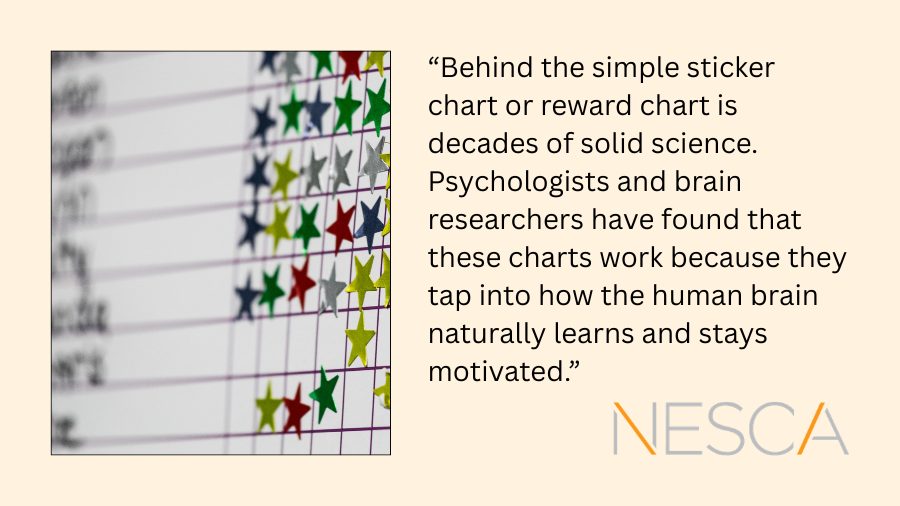
Behind the simple sticker chart or reward chart is decades of solid science. Psychologists and brain researchers have found that these charts work because they tap into how the human brain naturally learns and stays motivated. When a child gets a sticker or a point towards a reward immediately after doing a good job, their brain releases a tiny splash of dopamine, the “feel-good” chemical that helps us focus and feel successful. Decades of research, especially with kids who have ADHD, shows that rewards make boring or difficult tasks feel achievable. By focusing on positive rewards rather than nagging or punishment, these charts help shape behavior through slowly motivating changes which become habits or routines.
Incentive charts are highly versatile tools. While most commonly associated with young children, they are effective for anyone, including elementary-aged students and teenagers, who need help changing behaviors, building new habits, or staying motivated.
Despite these benefits, many parents I work with share the same frustration: “I’ve tried a sticker/reward chart, and it just didn’t work.”
When I dig a little deeper, I usually find that the incentive system wasn’t set up in a way that allowed the child, and the family, to succeed. I provide the following guidance to make their incentive plans more effective:
- Pick Your Battles: Focus on just 2 to 3 goals at a time (or even just one for very young kids). Ask yourself: What is the most pressing behavior change we need right now? Is it brushing teeth without an argument? Getting out the door on time for school? Stopping hitting or food-throwing? Trying to change too many things at once is a major reason why these charts fail. Think of it like New Year’s resolutions: when we try to overhaul our diet, go to sleep early, start a daily workout routine, complete a gratitude journal, and read a book a week all at the same time, we quickly burn out. It is simply too hard to maintain that much change long enough for new habits to stick. The same is true for your child. Keep it simple. Once your child masters one specific goal, you can “graduate” them from that goal and introduce a new one.
- State Goals Clearly and Positively: Tell your child exactly what you want them to do, rather than what you want them to stop doing. Instead of “Don’t be late for school,” phrase the goal as “Be ready with your shoes on and backpack packed by 7:20 AM.”
- Start with “Easy Wins”: Incentive plans often fail when parents set the bar too high right away; if a child goes several days without earning a reward, they will lose motivation and give up. Instead, start with an easy, highly achievable version of your goal and slowly raise the bar. For example, if your ultimate goal is for your child to have their shoes on and backpack packed by 7:20 AM, start by rewarding them just for having their shoes on by 7:20. Once that becomes a habit, you can raise the bar to include the backpack. Slowly shaping the behavior in these small, manageable steps keeps your child winning, building the momentum they need to succeed rather than setting the bar out of reach and causing them to throw in the towel.
- Reward the Behavior Immediately: Timing is everything. To help your child’s brain connect the good behavior with the reward, hand over the incentive right away. For timed tasks (like being ready by 7:20 AM), give the sticker, token, or point the second they finish. For all-day goals (like keeping hands to themselves), have a set time every day (like right after dinner) to hand out the reward. Connect the dots for them by saying: “Because you kept your hands to yourself today, you earned your sticker!” The more immediate or consistent the reward process is, the more likely the incentive system will be a success.
- Let Your Child Choose the Rewards: Children are far more motivated by rewards they actually care about. Sit down together and make a list of prizes. Remember, rewards do not have to be toys or cost money. Kids are highly motivated by quality time and special privileges, such as an extra bedtime story, 10 minutes of one-on-one time with a parent, choosing what’s for dinner, or picking the movie for family night.
- Make the “Exchange Rate” Clear: Make sure your child knows exactly what their stickers/points can buy. For young kids: Keep it simple. Placing the sticker on the chart might be enough, or they can “cash in” 3 stickers for a reward (like 10 minutes of screen time). For older kids, let them save up. They can earn points daily, but saving up 5 points might earn them a larger weekend reward (like a trip to get ice cream).
- Never Take Stickers Away: This is the golden rule of incentive charts. Once a sticker or point is earned, it is locked in. If your child has a great morning and earns a sticker/point, but has a meltdown in the afternoon, do not peel the morning sticker off or take away a point. Taking away earned rewards feels unfair to kids and ruins their motivation to keep trying. If they have a tough afternoon, simply say: “You didn’t earn your sticker/point for this afternoon, but you can try again tomorrow.”
Why Summer is the Perfect Time to Start
Summer is a fantastic time to introduce an incentive plan because it provides a light, predictable structure to those otherwise unstructured summer days. Furthermore, behavior change can be easier to accomplish when kids are relaxed and free from the daily stress of the school year. Making small, positive changes over the summer months can pay large dividends and set your family up for a smooth transition back to school in the fall. Not only will your child be accustomed to using a reward system by then, but they will also have already established several positive habits that will make the start of the school year much easier for everyone!
About the Author
Dr. Burns conducts comprehensive evaluations of school-aged children, adolescents, and young adults with a variety of developmental, learning, and emotional difficulties. She has expertise in the evaluation of individuals following a concussion/mild traumatic brain injury and particularly enjoys working with individuals with attention (ADHD) and executive functioning (EF) difficulties. Dr. Burns is passionate about helping individuals and their families better understand their areas of strength and weakness and provides tailored treatment recommendations based upon that unique profile to make the evaluation most helpful for each client.
To book a consultation with Dr. Burns or one of our many other expert neuropsychologists, complete NESCA’s online intake form.
NESCA is a pediatric neuropsychology practice and related services practice with offices in Newton, Plainville, and Hingham, Massachusetts; Londonderry, New Hampshire; and Coral Gables, Florida, serving clients from infancy through young adulthood and their families. For more information, please email info@nesca-newton.com or call 617-658-9800.