NESCA now accepts United Behavioral Health for neuropsychological evaluations!

To book an appointment, complete our Inquiry/Intake Form.

Tag

Ann Helmus Archives - NESCA

Subscribe to NESCA Notes

Dot Lucci and Dr. Ann Helmus consulting internationally

Advancing Inclusion and Education Internationally

By | NESCA Notes 2025

Dot Lucci and Dr. Ann Helmus consulting internationallyBy Dot Lucci, M.Ed., CAGS
Director of Consultation and Psychoeducational Services, NESCA

Expanding on NESCA’s previous work in the Philippines and other Asian countries, this October, NESCA’s Founder and Director Dr. Ann Helmus and I widened NESCA’s outreach and education around the world, traveling to Central America, specifically Honduras, Nicaragua, El Salvador, and Costa Rica.

During our time in Central America, we presented multiple full-day workshops to various educational

NESCA’s Dot Lucci and Dr. Ann Helmus with a group of Central American Principals at the Association of American Schools of Central America Conference

professional and administrative audiences at the Association of American Schools of Central America conference, the Elementary Principals Conference, and at individual schools. The full-day workshops included information about: the presentations and diagnosis of various conditions, such as ADHD, ASD, SLD, anxiety, etc., how to best serve these students in general education classrooms, and the most current thinking on specific interventions and curriculums.

Along our journey, Dr. Helmus also presented to parents in Nicaragua and Honduras, discussing what exactly makes a high-quality evaluation, what an evaluation should include, and how to integrate all the findings to produce individualized recommendations for students.

On this trip, our consultations consisted of onsite visits that provide professional development, modeling, direct service of instruction/ongoing virtual consultation, and the sharing of resources and tools. We help these teams develop or enhance their programs and systems aimed at supporting students with special needs. While much of this work pertains to educational programming, it also involves expanding the mindsets of some teachers about neurodivergent students, who may require additional time and effort than typically developing students. In our work, we are helping teachers to recognize students’ disabilities, how they present, and how to work with the various challenges while identifying and capitalizing on their strengths.

Consulting internationally allows us to share our knowledge and expertise of neuropsychological assessment and educational practices with schools and families abroad, where resources may be scarce or non-existent. While each country has special education laws pertaining to inclusion, when children struggle in these classrooms, there are unfortunately limited resources for them. Many of these students are expelled and do not receive an education due to aberrant behavior. There are some separate “special education” schools, but these are also limited in their ability to educate neurodivergent children. In all of these countries, the training of teachers in special education is not in-depth, which is why NESCA was there to support their efforts. This work is vital to the improvement of the education of all students and especially those with special needs.

With very few – if any – related service professionals in this region (i.e., neuropsychologists, SLPs, OTs, etc.), many students go without direct services or travel to Miami for evaluations and care during the summer months. Because of the lack of supports in this region, we noticed more clients over the past several years traveling to Boston for evaluations and services. This is one of the reasons NESCA opened an office in Miami, more conveniently offering better supports and services for our Central American clients.

We look forward to continuing this consultation work with schools, organizations, etc., while also making big differences for families on a more individualized level, educating them on how they can support their children.

Our work in international schools and families is rich and rewarding, and is making big differences.


About the Author

NESCA’s Director of Consultation and Psychoeducational Services Dot Lucci has been active in the fields of education, psychology, research and academia for over 30 years. She is a national consultant and speaker on program design and the inclusion of children and adolescents with special needs, especially those diagnosed with Autism Spectrum Disorder (ASD). Prior to joining NESCA, Ms. Lucci was the Principal of the Partners Program/EDCO Collaborative and previously the Program Director and Director of Consultation at MGH/Aspire for 13 years, where she built child, teen and young adult programs and established the 3-Ss (self-awareness, social competency and stress management) as the programming backbone. She also served as director of the Autism Support Center. Ms. Lucci was previously an elementary classroom teacher, special educator, researcher, school psychologist, college professor and director of public schools, a private special education school and an education collaborative.

Ms. Lucci directs NESCA’s consultation services to public and private schools, colleges and universities, businesses and community agencies. She also provides psychoeducational counseling directly to students and parents. Ms. Lucci’s clinical interests include mind-body practices, positive psychology, and the use of technology and biofeedback devices in the instruction of social and emotional learning, especially as they apply to neurodiverse individuals.

To book a consultation with Ms. Lucci or one of our many expert clinicians, complete NESCA’s online intake form. Indicate whether you are seeking an “evaluation” or “consultation” and your preferred clinician/consultant/service in the referral line.

NESCA is a pediatric neuropsychology practice and related services center with offices in Newton, Plainville, and Hingham, Massachusetts; Londonderry, New Hampshire; the greater Burlington, Vermont region; and Coral Gables, Florida, serving clients from infancy through young adulthood and their families. For more information, please email info@nesca-newton.com or call 617-658-9800.


Welcome 2025 banner with quote from Dr. Ann Helmus

NESCA Welcomes 2025!

By | NESCA Notes 2024

Welcome 2025 banner with quote from Dr. Ann HelmusBy Ann Helmus, Ph.D.
Founder and Director, NESCA

At NESCA, we are thrilled to share how 2025 has gotten off to an incredible start! During the very first week of the year, we had the pleasure of welcoming three new neuropsychologists to the NESCA team. These talented clinicians started their NESCA careers with an intensive week-long training, during which many of our seasoned NESCA clinicians presented on their areas of specialization. This immersive onboarding experience underscored our commitment to professional growth and ensuring that every team member has the tools to provide the highest level of care to our clients.

Adding to the richness of the week, we were joined by a neuropsychologist from Florida, who is considering relocating to Boston to become part of our team. Her perspectives on regional differences in neuropsychological practice, including bilingual evaluations,  added a valuable dimension to our discussions, enhancing the exchange of ideas. All of our new neuropsychologists are mid-career professionals, and the week was characterized by vibrant discussions where everyone learned from each other. This mutual sharing of knowledge exemplifies the collaborative and collegial spirit that makes NESCA a leader in the field of pediatric neuropsychology.

We also had the honor of hosting a special evening for pediatric neuropsychology postdoctoral fellows and interns, aimed at supporting them in their career exploration. Over dinner, these early-career clinicians heard from a panel of four experienced pediatric neuropsychologists working in diverse settings, including hospital-based roles, solo practices, and group practices like NESCA. The panelists shared insights on what drives career satisfaction, how to achieve work-family balance, and considerations around compensation. The discussions were lively and thought-provoking, providing invaluable guidance to those embarking on their careers in pediatric neuropsychology.

At NESCA, our mission goes beyond delivering exceptional neuropsychological evaluations. We are deeply committed to fostering an environment of learning, professional development, and collaboration. Whether it’s through welcoming new team members, creating opportunities for knowledge-sharing, or helping early-career clinicians chart their career paths, we strive to build a professional community that embodies support and excellence.

What I saw unfold and experienced during our training week – from both NESCA’s seasoned clinical staff and our newest additions – gives me immense job satisfaction and gets me out of bed in the morning. While I am no longer seeing clients myself, I am now inspired by creating opportunities for people to learn from each other and exchange ideas; watching people meet and collaborate; and working closely with NESCA’s leadership team to continuously improve NESCA. All these things drive me personally, but, more importantly, lead to better client care.

Here’s to a 2025 filled with growth, connection, and continued dedication to our mission of helping children and families thrive. We look forward to the year ahead and all that we will accomplish together!


About the Author

NESCA Founder/Director Ann Helmus, Ph.D. is a licensed clinical neuropsychologist who has been practicing for almost 30 years. In 1996,Ann Helmus headshot she jointly founded the Children’s Evaluation Center (CEC) in Newton, Massachusetts, serving as co-director there for almost 10 years. During that time, CEC emerged as a leading regional center for the diagnosis and remediation of both learning disabilities and Autism Spectrum Disorders.

In September of 2007, Dr. Helmus established NESCA (Neuropsychology & Education Services for Children & Adolescents), a client and family-centered group of seasoned neuropsychologists and allied staff, many of whom she trained, striving to create and refine innovative clinical protocols and dedicated to setting new standards of care in the field.

She is an active participant in the Trauma and Learning Policy Initiative, a collaborative effort between Massachusetts Advocates for Children and Harvard Law School’s Education Law Clinic, a project involving a multi-disciplinary group of professionals working together to better define and meet the educational needs of children who have been traumatized.

She received her undergraduate degree in Neural Science from Brown University and earned her doctorate at Boston University School of Medicine. Her postdoctoral fellowship in pediatric neuropsychology was completed at Children’s Hospital in Boston, where she remained on staff for seven years. Concurrently, she served as neuropsychologist to the Pediatric Brain Tumor Clinic at Dana-Farber Cancer Institute in Boston.

To book an appointment with NESCA’s expert neuropsychologists, please complete our Intake Form today. 

NESCA is a pediatric neuropsychology practice and integrative treatment center with offices in Newton, Plainville, and Hingham, Massachusetts; Londonderry, New Hampshire; the greater Burlington, Vermont region; and Brooklyn, New York (coaching services only) serving clients from infancy through young adulthood and their families. For more information, please email info@nesca-newton.com or call 617-658-9800.


The Importance of SMEDMERTS

By | NESCA Notes 2022

By: Ann Helmus, Ph.D.
NESCA Founder/Director; Clinical Neuropsychologist

While supporting a friend who was recently diagnosed with bipolar disorder, I have come to appreciate how challenging it is for people with this disorder to maintain a stable mood state. One of the most helpful resources I discovered in my search for information to help me support my friend was a TEDx talk by Ellen Forney, an author who has successfully managed her bipolar disorder for two decades by following SMEDMERTS, an acronym for: Sleep, Medication, Eat Well, Doctor/therapy, Mindfulness/Meditation, Exercise, Routine, Tools (coping), and Support System. I was struck that only 25% of the solution for managing her mental illness involves the mental health system: medication and doctor. The bulk of her treatment system relates to lifestyle choices.

While attention to SMEDMERTS is important for all of us, especially in these stressful times, consistent focus on these lifestyle choices is particularly critical for the many children and adolescents who we see at NESCA presenting with anxiety, mood disorders, ADHD, and behavioral issues. Most of us struggle to achieve our daily goals for sleep, diet, meditation, exercise, sticking to a routine, practicing adaptive coping strategies, and nurturing our support system, even though we know how much better we feel and how much better our children function when we are focused on SMEDMERTS in our daily life. While the impact of medications and doctors on functioning is largely outside of our control, we can control our lifestyle choices, which are critical to the success of managing any mental health issue.

How can we help the children in our lives to embrace SMEDMERTS?

  • Modeling it for them. As Robert Fulgham said, “Don’t worry that your children never listen to you; worry that they are always watching you.”
  • Praising their efforts. Offer positive feedback, such as, “Great idea to get up early to go for a run,” or, “I like how you called a friend when you were upset to get some advice.”
  • Enlisting the help of a coach. NESCA offers real-life skills coaching, executive functioning coaching, and health coaching to help children, adolescents, and young adults build and maintain habits to support positive lifestyle choices.

Health coaching is available to parents of NESCA clients who are seeking support in developing positive health habits, such as exercise, diet, stress management, and meditation.

If you are interested in coaching services at NESCA to support your quest for SMEDMERTS, please contact Crystal Jean: cjean@nesca-newton.com or fill out our intake form at www.nesca-newton.com.


About the Author
NESCA Founder/Director Ann Helmus, Ph.D. is a licensed clinical neuropsychologist who has been practicing for almost 20 years. In 1996, she jointly founded the  Children’s Evaluation Center (CEC) in Newton, Massachusetts, serving as co-director there for almost ten years. During that time, CEC emerged as a leading regional center for the diagnosis and remediation of both learning disabilities and Autism Spectrum Disorders.

In September of 2007, Dr. Helmus established NESCA (Neuropsychology & Education Services for Children & Adolescents), a client and family-centered group of seasoned neuropsychologists and allied staff, many of whom she trained, striving to create and refine innovative clinical protocols and dedicated to setting new standards of care in the field.

Dr. Helmus specializes in the evaluation of children with learning disabilities, attention and executive function deficits and primary neurological disorders. In addition to assessing children, she also provides consultation and training to both public and private school systems. She frequently makes presentations to groups of parents, particularly on the topics of non-verbal learning disability and executive functioning.

To book an evaluation with one of NESCA’s many expert neuropsychologists, complete NESCA’s online intake form

Neuropsychology & Education Services for Children & Adolescents (NESCA) is a pediatric neuropsychology practice and integrative treatment center with offices in Newton and Plainville, Massachusetts, as well as Londonderry, New Hampshire. NESCA serves clients from preschool through young adulthood and their families. For more information, please email info@nesca-newton.com or call 617-658-9800.

Testing the Limits

By | NESCA Notes 2022

By: Ann Helmus, Ph.D.
NESCA Founder/Director; Clinical Neuropsychologist

In the world of assessment, “testing the limits” means essentially bending the rules of test administration in order to see if the change in administration allows the test-taker to demonstrate their knowledge more effectively. For example, some children and adolescents respond impulsively to multiple-choice tests, picking the first choice that appears to be correct without looking at all of the choices. Standardized test administration dictates that the evaluator accepts that impulsive response and, as such, impulsivity will compromise the client’s score.

In the example above, the student was unable to demonstrate their knowledge or skills effectively on tests because of the standardized administration procedures. While it is important to generate these scores, it is also important to gain an understanding of what the student actually knows, and this is where testing the limits comes in. For the impulsive student, the evaluator would test the limits by reminding the student to slow down and look at all the choices before responding. This is non-standard test administration, and so the score is not considered valid but the results give us a great deal of information about the student’s strengths and weaknesses. There is a big difference between the student who is able to achieve the correct score when cued to slow down and the student who still answers incorrectly, even with reminders to slow down. The former student can be said to have much higher potential than the latter student. However, their ability to demonstrate their potential is hampered by impulsivity, a problem that needs to be addressed.

In the course of most neuropsychological evaluations, we are trying to understand the student’s profile of strengths and weaknesses, which often requires testing the limits. This raises the question of the value of the standardized scores. The standardized scores likely reflect the level at which the child or adolescent is functioning in the “real world.” Impulsive test-takers are almost certainly impulsive students; just as they don’t demonstrate their true potential in testing, they are not doing so in school.

Many students are able to fully demonstrate their skills and knowledge with standardized testing and don’t require “testing the limits.” However, at NESCA, we also see many highly complex students whose ability to access their potential is limited by issues of attention, executive functioning, communication, or emotional/behavioral regulation. In these cases, we routinely “test the limits” and report both standardized administration and non-standardized (“testing the limits”) scores and explain what these scores mean for the individual, what the scores tell us about daily functioning as well as untapped potential.


About the Author
NESCA Founder/Director Ann Helmus, Ph.D. is a licensed clinical neuropsychologist who has been practicing for almost 20 years. In 1996, she jointly founded the  Children’s Evaluation Center (CEC) in Newton, Massachusetts, serving as co-director there for almost ten years. During that time, CEC emerged as a leading regional center for the diagnosis and remediation of both learning disabilities and Autism Spectrum Disorders.
In September of 2007, Dr. Helmus established NESCA (Neuropsychology & Education Services for Children & Adolescents), a client and family-centered group of seasoned neuropsychologists and allied staff, many of whom she trained, striving to create and refine innovative clinical protocols and dedicated to setting new standards of care in the field.

Dr. Helmus specializes in the evaluation of children with learning disabilities, attention and executive function deficits and primary neurological disorders. In addition to assessing children, she also provides consultation and training to both public and private school systems. She frequently makes presentations to groups of parents, particularly on the topics of non-verbal learning disability and executive functioning.

To book an evaluation with Dr. Helmus, NESCA Founder and Director, or one of our many other expert neuropsychologists, complete NESCA’s online intake form

Neuropsychology & Education Services for Children & Adolescents (NESCA) is a pediatric neuropsychology practice and integrative treatment center with offices in Newton and Plainville, Massachusetts, as well as Londonderry, New Hampshire. NESCA serves clients from preschool through young adulthood and their families. For more information, please email info@nesca-newton.com or call 617-658-9800.

The Path Back to Fitness

By | NESCA Notes 2021

By: Ann Helmus, Ph.D.
NESCA Founder/Director

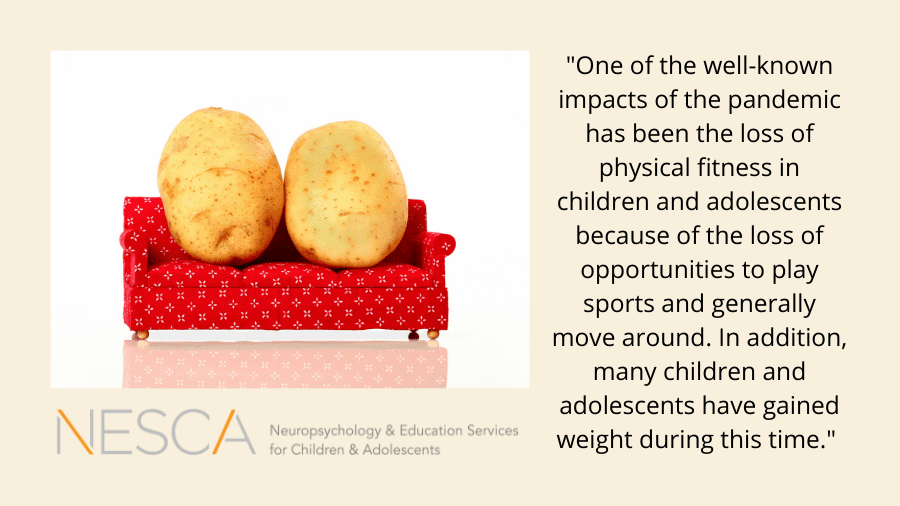
One of the well-known impacts of the pandemic has been the loss of physical fitness in children and adolescents because of the loss of opportunities to play sports and generally move around. In addition, many children and adolescents have gained weight during this time. Maintaining a healthy weight and being physically fit offer many benefits for social-emotional development as well as academic performance. Numerous research studies link physical exercise to significant improvements in the regulation of mood and anxiety as well as attention and executive functioning.

Parents are often at a loss for how to help their child get back into good habits to lose weight, exercise regularly, or get back into a sport. Common parenting approaches, such as offering “helpful suggestions,” encouraging, nagging and bribing usually don’t work for long term—or even short term—positive change. Instead, these approaches often “back fire,” making the child feel even more ashamed or powerless—emotions that are not likely to fuel motivation to change habits.

So how do we support children and adolescents in developing the positive habits that are necessary for maintaining health and fitness? The key lies in empowering the child to determine his or her own goals and establishing their “why” through discussion of why they would like to reach this goal, what they will get by achieving the goal, and, perhaps most important, how they will feel when they reach this goal. This type of motivational interviewing builds internal motivation, which beats external motivators every time in terms of creating long term change.

Once the child or adolescent is clear on what they would like to achieve and why, the next step is determining the behavior changes that will help the child achieve their outlined goal and working with the child to figure out what’s manageable so that success can be ensured. For example, one adolescent might easily commit to a 30-minute daily bike ride, whereas another might want to start with a daily 10-minute walk. Success breeds success, so it is important to set goals that are challenging but also achievable. Throughout this process, the focus is on creating a positive mindset and positive emotional state of empowerment, hopefulness, optimism, and pride.

Some children may be open to this type of process with their parents; however, most adolescents will likely not want to be involved at this level with a parent. NESCA offers health and life coaching, aimed at helping adolescents and young adults with this process. Coaching offers a structured approach to helping an adolescent or young adult define his/her own goals and motivations as well as understanding the obstacles that they have encountered in reaching those goals, which are usually limiting beliefs (e.g., “I can never stick to things.”) or faulty self-identities (e.g., “I’m not athletic.”). The coaching process works through a combination of structured activities as well as a highly supportive personal relationship. To learn more, please join us for a webinar on Thursday, September 23 at 1:00 PM ET, view a previous webinar on this topic on our website or contact Health & Life Coach Billy Demiri for a free 30-minute consultation to determine if health coaching might be helpful for your child.


About the Author

NESCA Founder/Director Ann Helmus, Ph.D. is a licensed clinical neuropsychologist who has been practicing for almost 20 years. In 1996, she jointly founded the  Children’s Evaluation Center (CEC) in Newton, Massachusetts, serving as co-director there for almost ten years. During that time, CEC emerged as a leading regional center for the diagnosis and remediation of both learning disabilities and Autism Spectrum Disorders.
In September of 2007, Dr. Helmus established NESCA (Neuropsychology & Education Services for Children & Adolescents), a client and family-centered group of seasoned neuropsychologists and allied staff, many of whom she trained, striving to create and refine innovative clinical protocols and dedicated to setting new standards of care in the field.

Dr. Helmus specializes in the evaluation of children with learning disabilities, attention and executive function deficits and primary neurological disorders. In addition to assessing children, she also provides consultation and training to both public and private school systems. She frequently makes presentations to groups of parents, particularly on the topics of non-verbal learning disability and executive functioning.

To book an evaluation with Dr. Helmus, NESCA Founder and Director, or one of our many other expert neuropsychologists or therapists, complete NESCA’s online intake form

Neuropsychology & Education Services for Children & Adolescents (NESCA) is a pediatric neuropsychology practice and integrative treatment center with offices in Newton and Plainville, Massachusetts, as well as Londonderry, New Hampshire. NESCA serves clients from preschool through young adulthood and their families. For more information, please email info@nesca-newton.com or call 617-658-9800.

Looking for Answers? Ask the Right Questions.

By | NESCA Notes 2021

By: Ann Helmus, Ph.D.
NESCA Founder/Director; Clinical Neuropsychologist

Many parents have met with me concerned that, “We had a full evaluation and got a lot of scores and a diagnosis but we still don’t understand why our child has this problem and what we can do about it.” This outcome can be avoided if parents and the evaluator are both clear on why the child is being evaluated, have laid out specific questions to be answered and what kinds of recommendations are being sought. Determining the referral question(s) should be a key goal of the intake session.

During the intake meeting, the evaluator can help the parent to shape their concerns into a specific referral question that can be addressed effectively through the process of neuropsychological evaluation. The evaluator can manage parental expectations in this process so there is not disappointment with evaluation results that don’t answer the parents’ questions. For example, I’ve had parents request an evaluation because they want to know if their fifth grader will get into Harvard or their child with high-functioning ASD (autism spectrum disorder) will get married. These questions can’t be addressed through a neuropsychological evaluation, but they can be re-worked into answerable questions. A neuropsychological evaluation can tell us if a child’s cognitive and academic skills are in the range of students who attend the most competitive colleges. However, there are many other factors that influence the college acceptance process. In this case, the referral question might be revised into “assess the child’s potential for academic success in a rigorous academic setting.” Similarly, it is beyond the scope of a neuropsychologist to determine if anyone will get married, but through the evaluation process we can assess the child’s current social and emotional functioning and offer some predictions about their likely developmental trajectory in the social domain.

While the previous examples of referral questions are too broad or abstract, I am also often confronted with referral questions that are too narrow, such as, “Does this child have ADHD?”.  In this case, I would work with the parents to reframe the referral question to, “Why does this child appear to have difficulty paying attention in school?” This referral question recognizes the fact that there are many reasons that a child may have difficulty concentrating or appear distractible – ADHD being only one of the possibilities.

When I train neuropsychologists, I emphasize the importance of understanding “Why now?”. What is it that motivated the parent or school team to seek evaluation at this point in time as they work to frame the referral question with parents? Common reasons include: concern about how the child will manage an upcoming transition (e.g., to middle school), sudden appearance of a problem, obvious widening of the gap between a child and peers, inability to meet increased developmental demands, lack of response to interventions, change in emotional status, or deterioration in academic performance.

It is extremely helpful when parents and/or school teams prepare for the intake meeting by brainstorming what they are seeking from the evaluation, questions they hope will be answered, issues to be assessed, and specific guidance that is being requested. The evaluator can then work with the parents or school team to fashion these into a referral question that is specific and relevant to the child so that all parties are “on the same page” as they undertake the evaluation process.


About the Author
NESCA Founder/Director Ann Helmus, Ph.D. is a licensed clinical neuropsychologist who has been practicing for almost 20 years. In 1996, she jointly founded the  Children’s Evaluation Center (CEC) in Newton, Massachusetts, serving as co-director there for almost ten years. During that time, CEC emerged as a leading regional center for the diagnosis and remediation of both learning disabilities and Autism Spectrum Disorders.

In September of 2007, Dr. Helmus established NESCA (Neuropsychology & Education Services for Children & Adolescents), a client and family-centered group of seasoned neuropsychologists and allied staff, many of whom she trained, striving to create and refine innovative clinical protocols and dedicated to setting new standards of care in the field.

Dr. Helmus specializes in the evaluation of children with learning disabilities, attention and executive function deficits and primary neurological disorders. In addition to assessing children, she also provides consultation and training to both public and private school systems. She frequently makes presentations to groups of parents, particularly on the topics of non-verbal learning disability and executive functioning.

To book an evaluation with Dr. Helmus, NESCA Founder and Director, or one of our many other expert neuropsychologists or therapists, complete NESCA’s online intake form

Neuropsychology & Education Services for Children & Adolescents (NESCA) is a pediatric neuropsychology practice and integrative treatment center with offices in Newton and Plainville, Massachusetts, as well as Londonderry, New Hampshire. NESCA serves clients from preschool through young adulthood and their families. For more information, please email info@nesca-newton.com or call 617-658-9800.

The Intention to Thrive

By | NESCA Notes 2021

By: Ann Helmus, Ph.D.
NESCA Founder/Director

As I reflect on the year that we have all come through, my overwhelming emotion (aside from exhaustion) is pride in the NESCA team for working together in an extraordinary manner under incredibly challenging circumstances. Just before closing the doors at NESCA in mid-March, I wrote to all staff:

NESCA is going to not only survive through this pandemic but we are going to thrive as an organization and show leadership in the special education community. The needs of our clients have not gone away; in fact, they are likely increasing.  School systems are scrambling to meet their obligations for students with special needs. We will continue to do the work we have always done, albeit in a somewhat modified fashion. 

Each of the NESCA staff—clinical and administrative—immediately rose to the occasion to help me realize this vision for navigating the pandemic. We increased the frequency our blog posts and introduced regular webinars, gearing them towards the needs of parents facing the challenges of the pandemic and increased our social media following from 4,000 to more than 40,000 by offering supportive and helpful content. NESCA clinicians offered multiple, free online support groups for parents and professionals related to topics they were now experiencing due to COVID-19. We acknowledged and addressed the unprecedented COVID-19-related concerns and challenges professionals and educators who support those with autism were experiencing through our free Autism Educator Hangouts.

After a great deal of research and discussion about how to conduct evaluations in a manner that ensured the safety of staff and clients while producing valid results, we settled on our “two office model,” renovating our space with plexiglass panes so that clients and clinicians would be able to work together in separate but adjoining offices. We collaborated with Massachusetts Advocates for Children (MAC), Massachusetts Department of Elementary and Secondary Education (DESE), The Federation for Children with Special Needs (FCSN) and the Massachusetts Urban Project, Inc., providing information about assessments and other services during the pandemic.

NESCA grew by adding new staff and service offerings this past year. We welcomed Dr. Moira Creedon to our pediatric neuropsychology staff. Tabitha Monahan, M.A., CRC, and Becki Lauzon, M.A., CRC, both joined NESCA’s Transition Services team. Julie Robinson, OT, joined NESCA in September with three occupational therapists to offer insurance-based, sensory-motor therapy. Abigael Gray, MS, CCC-SLP, also joined at that time to offer insurance-based speech/language and feeding therapy at NESCA. These staff have been incredibly innovative in their use of teletherapy to continue providing services to clients remotely.  And, they and their clients have experienced some surprising benefits stemming from the delivery of services via telehealth. 2020 also saw the introduction of NESCA’s ASD Diagnostic Clinic, helping families to diagnose children with Autism Spectrum Disorder as early as possible so they may gain access to critically important interventions.

Over the last decade, NESCA has had a strong commitment to international work, seeing clients for evaluation and consultation in the NESCA offices as well as abroad. With travel severely limited by the pandemic, we have instituted teletherapy for international work and are pleased to continue to assist  families abroad. NESCA was honored to be a Gold Sponsor for the annual SENIA conference (Special Education Network & Inclusion Association) that was held virtually. I was pleased to present about the differences between testing and assessment with professionals from schools all over Asia.

In the midst of the global pandemic, we continued to do the work that we have always done. We continued to support each other and became even more closely bonded as a team. We contributed to the community. No matter how challenging it has been, we are motivated by the knowledge that children with special needs and their parents need our support now more than ever.


About the Author: 

NESCA Founder/Director Ann Helmus, Ph.D. is a licensed clinical neuropsychologist who has been practicing for almost 20 years. In 1996, she jointly founded the  Children’s Evaluation Center (CEC) in Newton, Massachusetts, serving as co-director there for almost ten years. During that time, CEC emerged as a leading regional center for the diagnosis and remediation of both learning disabilities and Autism Spectrum Disorders.

In September of 2007, Dr. Helmus established NESCA (Neuropsychology & Education Services for Children & Adolescents), a client and family-centered group of seasoned neuropsychologists and allied staff, many of whom she trained, striving to create and refine innovative clinical protocols and dedicated to setting new standards of care in the field.

Dr. Helmus specializes in the evaluation of children with learning disabilities, attention and executive function deficits and primary neurological disorders. In addition to assessing children, she also provides consultation and training to both public and private school systems. She frequently makes presentations to groups of parents, particularly on the topics of non-verbal learning disability and executive functioning.

To book an evaluation with Dr. Helmus, NESCA Founder and Director, or one of our many other expert neuropsychologists or therapists, complete NESCA’s online intake form

Neuropsychology & Education Services for Children & Adolescents (NESCA) is a pediatric neuropsychology practice and integrative treatment center with offices in Newton and Plainville, Massachusetts, as well as Londonderry, New Hampshire. NESCA serves clients from preschool through young adulthood and their families. For more information, please email info@nesca-newton.com or call 617-658-9800.

The Next Pandemic: Mental Health Issues

By | NESCA Notes 2020

By: Ann Helmus, Ph.D.
NESCA Founder/Director

The return to school, whether remotely or in person, will be a transition that is bound to be stressful for many children and adolescents as well as their parents and teachers. Coming on the heels of five stressful months of lockdown, remote learning, loss of social contact and so many other changes,  children will be meeting this challenge with depleted resources for coping with stress and may show new signs of anxiety or mood issues. This will be particularly true for children and adolescents who have underlying issues with mental health, attention or learning. Prioritizing the mental health of students and focusing on providing emotional support will be key to helping children manage the transition back to school. “When children feel connected, they’re going to learn better, do better, stay on track,” commented Dr. Nadine Kaslow, professor of psychiatry at Emory School of Medicine and past president of the American Psychological Association, in this article. She emphasized that “loving warm interactions need to take precedence” over struggling with them about behavior or about schoolwork.”   Remembering that undesirable behaviors are often driven by emotional distress and are a form of communication can be helpful for parents in responding in a positive and supportive manner. As we continue through this period of unprecedented levels of stress and change, children need to feel connected to and supported by their parents even more than is usual; maintaining this connection is far more important than any academic goals, no matter how far behind parents fear their child is as a result of the interruption to regular schooling.

If you have concerns about your child’s mental health, clinicians at NESCA are available for expert consultation or evaluation of your child’s emotional functioning so that the appropriate supports can be put in place. This work can be done either through teletherapy or in-person through contactless evaluations in all three of our locations (Newton and Plainville, MA and Londonderry, NH). NESCA has several suites in which there is a large plexiglass panel in the shared wall between two offices so that the child/parent and evaluator/therapist are in separate offices but have the benefit of full visibility and communication through headphones. For more information, please view, “Testing in the Age of COVID-19” on our Video Resources page.

If you have questions about your child’s mental health and would like professional help, please reach out to Dot Lucci, M.Ed., CAGS: dlucci@nesca-newton.com for an intake and screening.


About the Author: 

NESCA Founder/Director Ann Helmus, Ph.D. is a licensed clinical neuropsychologist who has been practicing for almost 20 years. In 1996, she jointly founded the  Children’s Evaluation Center (CEC) in Newton, Massachusetts, serving as co-director there for almost ten years. During that time, CEC emerged as a leading regional center for the diagnosis and remediation of both learning disabilities and Autism Spectrum Disorders.

In September of 2007, Dr. Helmus established NESCA (Neuropsychology & Education Services for Children & Adolescents), a client and family-centered group of seasoned neuropsychologists and allied staff, many of whom she trained, striving to create and refine innovative clinical protocols and dedicated to setting new standards of care in the field.

Dr. Helmus specializes in the evaluation of children with learning disabilities, attention and executive function deficits and primary neurological disorders. In addition to assessing children, she also provides consultation and training to both public and private school systems. She frequently makes presentations to groups of parents, particularly on the topics of non-verbal learning disability and executive functioning.

To book an evaluation with Dr. Helmus, NESCA Founder and Director, or one of our many other expert neuropsychologists or therapists, complete NESCA’s online intake form

Neuropsychology & Education Services for Children & Adolescents (NESCA) is a pediatric neuropsychology practice and integrative treatment center with offices in Newton and Plainville, Massachusetts, as well as Londonderry, New Hampshire. NESCA serves clients from preschool through young adulthood and their families. For more information, please email info@nesca-newton.com or call 617-658-9800.

Skip to content