To accommodate requests for neuropsychological evaluations after the start of the new school year, NESCA has added evaluation dates in its Newton, MA office. Immediate openings are now available for scheduling. Please complete our Inquiry/Intake Form for more information or to start the scheduling process.

Tag

Dot Lucci Archives - Page 4 of 4 - NESCA

Subscribe to NESCA Notes

Meltdown Analysis — Part 2

By | NESCA Notes 2020

By Dot Lucci, M.Ed., CAGS

Director of Consultation and Psychoeducational Services, NESCA

As discussed in last week’s blog, Meltdowns Happen, all children meltdown. Adults meltdown, too. Losing control can take many forms. It is a part of human nature unless we deliberately work on “controlling the beast” that’s lurking inside of us when our system gets taxed. When children are very young, we expect them to lose control because they are learning how to identify and express their emotions. A three-year-old who tantrums is not that uncommon; however, by the time that child is six and then 10, we want them to have developed more and more control as they mature.  But, many children don’t always develop the control that we’d like, and those diagnosed with learning differences sometimes have even more difficulty controlling their emotions.

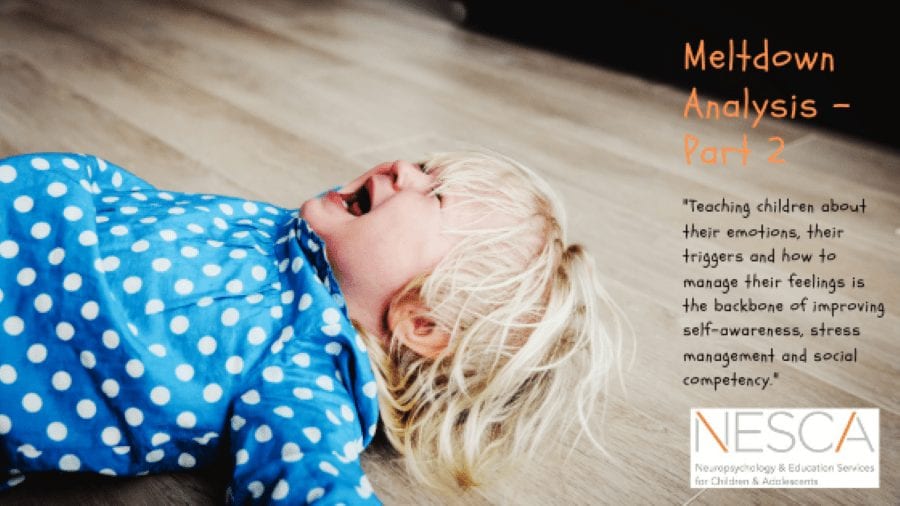
Teaching children about their emotions, their triggers and how to manage their feelings is the backbone of improving self-awareness, stress management and social competency (3 Ss). If children can label and recognize feelings, notice how their body feels with different emotions and know how to calm themselves when stressed, the better off they will be in life. In a previous role as the program director of Aspire/MGH, we focused on these 3 Ss and utilized a volcano image with our autism spectrum disorder (ASD) participants to teach them about their stress cycle. The volcano image represented a meltdown (see below).

In using this with your child, pick a quiet, calm moment to introduce it to him/her. You might want to start the conversation by reading a book about stress or big emotions. There are many to choose from depending upon the age of your child. You could also just begin a discussion with volcano image to help them understand what they look like and sound like when they are melting down. Discuss with your child what you think s/he looks like as s/he begins to meltdown starting at the bottom of the volcano and working all the way to the top (5) and then what s/he looks like when s/he begins to calm down and recover (moving down the right side of the volcano). If your child has not learned stress management strategies, this is a good time to practice. If your child has learned some techniques, you can also create a list of strategies that s/he can do at each step to help gain control so s/he doesn’t continue to escalate to the next stage. For instance, at a 3, you may be able to use humor to help redirect, but when s/he is at a 4 or 5, using humor may increase distress. I hope this image helps with understanding and reducing the meltdowns that are occurring every day in everyone’s home.

If you’d like assistance in creating your child’s personal meltdown plan, self-awareness plan or behavior plan, NESCA’s parent coaching services can assist you in the journey.


About the Author

NESCA’s Director of Consultation and Psychoeducational Services Dot Lucci has been active in the fields of education, psychology, research and academia for over 30 years. She is a national consultant and speaker on program design and the inclusion of children and adolescents with special needs, especially those diagnosed with Autism Spectrum Disorder (ASD). Prior to joining NESCA, Ms. Lucci was the Principal of the Partners Program/EDCO Collaborative and previously the Program Director and Director of Consultation at MGH/Aspire for 13 years, where she built child, teen and young adult programs and established the 3-Ss (self-awareness, social competency and stress management) as the programming backbone. She also served as director of the Autism Support Center. Ms. Lucci was previously an elementary classroom teacher, special educator, researcher, school psychologist, college professor and director of public schools, a private special education school and an education collaborative.

Ms. Lucci directs NESCA’s consultation services to public and private schools, colleges and universities, businesses and community agencies. She also provides psychoeducational counseling directly to students and parents. Ms. Lucci’s clinical interests include mind-body practices, positive psychology, and the use of technology and biofeedback devices in the instruction of social and emotional learning, especially as they apply to neurodiverse individuals.


To book a consultation with Ms. Lucci or one of our many expert neuropsychologists, complete NESCA’s online intake form. Indicate whether you are seeking an “evaluation” or “consultation” and your preferred clinician/consultant in the referral line.


Neuropsychology & Education Services for Children & Adolescents (NESCA) is a pediatric neuropsychology practice and integrative treatment center with offices in Newton, Massachusetts, Plainville, Massachusetts, and Londonderry, New Hampshire, serving clients from preschool through young adulthood and their families. For more information, please email info@nesca-newton.com or call 617-658-9800.
 

Meltdowns Happen

By | NESCA Notes 2020

By Dot Lucci, M.Ed., CAGS

Director of Consultation and Psychoeducational Services, NESCA

When we think of the word meltdown, we may think of the economy or stock market, glaciers, nuclear meltdowns or even volcanoes erupting. These are all examples of things collapsing from being over-stressed, overheating, a major disruption to a system or an internal collapse. Using the word meltdown to describe people is similar. In homes across America, even as we settle into quarantine, slow down our lives and find ways to enjoy our time together, there may be more meltdowns happening that are filled with tears, screams and lots of “No, I don’t want to!” Adults and children are becoming overheated, over-stressed, and our systems are over-burdened. And when a system can no longer take it, it melts down, boils over, erupts, or crashes and burns. In these moments, it is the only way of coping – to let loose, let off of steam, erupt – or just plain melt down. Sometimes it’s hard to believe, but each of us is doing the best we can to cope with a difficult environment. We’re trying to do the best we can, because our biological system is in a meltdown. We are not responding; instead we are reacting from our “downstairs” brain and not our “upstairs” brain.

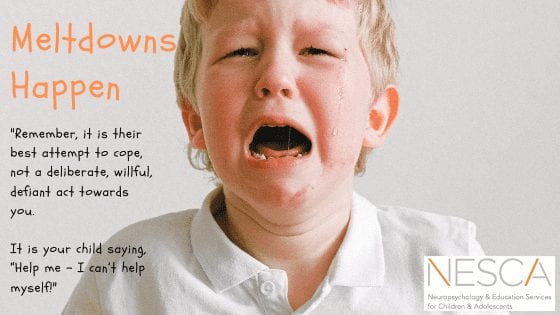
A meltdown may be an explosion and look like crying, throwing things, yelling, aggressing, breaking things, etc. Or it may be more like an implosion – a withdrawal from the family, hiding, sleeping more, lethargy, etc. Both are the same in many ways biologically; the system is in fight, fright or freeze. A meltdown should be viewed as a “neurological storm.” This fight, flight or freeze response is not a child being “bad” or disrespectful, but rather is “bad behavior” that needs to be changed. Remember, it is their best attempt to cope, not a deliberate, willful, defiant act towards you. It is your child saying, “Help me – I can’t help myself! I’ve lost it!” This is not a time to teach, reason with, or win a battle. It is a fire to be put out, and you as the parent or caretaker is the firefighter. It’s a crisis to be managed, and you become your child’s “upstairs brain” or frontal lobe (even though you may want to react from your “downstairs brain,” because you may also be losing it.

Everyone wants to have a good day. Remember, when it’s going in a different direction, you are the adult. You can take a breath and even walk away (if you can) for a few seconds to compose yourself. This allows you to respond versus react. It is your job to manage the situation and take the emotional high road (often easier said than done). In these moments, it is really only about a few things.

  1. Safety and dignity
  2. Keep calm and reduce/simplify your language
  3. Keep calm and know this too shall pass
  4. Don’t get pulled off topic by all the things your child is saying or doing – this is a rabbit hole that you won’t emerge from
  5. Mention what you want to have happen, rather than what you want to stop (“Bang your pillow” instead of “Stop banging the wall”)
  6. Establish connection – right brain to right brain. Remember the mantra, “Name it to tame it.” (i.e. I know this is hard; I know you don’t want to do it; I wouldn’t want to either; or I know you don’t like it, etc.)

Resources:

https://www.drdansiegel.com/books/the_whole_brain_child/


About the Author

NESCA’s Director of Consultation and Psychoeducational Services Dot Lucci has been active in the fields of education, psychology, research and academia for over 30 years. She is a national consultant and speaker on program design and the inclusion of children and adolescents with special needs, especially those diagnosed with Autism Spectrum Disorder (ASD). Prior to joining NESCA, Ms. Lucci was the Principal of the Partners Program/EDCO Collaborative and previously the Program Director and Director of Consultation at MGH/Aspire for 13 years, where she built child, teen and young adult programs and established the 3-Ss (self-awareness, social competency and stress management) as the programming backbone. She also served as director of the Autism Support Center. Ms. Lucci was previously an elementary classroom teacher, special educator, researcher, school psychologist, college professor and director of public schools, a private special education school and an education collaborative.

Ms. Lucci directs NESCA’s consultation services to public and private schools, colleges and universities, businesses and community agencies. She also provides psychoeducational counseling directly to students and parents. Ms. Lucci’s clinical interests include mind-body practices, positive psychology, and the use of technology and biofeedback devices in the instruction of social and emotional learning, especially as they apply to neurodiverse individuals.


To book a consultation with Ms. Lucci or one of our many expert neuropsychologists, complete NESCA’s online intake form. Indicate whether you are seeking an “evaluation” or “consultation” and your preferred clinician/consultant in the referral line.


Neuropsychology & Education Services for Children & Adolescents (NESCA) is a pediatric neuropsychology practice and integrative treatment center with offices in Newton, Massachusetts, Plainville, Massachusetts, and Londonderry, New Hampshire, serving clients from preschool through young adulthood and their families. For more information, please email info@nesca-newton.com or call 617-658-9800.


Good Ideas for Dogs are Good for People, Too

By | NESCA Notes 2020

By Dot Lucci, M.Ed., CAGS

Director of Consultation and Psychoeducational Services, NESCA

  • Play Every Day! — Play can promote calmness and reduce anxiety. This is true for adults and kids.
  • Play Is Learning — Reflect after play by creating and asking questions. Did you learn anything new? What surprised you? How did you feel before you played? How you feel now?
  • Walk, Walk, Walk! — Walking helps dogs stay engaged with the world and brains stimulated. Yup, works for humans, too.
  • Be Present While Walking — Go for walks with or without a dog. Feel the air blowing, smell the flowers, hear the birds singing, feel the rain on your face. Learn the bird calls, bring binoculars and look closely at the birds. Be present as you walk, laugh, sing, splash in puddles….
  • Game Play — Playing games can help satisfy natural instincts. Play old games, teach your children games you played as a child, learn new games. Any games will do – board, card, dice, movement, etc. Play skill games, games of chance or luck games, silly games, etc.
  • Feed Relationships Through Play and Exercise — Bond with each other (a child, a dog or both!) through playing or getting some exercise together. Be active together…teach new tricks, kick a ball around, play catch, take a yoga or Zumba class, watch GoNoodle as long as it’s together.
  • Be in gratitude that you are experiencing this time together to slow down and reconnect with each other. Laugh, play, sing and dance together. Love and care for each other. Enjoy each other.


About the Author

NESCA’s Director of Consultation and Psychoeducational Services Dot Lucci has been active in the fields of education, psychology, research and academia for over 30 years. She is a national consultant and speaker on program design and the inclusion of children and adolescents with special needs, especially those diagnosed with Autism Spectrum Disorder (ASD). Prior to joining NESCA, Ms. Lucci was the Principal of the Partners Program/EDCO Collaborative and previously the Program Director and Director of Consultation at MGH/Aspire for 13 years, where she built child, teen and young adult programs and established the 3-Ss (self-awareness, social competency and stress management) as the programming backbone. She also served as director of the Autism Support Center. Ms. Lucci was previously an elementary classroom teacher, special educator, researcher, school psychologist, college professor and director of public schools, a private special education school and an education collaborative.

Ms. Lucci directs NESCA’s consultation services to public and private schools, colleges and universities, businesses and community agencies. She also provides psychoeducational counseling directly to students and parents. Ms. Lucci’s clinical interests include mind-body practices, positive psychology, and the use of technology and biofeedback devices in the instruction of social and emotional learning, especially as they apply to neurodiverse individuals.


To book a consultation with Ms. Lucci or one of our many expert neuropsychologists, complete NESCA’s online intake form. Indicate whether you are seeking an “evaluation” or “consultation” and your preferred clinician/consultant in the referral line.


Neuropsychology & Education Services for Children & Adolescents (NESCA) is a pediatric neuropsychology practice and integrative treatment center with offices in Newton, Massachusetts, Plainville, Massachusetts, and Londonderry, New Hampshire, serving clients from preschool through young adulthood and their families. For more information, please email info@nesca-newton.com or call 617-658-9800.


Skip to content