Real-life Skills Coaching Alert!

NESCA now has two Occupational Therapists offering in-person, community-based Real-life Skills Coaching in the Newton area. To learn more or book sessions, complete our Inquiry/Intake Form.

Tag

Dr. Ann Helmus Archives - NESCA

Subscribe to NESCA Notes

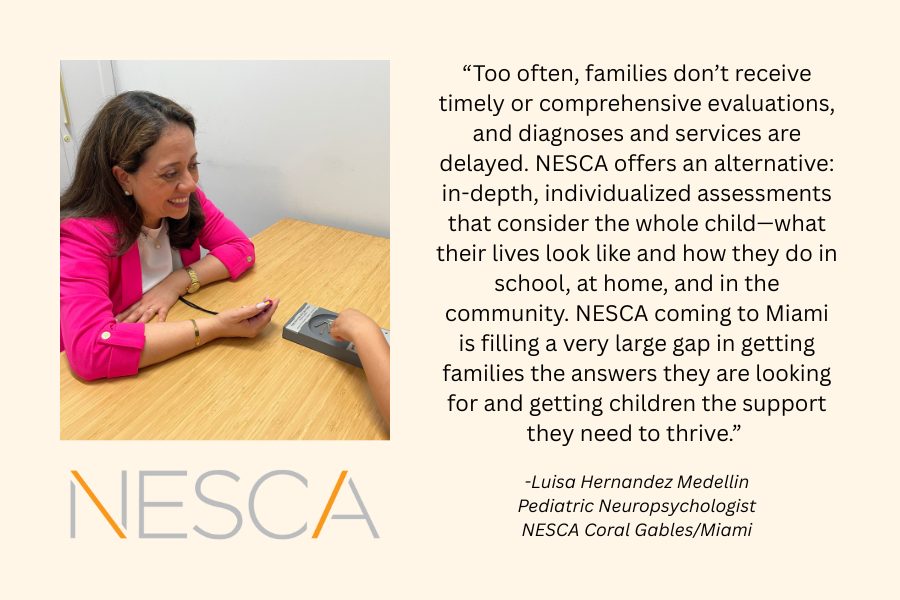
Dr. Luisa Hernandez Medellin evaluating a child

NESCA’s Heading South to Care for Children and Empower Families

By | NESCA Notes 2025

Dr. Luisa Hernandez Medellin evaluating a childBy Jane Hauser
Director of Marketing & Outreach, NESCA

Dr. Luisa Hernandez Medellin Discusses NESCA’s Miami Launch

NESCA recently opened its latest pediatric neuropsychology office in Coral Gables/Miami, Florida, headed up by Dr. Luisa Hernandez Medellin. I had the opportunity to speak with Dr. Luisa Hernandez Medellin to get to know more about her background, the current evaluation landscape in South Florida, Latin America, and the Caribbean, and to hear from her what unmet needs NESCA addresses in bringing its expertise to that region.

Tell us about your background and how you chose to become a pediatric neuropsychologist.
I was born and raised in Mexico City in a family that valued service and helping others. As a teen, I considered becoming a missionary nun because I wanted to travel to deliver services and support to children in need. During those years, I spent time in Cuba, Nicaragua, Guatemala, and Costa Rica, where I witnessed numerous disparities in the way people lived. That experience shaped my commitment to serving children and families.

When I returned to Mexico, I explored different careers, including teaching and medicine, as my father was a doctor, and eventually landed in psychology almost by chance—but it felt like home as soon as I discovered it. Later, when I moved to Miami, I completed my bachelor’s degree and entered a doctoral program in child psychology. During my training, I discovered neuropsychology, and it was a perfect fit: a way to combine psychology with the medical world, caring for both the mind and the body of an individual.

I trained at Jackson Memorial Hospital, where I fell in love with pediatric neuropsychology, working with children with neurodevelopmental disorders in both inpatient and outpatient settings. That experience set the foundation for my career. Since then, I’ve worked in hospitals, private practice, and now with NESCA, where I get to provide high-quality evaluations in a compassionate way that will help children and their families have a path to move forward on.

What is your philosophy when working with children and families?
I treat every child as I would my own. I’m a mother of three, all neurodivergent in different ways, so I understand how hard it can be to navigate the challenges of having children with disabilities while also loving them so deeply. My role is to get to know each child who comes in for an evaluation—what makes them unique, what’s important to them—and to help uncover what’s happening so they can flourish.

How do you feel neuropsychological evaluations benefit individuals and families?
Evaluations give us a deeper, objective understanding of a child’s strengths and challenges. Parents often come to me worried that they’ve done something wrong that caused their child’s struggles. I reassure them that no one is at fault. The goal is not to find problems or identify something or someone to blame; rather, it’s to identify the root cause of a child’s challenges while also highlighting each child’s strengths. It’s about finding the “lights AND the shadows.” For example, if a child struggles in math but loves music, we lean into music as a source of joy and growth for the child while knowing how to  properly provide support in areas like math, that may be more stressful.

How do you approach parents or caregivers who are resistant to the evaluation process or the possibility of their child receiving a diagnosis from it?
In Miami, many families are hesitant about their child receiving a diagnosis(es). I take the time during the intake process to listen to their concerns and gently plant seeds about the types of issues we may be seeing. That way, parents aren’t shocked during the feedback session where they learn the findings from the evaluation, which may include one or more diagnosis(es). It helps them process the information and reduces their fears. I emphasize that neurodivergence isn’t caused by parenting choices or styles, screen time, or the Covid experience. It’s just how a child is wired. My focus is on supporting families and children and building hope with new information from the evaluation.

How did you connect with NESCA, and what excites you about bringing NESCA to Miami?
While considering a move to Boston, I met NESCA’s founder and director, Dr. Ann Helmus, and our conversation felt like meeting a kindred spirit. She reminded me of my attending supervisor from Jackson Memorial Hospital in that they both expect very high quality evaluations, really care about their patients, and truly value the quality of the training provided to their trainees. That’s not always the way with providers, so that was very important to me.

She shared that NESCA was planning to open a Miami office, which felt like the perfect match. Now, I get to help NESCA bring its 30 years of expertise to our region, while I’m also contributing my own 20 years of experience right here in Miami. Together, we’re offering high-quality, culturally-sensitive evaluations in both Spanish and English.

Why does Miami need a practice like NESCA?
The system here in South Florida often creates delays in the identification of developmental, emotional, or learning disabilities. Pediatricians sometimes use a “wait and see” approach; bilingualism is sometimes mistaken for a speech delay when it’s really a sign of autism; and schools often face huge, lengthy backlogs for testing students.

It can be tricky to find the right resource or professional to help identify challenges early on. Neurologists tend to be trained in the brain as “hardware,” whereas we examine the brain’s operating system and how it functions when there is a brain injury, a developmental disorder, or other issue. More often, they look to scans and imaging for answers, where we look at the child’s wellbeing and growth, especially when there is a more complex presentation that may lead to several diagnoses, like ADHD, autism, and anxiety, all co-occurring. And due to productivity pressures in large Miami hospitals, they are only able to see patients for 15 minutes or so and often via telehealth.

And again, with our medical system not being optimized, there is a lot of overwhelm among pediatricians who are forced to operate in a factory-like system. Many people here in South Florida don’t actually have a dedicated pediatrician who knows them and their families. It’s more of a walk-in urgent care system, and that means there is no follow-up in six months or even a year to see how a child is progressing or not. No one is tracking them and is dedicated to their developmental well-being. This is another reason for the frequent delays in diagnosis here.

Because of all of these issues, too often, families don’t receive timely or comprehensive evaluations, and diagnoses and services are delayed. NESCA offers an alternative: in-depth, individualized assessments that consider the whole child—what their lives look like and how they do in school, at home, and in the community. NESCA coming to Miami is filling a very large gap in getting families the answers they are looking for and getting children the support they need to thrive.

What do you evaluate at NESCA in Coral Gables?
I focus primarily in pediatric neurodevelopmental disorders, ADHD, Autism Spectrum Disorders, and learning disabilities, providing evaluations and highly tailored recommendations for interventions. I have also been training practicum students in the Miami area, which we will continue to do as part of the NESCA practice in Coral Gables. There are currently only two sites in Miami where doctoral-level students can train at a practicum level in pediatric neuropsychology, and one of them is now NESCA.

What are your plans for working with schools and international families?
International families and private schools are actively seeking support for their students. Many families from Latin America and the Caribbean face limited resources in their home countries. They come to NESCA for specialized, highly personalized evaluations and recommendations on how to support their child or student at home or in school, in their country. NESCA in Miami will provide these families with the guidance and expertise they need—tailored to their cultural context and delivered with compassion.

Any final thoughts?
NESCA offers families in South Florida, Latin America, and the Caribbean the best of both worlds. We’re bringing NESCA’s legacy of excellence from 30 years of practice in New England, along with my decades of experience living and practicing in Miami, to serve families in this diverse, multicultural community. My goal is simple: to help every child be understood, supported, and given the guidance and tools necessary to thrive.
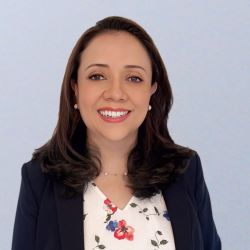
Headshot of NESCA Pediatric Neuropsychologist Dr. Luisa Hernandez MedellinAbout the Author

As a bilingual pediatric neuropsychologist, Dr. Hernandez Medellin conducts comprehensive and culturally sensitive neurodevelopmental and neuropsychological assessments, comprehensive diagnostic evaluations, and effective care plans, providing appropriate recommendations for the client’s school, home, and the community. She specializes in the identification and assessment of neurodevelopmental disorders such as Autism Spectrum Disorders, ADHD, developmental and learning disorders, and their co-occurrence with anxiety and mood disorders. She also works with children and young adults with acquired brain injuries, epilepsy, brain tumors, strokes, general medical conditions, and genetic disorders affecting the nervous system. She is a native Spanish-speaker, passionate about serving the eclectic and vibrant South Florida community, as well as international patients looking for high-quality and compassionate care.

To book evaluation services at NESCA in Coral Gables, Florida, complete NESCA’s online intake form. 

To book a neuropsychological evaluation or other services at NESCA’s New England offices, complete NESCA’s online intake form

NESCA is a pediatric neuropsychology practice with offices in Newton, Plainville, and Hingham, Massachusetts; Londonderry, New Hampshire; the greater Burlington, Vermont region; and Miami/Coral Gables, Florida, serving clients from infancy through young adulthood and their families. For more information, please email info@nesca-newton.com or call 617-658-9800.

Engineered for Excellence

By | NESCA Notes 2025

Image of NESCA clinicians conferring with each other and a quote from Dr. Ann HelmusBy Ann Helmus, Ph.D.
Founder & Director, NESCA

NESCA supports your clinician—so your clinician can support you and your child

When you choose NESCA, you’re not just hiring an individual clinician—you’re accessing an entire organization built to deliver excellence to each family who works with us. From the first intake call to the final report, every step of our process is designed to ensure quality, accuracy, and the best outcomes for your family. Parents invest in this process to resolve complex questions about their child’s learning, development, or emotional well-being—questions that can only be addressed by a thoughtful, thorough evaluation leading to recommendations that will truly make a difference.

At NESCA, we believe that the best way to provide this level of care is to take extraordinary care of our clinicians. Our equation is simple:

Lower Case Volume + High Clinician Support =

Exceptional Evaluations + Better Outcomes

Supporting Clinicians in Doing Their Best Work
In some practices and settings, clinicians face heavy caseloads, which can make it difficult to dedicate as much time to each child as they’d like. With larger caseloads, clinicians are often left with little time for reflection, professional growth, or collaboration. At NESCA, we intentionally structure things differently. We greatly value our clinicians as highly educated professionals with many years of training and provide them with the support, environment, and opportunity to produce their most thorough and careful work.

From the beginning, NESCA was intentionally designed for clinicians to typically work with six or fewer clients each month—a low volume compared to many other practices or settings. This structure ensures that every child’s evaluation receives the time, attention, and individualized analysis it deserves.

We Care for Our Clinicians—So They Are Able to Care for Your Child
Behind the scenes, our clinicians are supported in ways that are uncommon in many private practices:

  • Professional Development: Weekly seminars, ongoing mentorship, and access to senior clinical directors to ensure that every clinician is continually learning and growing.
  • Collaboration: Regular case conferences provide a forum for discussing complex cases and drawing on the expertise of their NESCA colleagues who specialize in multiple disciplines, providing well-rounded and forward-looking perspectives. Your child’s clinician is never working in isolation.
  • Dedicated Support Staff: Psychometricians handle test scoring, and administrative staff manage scheduling and logistics. This frees clinicians to focus entirely on the heart of their work—understanding your child.
  • Quality over Quantity: Because we are not driven by volume, clinicians can invest the time needed to observe your child carefully, analyze test results holistically, speak with educators and providers on your team, and craft thoughtful recommendations.

What This Means for Families
We know that clinicians do their best work when they feel secure, valued, and engaged. That’s why NESCA provides stability, top notch administrative support, and a professional community. When challenges arise, we work with our clinicians to resolve them, offering mentorship and guidance rather than leaving them to struggle and produce work that doesn’t meet NESCA’s high standards.

This culture of care is not just good for our staff—it’s essential to the families we serve. It means that when you come to NESCA, you are working with professionals who are deeply committed, well supported, and fully equipped to provide the highest quality evaluations and recommendations.

We take care of our clinicians so that they can take the best possible care of your child.


About the Author

NESCA Founder and Director Ann Helmus, Ph.D., is a licensed clinical neuropsychologist who has beenAnn Helmus headshot practicing neuropsychology for 35 years and has been director of NESCA’s Neuropsychology practice for nearly three decades, continuously training and mentoring  neuropsychologists to meet the highest professional standards.

To book a neuropsychological evaluation at NESCA, complete NESCA’s online intake form

NESCA is a pediatric neuropsychology practice with offices in Newton, Plainville, and Hingham, Massachusetts; Londonderry, New Hampshire; the greater Burlington, Vermont region; and Miami/Coral Gables, Florida, serving clients from infancy through young adulthood and their families. For more information, please email info@nesca-newton.com or call 617-658-9800.

Image of a middle schooler writing and a quote about summer intensive therapy by Dr. Ann Helmus about summer intensive therapy

Supercharge Communication Skills This Summer: The Case for Intensive Speech & Language Therapy

By | NESCA Notes 2025

Image of a middle schooler writing and a quote about summer intensive therapy by Dr. Ann Helmus about summer intensive therapyBy Ann Helmus, Ph.D.
Founder & Director, NESCA

For many students, summer is a much-needed break from the pressures of the long school year. But it’s also a unique opportunity to make powerful strides in speech and language development—far more than is often possible with weekly sessions during the academic year.

At NESCA, we offer intensive summer therapy that targets both verbal communication (such as listening comprehension, expressive language, and social communication) and written expression, an area where many students struggle.

Here’s why summer intensives can be especially effective:

  1. More Frequent Sessions = Greater Momentum
    When sessions are scheduled every other day (rather than once a week), skills are reinforced more consistently. Students retain strategies better, build habits faster, and make visible progress over a shorter period of time.
  2. Longer Sessions Allow for Deeper Work
    Without the time constraints of school-day schedules, therapy sessions can go beyond the traditional one-hour format. This gives students and therapists time to dig into more complex language tasks, problem-solve in real time, and practice generalizing skills across different contexts.
  3. Less Time Lost Re-Orienting
    With weekly sessions, valuable time is often spent reviewing what was last covered. Frequent summer sessions minimize this start-up time and allow therapy to pick up right where it left off—keeping the focus on forward movement.
  4. Fewer Distractions, Better Focus
    The relaxed pace of summer means students are often more receptive to learning. Without competing demands like homework, tests, and extracurriculars, they can be more focused and emotionally available for therapeutic work.
  5. Support for Written Expression with Proven Methods
    Our speech-language pathologist is trained in the EmPOWER method, a structured approach to teaching written expression. EmPOWER helps students organize their thoughts, clarify their ideas, and express themselves in writing with greater clarity and confidence—skills that are essential for success in school and beyond.
  6. A Stronger Start to the School Year
    Students who make gains in the summer enter the fall with more confidence, stronger foundational skills, and better self-awareness as communicators and learners.

If your child struggles with speaking, listening, or writing, summer can be the perfect time to make meaningful gains that will carry over into the school year. Intensive speech and language therapy can provide just the boost they need.

To explore next steps with NESCA’s Speech and Language Pathologists, fill out our Inquiry/Intake Form or visit our Speech and Language Evaluation and Therapy page. Our team will be in touch with you shortly to provide more information or set up a schedule of sessions that work with your family’s summer plans.


About the Author

NESCA Founder and Director Ann Helmus, Ph.D., is a licensed clinical neuropsychologist who has beenAnn Helmus headshot practicing neuropsychology for 35 years and has been director of NESCA’s Neuropsychology practice for nearly three decades, continuously training and mentoring  neuropsychologists to meet the highest professional standards.

To book a neuropsychological evaluation at NESCA, complete NESCA’s online intake form

NESCA is a pediatric neuropsychology practice and integrative treatment center with offices in Newton, Plainville, and Hingham, Massachusetts; Londonderry, New Hampshire; the greater Burlington, Vermont region; and Brooklyn, New York (coaching services only) serving clients from infancy through young adulthood and their families. For more information, please email info@nesca-newton.com or call 617-658-9800.

Picture depicting the root cause of a person's functioning or challenges

When Neuropsychological Evaluations Fall Short: Finding the Root Cause through Thorough Analysis vs. Giving a Label

By | NESCA Notes 2025

Picture depicting the root cause of a person's functioning or challengesBy Ann Helmus, Ph.D.
Founder & Director, NESCA

In a recent blog, I discussed how not all neuropsychological evaluations yield equally useful outcomes for helping a struggling child and touched on the consequences of misdiagnosis. This week, I’d like to explore another common challenge: evaluations that merely label a symptom without uncovering the underlying cause.

Consider a patient who visits a doctor with concerns of persistent fatigue and weight gain. After routine labwork returns normal results, the doctor offers the diagnoses  “mild obesity” and “idiopathic fatigue”—labels that describe the symptoms but do not provide a meaningful explanation. The patient is advised to get more sleep or possibly prescribed a new medication. After waiting months for the appointment and paying out of pocket, the individual is left feeling frustrated and still without clarity or direction about how to address the root cause of the problem.

Parents sometimes experience this result from their child’s neuropsychological evaluations, particularly when conclusions focus primarily on standardized test results without integrating the broader picture of a child’s daily functioning, course of development, and learning profile.

For example, I recently reviewed a report for a fifth grader whose parent was deeply concerned about the emotional distress their child experienced with writing. Despite the teacher reporting that the child’s writing was “fine,” and the child handling other homework with ease, the parent observed significant distress during writing tasks. The evaluation found a discrepancy between IQ and written expression scores, diagnosing a Disorder of Written Expression (ICD-10 F81.81), and recommending a writing tutor as intervention.

While this diagnosis is valid based on test scores, it simply labels the problem rather than explaining why the writing challenge existed or what type of support might be most effective for this individual. Difficulties with written expression can stem from a variety of root causes—fine motor challenges, language deficits, executive functioning difficulties, or learning differences like dyslexia, among others. Effective interventions vary widely depending on the underlying issue. For example:

  • Children with communication disorders may benefit most from working with a speech-language pathologist on written expression embedded in the context of language development
  • Children with dyslexia often require structured literacy approaches
  • Children with executive functioning challenges may need explicit, scaffolded instruction in planning and organizing written output

In the case I reviewed, the child’s intellectual abilities were in the Very Superior range, with especially strong abstract reasoning and pattern recognition. Standard tests showed that his organizational skills were age-appropriate, yet he struggled to express his ideas in writing. Why? Because the complexity and richness of his ideas exceeded his ability to structure them effectively. In this case, his frustration stemmed from a bottleneck in translating thoughts into written form—a challenge not uncommon in gifted learners.

The solution wasn’t simply more writing practice; it was a targeted program matched to his unique cognitive profile, along with strategies for reducing emotional stress around writing.

After additional observation and analysis, we were able to offer the family not only a clear explanation but also a tailored plan, including specific interventions and home supports. Most importantly, we helped the child understand why writing felt so difficult and reassured him that effective help was available.

When done thoughtfully, a neuropsychological evaluation can be truly transformative. At NESCA, we are deeply committed to providing comprehensive evaluations that go beyond scores to understand the whole child. We aim to provide the kind of service we would want for our own children—thorough, compassionate, and actionable.

NESCA clinicians receive ongoing training and mentorship to ensure a consistently high standard of care. Each clinician participates in multiple weekly case conferences to discuss complex profiles and refine their clinical thinking. We also offer weekly seminars to stay informed about evolving interventions and treatments. New team members—regardless of prior experience—receive six months of mentorship to support their transition into our collaborative model. This structure fosters a culture of continual learning and clinical rigor. We take pride in our work because we know that careful, individualized evaluations can change the trajectory of a child’s life.


About the Author

NESCA Founder and Director Ann Helmus, Ph.D., is a licensed clinical neuropsychologist who has beenAnn Helmus headshot practicing neuropsychology for 35 years and has been director of NESCA’s Neuropsychology practice for nearly three decades, continuously training and mentoring neuropsychologists to meet the highest professional standards.

To book a neuropsychological evaluation at NESCA, complete NESCA’s online intake form

NESCA is a pediatric neuropsychology practice and integrative treatment center with offices in Newton, Plainville, and Hingham, Massachusetts; Londonderry, New Hampshire; the greater Burlington, Vermont region; and Brooklyn, New York (coaching services only) serving clients from infancy through young adulthood and their families. For more information, please email info@nesca-newton.com or call 617-658-9800.

Graphic with the words, "THE HIGH COST OF MISDIAGNOSIS" and a quote from Dr. Ann Helmus

When Neuropsychological Evaluations Fall Short: The High Cost of Misdiagnosis

By | NESCA Notes 2025

Graphic with the words, "THE HIGH COST OF MISDIAGNOSIS" and a quote from Dr. Ann HelmusBy Ann Helmus, Ph.D.
Founder & Director, NESCA

At NESCA, we often see students who have been through neuropsychological evaluations before—but whose needs remain unmet. Unfortunately, not all evaluations are created equal, and a poorly done assessment can have serious, lasting consequences for a child.

It’s important for parents to understand that test scores do not provide the answers; tests are tools that skilled evaluators use to evaluate hypotheses that arise from analyzing information provided by parents and teachers (e.g., the presenting concerns could be caused by ADHD, anxiety, or a poor teacher match). When an evaluator fails to carefully integrate the testing data with history and observations, the child’s underlying issues may not be accurately explained, and they are unlikely to receive the treatment or educational supports they truly need. Worse, they may be misdirected into interventions that are ineffective or even inappropriate. Time is lost. Money is wasted. And critically, the window for meaningful intervention begins to close.

Consider a recent case we saw at NESCA. A middle schooler had been diagnosed by an outside evaluator with Autism Spectrum Disorder (ASD) at a young age. More recently, she had another neuropsychological evaluation, again not at NESCA. The clinician didn’t question or reevaluate the ASD diagnosis and recommended placement in a specialized program for students with autism.

The problem? This student was not autistic.

She was more cognitively and socially advanced than her peers in the program and made little effective progress on her IEP goals.

Her parents knew that something was wrong and sought a reevaluation at NESCA. Our clinician doubted the diagnosis of ASD based on information provided by her parents and teachers. The results of NESCA’s comprehensive neuropsychological assessment clearly indicated that this student did not meet criteria for ASD. Rather, she was found to have a significant communication disorder, along with social anxiety, which is commonly seen in individuals with weak language skills.

Because these underlying challenges had not been identified, they had not been properly treated. By the time the student was reevaluated, she was already finishing middle school, and valuable years for remediation had been lost.

The differential diagnosis between autism, communication disorders, and anxiety can be complex. These conditions share many overlapping symptoms—difficulty with social interaction, trouble expressing oneself, rigid thinking patterns, emotional dysregulation—and it takes careful, thoughtful assessment to tease apart the diagnostic picture.

Too often, I read reports from outside of NESCA that show little analysis of the data: tests are administered, deficits are listed, and a diagnosis is selected without adequate integration of the child’s history, day-to-day functioning, and observed behavior. Neuropsychological testing is not a mechanical process or a checklist; it is a process of clinical reasoning based on experience, judgement, knowledge, and acumen.

When done properly, a neuropsychological evaluation can be life-changing. At NESCA, we take the power of this tool seriously and honor our commitment to parents to provide the high level of service that we would want for our own children. We train our clinicians to analyze test results in the full context of a child’s developmental history, real-world behavior, and educational trajectory. We make diagnoses carefully and intentionally, because we know that accurate identification is the first step toward effective support.

The NESCA Difference is in the level of training, support, and accountability that we provide for our clinicians. I am actively involved in training our neuropsychologists—reading and editing reports and providing guidance. We have two clinical directors who have been at NESCA for more than 15 years and are responsible for supporting clinicians in thinking through complex cases, reviewing reports, and honing recommendations. All NESCA clinicians participate in one to two case conferences each week for group discussion of complicated cases. All clinicians attend a weekly seminar or discussion group to learn about various evidence-based interventions and treatments, often from trusted professionals that we invite in to share their knowledge. Neuropsychologists who join the NESCA team are provided with at least six months of mentoring by a senior clinician on staff, regardless of how experienced they are when they are hired. As a result of these requirements, NESCA attracts intellectually curious professionals who want to continue to learn and develop skills as they progress in their careers. They are passionate about their work and take pride in the high quality of their evaluations, knowing that they are impacting the course of a child’s life.


About the Author

NESCA Founder and Director Ann Helmus, Ph.D., is a licensed clinical neuropsychologist who has beenAnn Helmus headshot practicing neuropsychology for 35 years and has been director of NESCA’s Neuropsychology practice for nearly three decades, continuously training and mentoring  neuropsychologists to meet the highest professional standards.

To book a neuropsychological evaluation at NESCA, complete NESCA’s online intake form

NESCA is a pediatric neuropsychology practice and integrative treatment center with offices in Newton, Plainville, and Hingham, Massachusetts; Londonderry, New Hampshire; the greater Burlington, Vermont region; and Brooklyn, New York (coaching services only) serving clients from infancy through young adulthood and their families. For more information, please email info@nesca-newton.com or call 617-658-9800.

Skip to content