

By Madeline Manning, Ph.D.
Pediatric Neuropsychologist, NESCA Hingham
A comprehensive neuropsychological evaluation offers a clear, objective look at how your child learns, processes information, and navigates their environment. However, receiving the evaluation report is only the first step in the journey to ensuring those findings translate into meaningful, everyday classroom support. The next crucial phase is working alongside educators to transform these clinical insights into real-world, school-based strategies. By understanding how to utilize the recommendations provided within the report, parents are equipped to foster a collaborative relationship with the school team and establish the precise structural and academic supports their child needs to succeed.
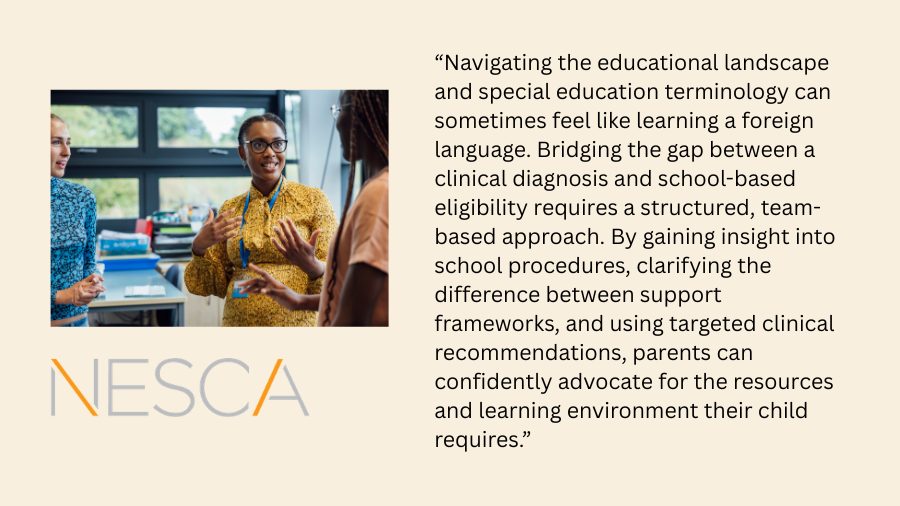
Navigating the educational landscape and special education terminology can sometimes feel like learning a foreign language. Bridging the gap between a clinical diagnosis and school-based eligibility requires a structured, team-based approach. By gaining insight into school procedures, clarifying the difference between support frameworks, and using targeted clinical recommendations, parents can confidently advocate for the resources and learning environment their child requires.
Understanding the Frameworks: 504 Plan vs. IEP
The first step in advocacy is understanding the two primary pathways for school-based support. While both provide essential assistance, these public school documents are governed by different federal laws and serve distinct purposes:
- The 504 Plan (Section 504 of the Rehabilitation Act): This civil rights statute is designed to prevent discrimination by ensuring “equal access” to learning. A 504 Plan provides accommodations, which are changes to how a student learns, without altering the curriculum. Examples include extra time on tests, preferential seating, or sensory breaks. It is appropriate for students who can access the general education curriculum but need environmental adjustments to do so.
- The Individualized Education Program (IEP; Individuals with Disabilities Education Act): An IEP is a specialized blueprint for students who require specialized instruction. This involves changes to what they are being taught, where they are being taught, or the delivery of direct services (such as speech-language therapy, occupational therapy, or specialized reading instruction). To qualify for an IEP, a student must have a documented disability that directly impacts their ability to make effective progress in school, requiring targeted, specialized instruction.
A comprehensive neuropsychological evaluation is invaluable for both pathways, as it provides the objective, standardized data necessary to document a child’s functional limitations and academic needs. A primary goal of our evaluation report is to clearly connect your child’s profile directly to appropriate recommendations, including practical classroom strategies.
Translating Clinical Findings into Classroom Supports and Placement
A high-quality neuropsychological report does not simply list test scores and diagnoses; it outlines the underlying cognitive, learning, and social-emotional factors driving a student’s classroom challenges. At NESCA, what sets our reports apart is our commitment to understanding the whole child, including the complex, interacting variables that shape their daily experience. This holistic view allows us to provide highly individualized, detailed recommendations rather than generic lists of accommodations. We specify the exact nature of the support your child needs, including the recommended frequency of services, the provider best suited to deliver the intervention, tailored environmental accommodations, and the specific setting where the support should occur.
A comprehensive evaluation can also inform appropriate classroom placement. For some students, making effective progress requires a specialized language-based, co-taught, or therapeutic classroom setting rather than a standard general education environment.
You do not need to be a clinical expert to advocate effectively during this process. A high-quality report does the heavy lifting by reframing classroom struggles into clear, actionable solutions. For instance, a student who appears “disorganized” or “unmotivated” is often actually experiencing executive dysfunction. Thus, the report may reframe this difficulty to advocate for structured scaffolding, like breaking long-term projects into mini-deadlines with daily staff check-ins.
Similarly, a child labeled “inattentive or slow to finish work” may be managing the impact of slow processing speed, meaning they comprehend the material well but require significantly more time and cognitive energy to show what they know. The report can use this insight to justify pacing accommodations, such as reduced homework volume to prioritize concept mastery over repetitive task completion.
Even emotional vulnerabilities, such as presenting as “withdrawn or resistant to participate,” may be reframed within a report through the lens of underlying sensory overload or social fatigue, pointing the school team toward proactive supports like a designated safe space or scheduled sensory breaks throughout the day. Ultimately, by translating complex behaviors into these precise, real-world connections, the evaluation report provides you and the school with a shared, compassionate roadmap towards supporting the student’s success.
Collaborative Advocacy: Partnering with the School Team
Preparing for a multidisciplinary team meeting can be a deeply personal process, and it is completely natural to want to ensure your child’s needs are fully understood. The most productive school meetings are often built on a foundation of partnership, where everyone brings valuable expertise to the table. Successful advocacy relies on uniting two distinct areas of expertise: the school team’s deep knowledge of curriculum and classroom dynamics, and your unmatched understanding of your child’s unique personality, strengths, and history. By uniting these unique perspectives, you and the school team can work together to build the best possible path forward. To foster a collaborative partnership during your next team meeting, consider these strategies:
- Share the Report Early to Build a Collaborative Bridge (Preparation): When possible, provide the school’s multidisciplinary team with the neuropsychological report at least two weeks prior to the scheduled meeting. This gives the educators and specialists adequate time to digest the findings and formulate thoughtful, proactive service proposals. To foster a true partnership, consider sending a brief, friendly email along with the report highlighting your top two or three priorities or questions, ensuring your voice is integrated into the meeting agenda from the very start.
- Reframe Behavior Through a Clinical Lens (During the Meeting): Use the evaluation findings to identify the root cause of certain behaviors, allowing the team to reframe classroom challenges and guide targeted, proactive interventions. If it is noted that your child is “disengaged” or “refuses to write,” pointing to the objective data showing fine-motor fatigue, language-retrieval deficits, or underlying performance anxiety helps the team view the behavior as a skill deficit rather than a compliance issue. Reframing these challenges empowers the team to focus on teaching coping strategies and providing proactive supports that set your child up for success.
- Focus on “Effective Progress” and Accountability (The Goal): Under special education guidelines, eligibility and services hinge on whether a child is making meaningful, “effective progress” in school. Use the standardized, objective data in your report to highlight where your child is struggling, both compared to their peers and relative to their own capabilities. Rather than asking for generalized help, frame your requests around helping them close these specific developmental and academic gaps, and ask the team how the success of any new accommodations or interventions will be actively measured and tracked.
Translating a neuropsychological evaluation into a school-based plan is a journey that requires patience, clarity, and persistence. Ultimately, your child’s report is far more than a diagnostic document; it is a powerful roadmap designed to align parents and educators around a shared vision. By using objective clinical data to guide the conversation, you can ensure your child receives the precise, individualized support required to build academic self-efficacy, emotional resilience, and the foundation they need to thrive.
School Meeting Support
Are you preparing to navigate an upcoming multidisciplinary school meeting to discuss an IEP or 504 plan for your child? To bridge the gap between our clinical findings and your child’s classroom, neuropsychologists at NESCA are available to attend school team meetings. In these meetings, our role is to succinctly present the objective evaluation findings directly to the school team, illustrate how your child’s unique profile impacts their classroom learning, and walk educators through our tailored recommendations.
Please note that school meeting attendance is a distinct clinical service and is not included in the core evaluation and report process. Clinicians participate strictly in an advisory, clinical capacity rather than as educational advocates. To inquire about your clinician’s availability and the rates for this service, please reach out to our intake team at NESCA.
About Dr. Madeline Manning
Dr. Madeline Manning is committed to providing comprehensive, collaborative evaluations that help families better understand their child’s unique neurocognitive, developmental, learning, and social-emotional profiles. She specializes in the assessment of toddlers, school-aged children, adolescents, and young adults. Her expertise involves working with youth exhibiting a diverse range of clinical presentations, including neurodevelopmental disorders, such as autism spectrum disorder, attention and executive functioning deficits, learning disabilities, developmental delays, intellectual disabilities, and associated emotional challenges. Dr. Manning is also trained in the assessment of children with medical complexities, recognizing how health conditions can impact a child’s development and functioning. She partners closely with families to develop practical, personalized recommendations that support each individual’s success and growth at home, in school, and within the community.
To book a neuropsychological evaluation at NESCA, complete NESCA’s online intake form.
NESCA is a pediatric neuropsychology and related services practice with offices in Newton, Plainville, and Hingham, Massachusetts; Londonderry, New Hampshire; and Coral Gables, Florida, serving clients from infancy through young adulthood and their families. For more information, please email info@nesca-newton.com or call 617-658-9800.


Connect with Us