
NESCA’s Newton, MA location has immediate availability for neuropsychological evaluations. Our MA clinicians specialize in the following evaluations: Neuropsychological; Autism; and Emotional and Psychological, as well as Academic Achievement and Learning Disability Testing.

Visit www.nesca-newton.com/intake for more information or to book an evaluation.

Tag

EF Archives - Page 2 of 2 - NESCA

Subscribe to NESCA Notes

YES! COVID-19 May be Making Basic Daily Tasks More Difficult: The Link Between Executive Function Difficulties and Anxiety/Stress

By | NESCA Notes 2020

By: Sophie Bellenis, OTD, OTR/L

Occupational Therapist; Real-life Skills Program Manager and Coach

As our country continues to adapt to life in the era of COVID-19, it is quite well established that there has been a rise in anxiety and stress among our population. According to the Centers for Disease Control and Prevention (CDC), the mental health effects of the current pandemic have been substantial and include difficulty sleeping, worsening chronic health problems, changes in eating patterns, fear about personal health and the health of loved ones, and increased use of tobacco and alcohol (CDC, 2020). Many of these fears and new challenges are expected and understandable. They are responses that intuitively make sense to us as humans, as many of us experience them on a small scale throughout a typical year. Most people can name a time when they could not fall asleep before a big test or did not take excellent care of their physical health when they were hugely stressed or anxious. However, one effect of this newly heightened stress and anxiety that is less frequently mentioned is the decrease in executive function skills.

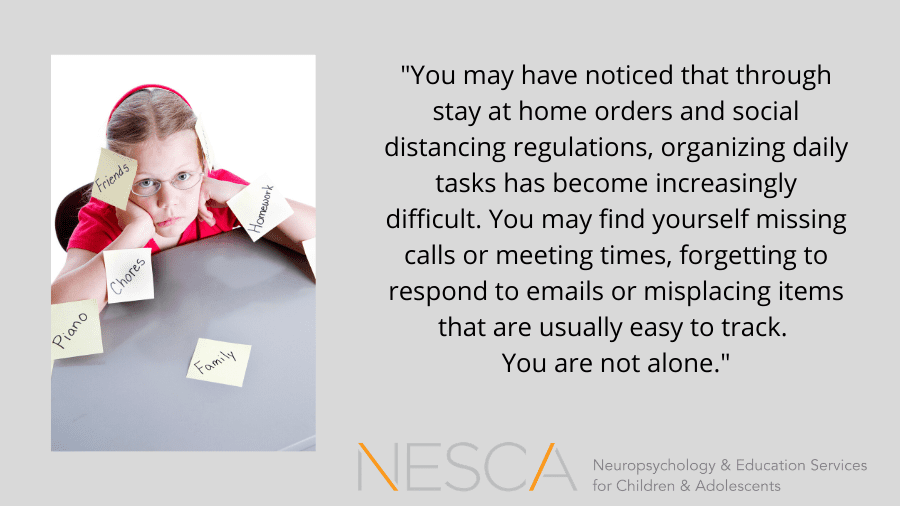
The term executive function refers to the brain processes that allow someone to stay organized, initiate tasks, maintain focus and attention, and manipulative information in their mind. As NESCA Pediatric Neuropsychologist Dr. Alissa Talamo describes in her piece, “What is Executive Function?,” this group of skills can be thought of as the conductor of the brain, similar to the conductor of an orchestra. They are keeping time, telling us when to start and stop tasks and helping us to stay regulated through the ups and downs of the day. You may have noticed that through stay at home orders and social distancing regulations, organizing daily tasks has become increasingly difficult. You may find yourself missing calls or meeting times, forgetting to respond to emails or misplacing items that are usually easy to track. You are not alone. Some people have started to describe a brain fog and a perceived inability to stay focused on a task for more than a short period of time.

While maybe not as intuitive as a lack of sleep, this decrease in executive function is to be expected as we collectively move through this stressful experience. Substantial research has described the correlation between depression, anxiety and stress, and executive function deficits. This seems to be particularly strong for adolescents with depressive and anxious symptoms, who have trouble with cognitive flexibility (Han, Helm, Iucha, Zahn-Waxler & Hastings, 2016). Similarly, university students are another population vulnerable to these effects, as described by Ajilchi and Nejati in 2017, who found specific difficulties with sustained attention and decision making. It is no surprise that one diagnostic criteria for generalized anxiety disorder is “difficulty concentrating or mind going blank” (APA, 2013). When reviewing the literature, it is clear that the brain fog and inability to focus through COVID-19 is not only unsurprising, for many people, it was inevitable.

So, what do we do? How do we soldier on through this incredibly unique time, despite the feeling that everything takes just a bit more time and effort?

It is increasingly important to cut ourselves some slack and stop expecting perfection. Focusing on self-care and taking care of each other emotionally will potentially lead to a natural return to successful executive function. By creating habits and routines that promote positive mental health, we are more likely to mitigate the feelings of being overwhelmed and the potential for burnout. Additionally, using technology and digital reminders to help take over the tasks of initiation and organization can give our over-extended brains a bit of a rest.

Finally, it is imperative that we think about the adolescents and students in our communities who are just starting to build these skills. Building executive function skills comes from a combination of direct instruction and opportunity to practice. Currently, students are being provided ample opportunity to practice, with limited direct instruction and guidance. Consider teaching your children and adolescents the tricks that you have learned to stay organized, prepared and productive. If you feel like teaching these skills is outside of your wheelhouse, or at all daunting, look into the prospect of an executive function coach. With all of the uncertainty about what education will look like this fall, helping students feel ready to tackle learning is one way to mitigate the anxiety and stress of this transitional time.


References

Ajilchi, B., & Nejati, V. (2017). Executive Functions in Students with Depression, Anxiety, and Stress Symptoms. Basic and clinical neuroscience8(3), 223–232. https://doi.org/10.18869/nirp.bcn.8.3.223

American Psychiatric Association. (2013). Diagnostic and statistical manual of mental disorders (5th ed.). Arlington, VA: American Psychiatric Publishing.

Center for Disease Control and Prevention. (2020) Coronavirus disease 2019: Coping with stress. Retrieved from: https://www.cdc.gov/coronavirus/2019-ncov/daily-life-coping/managing-stress-anxiety.html

Han, G., Helm, J., Iucha, C., Zahn-Waxler, C., Hastings, P. D., & Klimes-Dougan, B. (2016). Are Executive Functioning Deficits Concurrently and Predictively Associated with Depressive and Anxiety Symptoms in Adolescents?. Journal of clinical child and adolescent psychology : the official journal for the Society of Clinical Child and Adolescent Psychology, American Psychological Association, Division 5345(1), 44–58. https://doi.org/10.1080/15374416.2015.1041592


About the Author

Dr. Sophie Bellenis is a Licensed Occupational Therapist in Massachusetts, specializing in educational OT and functional life skills development. Dr. Bellenis joined NESCA in the fall of 2017 to offer community-based skills coaching services as a part of the Real-life Skills Program within NESCA’s Transition Services team. Dr. Bellenis graduated from the MGH Institute of Health Professions with a Doctorate in Occupational Therapy, with a focus on pediatrics and international program evaluation. She is a member of the American Occupational Therapy Association, as well as the World Federation of Occupational Therapists. Having spent years delivering direct services at the elementary, middle school and high school levels, Dr. Bellenis has extensive background with school-based occupational therapy services.  She believes that individual sensory needs and visual skills must be taken into account to create comprehensive educational programming.

To book an appointment or to learn more about NESCA’s Occupational Therapy Services, please fill out our online Intake Form, email info@nesca-newton.com or call 617-658-9800.


Neuropsychology & Education Services for Children & Adolescents (NESCA) is a pediatric neuropsychology practice and integrative treatment center with offices in Newton, Massachusetts, Plainville, Massachusetts, and Londonderry, New Hampshire, serving clients from preschool through young adulthood and their families. For more information, please email info@nesca-newton.com or call 617-658-9800.


What is executive functioning? – Part 2 – How can adolescents develop these important skills?

By | NESCA Notes 2019

By: Alissa Talamo, PhD
Clinical Neuropsychologist, NESCA

Cody is a 17-year-old young man participating in 11th grade. He is a talented runner with a good sense of humor and he has achieved mostly Bs in his college preparatory and advanced college preparatory high school classes. However, Cody’s mother describes him as the kind of kid whose “head would fall off if it was not attached.” Cody has an English tutor who has helped him to organize his thoughts and writing throughout high school. He seems to run out of time with everything—homework, tests, showers, video games—unless his parents and teachers provide him with several reminders. He also has trouble starting and finishing tasks, even things that are important to him. For example, he wanted to apply for a job at Market Basket. His mother has emailed him the online application link three times, but he still had not completed it after two months. Cody wants to go to college and is hoping to be recruited by a men’s cross country team. So, his parents took him to see a neuropsychologist to see if he could qualify for extra time on the SAT. They had heard the term executive functioning and knew that this was an area where Cody struggled, but they did not realize how significant his challenges were until the neuropsychologist shared his test results. Cody and his parents were grateful to have a better understanding of Cody’s learning strengths and challenges and also to learn that executive functioning skills can be remediated throughout the lifespan.

What is executive functioning?

Part 1 of this blog defined executive functioning as the “conductor” of all cognitive skills and identified three main components:

  • Working memory (the ability to hold and manipulate information in your mind),
  • Inhibitory control (inhibiting impulsivity, to pause and think before reacting),
  • Cognitive flexibility (the ability to adjust to changing demands).

Part 2 of this blog post highlights activities suggested to enhance the development of executive functioning and self-regulation skills during adolescence (taken from developingchild.harvard.edu booklet titled “Enhancing and Practicing Executive Function Skills with Children from Infancy to Adolescence.”). The full guide is available for download and describes many additional activities and games that provide ways for adults to support various aspects of executive functioning and self-regulation in adolescents (Center on the Developing Child at Harvard University, 2014). While neuropsychological evaluation can be extremely important for understanding an adolescent’s executive functioning profile and planning for postsecondary education, there are a number of activities that young people can work on at home in order to build their executive functioning skills.

Here are some examples of activities suggested for adolescents:

  • Goal setting, planning and monitoring
    • Help the adolescent identify short and long-term goals and think about what has to be done to achieve them.
    • Help adolescents be mindful of interruptions (particularly from electronic communication such as email and cell phones).
  • Activities
    • Sports — The focused attention and skill development inherent in competitive sports improve the ability to monitor one’s own and others’ actions, make quick decisions, and respond flexibly.
    • Yoga and meditation — Activities that support a state of mindfulness may help teens develop sustained attention, reduce stress, and promote less reactive, more reflective decision-making and behavior.
    • Strategy games and logic puzzles — Classic games like chess exercise aspects of working memory, planning, and attention.
  • Study skills
    • Break a project down into manageable pieces.
    • Identify reasonable plans (with timelines) for completing each piece.
    • Self-monitor while working
    • When you don’t understand, what might be the problem? Do you know what the directions are? Is there someone you can ask for help?
    • Think about what was learned from an assignment that was not completed well. Was this due to a lack of information, a need to improve certain skills, bad time management, etc.?
    • Keep a calendar of project deadlines and steps needed to complete along the way
    • Identify ways to reduce distractions (e.g., turn off electronics, find a quiet room).

Are you concerned your adolescent’s trouble with getting organized, starting tasks, or keeping his/her emotions in check could be related to executive functioning issues?

There are many things you can do to get the answers you need to best help your adolescent. The most comprehensive way to assess a child’s executive functioning difficulties and determine a cause is a neuropsychological evaluation. A comprehensive neuropsychological evaluation is made up of a set of tests, questionnaires, interviews, and observations that a clinician will use to gain a good understanding of a young person’s strengths and weaknesses, along with learning how the individual processes information and completes tasks. At NESCA, we offer comprehensive evaluations that can look for potential learning disabilities, attentional difficulties, and other challenges that can negatively impact a child’s executive functioning development. In addition, a NESCA evaluation will include explicit recommendations to address challenges that have been identified.

Also, if you want to learn strategies for helping a teenager or young adult develop executive functioning skills, read Part 1 of this blog!

About the Author:
Talamo

With NESCA since its inception in 2007,  Dr. Talamo had previously practiced for many years as a child and adolescent clinical psychologist before completing postdoctoral re-training in pediatric neuropsychology at the Children’s Evaluation Center. After receiving her undergraduate degree from Columbia University, Dr. Talamo earned her doctorate in clinical health psychology from Ferkauf Graduate School of Psychology and the Albert Einstein College of Medicine at Yeshiva University. She has given a number of presentations, most recently on “How to Recognize a Struggling Reader,” “Supporting Students with Working Memory Limitations,” (with Bonnie Singer, Ph.D., CCC-SLP of Architects for Learning ), and “Executive Function in Elementary and Middle School StudentsDr. Talamo specializes in working with children and adolescents with language-based learning disabilities including dyslexia, attentional disorders and emotional issues. She is also interested in working with highly gifted children.


To book a neuropsychological evaluation or consultation  with Dr. Talamo or one of our many other expert neuropsychologists, complete NESCA’s online intake form. Indicate that you would like to see “Dr. Talamo” in the referral line.


Neuropsychology & Education Services for Children & Adolescents (NESCA) is a pediatric neuropsychology practice and integrative treatment center with offices in Newton, Massachusetts, and Londonderry, New Hampshire, serving clients from preschool through young adulthood and their families. For more information, please email info@nesca-newton.com or call 617-658-9800.

What is executive functioning? How do I help my child develop these important skills? – Part 1

By | NESCA Notes 2019

By: Alissa Talamo, PhD
Clinical Neuropsychologist, NESCA

Alexis is a 5-year-old girl midway through kindergarten. She is well-liked, social, and has a strong vocabulary for her age. But her kindergarten teacher has noticed that Alexis has some difficulties in the classroom. Alexis raises her hand often during circle time, but when she is called on she  usually freezes or contributes something unrelated to the class discussion. Alexis also frustrates easily. When her first attempt at an art project doesn’t look like the example, she will throw it away or ask to do something else. And when she is given a multi-step direction to put her work away and get on her coat to go outside, she usually stops working but doesn’t move until she sees what her peers are doing, then she will follow along. Alexis’ parents have always noticed similar challenges at home such as giving up on difficult activities, forgetting where she has left her toys, and freezing when given too many choices or directions. But until her kindergarten teacher mentioned these classroom challenges, and they took her to see a neuropsychologist to better understand her classroom struggles, they did not realize that there was a name for her difficulties: Alexis is struggling with executive functioning.

What is executive functioning?

Executive functioning can be considered the “conductor” of all cognitive skills. Research has shown that executive function and self-regulation skills are critical for learning and development and help a person manage life tasks of all types.  While humans are not born with executive function skills, we are born with the potential to develop them. Moreover, studies show that we can continue developing the skills throughout our lifespans.

Executive function and self-regulation skills include three key components:

  • Working memory (the ability to hold and manipulate information in your mind),
  • Inhibitory control (inhibiting impulsivity, to pause and think before reacting),
  • Cognitive flexibility (the ability to adjust to changing demands).

While neuropsychological evaluation can be a critical step in learning about a child’s executive functioning skills and gaining recommendations for helping to remediate executive functioning challenges, there are a number of activities that parents can initiate to develop executive functioning skills at home.

Part 1 of this blog post highlights activities suggested to enhance the development of executive functioning and self-regulation skills from infancy through age 12 (taken from developingchild.harvard.edu booklet titled “Enhancing and Practicing Executive Function Skills with Children from Infancy to Adolescence.”). The full guide is available for download and describes many additional activities and games that provide ways for adults to support various aspects of executive functioning and self-regulation in children (Center on the Developing Child at Harvard University, 2014).

Here are some examples of activities suggested for children of different ages.

Ages 6-18 months old

  • Peekaboo —this activity exercises working memory, challenging the baby to remember who is hiding, and also introduces basic self-control skills as the baby waits for the adult to be revealed.
  • Pat-a-Cake — Predictable rhymes that end with a stimulating yet expected surprise. Infants exercise working memory, becoming familiar with the rhyme and anticipating a surprise.
  • Songs or chants with simple hand motions help develop working memory and language. Infants can learn to copy the movements to a song and, with practice, will remember the sequence (e.g., Eensy Weensy Spider; Open, Shut Them).

Ages 18-36 months old

  • Older toddlers can enjoy simple imitation games (e.g., Follow the Leader) which can help develop working memory as well as attention and inhibition.
  • Song games with many movements are also fun (The Hokey Pokey; Head, Shoulders, Knees, and Toes). These require children to attend to the song’s words and hold them in working memory, using the song to guide their actions.

Ages 3-5 years old

  • Encourage children to tell you stories while you write them down. Also, have the children act out stories they have written. The story provides a structure that guides children’s actions and requires them to attend to the story, while inhibiting their impulse to create a new plot.
  • Play matching and sorting activities that promote cognitive flexibility. Children can first sort or match by one rule (such as by color), and then immediately be asked to switch to a new rule (such as by shape).

Ages 5-7 years old

  • Games that require players to remember the location of particular cards are great at exercising working memory (e.g., Concentration).
  • Games in which the child can match playing cards, either by suit or number, are also good to help strengthen cognitive flexibility (e.g., Crazy Eights, Uno).
  • Games that require attention and quick responses help children practice attention and inhibition (e.g., for younger children – Red Light, Green Light or Duck, Duck, Goose; for older children – Simon Says, Mother May I?).

Ages 7-12 years old

  • Games that require monitoring and fast responses are great for challenging attention and quick decision-making in children at this age (e.g., Spit)
  • Physical activities/games help develop a child’s ability to hold complicated rules and strategies in mind, monitor their own and others’ actions, make quick decisions and respond flexibly.
  • Brain teasers (e.g., Sudoku, Rubik’s Cube) require children to be mentally flexible and consider spatial information.

Are you concerned your child’s trouble keeping his/her emotions in check, answering questions in vague or off-topic ways, managing their belongings, or forgetting what comes next could be related to executive functioning issues?

There are many things you can do to get the answers you need to best help your child. The most comprehensive way to assess a child’s executive functioning difficulties and determine a cause is a neuropsychological evaluation. A comprehensive neuropsychological evaluation is made up of a set of tests, questionnaires, interviews, and observations that a clinician will use to gain a good understanding of a child’s strengths and weaknesses, along with learning how a child processes information and completes tasks. At NESCA, we offer comprehensive evaluations that can look for potential learning disabilities, attentional difficulties, and other challenges that can negatively impact a child’s executive functioning development. In addition, a NESCA evaluation will include explicit recommendations to address challenges that have been identified.

Also, if you want to learn strategies for helping a teenager or young adult develop executive functioning skills, stay tuned for next week’s edition of NESCA Notes!

About the Author:
Talamo

With NESCA since its inception in 2007,  Dr. Talamo had previously practiced for many years as a child and adolescent clinical psychologist before completing postdoctoral re-training in pediatric neuropsychology at the Children’s Evaluation Center. After receiving her undergraduate degree from Columbia University, Dr. Talamo earned her doctorate in clinical health psychology from Ferkauf Graduate School of Psychology and the Albert Einstein College of Medicine at Yeshiva University. She has given a number of presentations, most recently on “How to Recognize a Struggling Reader,” “Supporting Students with Working Memory Limitations,” (with Bonnie Singer, Ph.D., CCC-SLP of Architects for Learning ), and “Executive Function in Elementary and Middle School StudentsDr. Talamo specializes in working with children and adolescents with language-based learning disabilities including dyslexia, attentional disorders and emotional issues. She is also interested in working with highly gifted children.


To book a neuropsychological evaluation or consultation  with Dr. Talamo or one of our many other expert neuropsychologists, complete NESCA’s online intake form. Indicate that you would like to see “Dr. Talamo” in the referral line.


Neuropsychology & Education Services for Children & Adolescents (NESCA) is a pediatric neuropsychology practice and integrative treatment center with offices in Newton, Massachusetts, and Londonderry, New Hampshire, serving clients from preschool through young adulthood and their families. For more information, please email info@nesca-newton.com or call 617-658-9800.

Skip to content