

By Jasmine Badamo, MA
Educational Counselor; Executive Function Tutor
Last week I discussed how being flexible and adaptable is a great way to support individuals with executive function struggles. Today I’d like to give you a few examples of how that would look in real life!
Scenario #1
You are the parent from the nighttime routine debacle from last week. Instead of bedtime being relaxing, it fills you with anticipatory dread. Bedtime is in 15 minutes, and you are scrambling to get your child ready. After prompting your child for the 27th time to pick a pair of pajamas and put them on – something they have to do literally every night and should come as no surprise to them, you walk into your child’s room to see the contents of their backpack strewn all over the floor as they look for their favorite plushie to pack for school tomorrow. Pajamas are not on, teeth are not brushed, and now there is a room to clean. You feel your frustration boil over as you realize that it will be yet another night of everyone going to bed late and stressed out. You think to yourself, “This shouldn’t be this difficult! My kid should be able to do a simple nighttime routine and get to bed on time!”
→ Examples of Flexibility and Adaptability: You stop constantly prompting (or as your child calls it, “nagging”) and start providing external supports that help them foster more independence. After sitting down together and learning that visual reminders are helpful, you posted a nighttime routine checklist on the wall. In your discussion, you also realized that your little one runs out of steam about 15 minutes in, so you simplified the nighttime routine to the bare minimum. You even started shuffling some of the nighttime tasks to earlier in the day when everyone has more energy. It’s a little unconventional to put on pajamas before dinner, but it’s one less task to do later, and it makes dinner fun.
Scenario #2
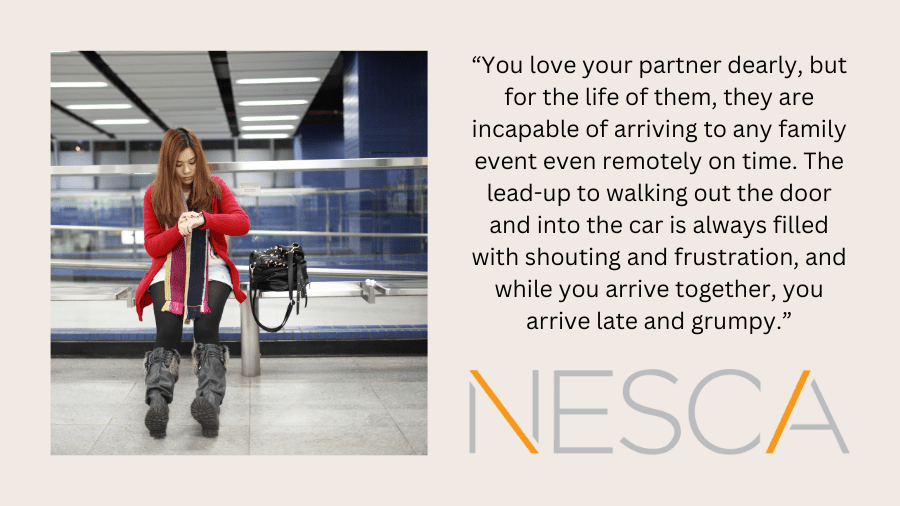
You love your partner dearly, but for the life of them, they are incapable of arriving to any family event even remotely on time. The lead-up to walking out the door and into the car is always filled with shouting and frustration, and while you arrive together, you arrive late and grumpy.
→ Examples of Flexibility and Adaptability: You started traveling separately to family events. Yeah, it confuses some of your relatives, you’re using double the gas, and your partner shows up way later than they would if you drove together, BUT you both arrive at the family gathering in great moods and enjoy your time with everyone, which is your actual priority. It’s also helped your relationship because it’s removed a lot of the push-pull dynamic that was created by rushing to get somewhere together on time. You also notice how it has opened the door to more conversations around your spouse’s neurodiversity and ways to support them. But really, the best part of this new flexible arrangement is that you can get there on time before all the tasty food runs out, and when you’re feeling generous, you even save your partner a plate!
Scenario #3
No matter how hard you try, your fridge is a warzone. Vegetables rot before you can cook them; you have multiple bottles of hot sauce because you keep forgetting you already have some; and a pack of mushrooms stares judgingly at you every time you pass over it because you still haven’t bought the other ingredients for the mushroom soup you plan(ned) to make.
→ Examples of Flexibility and Adaptability: You let go of how you thought a fridge needed to look, and organized it in a way that makes sense for your brain and eating habits. Vegetables now go in the fridge door where you’ll have a visual reminder to eat them before they go bad. Condiments are on a lazy Susan so you can quickly check what you have and don’t have. You also started shopping for only 1-2 dishes at a time, and now keep all the ingredients needed for a dish together in bins so they’re ready to go when you cook. Yes, you know pasta doesn’t need to be in the fridge, but you know what, this is your life, and this makes sense for you. And while it’s true that this new organization system is suboptimal in terms of space usage, you’ve noticed that you’re actually using more of what you do have in the fridge, which is your priority.
Want to explore this topic more?
Here are a few social media accounts that are modeling a more flexible and adaptable approach to executive function demands:
@thecenteredlifeco
@strugglecare (along with her Podcast “Struggle Care”)
@divergentcoachkelly
@adriabarich
And, if you would like to explore additional solutions to executive function challenges, NESCA’s team of expert executive function coaches is available to work with you and/or your family. We have coaches who can work in-person or remotely. Let us know how we can support you.
About the Author
Jasmine Badamo, MA, is an educational counselor and executive function coach who works full-time at NESCA supporting students ranging from elementary school through young adulthood. In addition to direct client work, Ms. Badamo provides consultation and support to parents and families in order to help change dynamics within the household and/or support the special education processes for students struggling with executive dysfunction. She also provides expert consultation to educators, special educators and related professionals.
Ms. Badamo is a New York State Certified ENL and Special Education teacher. She has more than 10 years of teaching experience across three countries and has worked with students and clients ranging in age from 7 to adulthood. She earned her bachelor’s degree in Biological Sciences from Cornell University and her master’s degree in TESOL from CUNY Hunter College. She has also participated in graduate coursework focusing on academic strategies and executive function supports for students with LD, ADHD, and autism as part of the Learning Differences and Neurodiversity (LDN) certification at Landmark College’s Institute for Research and Training. In addition to being a native English speaker, Ms. Badamo is also conversationally fluent in verbal and written Spanish.
Having worked in three different New York City public schools, Ms. Badamo has seen firsthand the importance of executive function skills in facilitating student confidence and success. Her coaching and consultation work focuses on creating individualized supports based on the specific needs and strengths of each client and supporting the development of metacognition (thinking about one’s own thought processes and patterns), executive function skills, and independence. She will guide clients to generate their own goals, identify the barriers to their goals, brainstorm potential strategies, advocate for support when needed, and reflect on the effectiveness of their applied strategies.
Ms. Badamo is a highly relational coach. Building an authentic connection with each client is a top priority and allows her to provide the best support possible. Additionally, as a teacher and coach, Ms. Badamo believes in fostering strong collaborations with anyone who supports her clients including service providers, classroom teachers, parents, administrators, and community providers.
To book executive function coaching with Jasmine Badamo or another EF or Real-life Skills Coach at NESCA, complete NESCA’s online intake form.
NESCA is a pediatric neuropsychology practice and integrative treatment center with offices in Newton, Plainville, and Hingham, Massachusetts; Londonderry, New Hampshire; and the greater Burlington, Vermont region, serving clients from infancy through young adulthood and their families. For more information, please email info@nesca-newton.com or call 617-658-9800.


 meaningful skills in order to reach their goals. She has spent the majority of her career working in a private school for students with ASD. She has also spent some time working in an inpatient mental health setting. Lyndsay uses occupation-based interventions and strategies to develop life skills, executive functioning, and emotional regulation. While completely her doctoral degree at MGH Institute of Health Professions, Lyndsay worked with the Boston Center for Independent Living to evaluate transition age services. She uses the results from her research to deliver services in a way that is most beneficial for clients. Specifically, she focuses on hands-on, occupation-based learning that is tailored the client’s goals and interests.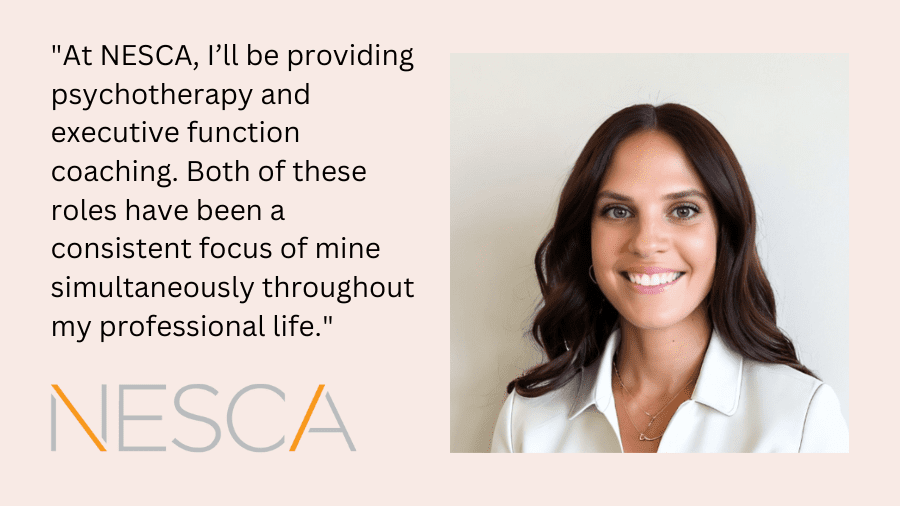
 private practice and schools, she has extensive experience supporting students, families and educational teams to make positive changes. Ms. Edelstein provides executive function coaching and psychotherapy to clients ranging from middle school through adulthood. She also offers consultation to schools and families in order to support her clients across home and community environments.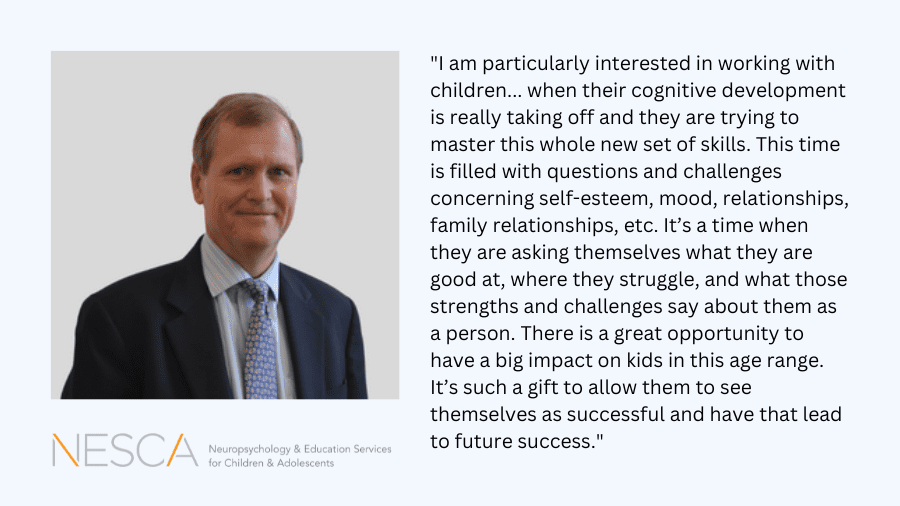
 in various settings. A significant aspect of Dr. Abrams’ continuing interest and experience also includes the psychological care and treatment of children, adolescents, and young adults with a broad variety of emotional and interpersonal problems, beyond those that arise in the context of developmental differences or learning-related difficulties.


 Londonderry, NH office. She specializes in the evaluation of anxious children and teens, working to tease apart the various factors lending to their stress, such as underlying learning, attentional, or emotional challenges. She particularly enjoys working with the seemingly “unmotivated” child, as well as children who have “flown under the radar” for years due to their desire to succeed.
 meaningful skills in order to reach their goals. She has spent the majority of her career working in a private school for students with ASD. She has also spent some time working in an inpatient mental health setting. Lyndsay uses occupation-based interventions and strategies to develop life skills, executive functioning, and emotional regulation. While completely her doctoral degree at MGH Institute of Health Professions, Lyndsay worked with the Boston Center for Independent Living to evaluate transition age services. She uses the results from her research to deliver services in a way that is most beneficial for clients. Specifically, she focuses on hands-on, occupation-based learning that is tailored the client’s goals and interests.

Connect with Us