NESCA’s Londonderry, NH location has immediate availability for neuropsychological evaluations. Our NH clinicians specialize in the following evaluations: Neuropsychological; Autism; and Emotional and Psychological, as well as Academic Achievement and Learning Disability Testing. Our NH clinicians also conduct evaluations for students who are at boarding schools, and two of our NH clinicians have PsyPACT authorization, allowing them to conduct evaluations out-of-state.

Visit www.nesca-newton.com/intake for more information or to book an evaluation.

Tag

international evaluations Archives - NESCA

Subscribe to NESCA Notes

Dot Lucci and Dr. Ann Helmus consulting internationally

Advancing Inclusion and Education Internationally

By | NESCA Notes 2025

Dot Lucci and Dr. Ann Helmus consulting internationallyBy Dot Lucci, M.Ed., CAGS
Director of Consultation and Psychoeducational Services, NESCA

Expanding on NESCA’s previous work in the Philippines and other Asian countries, this October, NESCA’s Founder and Director Dr. Ann Helmus and I widened NESCA’s outreach and education around the world, traveling to Central America, specifically Honduras, Nicaragua, El Salvador, and Costa Rica.

During our time in Central America, we presented multiple full-day workshops to various educational

NESCA’s Dot Lucci and Dr. Ann Helmus with a group of Central American Principals at the Association of American Schools of Central America Conference

professional and administrative audiences at the Association of American Schools of Central America conference, the Elementary Principals Conference, and at individual schools. The full-day workshops included information about: the presentations and diagnosis of various conditions, such as ADHD, ASD, SLD, anxiety, etc., how to best serve these students in general education classrooms, and the most current thinking on specific interventions and curriculums.

Along our journey, Dr. Helmus also presented to parents in Nicaragua and Honduras, discussing what exactly makes a high-quality evaluation, what an evaluation should include, and how to integrate all the findings to produce individualized recommendations for students.

On this trip, our consultations consisted of onsite visits that provide professional development, modeling, direct service of instruction/ongoing virtual consultation, and the sharing of resources and tools. We help these teams develop or enhance their programs and systems aimed at supporting students with special needs. While much of this work pertains to educational programming, it also involves expanding the mindsets of some teachers about neurodivergent students, who may require additional time and effort than typically developing students. In our work, we are helping teachers to recognize students’ disabilities, how they present, and how to work with the various challenges while identifying and capitalizing on their strengths.

Consulting internationally allows us to share our knowledge and expertise of neuropsychological assessment and educational practices with schools and families abroad, where resources may be scarce or non-existent. While each country has special education laws pertaining to inclusion, when children struggle in these classrooms, there are unfortunately limited resources for them. Many of these students are expelled and do not receive an education due to aberrant behavior. There are some separate “special education” schools, but these are also limited in their ability to educate neurodivergent children. In all of these countries, the training of teachers in special education is not in-depth, which is why NESCA was there to support their efforts. This work is vital to the improvement of the education of all students and especially those with special needs.

With very few – if any – related service professionals in this region (i.e., neuropsychologists, SLPs, OTs, etc.), many students go without direct services or travel to Miami for evaluations and care during the summer months. Because of the lack of supports in this region, we noticed more clients over the past several years traveling to Boston for evaluations and services. This is one of the reasons NESCA opened an office in Miami, more conveniently offering better supports and services for our Central American clients.

We look forward to continuing this consultation work with schools, organizations, etc., while also making big differences for families on a more individualized level, educating them on how they can support their children.

Our work in international schools and families is rich and rewarding, and is making big differences.


About the Author

NESCA’s Director of Consultation and Psychoeducational Services Dot Lucci has been active in the fields of education, psychology, research and academia for over 30 years. She is a national consultant and speaker on program design and the inclusion of children and adolescents with special needs, especially those diagnosed with Autism Spectrum Disorder (ASD). Prior to joining NESCA, Ms. Lucci was the Principal of the Partners Program/EDCO Collaborative and previously the Program Director and Director of Consultation at MGH/Aspire for 13 years, where she built child, teen and young adult programs and established the 3-Ss (self-awareness, social competency and stress management) as the programming backbone. She also served as director of the Autism Support Center. Ms. Lucci was previously an elementary classroom teacher, special educator, researcher, school psychologist, college professor and director of public schools, a private special education school and an education collaborative.

Ms. Lucci directs NESCA’s consultation services to public and private schools, colleges and universities, businesses and community agencies. She also provides psychoeducational counseling directly to students and parents. Ms. Lucci’s clinical interests include mind-body practices, positive psychology, and the use of technology and biofeedback devices in the instruction of social and emotional learning, especially as they apply to neurodiverse individuals.

To book a consultation with Ms. Lucci or one of our many expert clinicians, complete NESCA’s online intake form. Indicate whether you are seeking an “evaluation” or “consultation” and your preferred clinician/consultant/service in the referral line.

NESCA is a pediatric neuropsychology practice and related services center with offices in Newton, Plainville, and Hingham, Massachusetts; Londonderry, New Hampshire; the greater Burlington, Vermont region; and Coral Gables, Florida, serving clients from infancy through young adulthood and their families. For more information, please email info@nesca-newton.com or call 617-658-9800.
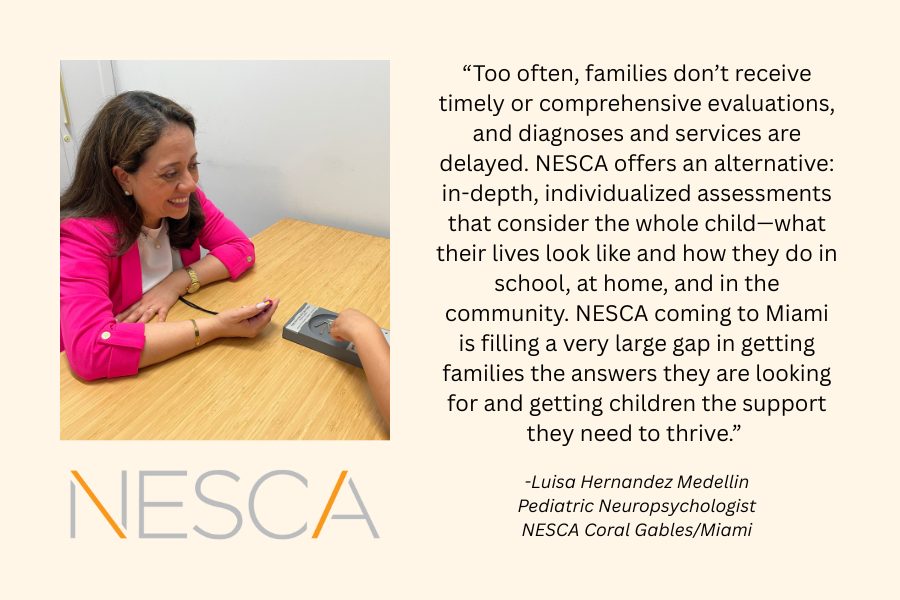
 

Dr. Luisa Hernandez Medellin evaluating a child

NESCA’s Heading South to Care for Children and Empower Families

By | NESCA Notes 2025

Dr. Luisa Hernandez Medellin evaluating a childBy Jane Hauser
Director of Marketing & Outreach, NESCA

Dr. Luisa Hernandez Medellin Discusses NESCA’s Miami Launch

NESCA recently opened its latest pediatric neuropsychology office in Coral Gables/Miami, Florida, headed up by Dr. Luisa Hernandez Medellin. I had the opportunity to speak with Dr. Luisa Hernandez Medellin to get to know more about her background, the current evaluation landscape in South Florida, Latin America, and the Caribbean, and to hear from her what unmet needs NESCA addresses in bringing its expertise to that region.

Tell us about your background and how you chose to become a pediatric neuropsychologist.
I was born and raised in Mexico City in a family that valued service and helping others. As a teen, I considered becoming a missionary nun because I wanted to travel to deliver services and support to children in need. During those years, I spent time in Cuba, Nicaragua, Guatemala, and Costa Rica, where I witnessed numerous disparities in the way people lived. That experience shaped my commitment to serving children and families.

When I returned to Mexico, I explored different careers, including teaching and medicine, as my father was a doctor, and eventually landed in psychology almost by chance—but it felt like home as soon as I discovered it. Later, when I moved to Miami, I completed my bachelor’s degree and entered a doctoral program in child psychology. During my training, I discovered neuropsychology, and it was a perfect fit: a way to combine psychology with the medical world, caring for both the mind and the body of an individual.

I trained at Jackson Memorial Hospital, where I fell in love with pediatric neuropsychology, working with children with neurodevelopmental disorders in both inpatient and outpatient settings. That experience set the foundation for my career. Since then, I’ve worked in hospitals, private practice, and now with NESCA, where I get to provide high-quality evaluations in a compassionate way that will help children and their families have a path to move forward on.

What is your philosophy when working with children and families?
I treat every child as I would my own. I’m a mother of three, all neurodivergent in different ways, so I understand how hard it can be to navigate the challenges of having children with disabilities while also loving them so deeply. My role is to get to know each child who comes in for an evaluation—what makes them unique, what’s important to them—and to help uncover what’s happening so they can flourish.

How do you feel neuropsychological evaluations benefit individuals and families?
Evaluations give us a deeper, objective understanding of a child’s strengths and challenges. Parents often come to me worried that they’ve done something wrong that caused their child’s struggles. I reassure them that no one is at fault. The goal is not to find problems or identify something or someone to blame; rather, it’s to identify the root cause of a child’s challenges while also highlighting each child’s strengths. It’s about finding the “lights AND the shadows.” For example, if a child struggles in math but loves music, we lean into music as a source of joy and growth for the child while knowing how to  properly provide support in areas like math, that may be more stressful.

How do you approach parents or caregivers who are resistant to the evaluation process or the possibility of their child receiving a diagnosis from it?
In Miami, many families are hesitant about their child receiving a diagnosis(es). I take the time during the intake process to listen to their concerns and gently plant seeds about the types of issues we may be seeing. That way, parents aren’t shocked during the feedback session where they learn the findings from the evaluation, which may include one or more diagnosis(es). It helps them process the information and reduces their fears. I emphasize that neurodivergence isn’t caused by parenting choices or styles, screen time, or the Covid experience. It’s just how a child is wired. My focus is on supporting families and children and building hope with new information from the evaluation.

How did you connect with NESCA, and what excites you about bringing NESCA to Miami?
While considering a move to Boston, I met NESCA’s founder and director, Dr. Ann Helmus, and our conversation felt like meeting a kindred spirit. She reminded me of my attending supervisor from Jackson Memorial Hospital in that they both expect very high quality evaluations, really care about their patients, and truly value the quality of the training provided to their trainees. That’s not always the way with providers, so that was very important to me.

She shared that NESCA was planning to open a Miami office, which felt like the perfect match. Now, I get to help NESCA bring its 30 years of expertise to our region, while I’m also contributing my own 20 years of experience right here in Miami. Together, we’re offering high-quality, culturally-sensitive evaluations in both Spanish and English.

Why does Miami need a practice like NESCA?
The system here in South Florida often creates delays in the identification of developmental, emotional, or learning disabilities. Pediatricians sometimes use a “wait and see” approach; bilingualism is sometimes mistaken for a speech delay when it’s really a sign of autism; and schools often face huge, lengthy backlogs for testing students.

It can be tricky to find the right resource or professional to help identify challenges early on. Neurologists tend to be trained in the brain as “hardware,” whereas we examine the brain’s operating system and how it functions when there is a brain injury, a developmental disorder, or other issue. More often, they look to scans and imaging for answers, where we look at the child’s wellbeing and growth, especially when there is a more complex presentation that may lead to several diagnoses, like ADHD, autism, and anxiety, all co-occurring. And due to productivity pressures in large Miami hospitals, they are only able to see patients for 15 minutes or so and often via telehealth.

And again, with our medical system not being optimized, there is a lot of overwhelm among pediatricians who are forced to operate in a factory-like system. Many people here in South Florida don’t actually have a dedicated pediatrician who knows them and their families. It’s more of a walk-in urgent care system, and that means there is no follow-up in six months or even a year to see how a child is progressing or not. No one is tracking them and is dedicated to their developmental well-being. This is another reason for the frequent delays in diagnosis here.

Because of all of these issues, too often, families don’t receive timely or comprehensive evaluations, and diagnoses and services are delayed. NESCA offers an alternative: in-depth, individualized assessments that consider the whole child—what their lives look like and how they do in school, at home, and in the community. NESCA coming to Miami is filling a very large gap in getting families the answers they are looking for and getting children the support they need to thrive.

What do you evaluate at NESCA in Coral Gables?
I focus primarily in pediatric neurodevelopmental disorders, ADHD, Autism Spectrum Disorders, and learning disabilities, providing evaluations and highly tailored recommendations for interventions. I have also been training practicum students in the Miami area, which we will continue to do as part of the NESCA practice in Coral Gables. There are currently only two sites in Miami where doctoral-level students can train at a practicum level in pediatric neuropsychology, and one of them is now NESCA.

What are your plans for working with schools and international families?
International families and private schools are actively seeking support for their students. Many families from Latin America and the Caribbean face limited resources in their home countries. They come to NESCA for specialized, highly personalized evaluations and recommendations on how to support their child or student at home or in school, in their country. NESCA in Miami will provide these families with the guidance and expertise they need—tailored to their cultural context and delivered with compassion.

Any final thoughts?
NESCA offers families in South Florida, Latin America, and the Caribbean the best of both worlds. We’re bringing NESCA’s legacy of excellence from 30 years of practice in New England, along with my decades of experience living and practicing in Miami, to serve families in this diverse, multicultural community. My goal is simple: to help every child be understood, supported, and given the guidance and tools necessary to thrive.

Headshot of NESCA Pediatric Neuropsychologist Dr. Luisa Hernandez MedellinAbout the Author

As a bilingual pediatric neuropsychologist, Dr. Hernandez Medellin conducts comprehensive and culturally sensitive neurodevelopmental and neuropsychological assessments, comprehensive diagnostic evaluations, and effective care plans, providing appropriate recommendations for the client’s school, home, and the community. She specializes in the identification and assessment of neurodevelopmental disorders such as Autism Spectrum Disorders, ADHD, developmental and learning disorders, and their co-occurrence with anxiety and mood disorders. She also works with children and young adults with acquired brain injuries, epilepsy, brain tumors, strokes, general medical conditions, and genetic disorders affecting the nervous system. She is a native Spanish-speaker, passionate about serving the eclectic and vibrant South Florida community, as well as international patients looking for high-quality and compassionate care.

To book evaluation services at NESCA in Coral Gables, Florida, complete NESCA’s online intake form. 

To book a neuropsychological evaluation or other services at NESCA’s New England offices, complete NESCA’s online intake form

NESCA is a pediatric neuropsychology practice with offices in Newton, Plainville, and Hingham, Massachusetts; Londonderry, New Hampshire; the greater Burlington, Vermont region; and Miami/Coral Gables, Florida, serving clients from infancy through young adulthood and their families. For more information, please email info@nesca-newton.com or call 617-658-9800.
On-the-Ground Parent & School Consultation in Honduras

By | Nesca Notes 2023

By Dot Lucci, M.Ed., CAGS
Director of Consultation and Psychoeducational Counseling Services, NESCA

NESCA’s International Work
NESCA is well regarded as an expert in providing neuropsychological evaluations for children and teens from around the globe as part of its International Evaluation program. To date, NESCA has provided evaluations to clients from more than 20 countries across Europe, Asia, Africa, South America, and North America.

Many families bring their child/children to our offices in New England to be evaluated, and NESCA’s founder and director Ann Helmus, Ph.D., has traveled to many countries to provide evaluations overseas. She also has a long-standing history training neuropsychologists in the Philippines. Our Transition and Coaching Services teams also conduct transition assessments for international clients as well as virtual executive function coaching to many young adults overseas.

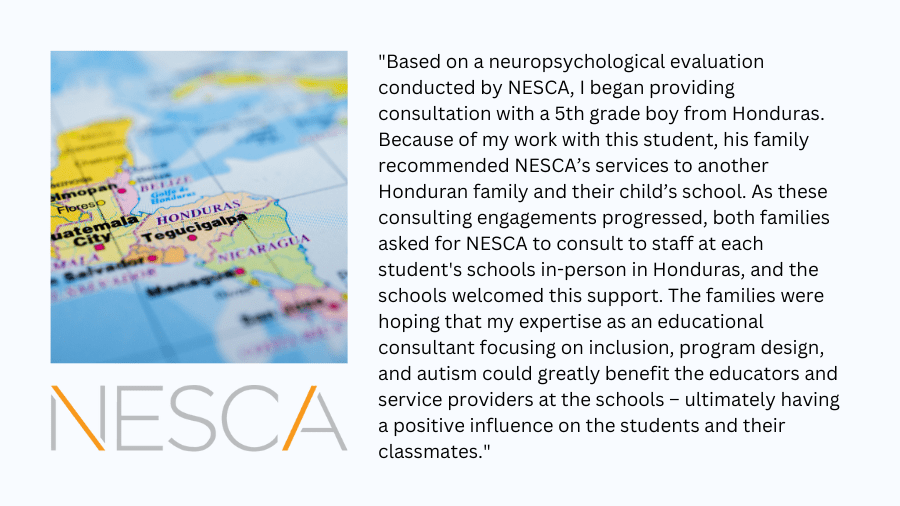
Based on a neuropsychological evaluation conducted by NESCA this past year, I began providing consultation with a 5th grade boy from Honduras who is a student at a non-profit, bilingual, independent, private PK-12 college preparatory school there. Because of my work with this student, his family recommended NESCA’s services to another Honduran family and their child’s school. As a provider, knowing that a family trusts us and finds what we do so beneficial that they recommend us to another family is extremely rewarding.

Setting the Stage: The Special Education Landscape in Honduras
The special education system in Honduras is very different than in the U.S. in that they do not have the variety of resources we are accustomed to in the U.S., and there are not many evaluators in Honduras in any discipline (i.e., neuropsychologists, speech/language, OT, etc.). For instance, there are only six neuropsychologists in the entire country. Another major difference is that it is the parents’ responsibility – not the school’s – to hire a 1:1 paraprofessional or aide if needed for their child. Paraprofessionals function similarly to their U.S. counterparts, but since they are not employed by the school, they are separate from the school.

The special education teachers and counselors also function similarly to those in the U.S.; however, there are unfortunately not enough of them, limiting treatment services. They work from documents similar to IEPs but that are qualitatively are very different from our IEPs.

There are only a couple of special education models used for students: 3 times a week for general special education support or 5 times a week for pull-out reading or math instruction. The 5 times a week options ends at 6th grade. Some of the teachers we worked with reportedly had training in Wilson and Orton-Gillingham, but there are no SLPs or OTs at the schools, and families pay for these services to be provided at the school or after school. Since there are so few professional service providers in the country, these interventions are extremely limited.

Parent & School Consultation in Honduras
As these consulting engagements progressed, both families asked for NESCA to consult to staff at each of the student’s schools in-person in Honduras, and the schools welcomed this support. The families were hoping that my expertise as an educational consultant focusing on inclusion, program design, and autism could greatly benefit the educators and service providers at the schools – ultimately having a positive influence on the students and their classmates.

Both schools are international, bilingual, non-profit, tuition-based college preparatory schools, and are accredited by the Honduran National Ministry of Education, AdvancED, and the International Baccalaureate Organization. One is a Christian faith-based school. Both serve students from nursery through high school and use N-12 American standards of Core Curriculum. They are similar to American schools in that they have a wide choice of classes/electives as students move up in the grades, as well as sports and after school clubs and activities. Upon completion of their high school careers, students at these schools have the opportunity to earn three diplomas: each school’s typical high school diploma, the Honduran Bachillerato, and the International Baccalaureate diploma. A high percentage of graduates go on to higher education in the United States and abroad. They accept students with a variety of “moderate” special needs and have special education teachers and mental health counselors to support them.

For these in-person school consults, I teamed up with another professional who was also already consulting at these schools. She is a Board Certified Behavior Analyst (BCBA) and speaks Spanish – a welcomed addition, as I do not. She is very skilled at providing behavioral support and is not overly rigid in her approach with students. Together, we presented Professional Development trainings for the two schools on the ground in Honduras. We brought a combined, well-rounded knowledge base to our work with the families and schools, offering lessons in a variety of topics, such as Universal Design in Learning (UDL), Differentiated Instruction (DI), Social Skills training/approaches, Mindset and Mindfulness, Sensory Integration, and Positive Behavioral Intervention and Supports (PBIS), along with the ABCs (antecedent-behavior-consequence) and functions of behavior (EATS: escape-attention-tangible-sensory). In this first engagement, we provided a broad overview of these topics, giving the staff much to think about regarding their instructional practices, behavior management, classroom design, and teaching styles. We will continue to provide both virtual and in-person consults this coming school year so their learning can continue to grow and deepen.

This is an ongoing training/learning process for the staff at these schools. As mentioned, we will continue providing ongoing training to help the staff implement Universal Design principles in developing their lessons. We will continue our discussion about viewing student aberrant behavior through multiple lenses – not just as “breaking the rules and needing consequences” (i.e., neurology-sensory, cognitive disconnect, attention, etc.), instead thinking about what the student is trying to communicate through their behavior. This education helps them to think differently about prevention and antecedents, thus impacting behavior management and discipline practices.

The Experience
Staff at both schools were willing to learn and collaborate, and welcomed our input, with one school attending the training the week before their school year started, because we were scheduled to be in-person! The Honduran teachers we worked with throughout the year, prior to our in-person visit, were so open to instruction, feedback, and learning more, often reaching out to us between our scheduled virtual meetings preceding our visit. They were eager to figure out how to support their neurodiverse (a new word for them) learners and allowed me to join their classes remotely so I could model different techniques and practices. They were willing to share their successes, questions, and challenges, making consultation both productive and powerful. They were open to the many “homework assignments” (i.e., articles/books to read, videos to watch, visuals to make, etc.) given to them and the recommendations provided. They implemented new class-wide and individual behavior plans (self-awareness plans) and benefited from the modeling of strategies I demonastrated.

It was a wonderful experience for them and us, and I am happy that our relationship is continuing and will deepen well into this new school year. I am looking forward to watching their continued growth – directly impacting the two students who started it all, as well as their classmates and those to come in future years.

If you are interested in learning more about NESCA’s international evaluation, transition, consultation, and coaching services, complete our online Intake Form.


About the Author

NESCA’s Director of Consultation and Psychoeducational Services Dot Lucci has been active in the fields of education, psychology, research and academia for over 30 years. She is a national consultant and speaker on program design and the inclusion of children and adolescents with special needs, especially those diagnosed with Autism Spectrum Disorder (ASD). Prior to joining NESCA, Ms. Lucci was the Principal of the Partners Program/EDCO Collaborative and previously the Program Director and Director of Consultation at MGH/Aspire for 13 years, where she built child, teen and young adult programs and established the 3-Ss (self-awareness, social competency and stress management) as the programming backbone. She also served as director of the Autism Support Center. Ms. Lucci was previously an elementary classroom teacher, special educator, researcher, school psychologist, college professor and director of public schools, a private special education school and an education collaborative.

Ms. Lucci directs NESCA’s consultation services to public and private schools, colleges and universities, businesses and community agencies. She also provides psychoeducational counseling directly to students and parents. Ms. Lucci’s clinical interests include mind-body practices, positive psychology, and the use of technology and biofeedback devices in the instruction of social and emotional learning, especially as they apply to neurodiverse individuals.


To book a consultation with Ms. Lucci or one of our many expert clinicians, complete NESCA’s online intake form. Indicate whether you are seeking an “evaluation” or “consultation” and your preferred clinician/consultant/service in the referral line.


NESCA is a pediatric neuropsychology practice and integrative treatment center with offices in Newton and Plainville, Massachusetts, Londonderry, New Hampshire, and Burlington, Vermont, serving clients from preschool through young adulthood and their families. For more information, please email info@nesca-newton.com or call 617-658-9800.


Skip to content