NESCA’s Newton, MA location has immediate availability for neuropsychological evaluations. Our MA clinicians specialize in the following evaluations: Neuropsychological; Autism; and Emotional and Psychological, as well as Academic Achievement and Learning Disability Testing.

Visit www.nesca-newton.com/intake for more information or to book an evaluation.

Tag

neuropsychology and education services for children and adolescents Archives - Page 11 of 13 - NESCA

Subscribe to NESCA Notes

Sitting Down to Work – Tips for Proper Set-up and Posture

By | NESCA Notes 2020

By: Sophie Bellenis, OTD, OTR/L

Occupational Therapist; Real-life Skills Program Manager and Coach

When working from home, it’s easy to ignore the important things that most people know about maintaining proper posture. The draw of a bed covered in pillows or a cozy nook on the couch can outweigh the rational knowledge that sitting with good posture will help us to stay focused, decrease back or joint pain, and help build a strong core. When it comes to children, they are often unaware of the ways that posture can affect their bodies and their work. They need cues, reminders and examples of the best way to sit to stay focused and be productive. In our last OT Tuesday blog, we discussed the importance of a child’s physical foundation, the core. When it comes to learning, a strong core helps with postural stability. As the start of a new school year draws near, let’s review some important things to consider about the environment and physical set-up for learning and the best positions for our students’ bodies.

Creating a space for learning helps to differentiate between school and home activities that, for many students, are currently happening in the same building. Here are some tips for setting up this space:

  • Find appropriately sized furniture. Children should have their feet on the ground when sitting at their desk! Tables should be at an appropriate height. Tables that are too tall tend to prompt children to hunch their shoulders or sit on their feet, while tables that are too small cause children to slouch and lean their heads on their hands.
  • Help them organize. Classrooms are built to help students grow their executive function skills, as teachers constantly help set up organizational systems and use tricks to keep students on track. Your child may benefit from color coded folders for each subject, a hard copy of their daily schedule (with pictures for younger kids!) or a visual timer.

There are also a few important things to remember to help with proper seated posture.

  • Use visual reminders. Your child may benefit from a picture of someone using proper seated position posted near their workspace. While they may still need a reminder every so often, having an image gives children a model to mimic.
  • The Rule of 90 Degrees. When sitting at a table, children’s hips, knees and ankles should all be positioned at 90 degrees. This helps to create a solid foundation. When children have a strong foundation and postural stability, they are set up to freely and accurately use their fine motor skills. Being grounded allows for easier writing, typing, cutting and manipulation of all the tools necessary for learning. Ideally, children’s elbows will also create a 90 degree angle.
  • Consider a slant board. Placing a computer or a paper on a slanted board can help students realize that they need to sit up straight, promote proper wrist placement and angle, and draw their eye gaze up from the desk. Writing on a vertical or slanted surface in general can help with the development of handwriting skills.
  • Stabilize that paper. Reminding students to use their non-dominant hand to hold their paper helps with precision and accuracy.
  • Allow them to switch it up! Some tasks really require a child to be sitting up straight, grounded and engaged. For example, a student who is hand-writing a final copy of their paragraph or using scissors for an art class will want to be cognizant of their bodies and how they are seated. In contrast, some activities provide opportunities to move around and change positions. If a student is reading a book for English Language Arts, they may want to lie on their belly or sit in a beanbag chair.
  • Take breaks. No matter how perfect a child’s seated posture is, they will benefit from movement and stretching breaks. Little bodies are built to move, bounce and wiggle!

Prioritizing posture as a child helps to build good habits, evenly distribute stress on the body’s muscle ligaments and joints, and create a strong, grounded foundation.


About the Author

Dr. Sophie Bellenis is a Licensed Occupational Therapist in Massachusetts, specializing in educational OT and functional life skills development. Dr. Bellenis joined NESCA in the fall of 2017 to offer community-based skills coaching services as a part of the Real-life Skills Program within NESCA’s Transition Services team. Dr. Bellenis graduated from the MGH Institute of Health Professions with a Doctorate in Occupational Therapy, with a focus on pediatrics and international program evaluation. She is a member of the American Occupational Therapy Association, as well as the World Federation of Occupational Therapists. Having spent years delivering direct services at the elementary, middle school and high school levels, Dr. Bellenis has extensive background with school-based occupational therapy services.  She believes that individual sensory needs and visual skills must be taken into account to create comprehensive educational programming.

To book an appointment or to learn more about NESCA’s Occupational Therapy Services, please fill out our online Intake Form, email info@nesca-newton.com or call 617-658-9800.


Neuropsychology & Education Services for Children & Adolescents (NESCA) is a pediatric neuropsychology practice and integrative treatment center with offices in Newton, Massachusetts, Plainville, Massachusetts, and Londonderry, New Hampshire, serving clients from preschool through young adulthood and their families. For more information, please email info@nesca-newton.com or call 617-658-9800.
 

What In-person School Looks Like During COVID-19

By | NESCA Notes 2020

By: Tabitha Monahan, M.A., CRC
Transition Specialist/Counselor

Fall is approaching, and school is starting. As a student, I always knew summer was close to ending when Staples started their “Most Wonderful Time of the Year” commercial. The joy that parents and the community feel as fall approaches and another year of learning begins is understandably absent this year. Many parents, teachers and students are still unsure if they will be remote, in-person or both. All are too aware that even if students and teachers return to the school building, school will not look as it did in the fall of 2019. The comradery that our children experience through recess and interactive group work will be limited. Lunch will not be the boisterous room of students comparing who is in each class and what teachers are giving homework the first week.

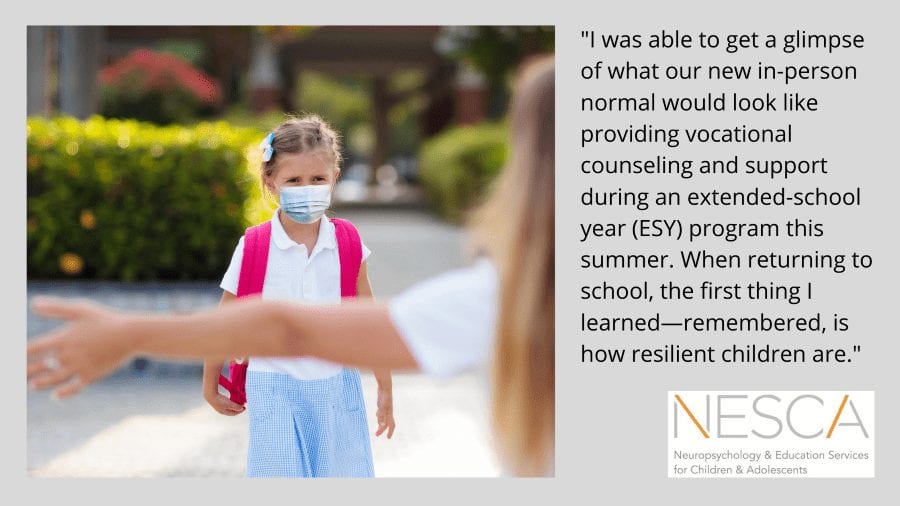
What can we expect then–especially our students who need the small in-person support they have received from their special education teachers, teaching assistants and related service providers? I was able to get a glimpse of what our new in-person normal would look like providing vocational counseling and support during an extended-school year (ESY) program this summer. When returning to school, the first thing I learned—remembered, is how resilient children are. Most students in the programs had very few issues with masks. For those who did, more frequent mask breaks and workarounds, such as face shields, greater distance between them and other students or neck scarves let them still participate in much needed in-person support. Hand-washing and sanitizer have become the norm, and staff and students had frequent opportunities to use both. Social Skills groups still occurred but were modified to continue to be possible. Community-based opportunities were limited, but again, teachers and service providers have long been accustomed to finding out of the box solutions for their students.

Yes, the first day was nerveracking. How were the students going to tolerate wearing a mask for hours on end? How were my co-workers and I going to wear a mask all day long? How was I going to get a drink safely while wearing a mask? But we did. Staff and students alike remained diligent with hand-washing, and the students were ready to learn. Teachers and teaching assistants (TAs) were available and came together for short periods to help students understand challenging tasks. Some of our children and students have behaviors or need activities of daily living (ADL) support that may have us more uneasy with their health and safety returning to in-person learning. Teachers and TAs were prepared for that, too. Whether it was a face shield with a mask, an extra set of clothes to change into or an additional layer of PPE, the student’s needs were met, and we all returned the next day.

Every district seems to have its own approach and plan. Still, in the end, each plan’s goal is the same: have every student continue to learn and prepare for life after high school and have each person return home safe and healthy.


About the Author

Tabitha Monahan, M.A., CRC, is an experienced transition evaluator and vocational counselor. While she is well-versed in supporting a wide range of transition-aged youth, she is especially passionate and knowledgeable in helping clients and their families navigate the complex systems of adult services and benefits as well as medical and mental health systems. She is further adept in working individually with students of all abilities to empower self-advocacy and goal achievement.


To schedule an appointment with one of NESCA’s expert transition specialists or neuropsychologists, please complete our online intake form


Neuropsychology & Education Services for Children & Adolescents (NESCA) is a pediatric neuropsychology practice and integrative treatment center with offices in Newton and Plainville, Massachusetts, and Londonderry, New Hampshire, serving clients from preschool through young adulthood and their families. For more information, please email info@nesca-newton.com or call 617-658-9800.


Core Strength and Stability: The Physical Foundation

By | NESCA Notes 2020

By: Sophie Bellenis, OTD, OTR/L

Occupational Therapist; Real-life Skills Program Manager and Coach

As our country heads into a period of unique learning, whether through a remote learning experience, a hybrid model or an in-person option with heightened rules and regulations, I find myself focusing on foundation. Foundation, simply defined, means, “the basis upon which something stands or is supported.” Currently, we are looking at a huge shift in how programs will run, how teachers will teach and how schools will support our children, but these principles are rooted in strong foundations. Our educators have knowledge, proven methods and an evidence base that allows for creativity, flexibility and evolution.

With regard to our students, foundational skills are the basics that help them feel secure and grounded enough to tackle the more individualized and creative aspects of learning. It is, in part, due to these foundational skills that many of our surprisingly resilient children have handled the COVID-19 pandemic with more flexibility and grace than the adults in their lives.

Today, let’s highlight the physical foundation that supports a child throughout their day, the core. Anatomically, the core refers to the transverse abdominis, internal and external oblique muscles, rectus abdominis, and the multifidus and erector spinae. This group of muscles holds a child upright when they are sitting at their seat, standing in line and running around on the playground. It is one of the foundational elements that promotes healthy motor development. Having a strong and active core makes it easier for a child to use their fine motor muscles with intent, stay alert for the duration of a class or a Zoom session, and develop healthy postural habits. Occupational therapists are trained to determine whether these activities are being affected by a weak core and if there is a need for intervention. Teachers and parents who spend substantial time with our children may want to be aware of and look out for the clues and signals of core instability, which include:

  • Compensatory strategies for stability – These are the subconscious ways that children compensate for core weakness. Essentially, they are bad habits that initially help to keep kids from getting too fatigued to participate in activities, but can have negative long-term effects. Some common examples include “W-sitting” and holding a breath during activities that require strength.
  • Leaning on anything and everything – Some children sit and lean their head on their hands or the desk when they write, lean against adults when standing up or sitting on a couch, and lean on furniture or tables when they are standing at home. These same students often slouch down in their seats and hunch their shoulders forward when they stand. This could signify a weak core.
  • Difficulty with balance – The inability to stay balanced and upright may be due to core instability. Many children are still developing the ability to run, jump, walk across a balance beam and stand on one foot, but if they seem to be falling over or losing control of their body more frequently than their peers, a weak core may be the culprit. These balance issues may also be apparent when a child is doing daily activities, such as getting dressed, putting on shoes or getting in and out of a car.
  • Difficulty with fine motor tasks – Sometimes children have a strong core and still have weak fine motor skills; however, often a weak core is exacerbating fine motor deficits. There is a little phrase that goes, “proximal stability for distal mobility” that is used by therapists, yogis and personal trainers alike. This means that it is important to have strength and stability at the core to easily move and control the muscles in our arms and legs.

Notably, helping a child to build their core is not always as simple as doing a few targeted exercises. While pure muscle strength may be the root cause of instability, it is not the only possibility. Other causes include poor alignment of the ribcage and pelvis, the need for some neuromuscular reeducation to help children engage the right muscles, and breathing habits that interfere with proper muscle use. If you feel like core weakness may be interfering with your child’s success, it may be worth seeking an occupational therapy assessment or speaking to your school’s occupational therapist about how to help them feel secure, sturdy and grounded. We can all benefit from a strong foundation.


About the Author

Dr. Sophie Bellenis is a Licensed Occupational Therapist in Massachusetts, specializing in educational OT and functional life skills development. Dr. Bellenis joined NESCA in the fall of 2017 to offer community-based skills coaching services as a part of the Real-life Skills Program within NESCA’s Transition Services team. Dr. Bellenis graduated from the MGH Institute of Health Professions with a Doctorate in Occupational Therapy, with a focus on pediatrics and international program evaluation. She is a member of the American Occupational Therapy Association, as well as the World Federation of Occupational Therapists. Having spent years delivering direct services at the elementary, middle school and high school levels, Dr. Bellenis has extensive background with school-based occupational therapy services.  She believes that individual sensory needs and visual skills must be taken into account to create comprehensive educational programming.

To book an appointment or to learn more about NESCA’s Occupational Therapy Services, please fill out our online Intake Form, email info@nesca-newton.com or call 617-658-9800.


Neuropsychology & Education Services for Children & Adolescents (NESCA) is a pediatric neuropsychology practice and integrative treatment center with offices in Newton, Massachusetts, Plainville, Massachusetts, and Londonderry, New Hampshire, serving clients from preschool through young adulthood and their families. For more information, please email info@nesca-newton.com or call 617-658-9800.


“Doomscrolling” and Creating Space for Gratitude

By | NESCA Notes 2020

By: Cynthia Hess, PsyD
Pediatric Neuropsychologist Fellow and Therapist

A recent article in the New York Times (July 15, 2020) discusses a newly coined term for a coping strategy that has become pervasive amidst all the uncertainty: “Doomscrolling.” In the article, doomscrolling is defined as, “…the experience of sinking into emotional quicksand while bingeing on doom-and-gloom news.” It has become so common, it has a name.

We are collectively experiencing a great deal of anticipatory anxiety, which occurs when we feel anxious or stressed about an event that will happen in the future. We know there will be an event, but we do not know when or what that event will be. For those who participate in doomscrolling, perhaps it is an effort to find a sense of certainty. If we know what is coming next, it helps us feel more in control. However, while doomscrolling may provide a short-term sense of control, like many maladaptive ways of coping, it will eventually take a toll on our mental and physical well-being. Several wonderful suggestions are offered in the article and a follow-up piece to deal with doomscrolling. Another positive strategy for coping with anxiety and stress is practicing gratitude.

According to the National Institutes of Health, early research suggests that a daily habit of practicing gratitude may improve emotional and physical health. Practicing gratitude reduces stress and anxiety by regulating stress hormones in the brain. It also enhances the production of dopamine and serotonin, two neurotransmitters responsible for our emotions and sense of well-being. Practicing gratitude can be as simple as taking a moment to appreciate a good cup of coffee or a refreshing breeze on a hot day. There are many ways to create space for gratitude:

  • Take a few moments each day to write down as many things as you can that you are grateful for
  • Try to notice positive moments as they are happening
  • Compliment yourself each day and say it out loud
  • Keep a gratitude journal that includes: Compliments that you give yourself, current challenges and what you are learning, people you are grateful for, and significant assets of your life right now.
  • Start a gratitude jar with your family where each person writes one thing they are grateful for that day on a slip of paper and adds it to the jar. The notes can be read aloud at the start of each new week.

For further reading check out these articles:

https://www.nytimes.com/2020/07/15/technology/personaltech/youre-doomscrolling-again-heres-how-to-snap-out-of-it.html

https://www.nytimes.com/2020/07/16/technology/coronavirus-doomscrolling.html?searchResultPosition=2

https://positivepsychology.com/neuroscience-of-gratitude.


About the Author

Dr. Cynthia Hess recently graduated from Rivier University with a PsyD in Counseling and School Psychology. Previously, she earned an M.A. from Antioch New England in Applied Psychology. She also worked as an elementary school counselor and school psychologist for 15 years before embarking on her doctorate. During her doctorate, she did her pre-doctoral internship with RIT in Rochester, N.Y. where she worked with youth ages 5-17 who had experienced complex developmental trauma. Dr. Hess’s first post-doctoral fellowship was with The Counseling Center of New England where she provided psychotherapy and family therapy to children ages 5-18, their families and young adults. She also trained part-time with a pediatric neuropsychologist conducting neuropsychological evaluations. Currently, Dr. Hess is a second-year post-doctoral fellow in pediatric neuropsychological assessment, working with NESCA Londonderry’s Dr. Angela Currie.


To schedule an appointment with one of NESCA’s expert neuropsychologists, please complete our online intake form


Neuropsychology & Education Services for Children & Adolescents (NESCA) is a pediatric neuropsychology practice and integrative treatment center with offices in Newton and Plainville, Massachusetts, and Londonderry, New Hampshire, serving clients from preschool through young adulthood and their families. For more information, please email info@nesca-newton.com or call 617-658-9800.


Interoception: Helping Children Develop their “Hidden Sense”

By | NESCA Notes 2020

By: Sophie Bellenis, OTD, OTR/L

Occupational Therapist; Real-life Skills Program Manager and Coach

In our last OT Tuesday, we reviewed the sense of interoception, the ability to perceive information coming from inside the body. From basic human experiences, such as hunger and fatigue, to more complex internal emotions, such as anxiety and fear, interoception allows us to perceive and understand the sensations coming from our own bodies. As with other senses, this sense develops as children grow and, like the rest of us, will all have varied abilities. Some of our kids are naturally in tune with their bodies – they take to potty training without a hitch, recognize when they need a snack or a drink of water, and intuitively understand what their bodies are trying to tell them. Unsurprising, these exceptionally well regulated kids are not the majority, and most of our children benefit from some guidance, modelling and direct education on how to interpret the signals and sensations they are experiencing. Let’s discuss some tips and strategies for helping children to perceive, understand and appropriately respond to this internal information. Many of these tips are simple ideas to build into daily life and ways to take advantage of naturally occurring teachable moments.

Language – Incorporating language that teaches children to acknowledge internal cues and body sensations helps them to naturally and consistently notice the clues they are receiving from their bodies.

  • Verbally describe the choices that you make based on your own sense of interoception.
    • “I am going to put on a jacket because when I stepped outside this morning, I felt really cold.”
    • “My mouth feels dry and I’m starting to get a bit of a headache, I am going to have some water because my body is telling me that I am thirsty.”
  • Link requests that your child makes to how they may be feeling inside.
    • “You asked me for a snack. Are you hungry? How is your belly telling you that you’re hungry?”
  • Point out physical clues that hint at internal sensations.
    • “I notice you are having a hard time keeping your eyes open. That tells me you are feeling tired.”
    • “You are crossing your legs and dancing around a bit while you are coloring that picture. I think that your body is giving signals that you have to pee. It is important to pay attention to those signals so that you don’t wet your pants.”

Activities

  • Check Your Pulse! – Have your child sit quietly and teach them how to feel their pulse or heartbeat. Ask them to describe it – is it slow, fast, moving, hitting their fingers, etc.? Then have them run in place and do the same thing. How has it changed? Have them describe it now. Once children understand how their heartrate may be affected by physical activity, a next step would be pointing out that strong emotions, such as anger or excitement, can also affect one’s heartrate. This is a simple activity that provides some biofeedback and teaches children how their actions can affect their bodies.
  • Mindfulness – Zen Master, Thich Nhat Hanh defines mindfulness by stating, “Mindfulness shows us what is happening in our bodies, our emotions, our minds, and in the world.” While not all mindfulness activities focus on interoception, many of the principles and activities build this skill. If you are looking for some resources to work on mindfulness with your child, explore these sites: org, susankaisergreenland.org, mindful.org, and drchristopherwillard.com. Additionally, consider some apps to use with your child: Mindful Powers, Smiling Mind, Breathe Think Do with Sesame and Headspace.
  • Breathing exercises – Breathing exercises are common in mindfulness and can help children to relax. If apps are not for you, consider researching breathing exercises, such as: five-finger breathing, lazy 8 breathing or bumblebee breathing.
  • Progressive muscle relaxation – This practice involves alternating tension and relaxation in different muscle groups in the body. Dr. Monica Fitzgerald provides an excellent script to use with children working to relax here. If you are interested in exploring this practice with children with disabilities, many resources can be found at org.
  • Yoga – Yoga focuses on intentionally moving the body, pairing body movement and breathing, and increasing the mind-body connection. There are many apps and online videos that make yoga accessible to children. Some options include Simply Yoga, Gaia.com and Cosmic Kids Yoga. For some of our children who may need yoga broken down and presented differently, consider com or childlightyoga.com.


About the Author

Dr. Sophie Bellenis is a Licensed Occupational Therapist in Massachusetts, specializing in educational OT and functional life skills development. Dr. Bellenis joined NESCA in the fall of 2017 to offer community-based skills coaching services as a part of the Real-life Skills Program within NESCA’s Transition Services team. Dr. Bellenis graduated from the MGH Institute of Health Professions with a Doctorate in Occupational Therapy, with a focus on pediatrics and international program evaluation. She is a member of the American Occupational Therapy Association, as well as the World Federation of Occupational Therapists. Having spent years delivering direct services at the elementary, middle school and high school levels, Dr. Bellenis has extensive background with school-based occupational therapy services.  She believes that individual sensory needs and visual skills must be taken into account to create comprehensive educational programming.

To book an appointment or to learn more about NESCA’s Occupational Therapy Services, please fill out our online Intake Form, email info@nesca-newton.com or call 617-658-9800.


Neuropsychology & Education Services for Children & Adolescents (NESCA) is a pediatric neuropsychology practice and integrative treatment center with offices in Newton, Massachusetts, Plainville, Massachusetts, and Londonderry, New Hampshire, serving clients from preschool through young adulthood and their families. For more information, please email info@nesca-newton.com or call 617-658-9800.


Interoception: The “Hidden Sense”

By | NESCA Notes 2020

By: Sophie Bellenis, OTD, OTR/L

Occupational Therapist; Real-life Skills Program Manager and Coach

Conventionally, children are taught that there are five different senses, and that these senses help them to experience and understand the world around them. These five senses are sight, sound, smell, taste and touch. Clinically, we refer to these sensory systems as the visual, auditory, olfactory, gustatory and tactile systems. Each system provides unique information and works to alert the brain about the environment around them. Children all develop these systems differently, and all have unique preferences, strengths and interpretations of the world around them. As adults, a sommelier likely has an incredibly refined gustatory system, while a classical musician’s strength lies in their auditory system.

As knowledge about the human body continues to expand, two additional sensory systems have started to make their way into the common lexicon—the vestibular system and the proprioceptive system—both of which describe body awareness. The vestibular system gathers information from the inner ear and tells us where our body is in space. It monitors movement, acceleration and deceleration, balance and any changes in position. A gymnast uses this sense constantly as they flip across a mat or balance on the beam. The proprioceptive system gathers information from our muscles and joints and tells our brains about our position in space and any strength or force that we are using. Proprioception allows us to touch our noses with our eyes closed! These seven senses are all generally acknowledged and frequently assessed by occupational therapists. But what is interoception? And why is it referred to as the hidden sense?

Interoception refers to the perception of information coming from inside the body. Organ systems and the autonomic nervous system provide information about heart rate, hunger, thirst, temperature, respiration and even emotion (Vaitl, 1996). This sense of interoception helps us meet our most basic needs, such as knowing when we need food and water, realizing that it is time to use the restroom and putting on a jacket if it is cold outside. It also helps us to gain a more nuanced understanding of ourselves, such as realizing that an activity is making us anxious by acknowledging heightened heart rate and perspiration. This sensory system is often referred to as the “hidden sense,” because it is completely unique to each individual and no one knows exactly what someone else is feeling internally.

Children develop this sense slowly, with the most basic cues, such as hunger being recognized first. As they continue to grow, different internal signals are more easily understood and start to impact behavior. For example, around the age of two or three, most children start the process of potty training when they begin to recognize what it feels like to have a full bladder. As children continue to grow through their elementary, middle and high school years, this sense continues to be refined. As is expected, this is easier for some children than others.

Recent research shows that there is a strong connection between interoception and emotional/self-regulation. Individuals with low interoception often have more difficulty with both understanding and regulating their bodies and emotions (Zamariola et al., 2019). It appears that the ability to truly understand our body allows us to more intentionally control our responses. Luckily, as with other sensory systems, there are ways to increase interoceptive awareness and help children to notice the information that their bodies are feeding to their brains. In our next OT Tuesday blog, we will discuss some tips and strategies for helping children to perceive, understand and appropriately respond to this internal information.


References

Vaitl D. (1996). Interoception. Biol. Psychol. 42 1–27. 10.1016/0301-0511(95)05144-9

Zamariola G., Frost N., Van Oost A., Corneille O., Luminet O. (2019). Relationship between interoception and emotion regulation: new evidence from mixed methods. J Affect Disord  246:480–5. doi: 10.1016/j.jad.2018.12.101

About the Author

Dr. Sophie Bellenis is a Licensed Occupational Therapist in Massachusetts, specializing in educational OT and functional life skills development. Dr. Bellenis joined NESCA in the fall of 2017 to offer community-based skills coaching services as a part of the Real-life Skills Program within NESCA’s Transition Services team. Dr. Bellenis graduated from the MGH Institute of Health Professions with a Doctorate in Occupational Therapy, with a focus on pediatrics and international program evaluation. She is a member of the American Occupational Therapy Association, as well as the World Federation of Occupational Therapists. Having spent years delivering direct services at the elementary, middle school and high school levels, Dr. Bellenis has extensive background with school-based occupational therapy services.  She believes that individual sensory needs and visual skills must be taken into account to create comprehensive educational programming.

To book an appointment or to learn more about NESCA’s Occupational Therapy Services, please fill out our online Intake Form, email info@nesca-newton.com or call 617-658-9800.


Neuropsychology & Education Services for Children & Adolescents (NESCA) is a pediatric neuropsychology practice and integrative treatment center with offices in Newton, Massachusetts, Plainville, Massachusetts, and Londonderry, New Hampshire, serving clients from preschool through young adulthood and their families. For more information, please email info@nesca-newton.com or call 617-658-9800.


There Is No Wrong Decision

By | NESCA Notes 2020

By:  Alissa Talamo, Ph.D.
Pediatric Neuropsychologist

We are living in an unprecedented time. As such, parents are faced with decisions that they have never faced before. For example, families are facing the challenging decision about whether or not to send their children back to school for in-person classes in the middle of the COVID-19 pandemic. Parents have to wrestle with the idea that, on the one hand, sending children to school could increase the risk of COVID-19 among children and family members; while on the other hand, children who don’t return to in-person school may experience disruptions in their education and may miss out on the social interaction and community feeling within the school building. In addition, some families simply don’t have a choice because they need to go to work or a family member at home is immunocompromised.

What is most important is to recognize is that whether or not to send a child to school in the fall means something different to everybody. It is imperative that, as parents, you give yourself permission to feel whatever it is that you are feeling, and that you do what feels right for you and your family. It may be difficult to accept, but we have little control over much of what is happening around us right now. While it is important to acknowledge how you are feeling, it is equally important to remember that, in fact, any reactions are normal under the current circumstances.

How you respond to stress during the COVID-19 pandemic can depend on your background, your financial situation, your health and emotional background, your social support system, the community you live in and many other factors. When it comes to parenting, every day can be a challenge, and the coronavirus has made an already scary world feel even more menacing.  Remember to “ignore the noise” and give yourself credit for taking care of yourself and your family.


About the Author:

With NESCA since its inception in 2007, Dr. Talamo had previously practiced for many years as a child and adolescent clinical psychologist before completing postdoctoral re-training in pediatric neuropsychology at the Children’s Evaluation Center.

After receiving her undergraduate degree from Columbia University, Dr. Talamo earned her doctorate in clinical health psychology from Ferkauf Graduate School of Psychology and the Albert Einstein College of Medicine at Yeshiva University.

She has given a number of presentations, most recently on “How to Recognize a Struggling Reader,” “Supporting Students with Working Memory Limitations,” (with Bonnie Singer, Ph.D., CCC-SLP of Architects for Learning), and “Executive Function in Elementary and Middle School Students.”

Dr. Talamo specializes in working with children and adolescents with language-based learning disabilities including dyslexia, attentional disorders, and emotional issues. She is also interested in working with highly gifted children.

Her professional memberships include MAGE (Massachusetts Association for Gifted Education), IDA (International Dyslexia Association), MABIDA (the Massachusetts division of IDA) and MNS (the Massachusetts Neuropsychological Society).

She is the mother of one teenage girl.

To book a consultation with Dr. Talamo or one of our many other expert neuropsychologists, complete NESCA’s online intake form.

Neuropsychology & Education Services for Children & Adolescents (NESCA) is a pediatric neuropsychology practice and integrative treatment center with offices in Newton, Massachusetts, Plainville, Massachusetts, and Londonderry, New Hampshire, serving clients from preschool through young adulthood and their families. For more information, please email info@nesca-newton.com or call 617-658-9800.

YES! COVID-19 May be Making Basic Daily Tasks More Difficult: The Link Between Executive Function Difficulties and Anxiety/Stress

By | NESCA Notes 2020

By: Sophie Bellenis, OTD, OTR/L

Occupational Therapist; Real-life Skills Program Manager and Coach

As our country continues to adapt to life in the era of COVID-19, it is quite well established that there has been a rise in anxiety and stress among our population. According to the Centers for Disease Control and Prevention (CDC), the mental health effects of the current pandemic have been substantial and include difficulty sleeping, worsening chronic health problems, changes in eating patterns, fear about personal health and the health of loved ones, and increased use of tobacco and alcohol (CDC, 2020). Many of these fears and new challenges are expected and understandable. They are responses that intuitively make sense to us as humans, as many of us experience them on a small scale throughout a typical year. Most people can name a time when they could not fall asleep before a big test or did not take excellent care of their physical health when they were hugely stressed or anxious. However, one effect of this newly heightened stress and anxiety that is less frequently mentioned is the decrease in executive function skills.

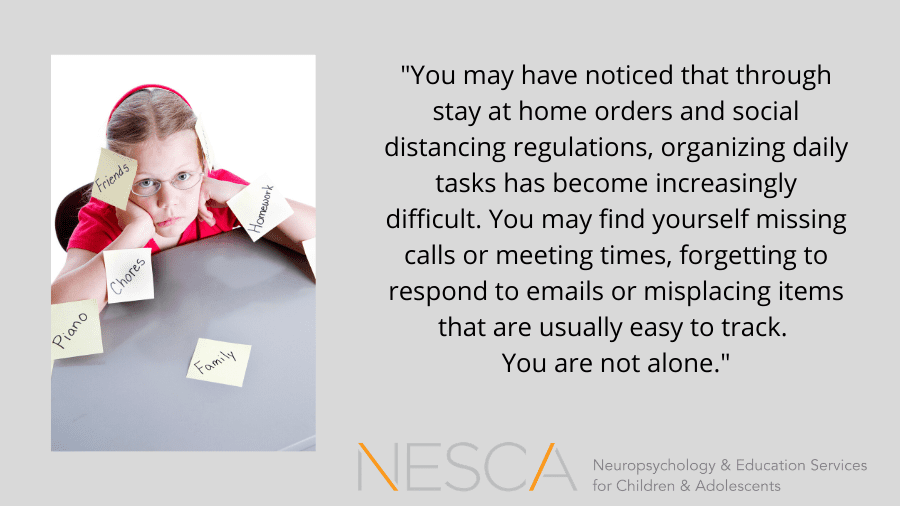
The term executive function refers to the brain processes that allow someone to stay organized, initiate tasks, maintain focus and attention, and manipulative information in their mind. As NESCA Pediatric Neuropsychologist Dr. Alissa Talamo describes in her piece, “What is Executive Function?,” this group of skills can be thought of as the conductor of the brain, similar to the conductor of an orchestra. They are keeping time, telling us when to start and stop tasks and helping us to stay regulated through the ups and downs of the day. You may have noticed that through stay at home orders and social distancing regulations, organizing daily tasks has become increasingly difficult. You may find yourself missing calls or meeting times, forgetting to respond to emails or misplacing items that are usually easy to track. You are not alone. Some people have started to describe a brain fog and a perceived inability to stay focused on a task for more than a short period of time.

While maybe not as intuitive as a lack of sleep, this decrease in executive function is to be expected as we collectively move through this stressful experience. Substantial research has described the correlation between depression, anxiety and stress, and executive function deficits. This seems to be particularly strong for adolescents with depressive and anxious symptoms, who have trouble with cognitive flexibility (Han, Helm, Iucha, Zahn-Waxler & Hastings, 2016). Similarly, university students are another population vulnerable to these effects, as described by Ajilchi and Nejati in 2017, who found specific difficulties with sustained attention and decision making. It is no surprise that one diagnostic criteria for generalized anxiety disorder is “difficulty concentrating or mind going blank” (APA, 2013). When reviewing the literature, it is clear that the brain fog and inability to focus through COVID-19 is not only unsurprising, for many people, it was inevitable.

So, what do we do? How do we soldier on through this incredibly unique time, despite the feeling that everything takes just a bit more time and effort?

It is increasingly important to cut ourselves some slack and stop expecting perfection. Focusing on self-care and taking care of each other emotionally will potentially lead to a natural return to successful executive function. By creating habits and routines that promote positive mental health, we are more likely to mitigate the feelings of being overwhelmed and the potential for burnout. Additionally, using technology and digital reminders to help take over the tasks of initiation and organization can give our over-extended brains a bit of a rest.

Finally, it is imperative that we think about the adolescents and students in our communities who are just starting to build these skills. Building executive function skills comes from a combination of direct instruction and opportunity to practice. Currently, students are being provided ample opportunity to practice, with limited direct instruction and guidance. Consider teaching your children and adolescents the tricks that you have learned to stay organized, prepared and productive. If you feel like teaching these skills is outside of your wheelhouse, or at all daunting, look into the prospect of an executive function coach. With all of the uncertainty about what education will look like this fall, helping students feel ready to tackle learning is one way to mitigate the anxiety and stress of this transitional time.


References

Ajilchi, B., & Nejati, V. (2017). Executive Functions in Students with Depression, Anxiety, and Stress Symptoms. Basic and clinical neuroscience8(3), 223–232. https://doi.org/10.18869/nirp.bcn.8.3.223

American Psychiatric Association. (2013). Diagnostic and statistical manual of mental disorders (5th ed.). Arlington, VA: American Psychiatric Publishing.

Center for Disease Control and Prevention. (2020) Coronavirus disease 2019: Coping with stress. Retrieved from: https://www.cdc.gov/coronavirus/2019-ncov/daily-life-coping/managing-stress-anxiety.html

Han, G., Helm, J., Iucha, C., Zahn-Waxler, C., Hastings, P. D., & Klimes-Dougan, B. (2016). Are Executive Functioning Deficits Concurrently and Predictively Associated with Depressive and Anxiety Symptoms in Adolescents?. Journal of clinical child and adolescent psychology : the official journal for the Society of Clinical Child and Adolescent Psychology, American Psychological Association, Division 5345(1), 44–58. https://doi.org/10.1080/15374416.2015.1041592


About the Author

Dr. Sophie Bellenis is a Licensed Occupational Therapist in Massachusetts, specializing in educational OT and functional life skills development. Dr. Bellenis joined NESCA in the fall of 2017 to offer community-based skills coaching services as a part of the Real-life Skills Program within NESCA’s Transition Services team. Dr. Bellenis graduated from the MGH Institute of Health Professions with a Doctorate in Occupational Therapy, with a focus on pediatrics and international program evaluation. She is a member of the American Occupational Therapy Association, as well as the World Federation of Occupational Therapists. Having spent years delivering direct services at the elementary, middle school and high school levels, Dr. Bellenis has extensive background with school-based occupational therapy services.  She believes that individual sensory needs and visual skills must be taken into account to create comprehensive educational programming.

To book an appointment or to learn more about NESCA’s Occupational Therapy Services, please fill out our online Intake Form, email info@nesca-newton.com or call 617-658-9800.


Neuropsychology & Education Services for Children & Adolescents (NESCA) is a pediatric neuropsychology practice and integrative treatment center with offices in Newton, Massachusetts, Plainville, Massachusetts, and Londonderry, New Hampshire, serving clients from preschool through young adulthood and their families. For more information, please email info@nesca-newton.com or call 617-658-9800.


From School to Summer – Life Rolls Along in the Era of COVID19

By | NESCA Notes 2020

By: Sophie Bellenis, OTD, OTR/L

Occupational Therapist; Real-life Skills Program Manager and Coach

This past March, families were thrown into the world of remote learning, Zoom classrooms, digital assignments and school at home. With little to no time to prepare, teachers and parents alike have worked tirelessly to provide a sense of routine and academic focus, while handling the social and emotional fallout of the COVID19 pandemic. As schools start to wrap up their years and families start to look ahead at what is sure to be a notably unique summer, there is a bit more time to plan, think proactively and chart a positive course for our children.

As summer camps, childcare options, volunteer opportunities, and internships are either cancelled, transitioning to an online format, or significantly limiting capacity, the need for children to manage and plan self-directed activities is becoming more and more apparent. With such an extended period of time ahead of us, let’s highlight some ways that we can create environments that allow our children autonomy while building important skills and leavings lots of room for fun.

Set Firm Boundaries

There is evidence that tells us our children most successfully build and demonstrate their executive function skills when they are allowed freedom and opportunities to make their own choices, within boundaries and limits set by their parents (Schroeder & Kelley, 2010). Consider what aspects of summer life are non-negotiable for your family. This may be a certain limit on hours of screen time per day, a time that all children are expected to be up and out of bed, or chores and expectations that they must meet as a part of the family unit. Make sure that these are clearly communicated and agreed upon by everyone in the home.

Set Goals

Helping children set and work on completing goals can provide a concrete representation of the accomplishments that they have achieved over the summer. There are many ways to organize and format this process, but one consistent theme should be creating goals that are measurable, achievable and specific. Consider the SMART goal format as a template. One way to help children to choose their goals is to have them focus on three categories: personal, family and community. Some examples are:

  1. Personal Goals – Develop a consistent exercise routine; try out a new form of exercise, such as running, yoga or Pilates; incorporate a mindfulness meditation into a weekly schedule; consistently wake up independently with an alarm; or drink the recommended amount of water per day for their age, etc.
  2. Goal to Benefit the Family – Cook dinner for the family once a week; commit to weeding a family garden; deep clean one room per week; learn which cleaning supplies are used for the bathroom and for the kitchen; add a new chore each week; or teach a grandparent or family friend how to use a new technology, etc.
  3. Goal to Benefit the Community – Collect box-tops from all of the food items in the home to give to their school once it’s back in session; take a walk and pick up trash on a road or beach; do a food drive for a local pantry; mow the lawn for a neighbor; or reach out to vulnerable people in the community and ask if they can do anything to help, etc.

Create an Activity Bank

Pediatric Neuropsychologist Dr. Angela Currie of NESCA recently explained why telling kids to simply, “find something to do,” rarely leads to positive results (Currie, 2020). One suggestion that Dr. Currie gives is to create an activity bank or “menu.” It is often difficult to come up with suggestions in the moment when a child mentions that they are bored or feel there is little to do. Take the proactive step of creating a list of activities that your child can go to when they are having a hard time deciding how to fill their time. This makes it easy to prompt them to independently choose something to do. The response, “Why don’t you go take a look at the activities bank and see if there is something that would be a great choice for today?” gives a child a concrete first step. Some families have used creative ways to help children decide between options, such as an activity dice, an activity grab-bag or a personal activity “menu” with specific options for each child.

Encourage Independent Learning

The old adage states that anyone can be an expert at something, if they spend 10,000 hours practicing. Teach this theory to your children and ask them what truly makes them feel excited and curious. What would they like to explore? Children are used to viewing themselves through the lens of a student; however, they rarely make decisions about exactly what they would like to learn. Help your child explore their personal interests and choose something they would like to learn about over the course of the summer. This could look like a 1st grader collecting sea shells at the beach and bringing them home to draw; a 5th grader spending a couple of hours a week researching underwater caves; an 8th grader learning how to keep a sourdough starter alive and bake bread; or a junior in high school doing a deep dive into the current cultural shift developing in the United States. The topic should be completely chosen by the child, with suggestions and support facilitated by their parents.


References

Currie, A. (2020). Why “find something to do” doesn’t work – Teaching independent play skills during quarantine, NESCA Notes. Retrieved from https://nesca-newton.com/why-find-something-to-do-doesnt-work-teaching-independent-play-skills-during-quarantine/

Schroeder, V. & Kelley, M. (2010) Family environment and parent‐child relationships as related to executive functioning in children, Early Child Development and Care, 180:10, 1285-1298, DOI: 10.1080/03004430902981512


About the Author

Dr. Sophie Bellenis is a Licensed Occupational Therapist in Massachusetts, specializing in educational OT and functional life skills development. Dr. Bellenis joined NESCA in the fall of 2017 to offer community-based skills coaching services as a part of the Real-life Skills Program within NESCA’s Transition Services team. Dr. Bellenis graduated from the MGH Institute of Health Professions with a Doctorate in Occupational Therapy, with a focus on pediatrics and international program evaluation. She is a member of the American Occupational Therapy Association, as well as the World Federation of Occupational Therapists. Having spent years delivering direct services at the elementary, middle school and high school levels, Dr. Bellenis has extensive background with school-based occupational therapy services.  She believes that individual sensory needs and visual skills must be taken into account to create comprehensive educational programming.

To book an appointment or to learn more about NESCA’s Occupational Therapy Services, please fill out our online Intake Form, email info@nesca-newton.com or call 617-658-9800.


Neuropsychology & Education Services for Children & Adolescents (NESCA) is a pediatric neuropsychology practice and integrative treatment center with offices in Newton, Massachusetts, Plainville, Massachusetts, and Londonderry, New Hampshire, serving clients from preschool through young adulthood and their families. For more information, please email info@nesca-newton.com or call 617-658-9800.


Let’s Stop Trash-talking Stress and Anxiety-Part 1

By | NESCA Notes 2020

By:  Stephanie Monaghan-Blout, Psy.D.

Coordinator of Therapy Services; Trauma-informed Therapist

Stress and anxiety have gotten a really bad name in our society. Just ask kids – it is a question we sometimes pose to our clients during testing, and the answers we get usually run along the lines of, “Are you kidding? There’s nothing good about stress!”. So, let’s talk about the purpose of stress, how it functions, and what we can do to manage it.

From a scientific viewpoint, stress is a challenge or stimulus to DO SOMETHING when certain circumstances arise – specifically, when danger is detected. Let’s make this easy – what would your body need to do if a tiger showed up? Let’s start with upping your heart rate and breathing faster to get oxygen into your blood so that you are able to move quickly, and then let’s send some fuel (glucose) to your muscles for strength. This is the process that happens when some kind of danger is sensed – the brain sends down orders to the body that diverts resources to the systems that help us escape from the tiger (fight, flight or freeze) while diverting resources from systems that are less important at that time (rest, digest and think). When the danger is over, the focus changes; our fear response is dampened, our heart rate and breathing slow down and those other systems come back online to get our bodies back to normal.

The feedback between these two systems of getting us prepared for danger (activation of the sympathetic nervous system) and calming down after the event has passed (activation of the parasympathetic nervous system) remain important, even when tigers are no longer a concern. Remember that stress is a stimulus to do something in the face of fear or danger. A little stress in our daily lives helps us get things done, like studying for that big test. It is also adaptive to be anxious at a time like now, when our whole world is under the threat of the COVID-19 virus. There’s lots to be worried about, and this stress can help us remember to take precautions like staying home and keeping physical distance. We’ll get back to this.

But what happens if the threat is more immediate, the danger sensor is too sensitive and/or the body never gets a chance to calm down? In this situation, the person remains activated, looking for danger and ready to respond, even when it is not appropriate or even against their best interests. Remember, during these times of perceived danger, the child does not have access to higher-level cognitive processes, like thinking flexibly, problem solving or even access to language. At these times of high stress, they are not available for learning. Asking a child to “talk about it” or even tell you what the problem is can be beyond their capacity at the time and will only add to their stress. This is the situation in school encountered by many children with learning issues, emotional concerns, autism or other neurodevelopmental disorders. They may find the academic, organizational and social demands of school to be so threatening that their danger alert is set off and only gets the chance to reset when school is finished.

So, what does the overly stressed child look like and how can we help? This is going to be the challenging part, because you are going to be asked to look at common behaviors in a different way. Let’s go back to the Fight-Flight-Freeze responses. Most of us tend to prefer one of these, though we will use all three depending on the situation.

Fight – This version of the response involves active resistance to the threat, but in the classroom or the dinner table, it more likely takes the shape of being argumentative, noncompliant and defiant (“You can’t make me!”).

Flight – This version is characterized by avoidance or getting away from the threat. This could mean needing to go the bathroom, see the school nurse or suddenly remembering that very important pen in their cubby that they absolutely have to have at that moment. However, it could also mean leaving mentally (“spacing out”).

Freeze – This version involves immobilization strategies, like wild animals who “freeze” so as not to attract the attention of a predator. In children, these behaviors are more subtle; they manifest as problems with getting started, switching from one thing to another and/or stopping. Oftentimes these kids are described as “shutting down,” but it is more accurate to describe them as “stuck.”

How do we help our kids get out of this stress response?

Remember, stress is a response to the perception of danger, and anxiety is the feeling of being helpless and out of control.

What “turns off” the threat alert and allows us to feel more capable and ready to try? The perception of being safe. When children feel safe, they can focus and concentrate on the task at hand. They can think and problem solve. And, they are more aware of others and what they are saying and doing.

How do we help our children feel safe and capable of tackling a challenge? Say a child doesn’t like math and does everything to avoid doing their homework. Which of these three approaches would make them feel more safe and ready to give it a try?

  • “Stop acting like a baby and just get that math done. It’s only 10 problems! Don’t even think of playing any video games tonight.”
  • “You poor thing. I know you are bad at math and it’s mean that your teacher is making     you work so hard. I’m going to write to her and tell her you can’t do that much.”
  • “Wow, you really don’t like to do your math homework, do you? That’s hard! Tell you what, I’ll help you with the first two and when you are done with the rest, we’ll play a game together!”

Notice that in the last example, the parent started with validating the child’s feelings, or just recognizing what the child’s emotional experience is like at the moment – not the same as agreeing with him or her. The second thing s/he did was to offer some help, and the third was to offer a fun activity to help the child feel calmer and more connected.

What if the child is really upset and can’t switch gears to start working? Just change the order of the events. Validate feelings, offer a calming and connecting activity and offer some help to get back to work. The calming/connecting activity doesn’t have to be a game – it just needs to be something they makes the child feel cared for and gives them something else to think about, like a cup of tea or a special cookie.

But what if the stress and anxiety is related to something that is bigger than math homework and can’t be easily fixed with a cup of tea and some extra help with those fractions? What if it is something that is out of the parent’s control, like the COVID pandemic? Again, the way to “turn off” the threat alert in our children’s brains is to help them feel safe and to have some control over what is happening to them. How do we do that? Validate their feelings makes them feel heard. Answering their questions (but sticking to their concerns) will tell you what they are really worried about and allow you to correct misperceptions and reassure them. Calming and connecting activities are still really important. Finally, helping them feel more in control by being able to do something to help. Utilize a child’s skills and interests in finding ways for them to help. If your child likes to draw, have them make pictures for family, friends and neighbors. Do you have a budding computer whiz? Help them make a zoom video of their classmates saying hi to their teacher. Is your child someone who loves people and isn’t shy? Have them call grandparents and older neighbors who may not be able to leave their houses. Equally importantly, remind them that they can help others by following the guidelines of washing their hands, keeping physical distance and, as hard as it is, staying home.

In a follow-on blog, we’ll discuss how to build resilience in children.


About the Author:

Dr. Stephanie Monaghan-Blout is a senior clinician who joined NESCA at its inception in 2007. She specializes in the neuropsychological and psychological assessment of children and adolescents with complex learning and emotional issues and enjoys consulting to schools on these issues. Her responsibilities at NESCA also include acting as Clinical Coordinator, overseeing therapeutic services, providing therapy and psychoeducational counseling and, in the time of the COVID-19 crisis, providing teletherapy to parents and teens.

In her early career as an adolescent and family therapist, Dr. Monaghan-Blout became very interested in the needs of those contending with traumatic experiences. She brought that interest to her work as a pediatric neuropsychologist and continues to be passionate about treating this population. She has developed an expertise in working with adoptive children and others who have experienced early trauma. She is a longtime member of the Trauma and Learning Policy Initiative (TLPI) associated with Massachusetts Advocates for Children and the Harvard Law Clinic and presents nationally and regionally on assessment and treatment of children with complex/developmental trauma.

Dr. Monaghan-Blout graduated from Bowdoin College and received a Master’s Degree in Counselor Education from Boston University. She obtained her Doctorate in Clinical Psychology from Antioch New England Graduate School with a dissertation entitled, “A Different Kind of Parent; Resisting the Intergenerational Legacy of Maltreatment.” She completed an internship in pediatric neuropsychology and child psychology at North Shore University Hospital in New York, and a postdoctoral fellowship at HealthSouth/Braintree Rehabilitation Hospital.

She joined Dr. Ann Helmus at Children’s Evaluation Center in 2003, and again at NESCA in 2007. A member of the Massachusetts Neuropsychological Society Board of Directors from 2010 – 2013 and from 2014-2017, Dr. Monaghan-Blout served in many capacities, including as President. Dr. Monaghan-Blout is the mother and stepmother of four children and the grandmother of six. She is also an avid ice hockey player, cook, gardener and devotee of urban fantasy.


To book therapy services with Dr. Monaghan-Blout or an evaluation with one of our many expert neuropsychologists and transition specialists, complete NESCA’s online intake form.


Neuropsychology & Education Services for Children & Adolescents (NESCA) is a pediatric neuropsychology practice and integrative treatment center with offices in Newton, Massachusetts, Plainville, Massachusetts, and Londonderry, New Hampshire, serving clients from preschool through young adulthood and their families. For more information, please email info@nesca-newton.com or call 617-658-9800.

Skip to content