
NESCA’s Londonderry, NH location has immediate availability for neuropsychological evaluations. Our NH clinicians specialize in the following evaluations: Neuropsychological; Autism; and Emotional and Psychological, as well as Academic Achievement and Learning Disability Testing. Our NH clinicians also conduct evaluations for students who are at boarding schools, and two of our NH clinicians have PsyPACT authorization, allowing them to conduct evaluations out-of-state.

Visit www.nesca-newton.com/intake for more information or to book an evaluation.

Tag

newton ma Archives - Page 3 of 6 - NESCA

Subscribe to NESCA Notes

Playgrounds & Their Role in Child Development

By | NESCA Notes 2021

By: Madelyn (Maddie) Girardi, OTD, OTR/L
Occupational Therapist, NESCA

Growing up, I remember spending hours and hours at playgrounds with friends and family. Running around, scraping our knees, and swinging from one structure to the next. While we all know that playgrounds can be loads of fun, the therapeutic benefit children can gain from these unique environments is often overlooked. Playgrounds allow children to explore the environment around them, develop important social/emotional skills, and build the necessary motor abilities to be successful in life.

Think of your average playground and consider the range of equipment that is present. Each type of equipment offers its own benefits in helping a child to build skills in different areas. Some common examples of playground equipment include:

  • Slides
  • Swings
  • Spinning equipment (e.g., tire swing, Sit N’ Spin, merry go round)
  • See-saw
  • Zipline, Static trapeze
  • Climbing structures
    • Ladders, monkey bars, stepping stones, vertical/fireman’s pole, coil climber, rock wall, rope structures
  • Imaginative play/Sensory-based equipment
    • Sandboxes, ball pits, splash pads, water tables, playhouse/kitchen set-ups

Gross Motor Skills

Playgrounds are great places for children to gain exposure and practice using gross motor skills. Some of the gross motor skills that can be targeted include upper and lower extremity strength, core strength and postural control, balance, shoulder/elbow/wrist stability, and bilateral coordination. Gross motor skills are important because they allow us to perform everyday functions, navigate and interact with our environment, and engage in leisure activities like sports! They also lay the foundation for our body to develop more refined motor skills in the hands. In other words, the child must have proximal stability before achieving distal mobility (Miss Jamie O.T, 2021). As our bodies develop these gross motor skills, this sets the groundwork for fine motor control. The more opportunities we give children to practice and explore, the better!

Image Credit: (Miss Jamie O.T, 2021)

Fine Motor Skills

Traditionally, we think of seated activities, such as coloring, writing, puzzles, or beads, as targeting our fine motor –  or hand –  skills. While this may be true, engagement in playground activities is also a great way to build hand strength, dexterity, grasp patterns, upper extremity coordination, and more. Think of a child climbing on a ladder, up a slide, or across a monkey bar structure. Our hands play a vital role in these activities. While engaging with playground environment, a child has ample opportunity to develop and use what is known as the “power grasp.” This is the grip needed to stabilize an object with the pinky side of the hand, while the thumb side of the hand wraps around the object (Miss Jamie O.T, 2021). This grasp is used in everyday life, such as when holding a cup, turning a doorknob, or opening a jar. Many skills established in this environment can then be transferred to the functional tasks performed in our daily routines. The playground is the perfect place to learn them!

Sensory Processing and Integration

In addition to motor skill practice, a playground environment can provide children with a plethora of sensory experiences that benefit overall regulation. When we think of playgrounds, many times swinging, spinning, and sliding activities come to mind. These activities provide a child with important vestibular information that allow for understanding of head/body position in space. This input can be crucial for regulation, social interaction, and successful navigation of the environment. Additionally, playground activities give our bodies ample proprioceptive, tactile, and visual input. Consider a child swinging on the monkey bars. While suspended, a child receives pulling/pushing input to the joints, which allows for increased body awareness and accurate grading of movements through space. Furthermore, a child is interacting with his or her environment, constantly taking in tactile, auditory, and visual information. For many children, exposure to these sensory-rich experiences can positively impact regulation, arousal, and social and emotional development.

Social/Emotional, Play Skills

Playground environments also provide abundant social interaction for children as they are often shared, public spaces utilized by mixed ages, genders, and abilities. We know that many children are highly motivated by peers and benefit from the opportunity to observe and learn from the actions of others. Consider the different components of a playground; each promotes different patterns of play, and therefore, reinforces different developmental skills. For example, overhead structures, such as monkey bars, tend to attract older children and facilitate independent, gross motor play. This kind of activity promotes problem-solving and persistence. See-saws and swings tend to promote collaboration between children, as they require turn-taking skills, communication, and teamwork. An area such as a sandbox or water table may facilitate imagination skills, as children use their creativity and explore tool use. While we know a playground allows for progression of development in various areas, the actual type of equipment being used may influence which specific skills are being targeted (Landscape Structures Incorporated, 2021).

References

  1. Landscape Structures Incorporated. (2021). Developmental Benefits of Playground Equipment. Benefits of Playground Equipment. https://www.playlsi.com/en/playground-planning-tools/education/playground-equipment-benefits/#:~:text=Stimulate%20Development%20through%20Playground%20Equipment&text=The%20movements%20children%20perform%20on,and%20develops%20better%20body%20awareness.
  2. Miss Jaime O.T. (2021). Promoting Fine Motor Skills on the Playground. Developing Fine Motor Skills at the Playground. https://www.missjaimeot.com/promoting-fine-motor-skills-playground/


About the Author
Madelyn (Maddie) Girardi is a Licensed Occupational Therapist in Massachusetts with experience in both school-based and outpatient pediatric settings. Maddie received her undergraduate degree in Exercise Science/Kinesiology at The College of Charleston in South Carolina and  earned her Doctorate degree in Occupational Therapy from The MGH Institute of Health Professions in Boston.

Maddie is a passionate therapist with professional interest in working with young children with neurodevelopmental disorders, fine and gross motor delays and Autism Spectrum Disorder (ASD).

To book an appointment or to learn more about NESCA’s Occupational Therapy Services, please fill out our online Intake Form, email info@nesca-newton.com or call 617-658-9800.


Neuropsychology & Education Services for Children & Adolescents (NESCA) is a pediatric neuropsychology practice and integrative treatment center with offices in Newton, Massachusetts, Plainville, Massachusetts, and Londonderry, New Hampshire, serving clients from preschool through young adulthood and their families. For more information, please email info@nesca-newton.com or call 617-658-9800.
 

Executive Function Tasks – Medication Management

By | NESCA Notes 2021

By: Sophie Bellenis, OTD, OTR/L
Occupational Therapist; Real-life Skills Program Manager and Coach, NESCA

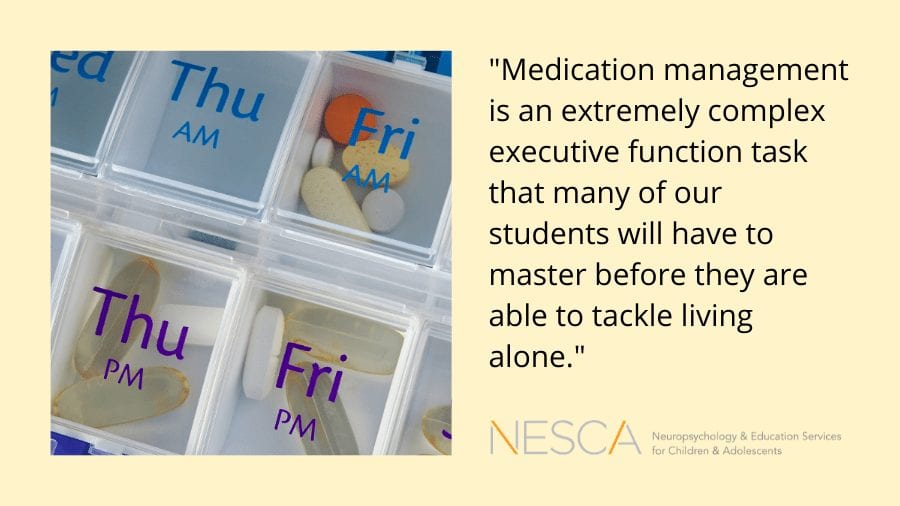
Medication management is an extremely complex executive function task that many of our students will have to master before they are able to tackle living alone. While there are many executive function tools available to help organize and remind individuals about their medication, there are also some long-term teaching strategies and opportunities for habit building throughout a students’ middle and high school career that parents may want to capitalize on before their children leave the home. Today we will explore some of the commonly used tools to help with medication adherence and touch on a few tips and suggestions to help adolescents develop a base of knowledge around their own health status and need for medication.

Tools

Seven Day Pillbox – The most ubiquitous tool to help individuals keep track of medication is a weekly pillbox. This may seem like a simple tool, but pillboxes are hugely varied and have many different additional features. Make sure to consider how many boxes there are per day (morning, afternoon, evening, etc.), whether there is a need for different colors to help with visual discrimination, and whether an audible or vibrating alarm could be beneficial. All of these are potential options that are built into the different pillbox options provided below:

Automatic Pill Dispenser – Some individuals may benefit from having the added support of a pill dispenser that automatically dispenses the correct prescriptions at the time they should be taken. Here is one example of this tool:

The Calendar – Those who have read my previous blog regarding the wonders of a functional digital calendar are likely unsurprised by this suggestion, but make use of this fabulous tool! Adding in an appointment to refill pillboxes, marking down anticipated dates to refill prescriptions, and setting notifications or alarms to go off when it is time to take medication each day can help students remember each step of the process.

Tips

Involve children in filling their pillboxes as early as possible. Many children will enjoy sitting down with a parent to place the pills in each little box and feel special when they are given some responsibility. When this is normalized as a typical part of a week, it becomes an expected activity of daily living for children. Make sure to point out the things that you notice as you fill the box. For example, stating, “Oh! I only count five pills left, that means I need to call and refill the prescription today,” each month will help your child to associate a nearly empty bottle with the need to problem solve.

Set a specific time or day of the week to refill pillboxes. Many children will continue to stick to routines and habits that they built up through childhood once they venture out of the home. Consider designating a specific time of the week to fill a pillbox together. For example, if Sunday after dinner works consistently, make this part of the family routine.

Pair medication with a daily task. Some individuals enjoy using alarms as reminders; however, others feel much more empowered by simply building medication into their routine. Pairing medication with an activity that happens daily anyways, such as brushing teeth in the morning, makes it easier to remember without direct prompting.

Help your child or adolescent put together a medication chart. Many of our children do not know the reasons for their medication. They are unaware of the intent, potential side effects, exact dosage, or name of the medication itself. The more our children and adolescents understand, the better they are able to advocate for themselves to doctors or other health professionals. Putting together a one-page medication chart that outlines all of this important information – in terms that can be easily understood and communicated to others by the child – can help children feel empowered in their conversation about their health. Consider adding a picture of each pill or capsule if they routinely appear the same. At times, pharmacies may unexpectedly need to fill generic prescriptions from different manufacturers, based on availability or other factors, therefore lending to a different appearance of the same generic prescription. This medication chart can also be a helpful tool to reference when adolescents start to independently fill their pillboxes.

Refill prescriptions together. While refilling prescriptions at the pharmacy is often a task that needs to be led and managed by adults, it’s still possible to include adolescents so that they start to learn the process. A great first step is to call the pharmacy on speaker phone and allow your child to listen in for a few months in a row.


About the Author
Sophie Bellenis is a Licensed Occupational Therapist in Massachusetts, specializing in educational OT and functional life skills development. Bellenis joined NESCA in the fall of 2017 to offer community-based skills coaching services as a part of the Real-life Skills Program within NESCA’s Transition Services team. Bellenis graduated from the MGH Institute of Health Professions with a Doctorate in Occupational Therapy, with a focus on pediatrics and international program evaluation. She is a member of the American Occupational Therapy Association, as well as the World Federation of Occupational Therapists. Having spent years delivering direct services at the elementary, middle school and high school levels, Bellenis has extensive background with school-based occupational therapy services.  She believes that individual sensory needs and visual skills must be taken into account to create comprehensive educational programming.


To book an appointment or to learn more about NESCA’s Occupational Therapy Services, please fill out our online Intake Form, email info@nesca-newton.com or call 617-658-9800.


Neuropsychology & Education Services for Children & Adolescents (NESCA) is a pediatric neuropsychology practice and integrative treatment center with offices in Newton, Massachusetts, Plainville, Massachusetts, and Londonderry, New Hampshire, serving clients from preschool through young adulthood and their families. For more information, please email info@nesca-newton.com or call 617-658-9800.


Learning to Ride a Bike: A Rite of Passage

By | NESCA Notes 2021

By: Jessica Hanna MS, OTR/L
Occupational Therapist, NESCA

If there is one positive takeaway from the COVID-19 pandemic, it’s the ever-growing love for being outdoors. It’s spring, the flowers are blooming, the sun is out, and the air is light. Everything in our body is telling us to go outside and play.

For many kids with and without disabilities, bike riding is meaningful, liberating, and a rite of passage. Close your eyes and try to remember the first time you rode a two-wheel bike. Can you remember the color of your bike? The smell in the air? The complete joy it brought you? That was the day we all felt a bit more confident and like we grew a bit taller.

So how do we help our children achieve this meaningful occupation? The days of running behind our children while holding onto their bike seat, telling them to pedal, not to stop, and hoping for the best and that they will forgive us when we let go (when we clearly promised we would not let go!) should be far behind us. But are they?

A lot goes into learning how to ride a bike, so do not let your child give up so soon when it takes more than a couple of days, weeks, or months to get it right. Consider the following skills that are addressed in learning to ride a bike:

  • Attention and concentration
  • Bilateral coordination
  • Balance
  • Body awareness
  • Core strength
  • Hand-eye coordination
  • Motor planning
  • Postural stability
  • Sensory processing
  • Upper and lower extremity strength
  • Visual scanning

Children as young as five years of age will begin to acquire and develop the skills needed to ride a two-wheel bike, and still others may not feel ready until they are pre-teens or even into adulthood.

Before getting started, here are a couple things to consider regarding the equipment involved in learning how to ride a bike:

  • Bike – The height of the bike is a crucial element to success when learning how to ride. When seated on the bike, your child’s feet should be firmly planted on the ground. The bike seat may appear too low and the bike too small; however, this technique enables movement security, engages proper core and postural stability, and increases confidence.
  • Braking System – Be sure to learn the difference between hand brakes vs. coaster brakes (using feet to backpedal). Both braking systems have pros and cons. Hand brakes are a personal favorite. They are more flexible to position, offer better control, but require adequate hand strength and coordination to manipulate. Coaster brakes (using your feet to pedal backward to brake) use an intuitive motor planning motion for children. When you pedal forward, you go; when pedaling backward, you stop. They are helpful for children who lack the hand strength skills to wrap and squeeze their hands around a hand brake; however, they provide awkward foot positioning and the constant tendency to backpedal.
  • Helmet – Safety, Safety, Safety! When handling a bike for any occasion (i.e., walking a bike, doing balance drills on a bike, or riding a bike), it should become an automatic habit to wear a helmet. Your child should be in charge of putting on and taking off their helmet independently. There is nothing more important than wearing a helmet that fits correctly with fasteners that can be easily manipulated. When choosing a helmet, be cognizant of the type of fastener/clasp it comes with and if your child has the fine motor skills to adjust it (this skill could take time to learn).If you are unsure if your child’s helmet is a good fit, any cycling store will be more than pleased to assist in finding your child the most appropriate size. 
  • Pedals – When learning to ride for the first time, the removal of pedals should be highly considered. It provides the opportunity to address balance, core, and postural stability for both younger and older children while also increasing movement security.
  • Training Bike – Which is best…balance bikes vs. training wheels? Balance bikes are light in weight and can be introduced to children at a much younger age than a pedal bike. They promote core strength and increase motor planning, sequencing, and balance training skills, making the transition from a balance bike to a two-wheel pedal bike more fluid and easier to manage. Training wheels promote ease in learning motor planning techniques to push on pedals while providing assisted balance. It’s important to note that removing the balance component can be disadvantageous when transitioning from training wheels to a two-wheel pedal bike.

Overall, the literature supports the observation that, for children with and without disabilities, learning to ride a bike is a popular activity that increases confidence, provides opportunities for shared recreation with families and peers, and promotes social inclusion (Dunford, Bannigan, Rathmell (2016).

Several of the many clinical diagnoses of children who can ride a bike follow here; however, this list is certainly not inclusive of the many other diagnoses that do not preclude children from bike riding:

  • ADHD
  • Anxiety
  • Autism Spectrum Disorder
  • Cerebral Palsy
  • Developmental Coordination Disorder
  • General learning disability
  • Hearing impairment
  • No diagnosis

The art of bike riding can be broken down into various steps, from learning how to use the kickstand to the act of pedaling. Each step deserves attention, because through repetition and practice, confidence is achieved.

If using these tips feels difficult or is not helping your child with the level of focus and skill they need to successfully achieve their goal to use a bike, we recommend reaching out to your occupational therapist or getting an occupational therapy evaluation. If in-person direct services continue to be a concern, biking riding skills can be offered via telehealth from the comfort of  your home. Jessica offers successful biking riding drills and adaptive home exercise plans through telehealth that address the skills required to learn to ride a bike. Contact NESCA’s Director of Clinical Services Julie Robinson, OT, to learn more at: jrobinson@nesca-newton.com.


References
Dunford, Bannigan, Rathmell (2016) Learning to ride a bike: Developing a therapeutic intervention. Children Young People & Families Occupational Therapy Journal 20(1) 10-18


About the Author

Jessica Hanna has over 10 years of pediatric OT experience in conducting assessments and providing treatment of children and adolescents with a broad range of challenges and disabilities, including autism spectrum disorders, sensory processing disorders, visual impairments, cerebral palsy, executive function deficits and developmental disorders of motor function. Prior to joining NESCA, Jessica trained and worked in a variety of settings, including inpatient and outpatient hospital settings, private practice, schools and homes. She has served on interdisciplinary treatment teams and worked closely with schools, medical staff and other service providers in coordinating care. In addition, Jessica provided occupational therapy services at Perkins School for the Blind and Spaulding Rehabilitation Hospital pediatric inpatient unit, where she conducted comprehensive evaluations and interventions for children with a broad range of presentations.


To book an appointment or to learn more about NESCA’s Occupational Therapy Services, please fill out our online Intake Form, email info@nesca-newton.com or call 617-658-9800.


Neuropsychology & Education Services for Children & Adolescents (NESCA) is a pediatric neuropsychology practice and integrative treatment center with offices in Newton, Massachusetts, Plainville, Massachusetts, and Londonderry, New Hampshire, serving clients from preschool through young adulthood and their families. For more information, please email info@nesca-newton.com or call 617-658-9800.


Executive Function Tools: Natural Consequences

By | NESCA Notes 2021

By: Sophie Bellenis, OTD, OTR/L
Occupational Therapist; Real-life Skills Program Manager and Coach, NESCA

In my last blog that focused on executive function tools, I delved into the benefits of using and committing to a digital calendar. The calendar is a concrete tool that can be directly taught to students using traditional methods. Less concrete, but in many ways equally useful, is this next executive function tool – the natural consequence.

When most people think of natural consequences, they think of younger children refusing to do things like eat a meal that their caregiver prepared or put on a coat when it is cold outside. If a child refuses their dinner, the natural consequence is hunger. If a child refuses to wear their coat, the natural consequence is feeling cold. These are consequences that will happen without parents or caregivers explicitly providing a consequence. When it comes to executive function mishaps, the natural consequence is often the need to independently deal with the fallout.

Many of the students I serve directly need scaffolded executive function support with direct instruction and specific opportunities for practice. I am not advocating for removing these services or throwing these students to the proverbial wolves. What I am advocating for is using mistakes or lapses in executive function skill as learning opportunities, as opposed to absolving our students from all responsibility and continuously jumping in to save the day. To demonstrate this difference, here are a few examples of ways I have seen parents successfully use natural consequences as a tool to teach executive function.

Case Studies

  1. Amber is a student who has had consistent difficulty organizing her time after school. While she attends many different afterschool activities, such as recycling club and track, she is often late to practice or misses important changes to the schedule. To help Amber, her parents set up a calendar with notifications and reminders that appear on her phone and her computer directly after school. Recently, Amber started driving lessons with the local driving school. A few weeks ago, Amber had a conversation with her mother in the morning about the fact that she would be picked up for a lesson 10 minutes after the end of the school day. Amber’s notification on her phone went off 15 minutes before the lesson, and she received a pop-up on her computer screen 30 minutes before the end of the school day. Despite these reminders, Amber hopped onto the bus at the end of the day. While this was an honest mistake, Amber was not using her tools or the time management strategies that she has been taught and is expected to use. Amber’s parents decided that as a natural consequence, Amber would need to deal with fixing her mistake. They were there to support her as she called the driving school, apologized to the instructor, and rescheduled her appointment. If she was not willing to take these steps, another natural consequence would have been a delay in getting her license. This caused some heightened anxiety for Amber, but with encouragement from her parents, she practiced the phone call out loud and looked through her calendar to see where she had availability for a make-up appointment. Amber’s parents could have easily called the driving school and fixed these problems for her; however, Amber would have missed out on an opportunity to practice problem solving.
  2. Another student who benefited from natural consequences is Albert. Albert’s parents hired a tutor to meet with him over Zoom twice per week to prepare for the SATs. He was expected to meet with his tutor, Barry, two times per week to start building up his skills. Unfortunately, despite frequent reminders and systems being put in place, Albert often missed or was late to these meetings as he was distracted by playing video games. When Albert’s parents started to receive charges for missed appointments from Barry’s company, they thought carefully about how to impress on Albert the importance of using his strategies and making it to his appointments. Eventually, Albert’s parents informed him that if he missed another session, he would be responsible for the late fee, as the charge was an inevitable consequence. When Albert eventually missed another session, his father drove him to the bank and helped him withdraw the money from his own savings account to pay his parents for the missed session. Unsurprisingly, this was hugely frustrating to Albert in the moment; however, his meetings with Barry became a priority and Albert quickly started making it to tutoring on time. After experiencing the natural consequence himself, Albert began to change his actions.

Both of these examples led to increased buy-in from the adolescents who were actively working on building up their executive functioning skills. As they started to participate in problem solving after they made a mistake, they were more aware of the work that their parents had typically been doing for them. Some language that can be productive includes:

  • “I know it was a mistake and now we just need to figure out how to fix it. What do you think we should do?”
  • “What are the next steps you need to take to solve this problem?”
  • “I can tell you what I think we should do, but I would love to hear your ideas first. Where would you start?”

As adolescents forge toward young adulthood, they will inevitably make mistakes, miss appointments, arrive late, and misplace some of their belongings. If we are constantly picking up the pieces, then they are missing out on the opportunity to learn how to solve their own problems and build an understanding of the consequences.


About the Author
Sophie Bellenis is a Licensed Occupational Therapist in Massachusetts, specializing in educational OT and functional life skills development. Bellenis joined NESCA in the fall of 2017 to offer community-based skills coaching services as a part of the Real-life Skills Program within NESCA’s Transition Services team. Bellenis graduated from the MGH Institute of Health Professions with a Doctorate in Occupational Therapy, with a focus on pediatrics and international program evaluation. She is a member of the American Occupational Therapy Association, as well as the World Federation of Occupational Therapists. Having spent years delivering direct services at the elementary, middle school and high school levels, Bellenis has extensive background with school-based occupational therapy services.  She believes that individual sensory needs and visual skills must be taken into account to create comprehensive educational programming.


To book an appointment or to learn more about NESCA’s Occupational Therapy Services, please fill out our online Intake Form, email info@nesca-newton.com or call 617-658-9800.


Neuropsychology & Education Services for Children & Adolescents (NESCA) is a pediatric neuropsychology practice and integrative treatment center with offices in Newton, Massachusetts, Plainville, Massachusetts, and Londonderry, New Hampshire, serving clients from preschool through young adulthood and their families. For more information, please email info@nesca-newton.com or call 617-658-9800.


Mind the Gap: Why You Should Consider Summer OT and Speech Services at NESCA

By | NESCA Notes 2021

By: Julie Robinson, OT
Director of Clinical Services; Occupational Therapist, NESCA

It has been a challenging school year, with ever-changing schedules, routines, and unfortunately with a good deal of inconsistency in the provision of therapeutic services through the schools, due to the many impacts of COVID. Parents, caregivers and students have all experienced differing levels of anxiety about what progress has been and is being made, with many children experiencing some level of regression with regard to behavior, self-regulation, motor skills or language development. In anticipation of many of our children returning to school in-person in April, parents have expressed concerns that their children may be lagging behind or that they have not had ample support throughout the earlier parts of their school year to ensure they can keep up with the other children in their class. Over the months of April, May and June, we will all get to see firsthand where the gaps might arise. And then when school is over, many of us might be concerned that the gains of just a few short months will be lost again over summer. This is why those of us at NESCA perceive that the benefits of summer services will be an important part of ensuring progress and the ability to jump right back into learning – as we hope all school will be in-person again in the fall.

NESCA is available to provide summer services, as we do consistently for our weekly patients. In addition, we are offering short-term services to those children who may not qualify for them through their school systems, or for those families who would simply like to supplement what their children are receiving in-district to give them a boost before school begins again in the fall.

Our occupational therapists (OTs) can work on the following areas of focus with your child:

  • self-regulation and coping skills
  • how best to transition from the quiet of home to the multiple stimuli of a classroom full of children
  • how to cope with longer hours of wearing a mask
  • how to follow social distancing requirements, when they long for a closer physical connection with their peers

We can also help to ease the anxiety some children may have about becoming sick or how NOT to feel fearful of getting back into the classroom when sensory processing issues push them to feel uneasy. Our OTs can continue work on handwriting and motor development work started throughout the school year to ensure there is no regression or to improve the speed and automaticity of written expression and legibility. We can teach organizational and executive functioning skills to encourage kids to be independent, prioritize assignments and manage their time. OTs can address self-care skills of dressing, shoe tying, feeding and hygiene, which are likely to require more independence with social distancing requirements. While it’s summer, we help build outdoor skills, such as bike riding and greater self-confidence on the playground to elicit more social connections with peers. Our OTs are providing services in-person in our Newton and Plainville, Massachusetts clinics, by teletherapy or outdoors in the community as appropriate.

Our speech therapists at NESCA can also help to continue and supplement the hard work children have been putting in throughout the school year. They can work on social pragmatics and help with the skills needed to transition from so much time alone, to being in groups with their peers once again. NESCA’s speech therapists can support children on how to:

  • initiate play
  • find shared interests
  • be flexible thinkers
  • communicate with kindness and an appropriate level of voice
  • read gestures and non-verbal communication (especially while wearing masks, which can impede the ability to properly read another person’s mood, reactions or emotions)

We can continue to work on the established goals from school, regarding both expressive and receptive communication, language articulation and language as it pertains to written communication. Our speech therapists are currently providing all services via teletherapy while we work on a transition back to in-person therapy.

If you are interested in seeking out summer services at NESCA, or any of our assessments and services, please contact NESCA’s Director of Clinical Services Julie A. Robinson. She can be reached at jrobinson@nesca-newton.org and will conduct a phone intake with you to help you best determine your needs.


About the Author

Julie Robinson is an occupational therapist with over 25 years of experience as a clinician. The work Julie does is integral to human development, wellness and a solid family unit. She particularly enjoys supporting families through the process of adoption and in working with children who are victims of trauma. Julie has extensive experience working with children diagnosed with an Autism Spectrum Disorder (ASD), or who have learning or emotional disabilities. She provides services that address Sensory Processing Disorder (SPD) and self-regulation challenges, as well as development of motor and executive functioning skills.

To book an appointment or to learn more about NESCA’s Occupational Therapy Services or other clinical therapies, please fill out our online Intake Form, email info@nesca-newton.com or call 617-658-9800.


Neuropsychology & Education Services for Children & Adolescents (NESCA) is a pediatric neuropsychology practice and integrative treatment center with offices in Newton, Massachusetts, Plainville, Massachusetts, and Londonderry, New Hampshire, serving clients from preschool through young adulthood and their families. For more information, please email info@nesca-newton.com or call 617-658-9800.


Facilitating Language Growth at Home

By | NESCA Notes 2021

By: Abigael Gray, MS, CCC-SLP
NESCA Speech-Language Pathologist

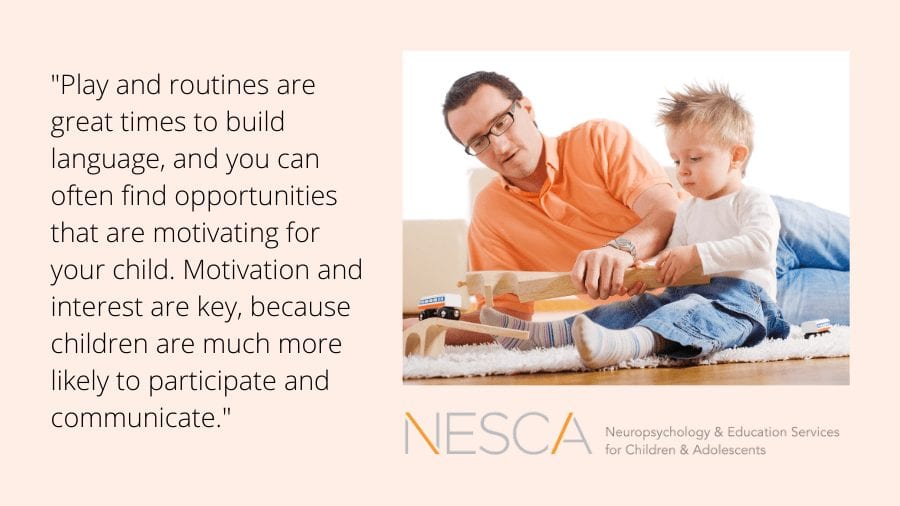
I recently got to spend time with my 18-month-old nephew, after not having seen him in a year and a half due to the pandemic. It got me thinking about practical ways to help facilitate language throughout the day without feeling like you’re doing anything extra. Play and routines are great times to build language, and you can often find opportunities that are motivating for your child. Motivation and interest are key, because children are much more likely to participate and communicate. Below, I discuss tips to incorporate into your daily routine at home.

Five ways to facilitate language growth at home:

  1. Play!
    • Play the way your child is playing and imitate what they’re doing.
    • Even if you had a plan, don’t be afraid to change it to focus on their interests (i.e., follow their lead, as explained below).
    • Use fun sounds, words and gestures to go with what you’re doing (e.g., “beep beep” when playing with cars, “pop” when popping bubbles, “yummy/mmm” and rubbing your stomach when pretending to eat play food).
  2. Follow your child’s lead
    • Observe what they’re interested in, wait until they initiate or continue interaction, and listen to their words and sounds.
    • Get on their level so they know you are joining in.
    • If they are doing something unsafe, explain why it’s unsafe in simple terms and redirect them to a safe activity.
  3. Get silly
    • Repeat actions they think are funny.
    • Switch up routines in a silly way (e.g., “forget” their favorite bath toy, give them a fork with their yogurt). This encourages language when your child notices and wants to tell you something is different or missing.
    • Change song lyrics or words in stories to be about your child, their interests and/or what is happening around you in the moment.
  4. Pause
    • Slowly sing familiar nursery rhymes and songs and then pause at key words to encourage them to fill in a word or gesture.
    • Pause a familiar activity, such as pushing the swing, and wait for them to ask you to continue using words or gestures (e.g., “more,” “again,” “go”).
    • When looking for a response, stop talking, lean forward and look at them expectantly. You can count slowly to 10 silently, which gives your child time to respond.
  5. Expand
    • When your child uses one to two words, turn it into a short sentence. For example, if they say “up” wanting you to pick them up, you could say, “Ok, I’ll pick you up.”
    • Be sure to use correct grammar when expanding their message, even if your child is still using immature grammar.
    • Use a variety of words (e.g., describing words, action words, words for feelings, location words, etc.). Start with words your child would want to say to talk about the things they are interested in.

Many of these ideas are things you may already be doing throughout the day, but it is good to think about how doing so helps your child learn to understand and use language. If you feel that your child may be behind in their language understanding or production, it is helpful to schedule an evaluation with a speech-language pathologist. If therapy is warranted, your speech-language pathologist can make recommendations specific to your child and family and show you how to best encourage language growth in the home environment.

References:
Weitzman, E. (2017). It takes two to talk: A practical guide for parents of children with language delays (5th ed.). Toronto: Hanen Centre.


About the Author

Abigael Gray has over six years of experience in assessment and treatment of a variety of disorders, including dysphagia, childhood apraxia of speech, speech sound disorder, receptive and expressive language disorder, autism spectrum disorder and attention deficit hyperactivity disorder. She has a special interest and experience in working with children with feeding and swallowing disorders, including transitioning infants to solid foods, weaning from tube feeding, improving sensory tolerance, developing chewing skills, increasing variety and volume of nutritional intake and reducing avoidance behaviors during mealtimes.


To book an appointment with or to learn more about NESCA’s Speech & Language Therapy, please fill out our online Intake Form, email NESCA’s Director of Clinical Services Julie Robinson or call 617-658-9800.


Neuropsychology & Education Services for Children & Adolescents (NESCA) is a pediatric neuropsychology practice and integrative treatment center with offices in Newton, Massachusetts, Plainville, Massachusetts, and Londonderry, New Hampshire, serving clients from preschool through young adulthood and their families. For more information, please email info@nesca-newton.com or call 617-658-9800.


Appreciating and Responding to The New York Times article, For Some Teens, It’s Been a Year of Anxiety and Trips to the E.R. by Benedict Carey

By | NESCA Notes 2021

By: Sophie Bellenis, OTD, OTR/L
Occupational Therapist; Real-life Skills Program Manager and Coach, NESCA

As an occupational therapist working almost exclusively with teenagers and young adults over the past year, the title of Benedict Carey’s article jumped out at me like a tired and worn flag, waving frantically for acknowledgement. Our teens are anxious, tired, and dealing with living through the proverbial “unprecedented times” without the developmental capabilities needed to quickly adapt in this era of remote learning, remote social interaction, and remote extracurriculars. Remote everything!

It is important for me to note that I really enjoy working with teenagers. I find myself in constant awe of their resiliency, their willingness to confront hard truths that many of us shy away from, and their ability to push forward despite having huge questions about who they truly are. All of these things are tough and require immense emotional fortitude, but this year many of these challenges feel impossible.

Carey has taken the time to gather perspectives from multiple stakeholders. He provides a platform for parents, educators, professors, therapists, pediatricians, and directors of hospital programs to explain the struggles of supporting these kids without adequate resources. Parents describe the fear of supporting their children as they struggle with mental health. Doctors discuss the frustration of having inadequate resources and support in emergency rooms around the country. Carey highlights that, according to the Centers for Disease Control and Prevention (CDC), the proportion of adolescent emergency admissions for mental problems, like panic and anxiety, is up 31 percent. Some of my clients add to this statistic and are navigating their own path through chaotic hospitalizations and overwhelmed support systems. Carey’s article is absolutely worth taking the time to read, if only to see the ubiquity of these issues and how they are happening all around our country. Simply put, we have a clear problem. Less clear, is the solution.

When meeting with adolescents and young adults themselves, I hear three main fears popping up week after week. Here are a few thoughts and suggestions on how to support these specific fears or feelings.

  1. “I can’t get this done, (and therefore) I am going to completely ruin my future.”

When looking at future success through a transition lens, we consider the areas of independent living, community participation, post-secondary education, and employment. In the school setting, most students’ curricula are focused solely on academic success. Sometimes, we do a poor job of teaching students about multiple intelligences or emphasizing the importance of hard work. While grades are important, they are not everything, and while standardized testing is returning to students’ schedules, they should not serve as students’ measure of self-worth. We know this, but do they? We have to teach our children that if they are hardworking, kind, and truly doing their best, the threat of “ruining their future” is much less likely than they fear. Let’s highlight the undeniably true narrative that everyone’s path can look different and still lead to success.

  1. “I’m so tired. All of the time.”

Many of my clients tell me they are not sleeping. If they are sleeping, they fall asleep late with a phone in their hand, constantly refreshing apps or trying to maintain communication with their peers. In our current remote world, the phone can feel like a lifeline. Sleep is a foundational need for mental and physical health. Students who are 15 or 16 years old often have a limited understanding of how holistic the effects of decreased sleep can be. Sleep is not their priority. Recently, I have seen parents disable the internet or have their teenagers put their phones into a lockbox from midnight until 6:00am. This new boundary is often met with anger or frustration at the beginning, but then these students start to sleep. They are better able to manage their emotions. They have more energy. They start to see the benefits despite their skepticism. If a tech break doesn’t feel quite right for your family, it is still worth opening up a conversation about the need for strong sleep hygiene and modeling a routine that promotes calming down by limiting screens before bed, which can have hugely positive effects.

  1. “This is never going to end.”

In many ways, a year feels much longer to a 17 year-old than it does to an older adult. Working at a job for four years never feels as long or as formative as the four years of high school. And objectively, a year to a 17 year-old is over five percent of their life, while it’s only two percent of 50 year old’s life. Let’s acknowledge that. Let’s verbalize the fact that teenage years are also full of milestones that have been constantly cancelled or changed to fit social distancing recommendations and safety precautions. There is a sense of loss and grief surrounding many events that these students have been looking forward to since elementary school. Encourage students to do their own research into what the next six months may look like as we start to open back up. Help them to understand the vaccine rollout and the pitfalls and successes that we have had as a nation tackling a novel disease.

Adolescent mental health is going to be an on-going challenge that we tackle as a community. As we slowly forge out of isolation, let’s center our conversations around the mental health of our teens and honestly acknowledge the unique position that they have found themselves in.

References

Carey, B. (2021, February 23). For some teens, it’s been a year of anxiety and trips to the e.r. The New York Times. https://www.nytimes.com/2021/02/23/health/coronavirus-mental-health-teens.html

Leeb, R.T., Radhakrishnan, L., Martinez, P., Njaj, R., Holland, K.M. (2020, October 27). Mental health-related emergency department visits among children aged <18 during the covid-19 pandemic. MMWR Morbidity and Mortality Weekly Report 2020:1675-1680. DOI: http://dx.doi.org/10.15585/mmwr.mm6945a3


About the Author

Sophie Bellenis is a Licensed Occupational Therapist in Massachusetts, specializing in educational OT and functional life skills development. Bellenis joined NESCA in the fall of 2017 to offer community-based skills coaching services as a part of the Real-life Skills Program within NESCA’s Transition Services team. Bellenis graduated from the MGH Institute of Health Professions with a Doctorate in Occupational Therapy, with a focus on pediatrics and international program evaluation. She is a member of the American Occupational Therapy Association, as well as the World Federation of Occupational Therapists. Having spent years delivering direct services at the elementary, middle school and high school levels, Bellenis has extensive background with school-based occupational therapy services.  She believes that individual sensory needs and visual skills must be taken into account to create comprehensive educational programming.


To book an appointment or to learn more about NESCA’s Occupational Therapy Services, please fill out our online Intake Form, email info@nesca-newton.com or call 617-658-9800.


Neuropsychology & Education Services for Children & Adolescents (NESCA) is a pediatric neuropsychology practice and integrative treatment center with offices in Newton, Massachusetts, Plainville, Massachusetts, and Londonderry, New Hampshire, serving clients from preschool through young adulthood and their families. For more information, please email info@nesca-newton.com or call 617-658-9800.


Executive Function Tools: The Calendar

By | NESCA Notes 2021

By: Sophie Bellenis, OTD, OTR/L
Occupational Therapist; Real-life Skills Program Manager and Coach, NESCA

When working with young adults and adolescents to build up executive function skills, my main goal is to find systems and strategies that are truly helpful, easily accessed and that will eventually be used independently. While there are many fabulous apps that have been developed to target specific organizational skills, such as medication management, creating to-do lists and taking notes, I would argue that the number one, most important tool is an accurate, up-to-date calendar. The format of a digital calendar provides three hugely important supports.

  1. Visual Map of Time – Time management is tricky, and for many of our students, the concept of time itself is quite abstract. A calendar that has chunks of time visually blocked out helps to concretize an abstract concept. Additionally, having a calendar can help students plan their work. If a student has five different assignments to work on in a given week, looking at a calendar to find available segments of time will often help them realize that leaving everything until the last minute will not be possible. Notably, this requires guidance at first. Asking students questions, such as, “how long does an assignment like this generally take you?” or “would that available hour on Tuesday give you enough time for your problem set?” will help them start to internally ask themselves the right questions.
  2. Built-in Notification Systems – Some students use the alarms on their phone as reminders that they need to complete academic or daily living tasks. For example, they may have an alarm at 7:00pm every evening as a prompt to take their medication. Digital calendar apps allow for notifications to be linked to an event or task. Sometimes a simple reminder 10 minutes before a meeting or class is plenty, and our students can arrive on time with that quick prompt. For other appointments, I have students set two separate notifications, one in the morning and one at the time they would need to start getting ready or prepared for an appointment. For example, if a student has a doctor’s appointment two months in the future, a student could benefit from setting a notification eight hours and 1 hour before the appointment. This way, they start their morning with an acute awareness of their responsibility that afternoon and are reminded again when they need to start getting ready to leave.
  3. Constant Access when Synced across Devices – Calendars, such as the Google Calendar, sync seamlessly across digital devices. The same calendar can be accessed from a phone, a tablet, a laptop or a desktop quickly and easily. Students can refer to their phone when they are out and about or their computer if they are focused in class.

Research shows us that building executive function skills requires direct instruction and the opportunity to practice (Semenov & Zelazo, 2019). While using a calendar may seem like a simple skill, many of the systems provided in high schools take away the opportunity for students to practice setting up and maintaining their own calendar. Online portals have calendars that are immediately synced to the teacher’s schedule with assignments and due dates already entered. Additionally, many of our students rely on their parents to keep track of any and all appointments (medical or otherwise), meetings and other scheduled activities. This means that when starting a more independent schedule – whether at a university, vocational program or first job – these students often find themselves overwhelmed by the deadlines and the number of responsibilities that they must track. I urge parents to slowly increase the number of appointment and activities that students are in charge of remembering on their own. Helping a student enter doctor or dentist appointments, vacation details, such as flight or bus times, and deadlines into their personal calendar helps them start to build this habit and provides opportunity for practice. We have the tools to help students make this transition more easily, and with small, intentional changes to expectations of responsibility and independence, we can provide students with tools in their back pockets so they are ready to support (and schedule) themselves!

References

Semenov A, D, Zelazo P, D: Mindful Family Routines and the Cultivation of Executive Function Skills in Childhood. Human Development 2019;63:112-131. doi: 10.1159/000503822


About the Author

Sophie Bellenis is a Licensed Occupational Therapist in Massachusetts, specializing in educational OT and functional life skills development. Bellenis joined NESCA in the fall of 2017 to offer community-based skills coaching services as a part of the Real-life Skills Program within NESCA’s Transition Services team. Bellenis graduated from the MGH Institute of Health Professions with a Doctorate in Occupational Therapy, with a focus on pediatrics and international program evaluation. She is a member of the American Occupational Therapy Association, as well as the World Federation of Occupational Therapists. Having spent years delivering direct services at the elementary, middle school and high school levels, Bellenis has extensive background with school-based occupational therapy services.  She believes that individual sensory needs and visual skills must be taken into account to create comprehensive educational programming.


To book an appointment or to learn more about NESCA’s Occupational Therapy Services, please fill out our online Intake Form, email info@nesca-newton.com or call 617-658-9800.


Neuropsychology & Education Services for Children & Adolescents (NESCA) is a pediatric neuropsychology practice and integrative treatment center with offices in Newton, Massachusetts, Plainville, Massachusetts, and Londonderry, New Hampshire, serving clients from preschool through young adulthood and their families. For more information, please email info@nesca-newton.com or call 617-658-9800.
 

The Benefits of Sensory-based Play

By | NESCA Notes 2021

By: Madelyn (Maddie) Girardi, OTD, OTR/L
Occupational Therapist, NESCA

The importance of play for child development

Play is considered an essential aspect of child development as it contributes to cognitive, physical, social and emotional well-being. As a pediatric occupational therapist, play is an integral part of my job. When children have opportunities to play, this allows them to build their creativity and imagination, resolve conflicts and learn self-advocacy skills. Through play, children develop new abilities that lead to enhanced confidence and resiliency, skills crucial for navigating day to day challenges. Play allows kids to practice decision-making skills, discover areas of interest and engage in passions. (Ginsburg, 2007).

 What is sensory-based play?

Sensory play can be described as any play activity that stimulates an individual’s sensory system. The sensory system includes touch (tactile), smell (olfactory), taste (gustatory), sight (visual), hearing (auditory), balance (vestibular) and movement (proprioception). Common examples include sensory bin or sandbox play, play with shaving cream, finger paint and/or food, use of a balance beam, ball pit, and/or swings, sound tubes, and so much more!

Why is sensory play beneficial?

While we know that play is a critical part of child development, incorporating a multi-sensory approach into play activities can be particularly beneficial. When activities are fun and meaningful – our senses are engaged – we learn best!

  • Promotes learning – children who engage multiple senses to accomplish a task are better able to remember and recall learned information.
  • Facilitates exploration, creativity and curiosity in children who may be seeking, or avoiding, certain types of stimuli.
  • Allows for strengthening of the brain pathways and connections that allow for efficient sensory integration.
  • Promotes self-regulation by allowing for interaction with different mediums that may be calming for the child (Educational Playcare, 2016).

What kinds of OT skills can be targeted through sensory play?

  • Sensory processing skills
  • Fine motor skills
  • Gross motor skills
  • Feeding skills
  • Body awareness
  • Motor planning
  • Visual perceptual skills
  • Communication and play skills
  • Self-regulation and coping skills

References:

Educational Playcare. (2016, October 27). Why Sensory Play is Important for Development.
https://www.educationalplaycare.com/blog/sensory-play-important-development/#:~:text=Sensory%20play%20includes%20any%20activity,%2C%20create%2C%20investigate%20and%20explore

Ginsburg, K. R. (2007). The importance of play in promoting healthy child development and
maintaining strong parent-child bonds. Pediatrics119(1), 182-191.

To learn more about Maddie Girardi, watch this video interview between NESCA Occupational Therapists Sophie Bellenis, OTD, OTR/L, and Maddie Girardi, OTD, OTR/L.

About the Author
Madelyn (Maddie) Girardi is a Licensed Occupational Therapist in Massachusetts with experience in both school-based and outpatient pediatric settings. Maddie received her undergraduate degree in Exercise Science/Kinesiology at The College of Charleston in South Carolina and  earned her Doctorate degree in Occupational Therapy from The MGH Institute of Health Professions in Boston.

Maddie is a passionate therapist with professional interest in working with young children with neurodevelopmental disorders, fine and gross motor delays and Autism Spectrum Disorder (ASD).

To book an appointment or to learn more about NESCA’s Occupational Therapy Services, please fill out our online Intake Form, email info@nesca-newton.com or call 617-658-9800.


Neuropsychology & Education Services for Children & Adolescents (NESCA) is a pediatric neuropsychology practice and integrative treatment center with offices in Newton, Massachusetts, Plainville, Massachusetts, and Londonderry, New Hampshire, serving clients from preschool through young adulthood and their families. For more information, please email info@nesca-newton.com or call 617-658-9800.


Literacy-based Speech Therapy: Winter Edition

By | NESCA Notes 2021

By: Abigael Gray, MS, CCC-SLP

NESCA Speech-Language Pathologist

Books are a great speech-language therapy tool. They can be used to target many different goals for a variety of ages and profiles. With books, children are given context for learning vocabulary, concepts and important story elements. Literacy-based therapy is not only more fun, but research also supports its use in teaching children with speech and language disorders:

  • Teaching story elements has been shown to improve oral language production and reading comprehension.
  • Teaching within a narrative context can make language learning less demanding, more meaningful and more authentic.
  • Students’ comprehension and story retelling/generation skills improved more with contextualized (literacy-based) intervention than decontextualized intervention.

Books can easily be incorporated into life at home, if they are not already a part of the daily routine. Just grab your or your child’s favorite book, or find a YouTube read aloud of it, and have your child help you read it! Be sure to pause throughout the book to talk about the pictures, make inferences about why events are happening and ask a few questions. Don’t be afraid to change the words to match your child’s level of understanding or interests.

My top three favorite winter books to use in speech-language therapy are:

  1. Sneezy the Snowman by Maureen Wright

A story about a cold and sneezy snowman who melts several times while trying to get warm. His human friends help him by rebuilding him and sharing their winter clothes.

Amazon: https://www.amazon.com/Sneezy-Snowman-Maureen-Wright/dp/1477810544

YouTube Read Aloud: https://youtu.be/iUsHnKSyDH0

Skills that I target and can be incorporated into shared book reading at home:

  • Producing subject-verb-object or complex sentences to talk about what is happening.
  • Predicting what will happen before and throughout reading (e.g., “Sneezy is drinking hot chocolate, what do you think will happen?”).
  • Answering detail (what, where, who, when) and inferential (why) questions.
  • Discussing story parts (e.g., characters, setting, problem, solution) and retelling the story.
  • Writing using different prompts, such as “My snowman melted because…” or “When I’m cold, I…”.
  1. The Mitten by Jan Brett

A traditional story about a boy whose grandmother knits him new mittens. He loses one mitten when he is outside playing, and many different animals climb inside to stay warm.

Amazon: https://www.amazon.com/Mitten-Jan-Brett/dp/0399231099

YouTube Read Aloud: https://youtu.be/duhj0Op_slo

Skills that I target and can be incorporated into shared book reading at home:

  • Sequencing events by talking about the order of animals that climbed into the mitten.
  • Creating a craft by printing a mitten and animals, coloring the animals and putting them inside the mitten as you retell the story.
  • Watching a different rendition of The Mitten on Vooks.com and comparing and contrasting the two stories using a Venn diagram.
  • Producing past tense verbs to describe what happened.
  • Making inferences about characters’ emotions and motivations.
  1. The Snowy Day by Ezra Jack Keats

A Caldecott Medal-winning book about a boy’s adventures in the snow when he puts on his snowsuit and goes outside to play.

Amazon: https://www.amazon.com/Snowy-Day-Board-Book/dp/0670867330

YouTube Read Aloud: https://youtu.be/FmZCQfeWjeQ

Skills that I target and can be incorporated into shared book reading at home:

  • Telling an original story together by covering up the words on the pages.
  • Finding words that contain the child’s target speech sound (i.e., if your child is working on producing the “R” sound, find all the words that contain “R” and practice those).
  • Describing character traits of Peter, the main character.
  • Discussing cause and effect (e.g., cause: Peter smacked a snow-covered tree, effect: snow fell on Peter’s head).
  • Writing using different prompts, such as “On a snowy day, I like to…” or “I can save a snowball by…”.


References:

Davies, P., Shanks, B., & Davies, K. (2004). Improving narrative skills in young children with delayed language development. Educational Review, 56, 271 – 286.

Gillam, S. L., Gillam, R. B., & Reece, K. (2012). Language outcomes of contextualized and decontextualized language intervention: results of an early efficacy study. Language, speech, and hearing services in schools43(3), 276–291. https://doi.org/10.1044/0161-1461(2011/11-0022)

Tomasello, M. (2003). Constructing a language. A usage-based theory of language acquisition. Cambridge, MA: Harvard University Press


About the Author

Abigael Gray has over six years of experience in assessment and treatment of a variety of disorders, including dysphagia, childhood apraxia of speech, speech sound disorder, receptive and expressive language disorder, autism spectrum disorder and attention deficit hyperactivity disorder. She has a special interest and experience in working with children with feeding and swallowing disorders, including transitioning infants to solid foods, weaning from tube feeding, improving sensory tolerance, developing chewing skills, increasing variety and volume of nutritional intake and reducing avoidance behaviors during mealtimes.


To book an appointment or to learn more about NESCA’s Speech & Language Therapy, please fill out our online Intake Form, email NESCA’s Director of Clinical Services Julie Robinson or call 617-658-9800.

Neuropsychology & Education Services for Children & Adolescents (NESCA) is a pediatric neuropsychology practice and integrative treatment center with offices in Newton, Massachusetts, Plainville, Massachusetts, and Londonderry, New Hampshire, serving clients from preschool through young adulthood and their families. For more information, please email info@nesca-newton.com or call 617-658-9800.


Skip to content