NESCA’s Newton, MA location has immediate availability for neuropsychological evaluations. Our MA clinicians specialize in the following evaluations: Neuropsychological; Autism; and Emotional and Psychological, as well as Academic Achievement and Learning Disability Testing.

Visit www.nesca-newton.com/intake for more information or to book an evaluation.

Tag

pediatric neuropsychology Archives - Page 10 of 18 - NESCA

Subscribe to NESCA Notes

Why Delay a Diagnosis?

By | NESCA Notes 2022

By Angela Currie, Ph.D.
Pediatric Neuropsychologist, NESCA
Director of Training and New Hampshire Operations

As part of NESCA’s ongoing blog series addressing some of the most frequently asked questions about neuropsychological testing, today we are addressing why neuropsychologists may choose to delay a diagnosis.

At NESCA, I often supervise neuropsychology trainees, and one of the first questions I asked them is: “What is the goal of a neuropsychological evaluation?” I often hear answers, such as “to identify strengths and weaknesses” or “to determine appropriate diagnosis.” These answers are not wrong, per se – they are what we are taught in graduate school. However, I often explain that while these may be part of our goal, the primary goal is to tell a client’s story and help them understand a path for moving forward. While this may sound a bit aspirational, it is the approach that best appreciates developmental, systemic, and individual factors that may come into play. As addressed by Dr. Moira Creedon in the first blog within this series, this is also one of the reasons why neuropsychologists want to review all prior evaluations and documentation, as this helps to elucidate the developmental timeline.

When a neuropsychologist is approaching an evaluation through the above developmental lens, it is not always possible to land on a specific diagnosis. This may sometimes be referenced as a “deferred diagnosis” or “differential diagnosis,” meaning there is evidence to possibly support the diagnosis, but not enough evidence at this time to decide for certain. Another term that may be used is “provisional diagnosis.” This indicates that there is enough evidence to support the diagnosis at this time, and there is clinical utility to diagnosing (e.g., informs intervention, qualifies for services, etc.); however, more information or monitoring may be needed to be completely confident, so future reassessment is warranted.

There are several reasons why a diagnosis may be deferred or deemed provisional. First, children are constantly developing, and sometimes the challenges they are demonstrating may be developmental in nature. This may be particularly so when evaluating young children. For example, if a young child has significant language delays, it may be difficult to assess whether they are also on the autism spectrum or have early signs of a learning disability, as their observed weaknesses in these areas may be accounted for by their language. Often times these are children who may “catch up” in skills once provided intervention, meaning their difficulties were related to delayed acquisition, rather than an being an issue of innate impairment.

Similarly, another reason diagnosis may be deferred is if a child’s self-regulation challenges interfere with their ability to engage in typical daily demands. For example, for a child who has significant anxiety or behavioral dysregulation that interferes with their ability to engage in school, it may be difficult to determine if academic delays are related to a learning disability or are a secondary consequence to their dysregulation. While provision of targeted instruction may still be necessary in order to help the child regulate and close gaps in skills, a full understanding of their innate learning profile may not be possible until such supports are in place.

Deferred diagnosis is quite common when more significant psychiatric diagnoses are in question, such as whether a child or adolescent is presenting with a mood or thought disorder, such as bipolar or emerging psychosis. There are many other conditions that may “look like” these disorders, including trauma or co-occurring anxiety and ADHD. When diagnosing more significant, often life-course disorders, it is important to ensure that all other potential explanations are identified and addressed. This is important for informing the appropriate treatments while also allowing the evaluator to outline some of the “red flags” that should be monitored by the client, their parents, and their care team over time.

Another reason why a diagnosis may be deferred is that there may be systemic factors at play. In other words, there may be things going on within the child’s home, peer setting, school, or other surroundings that interfere with the evaluator’s ability to understand the child in isolation. This is a particular issue when evaluating a client with a trauma history. Developmental trauma can often “mimic” other symptom profiles, and so it may be important to first address issues within the system before providing a diagnosis for the individual.

There are other less common situations in which diagnosis may be deferred, but they warrant mention. One is when the neuropsychologist is concerned about possible malingering, which is when certain symptoms are being falsified or exaggerated for personal gain (e.g., a child with learning disability exaggerating mood symptoms to avoid school). Another less common situation is when prescribed medication or recreational drugs may be inadvertently causing the symptoms of concern (e.g., depression occurring as a side effect).

A final reason why a diagnosis may be deferred is simply that things can sometimes be messy. We often evaluate children and teens who have several presenting concerns, and sometimes it takes time to peel away the layers of the onion. In any of the above scenarios, we start with “what we know” and then describe “what is possible.” Regardless of whether or not a diagnosis is certain, as neuropsychologists, we are still able to tell the client’s story, describing how they “got here” and how to move forward. This developmentally-sensitive approach allows us to make recommendations based on their need, not just their diagnostic label. We are then able to assess how their profile and symptoms change as they access intervention. It is for this reason that we enjoy the opportunity to develop long-term relationships with our clients, helping to monitor growth over time. Children do not develop in one finite time point, and the neuropsychological evaluation process sometimes has to be patient and continue to develop alongside them.


About the Author

Dr. Angela Currie is a pediatric neuropsychologist at NESCA. She conducts neuropsychological and psychological evaluations out of our Londonderry, NH office. She specializes in the evaluation of anxious children and teens, working to tease apart the various factors lending to their stress, such as underlying learning, attentional, or emotional challenges. She particularly enjoys working with the seemingly “unmotivated” child, as well as children who have “flown under the radar” for years due to their desire to succeed.


To book an evaluation with Dr. Currie or one of our many other expert neuropsychologists, complete NESCA’s online intake form. Indicate whether you are seeking an “evaluation” or “consultation” and your preferred clinician in the referral line.


Neuropsychology & Education Services for Children & Adolescents (NESCA) is a pediatric neuropsychology practice and integrative treatment center with offices in Londonderry, NH, Plainville, MA, and Newton, MA serving clients from preschool through young adulthood and their families. For more information, please email info@nesca-newton.com or call (603) 818-8526.

Are We Working With a Full Deck of Cards? Why Neuropsychologists Want Results from Previous Evaluations

By | NESCA Notes 2022

By: Moira Creedon, Ph.D. 
Pediatric Neuropsychologist, NESCA

Neuropsychological testing is a tremendous undertaking in time and effort for a family. It involves intake documents, questionnaires, financial paperwork, insurance information, teacher forms, and the list goes on. I promise this paperwork is meaningful and helpful, a way to get the most out of the time and investment in a neuropsychological evaluation. Over the next few weeks, several of NESCA’s neuropsychologists will tackle a few common questions that we face that will help you prepare for neuropsychological testing.

The first topic to tackle relates to the need for previous records. It can feel time consuming to track down documents from years ago, particularly if your child has grown and changed over time. There are many reasons why it is critical to provide these records so your provider has the full deck of cards as they build an individualized evaluation for your child. I’ll tackle the three most important reasons to me:

First, pediatric neuropsychologists want to understand the development of your child over time. For example, if we are evaluating learning problems, I want to know what it was like in kindergarten and early elementary school when your child learned to read. I want to know when the attention problems started or problems interacting with peers were first noticeable to those around them. As we build a developmental timeline, it can help to conceptualize where it all began to help us get at the magical “root cause” that parents often seek. Understanding development over time also helps us to build a better treatment plan. For example, if I can see that a child struggled to develop early reading skills and then years later is extremely anxious about attending school, it helps guide recommendations in both domains.

Secondly, records are critical so we do not risk “practice effects.” “Practice effects” refer to the improvement in scores that happens simply from being exposed to the task before. While guidelines are not as set in stone as some may think, it is generally advised not to repeat many neuropsychological measures within a year of testing. There may be reasons to speed up this timeline that are client-specific, but we cannot make that determination unless we see the documents. Research says practice effects diminish over a few months to a year. We want to eliminate any interfering factors that would make it harder to draw conclusions about the data in the current evaluation. With the time and investment you make in testing as a parent, I can only imagine how frustrating it would feel to hear that something we can manage interfered with the process. Access to records helps us to choose the right measures for the right moment.

Thirdly, providing previous records also allows us to track skill development over time. This is particularly important if we want to see if an intervention (e.g., reading instruction, therapy, attending social skill groups) is working to build the skills. Put simply, it tells us if a problem is getting better or getting worse. Even if you do not agree with the final conclusions drawn by the previous professional, the scores still provide critical data points in development. For more information on seeking a second opinion when you disagree with results, sit tight – that blog post is coming!

I often use the metaphor with kids and families that neuropsychological testing can help us to develop a type of “instructional manual” for how their brain works. With younger kids, I tell them that I am writing the LEGO instructional manual for which steps to take in what order and with what pieces. Without the prior records, I’m missing a bag of pieces. That is almost as frustrating as stepping on the actual LEGOs!

Please come back over the next several weeks to hear more from my colleagues about how to make the most of your child’s neuropsychological evaluation!


About the Author

Dr. Creedon has expertise in evaluating children and teens with a variety of presenting issues. She is interested in uncovering an individual’s unique pattern of strengths and weaknesses to best formulate a plan for intervention and success. With experiences providing therapy and assessments, Dr. Creedon bridges the gap between testing data and therapeutic services to develop a clear roadmap for change and deeper of understanding of individual needs.


If you are interested in booking an evaluation with Dr. Creedon or another NESCA neuropsychologist, please fill out and submit our online intake form


Neuropsychology & Education Services for Children & Adolescents (NESCA) is a pediatric neuropsychology practice and integrative treatment center with offices in Newton and Plainville, Massachusetts, and Londonderry, New Hampshire, serving clients from preschool through young adulthood and their families. For more information, please email info@nesca-newton.com or call 617-658-9800.

Why Kids Need to Outdoor Free Play

By | NESCA Notes 2020

Edit date and time By: Angela Currie, Ph.D.
Pediatric Neuropsychologist, NESCA
Director of Training and New Hampshire Operations

One of the best ways to make the most of your summer is to get outside and engage in lots of outdoor play. We live in a society where we tend to over-schedule ourselves and our children. Particularly during the school year, this makes it very difficult for children to get the amount of free play that they require. With this, I’m going to tell you five great reasons why you should throw away your schedule, put down the tablet, and get outside.

The first reason is probably the most obvious. Outdoor play provides great benefits to physical development. It improves motor coordination, strength, and balance, and it puts kids in an overall healthier position.

The next reason to play outside is that there are benefits for internal regulation. Not only does it make kids sleep better at night, but there is research to show that it aids attentional control and stress reduction. Being outdoors also provides kids with different sensory experiences – such as feeling the texture of sand and mud, or feeling the wind blow on your face – which will help to build children’s sensory tolerance.

The next reason to get outside is to improve cognitive development. Being outdoors provides a lot of opportunities to make observations, draw conclusions about things, see cause and effect, and be imaginative.

Next, playing outside aids emotional development. When we are over-scheduled, children do not have the opportunity to feel confident in their ability to step outside of their comfort zone or take risks. Experimenting and taking risks during outdoor play can help children understand that they have some control over what they can do within their environment, as well as begin to recognize boundaries.

Finally, the last reason to get outside is that it really bolsters social development. When there is no structure or there are no rules to follow, kids have to learn how to initiate their interactions, engage in conversation with each other, communicate, problem solve, and find ways to along, even when others have different ideas.

With all of the above benefits, outdoor free play is one of the best things you can give to your child. So as the weather is getting nicer and summer is fast approaching, if you are looking for something to do, sometimes it is best to just put down your schedule, get outside, and get dirty.


About the Author

Dr. Angela Currie is a pediatric neuropsychologist at NESCA. She conducts neuropsychological and psychological evaluations out of our Londonderry, NH office. She specializes in the evaluation of anxious children and teens, working to tease apart the various factors lending to their stress, such as underlying learning, attentional, or emotional challenges. She particularly enjoys working with the seemingly “unmotivated” child, as well as children who have “flown under the radar” for years due to their desire to succeed.


To book an evaluation with Dr. Currie or one of our many other expert neuropsychologists, complete NESCA’s online intake form. Indicate whether you are seeking an “evaluation” or “consultation” and your preferred clinician in the referral line.


Neuropsychology & Education Services for Children & Adolescents (NESCA) is a pediatric neuropsychology practice and integrative treatment center with offices in Londonderry, NH, Plainville, MA, and Newton, MA serving clients from preschool through young adulthood and their families. For more information, please email info@nesca-newton.com or call (603) 818-8526.

Testing Outside the Box—Vocational Assessments for Nonverbal, Nonreading and/or Hard-to-Test Students

By | NESCA Notes 2022

By: Kelley Challen, Ed.M., CAS
Director of Transition Services; Transition Specialist, NESCA

My colleague Tabitha Monahan and I have dedicated several recent blog entries to vocational assessment—a vital tool for helping students to learn about career planning and employment and to set career goals for themselves. Previous blogs have included an overview of vocational assessment as well as an in depth look at career interest inventories, career aptitude testing, assessing work motivation and values and real-life experiences, such as informational interviews and job shadows.

However, many of the most “popular” or common tools for vocation assessment are intended for use with students who have functional reading abilities (i.e., basic reading skills at or above 5th grade levels). While there are many accommodations a skilled evaluator might use to help a wide range of students effectively access these tests, there are also students who receive special education services and cannot access these word-based and rating-based assessment tools. So, what tools can be used effectively with these students? How do we assess interests and aptitudes for students who are nonverbal, have reduced reading skills, or may provide unreliable responses to language-based testing methodologies? Below are a few of the methods that we find particularly useful at NESCA.

  • Picture-based Interest Inventories

Instead of using text-based items and rating scales, picture-based career interest inventories help individuals to express their occupational interests by selecting preferred pictures of people at work or people performing work-related tasks. Pictures are presented in sets of two, three, or more, and the student points to or circles the picture that seems most interesting. Based on the number and types of pictures selected, the test identifies work themes that are most appealing to the student. Evaluators can also look for themes among pictures selected, such as a student who selects a high number of pictures that have multiple people, computers, vehicles, outdoor activities, etc. Three popular picture-based assessments are the Picture Interest Career Survey (PICS) published by JIST, the Reading-Free Vocational Interest Inventory-Third Edition (RFVII-3) by Katherine Synatschk and Ralph Becker, and the Career Interest Inventory – Pictorial Version by Shasta Twenty-first Century Career Connections.

  • Video-based Interest Assessment

Video-based career interest assessments are more difficult to find but can be incredibly useful nonverbal tools for vocational evaluation and career planning. A tool that we use at NESCA is Your Employment Selections (YES), which is a CD-ROM-based reading-free job preference and career exploration program that has 120 videos of different jobs which are viewed and compared strategically in pairs. Through initial video-based trial, students indicate preferences, such as a desire to work indoors or outdoors, work alone or with coworkers, interact with the public or coworkers, and do light or heavy lifting work. These preferences are used to determine which subset of job videos the student will view. Traditional testing involves the student watching two videos and pointing to, or clicking on, the one they like more. However, the evaluator can work with a student who has limited verbal abilities to determine some of the features or tasks the student likes most, or dislikes most, within the specific job videos shown. While this video program is no longer available for retail, there are plenty of great career videos that can be used to carry out similar informal assessment on web sites, such as CareerOneStop, Dr. Kit, MassHire Career Information System, and even YouTube.

  • Functional Assessments and Observations

For all students, regardless of communication or self-determination skills, functional assessments and real-world observations play a vital role in career assessment and planning. For students who struggle with reading- and writing-based assessments, it can be important to have access to more hands-on standardized assessments of employment strengths and abilities. One such assessment tool is the Skills Assessment Module (SAM) published by Piney Mountain Press, which includes an auditory directions screen to determine how well a student can follow verbal directions and 12 work-related activities that simulate actual work aptitudes required in training and jobs (e.g., mail sort, ruler reading, assembling small parts, etc.). However, evaluators who do not have access to formal assessments can purchase or create pre-vocational and vocational kits for assessing and learning work skills and can carry out functional assessment of real or simulated work-related tasks in school, community, and work settings.

Observing students performing work-related behaviors and tasks is one of the most powerful evaluation tools that we have for determining strengths and needed areas for growth. If a student is performing vocational activities at school or has a volunteer or paid job during the week, that can be critical for an evaluator to observe. There are also protocols that can be used to formally assess students’ skills during observations, such as the Vocational Skills Assessment Protocol from The Assessment of Functional Living Skills (AFLS), and the Becker Work Adjustment Profile – Second Edition (BWAP-2).

  • Interviews and Parent/Educator Participation in Interest Inventories

While some transition-aged students may have trouble clearly expressing interests using words or inventories, all students have some way of communicating information to people who know them well. Transition and vocational assessments often require creativity and effort to gain informal, subjective, and anecdotal information from educators, parents, and other stakeholders who know the student well. It is useful to interview several people, asking questions about the student’s preferred leisure and school activities, areas of strength, preferences that need to be taken into account when planning for future employment, and specifically asking if there are any jobs that the interviewee is aware of that they think might be a good fit for the student in the future. Another technique is to use career interest inventories which are intended for self-report, such as the O*Net Interest Profiler (IP) or RIASEC, and ask parents or educators to fill out the inventory with what they believe the student’s preferences would be. Having a high level of correlation between parent report, educator report, and the student’s responses on picture-based or video-based testing can be extremely helpful in knowing where to focus career planning energy for the student.

Conducting vocational assessment, or any assessment, for this population of students—when tests are often not explicitly designed for them–is difficult. There are some tremendous tools specifically designed for testing students who are nonverbal or nonreaders, and there are many other assessment tools which can be made, modified, or used in nontraditional ways to gain a more complete picture of the student. The most important aspect of assessment is to choose the tools that are going to best suit the student.

For more information about vocational assessment and transition assessment at NESCA, visit our transition services page and our transition FAQs.


About the Author
Kelley Challen, Ed.M., CAS, is NESCA’s Director of Transition Services, overseeing planning, consultation, evaluation, coaching, case management, training and program development services. Ms. Challen also provides expert witness testimony in legal proceedings related to special education. She is also the Assistant Director of NESCA, working under Dr. Ann Helmus to support day-to-day operations of the practice. Ms. Challen began facilitating programs for children and adolescents with special needs in 2004. After receiving her Master’s Degree and Certificate of Advanced Study in Risk and Prevention Counseling from Harvard Graduate School of Education, Ms. Challen spent several years at the MGH Aspire Program where she founded an array of social, life and career skill development programs for teens and young adults with Asperger’s Syndrome and related profiles. She additionally worked at the Northeast Arc as Program Director for the Spotlight Program, a drama-based social pragmatics program, serving youth with a wide range of diagnoses and collaborating with several school districts to design in-house social skills and transition programs. Ms. Challen is co-author of the chapter “Technologies to Support Interventions for Social- Emotional Intelligence, Self-Awareness, Personality Style, and Self-Regulation” for the book Technology Tools for Students with Autism. She is also a proud mother of two energetic boys, ages six and three. While Ms. Challen has special expertise in supporting students with Autism Spectrum Disorders, she provides support to individuals with a wide range of developmental and learning abilities, including students with complex medical needs.


Neuropsychology & Education Services for Children & Adolescents (NESCA) is a pediatric neuropsychology practice and integrative treatment center with offices in Newton, Massachusetts, Plainville, Massachusetts, and Londonderry, New Hampshire, serving clients from preschool through young adulthood and their families. For more information, please email info@nesca-newton.com, call 617-658-9800 or complete our online Intake Form.

Screen Time’s Impact on Child Development and How Play Can Be One Solution

By | NESCA Notes 2022

By: Cynthia Hess, PsyD
Pediatric Neuropsychologist

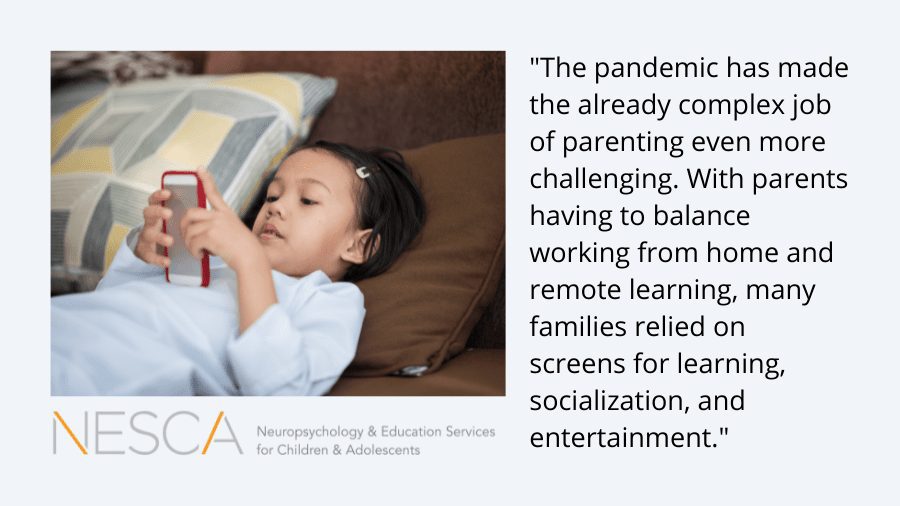
The pandemic has made the already complex job of parenting even more challenging. With parents having to balance working from home and remote learning, many families relied on screens for learning, socialization, and entertainment. Questions about screen time and the impact on child development were already hot topics in our digital age, but the pandemic brought about new and perhaps more compelling concerns.

It is common for children of all ages to engage with digital devices. Even prior to the pandemic, approximately 80% of parents reported that their child between the ages of five and 11 interacted with a tablet or computer, and 63% used a smartphone. For children under the age of five, 48% engaged with a tablet or computer, and 55% with a smartphone (pewresearch.org, July 2020).

While screens are an inevitable part of 21st century life, too much screen time can have a detrimental impact on child development. The American Academy of Pediatrics recommends no screen time for children younger than two years of age. Older children should limit their screen time to no more than one or two hours a day. According to the American Academy of Pediatrics, too much screen time can be linked to:

  • Obesity
  • Irregular sleep
  • Behavioral problems
  • Impaired academic performance
  • Desensitization to violence
  • Less time for play

It has been established that excessive screen time may lead to obesity due to inactivity and increased snacking that often coincides with screen use. Using screens too close to bedtime may disrupt the body’s biological preparation for sleep, making it difficult to fall asleep and disrupting sleep schedules. Research has shown that elementary school students who spend more than two hours a day watching TV, playing video games or using a computer or smartphone are more likely to have emotional, social, and attention problems. Furthermore, increased time spent on screens results in less time available for learning and practicing skills important for academic and social development. Such skills include, but are not limited to, managing emotions and behavior, paying attention, solving problems effectively and independently, dealing with conflict, and resilience. So, what is the remedy? Limited screen time and more opportunities for play.

The benefits of play are almost limitless. Play is brain building and leads to changes in even the smallest structures. Play develops skills in planning and organization, cooperation, self-control, and communication. Often play involves trying and failing, and learning from mistakes, which enhances children’s capacity for solving problems and learning to focus attention, ultimately promoting the growth of executive functioning skills. Play also provides opportunities for learning to cope with adversity, resulting in increased resilience. There are many great blog articles on NESCA’s website offering information and tips for engaging in play and its benefits. They are written from a range of perspectives, which aids in understanding the wide-ranging value of play.

References:

https://www.pewresearch.org/internet/2020/07/28/parenting-children-in-the-age-of-screens/

https://publications.aap.org/pediatrics/article/119/1/182/70699/The-Importance-of-Play-in-Promoting-Healthy-Child


About the Author

Dr. Cynthia Hess recently graduated from Rivier University with a PsyD in Counseling and School Psychology. Previously, she earned an M.A. from Antioch New England in Applied Psychology. She also worked as an elementary school counselor and school psychologist for 15 years before embarking on her doctorate. During her doctorate, she did her pre-doctoral internship with RIT in Rochester, N.Y. where she worked with youth ages 5-17 who had experienced complex developmental trauma. Dr. Hess’s first post-doctoral fellowship was with The Counseling Center of New England where she provided psychotherapy and family therapy to children ages 5-18, their families and young adults. She also trained part-time with a pediatric neuropsychologist conducting neuropsychological evaluations.


To schedule an appointment with one of NESCA’s expert neuropsychologists, please complete our online intake form


Neuropsychology & Education Services for Children & Adolescents (NESCA) is a pediatric neuropsychology practice and integrative treatment center with offices in Newton and Plainville, Massachusetts, and Londonderry, New Hampshire, serving clients from preschool through young adulthood and their families. For more information, please email info@nesca-newton.com or call 617-658-9800.


Transition Assessment: How to Prepare for the Team Meeting

By | NESCA Notes 2022

By: Kelley Challen, Ed.M., CAS
Director of Transition Services; Transition Specialist, NESCA

Every child who receives special education services in the United States is entitled to transition services—a coordinated set of activities that will facilitate the student’s preparation for postsecondary education and/or training, competitive employment, independent living, and community participation.[1] In order to provide these services, an IEP team has to first conduct “age-appropriate transition assessment.”[2] I have written about transition assessment in previous blogs, including Transition Assessment: What is it anyway? How is it different from neuropsychological evaluation? and Vocational Assessment and Transition Planning.

A challenge for students and families who are participating in transition assessment for the first time, is knowing how to prepare for team meetings where transition planning and services will be discussed. When you attend a team meeting after an occupational therapy evaluation or academic evaluation, you know that you are going to be discussing what occupational therapy services or academic instruction your child may need as part of their IEP process. However, when a student has participated in transition assessment, the team will be discussing a whole variety of activities (e.g., regular and specialized instruction, related services, community experiences, linkage to adult human service agencies) that the student will need to participate in as the student is preparing for adulthood. Some transition assessment reports contain dozens of recommendations for comprehensive planning. Recommendations may include activities that you are used to discussing with your team, such as instruction and services for a current IEP period, but recommendations may also include other activities that should occur outside of school with support from a parent or community member or actions that may need to occur at a later date. To make the most of your team meeting, it is helpful to do a little bit of homework and preparation after you receive your transition assessment report.

As discussed in previous blogs, if the student is going to be part of the team meeting (which they should be), then the student should have the opportunity to discuss the assessment results with the evaluator or another trusted adult. If your school district conducted the transition assessment, ask when and how they are going to review the results with the student prior to the meeting. If you obtained an independent or private evaluation, ask if you can schedule a student feedback meeting with that evaluator prior to the student’s team meeting. Students need to be aware of the findings and the recommendations that are being made, and they need to be prepared to actively participate in discussion about the results. Whether a student supports or disagrees with recommendations from a transition assessment can have a large impact on changes that are made, or not made, to the IEP.

In addition to student preparation, all team members should be prepared to discuss the assessment recommendations in a planful and organized manner. As a parent, it is helpful to read each recommendation in the report and consider the following questions:

  • Is this a skill or activity that you can reasonably tackle at home this year or in coming years? Do you need any training or consultation to be able to support the student?
  • Is this a skill or activity that would be best supported by a community provider rather than a parent, family member, or school staff?
  • Is this a skill or piece of knowledge that the student must attain this academic year in order to make progress toward their long-term goals? Do they need specialized instruction or related services to learn the skills or gain this knowledge?
  • Is this a skill, piece of knowledge, or service that needs to be focused on at a later time, but documented somewhere so that the team does not forget the recommendation?

It can be helpful to put together an abbreviated list of the goals, objectives, or services that you know your child will need this school year based on the assessment. Alternatively, some families find it useful to create a table or grid to organize transition planning activities. Here is one possible presentation that a family might use to prepare for a team meeting.


  Parent Community Providers School/IEP
Education/Training ·   Tour three colleges

·   Attend summer program on college campus

·   Counseling on enrollment process for postsecondary educational programs with Pre-Employment Transition Service (Pre-ETS) provider ·   Update postsecondary goals

·   Instruction of Study Skills, including notetaking

·   Assistive technology consultation

·   Personal Finance course

·   Sexual Health Instruction

Employment ·   Create first student resume

·   Set up informational interview with family friend who works as an accountant

·   Self-advocacy counseling with Pre-ETS provider ·   Help student obtain work permit

·   Support student in applying for paid part-time work

Independent Living ·   Review family health history

·   Teach student to complete medical history paperwork

·   Prepare questions with student ahead of medical appointments

·   Assist student in opening checking account

·   Include student in home maintenance activities

·   Individual counseling


·   Instruction in tracking sleep hygiene, diet, and exercise activities

·   Assistive technology consultation for health habits

Community Engagement ·   Support student in learning to carry out personal shopping activities ·   Social skills group with insurance-based provider

·   Study for driver’s permit test with Transition to Adulthood Program (TAP) provider

·   Travel orientation with local public transit authority

·   Make referral to Vocational Rehabilitation (VR) service provider

·   Invite VR service provider to team meeting with parent & student consent


It is also helpful to consider how the information from the transition assessment can flow through the IEP document. Information learned about the student’s postsecondary goals (i.e., the student’s goals for their life after high school) must be documented in the IEP and used to guide IEP development. Portions of the assessment may also be included as key evaluation results and current performance data, may inform how the team considers various federal and state special factors such as the students need for assistive technology or more functional means of communication, may suggest linkages that are needed with state resources and adult human service agencies, and may inform other aspects of the IEP. It is important to think about each section of your child’s IEP and how the assessment results might impact the team’s discussion of that section.

Many schools and families are familiar with transition assessment services at NESCA but do not realize that our transition specialists will consult with students, parents, and teams to plan for transition assessments, review assessments that have been conducted by other clinicians, or support the team meeting process. For more information about transition planning, consultation, and assessment services at NESCA, visit our transition services page and our transition FAQs.

[1] https://sites.ed.gov/idea/regs/b/a/300.43

[2] https://sites.ed.gov/idea/regs/b/d/300.320/b


About the Author
Kelley Challen, Ed.M., CAS, is NESCA’s Director of Transition Services, overseeing planning, consultation, evaluation, coaching, case management, training and program development services. Ms. Challen also provides expert witness testimony in legal proceedings related to special education. She is also the Assistant Director of NESCA, working under Dr. Ann Helmus to support day-to-day operations of the practice. Ms. Challen began facilitating programs for children and adolescents with special needs in 2004. After receiving her Master’s Degree and Certificate of Advanced Study in Risk and Prevention Counseling from Harvard Graduate School of Education, Ms. Challen spent several years at the MGH Aspire Program where she founded an array of social, life and career skill development programs for teens and young adults with Asperger’s Syndrome and related profiles. She additionally worked at the Northeast Arc as Program Director for the Spotlight Program, a drama-based social pragmatics program, serving youth with a wide range of diagnoses and collaborating with several school districts to design in-house social skills and transition programs. Ms. Challen is co-author of the chapter “Technologies to Support Interventions for Social- Emotional Intelligence, Self-Awareness, Personality Style, and Self-Regulation” for the book Technology Tools for Students with Autism. She is also a proud mother of two energetic boys, ages six and three. While Ms. Challen has special expertise in supporting students with Autism Spectrum Disorders, she provides support to individuals with a wide range of developmental and learning abilities, including students with complex medical needs.


Neuropsychology & Education Services for Children & Adolescents (NESCA) is a pediatric neuropsychology practice and integrative treatment center with offices in Newton, Massachusetts, Plainville, Massachusetts, and Londonderry, New Hampshire, serving clients from preschool through young adulthood and their families. For more information, please email info@nesca-newton.com, call 617-658-9800 or complete our online Intake Form.

Pediatric Neuropsychologist Maggie Rodriguez, Psy.D., Joins NESCA

By | NESCA Notes 2022

By: Jane Hauser
Director of Marketing & Outreach

In today’s blog, I have the pleasure of introducing you to NESCA Pediatric Neuropsychologist Maggie Rodriguez, Psy.D., who recently joined our team of expert clinicians.

How did you discover your interest in neuropsychology?

It was a long and winding road! I went into college, interested in a wide range of subject areas, including medicine. Eventually, I realized my area of interest was truly in psychology. I discovered that I really enjoyed neuropsychological evaluations, since they combined my interests in psychology, neuroscience, working with medical providers, educators, as well as writing and the creativity involved in making a child come alive in a report.

In graduate school, I was fortunate to learn from a number of extremely talented neuropsychologists in a variety of settings. While completing a placement at Children’s Hospital Boston, I remember hearing my very wise supervisor say that, “one year in the correct school placement is worth two years of therapy.” As I continued on with my coursework and clinical training, I repeatedly saw the truth in that statement. I witnessed the value of nuanced neuropsychological assessment in allowing students to receive accurate diagnoses and, in turn, the correct academic accommodations and interventions. I wanted to be part of that, not only to help children and teens succeed academically but to prevent the secondary effects that undiagnosed and untreated learning disorders, neurodevelopmental disorders, and cognitive challenges can have on emotional health, self-esteem, and social functioning.

On the personal side, my interest in neuropsychology was sparked again when I had my own child evaluated. It was surprisingly powerful to go through the process on the parent side, and after taking some time off to have a family, I knew that I wanted to get back into neuropsychology again!

Why did you choose to come to NESCA when re-entering your professional career?

There were several reasons that I looked into NESCA and ultimately opted to join its team. I learned about NESCA while researching neuropsychologists for my child’s evaluation and was impressed with what I saw. Additionally, one of my former testing supervisors told me NESCA is among the best in the business. Having that kind of endorsement from such a trusted source provided me with great confidence being part of NESCA.

I also was really drawn in by NESCA’s emphasis on the continued growth and learning for its clinicians. It was obvious that NESCA is comprised of a highly invested and collaborative team. Every one of us has a lot to learn still, and I valued the opportunity for not just a job, but the continued learning.

NESCA also offers a great work/life balance. Having a family of my own and parents who are approaching the stage where they also require care is a lot to balance. NESCA’s emphasis on supporting its staff in balancing work and life has made it very rewarding. I’ve seen several examples of how the culture of understanding is very much active.

On a very practical level, having clear protocols for handling day-to-day Covid strategies, like masking, cleaning, etc., has been comforting. Returning to clinical work in the midst of a pandemic has been a big transition, and knowing NESCA has put in place measures for keeping staff and clients safe is tremendously important to me. Seeing the creativity and agility in the way the team here tackled the larger challenges—evaluating clients safely and in-person—during Covid was inspiring and told me a lot about the team and culture. Learning that NESCA adapted its methods of testing via the two-office model demonstrated to me that they, as a practice, they are able to roll with those kinds of challenges. That was also very reassuring.

Finally, the interview process provided me with the chance to speak with a number of NESCA’s clinical staff. I was able to get a great feel for the culture and high standards the practice has, which made me confident that this was the right fit for me.

What kinds of concerns do you evaluate or enjoy the most?

I really enjoy working with kids of varying ages, but I do have a keen interest in working with families and children who are just hitting the adolescent years. I get the opportunity to help them understand how all the, sometimes confusing, pieces fit together.

I really enjoy working with kids who may be deemed as “complicated,” where things may have previously been overlooked. Maybe things were going fine for them until they hit a wall academically. Perhaps they got to middle school or high school or even college and began to wonder why things seemed to be falling apart for them. I enjoy the challenge of working with kids who are experiencing executive function deficits, social communication issues, kids whose disability or disabilities are not as straightforward. I like to tease apart whether there are executive function (EF) issues, Attention-Deficit/Hyperactivity Disorder (ADHD), or sensory integration challenges…or perhaps explore whether it could be something else altogether. Is a child’s rigidity due to anxiety, an Autism Spectrum Disorder (ASD), Obsessive-Compulsive Disorder (OCD), cognitive issues or a combination of overlapping challenges? I love teasing all of these things apart. I also work with children whose families have concerns about potential language-based learning disabilities (LBLD), communication issues and challenges with social pragmatics.

It’s incredibly rewarding when you are able to help families understand answers to these kinds of questions that they may have been grappling with for a long time.


About Pediatric Neuropsychologist Maggie Rodriguez, Psy.D. 

Maggie Rodriguez, Psy.D., provides comprehensive evaluation services for children, adolescents, and young adults with often complex presentations. She particularly enjoys working with individuals who have concerns about attention and executive functioning, language-based learning disorders, and those with overlapping cognitive and social/emotional difficulties.

Prior to joining NESCA, Dr. Rodriguez worked in private practice, where she completed assessments with high-functioning students presenting with complex cognitive profiles whose areas of weakness may have gone previously undiagnosed. Dr. Rodriguez’s experience also includes pre- and post-doctoral training in the Learning Disability Clinic at Boston Children’s Hospital and the Neurodevelopmental Center at MassGeneral for Children/North Shore Medical Center. Dr. Rodriguez has spent significant time working with students in academic settings, including k-12 public and charter school systems and private academic programs, such as the Threshold Program at Lesley University.

Dr. Rodriguez earned her Psy.D. from William James College in 2012, where her coursework and practicum training focused on clinical work with children and adolescents and on assessment. Her doctoral thesis centered on cultural issues related to evaluation.

To book a neuropsychological evaluation with Dr. Rodriguez or another expert neuropsychologist at NESCA, complete NESCA’s online intake form

Neuropsychology & Education Services for Children & Adolescents (NESCA) is a pediatric neuropsychology practice and integrative treatment center with offices in Newton and Plainville, Massachusetts, as well as Londonderry, New Hampshire. NESCA serves clients from preschool through young adulthood and their families. For more information, please email info@nesca-newton.com or call 617-658-9800.

Testing the Limits

By | NESCA Notes 2022

By: Ann Helmus, Ph.D.
NESCA Founder/Director; Clinical Neuropsychologist

In the world of assessment, “testing the limits” means essentially bending the rules of test administration in order to see if the change in administration allows the test-taker to demonstrate their knowledge more effectively. For example, some children and adolescents respond impulsively to multiple-choice tests, picking the first choice that appears to be correct without looking at all of the choices. Standardized test administration dictates that the evaluator accepts that impulsive response and, as such, impulsivity will compromise the client’s score.

In the example above, the student was unable to demonstrate their knowledge or skills effectively on tests because of the standardized administration procedures. While it is important to generate these scores, it is also important to gain an understanding of what the student actually knows, and this is where testing the limits comes in. For the impulsive student, the evaluator would test the limits by reminding the student to slow down and look at all the choices before responding. This is non-standard test administration, and so the score is not considered valid but the results give us a great deal of information about the student’s strengths and weaknesses. There is a big difference between the student who is able to achieve the correct score when cued to slow down and the student who still answers incorrectly, even with reminders to slow down. The former student can be said to have much higher potential than the latter student. However, their ability to demonstrate their potential is hampered by impulsivity, a problem that needs to be addressed.

In the course of most neuropsychological evaluations, we are trying to understand the student’s profile of strengths and weaknesses, which often requires testing the limits. This raises the question of the value of the standardized scores. The standardized scores likely reflect the level at which the child or adolescent is functioning in the “real world.” Impulsive test-takers are almost certainly impulsive students; just as they don’t demonstrate their true potential in testing, they are not doing so in school.

Many students are able to fully demonstrate their skills and knowledge with standardized testing and don’t require “testing the limits.” However, at NESCA, we also see many highly complex students whose ability to access their potential is limited by issues of attention, executive functioning, communication, or emotional/behavioral regulation. In these cases, we routinely “test the limits” and report both standardized administration and non-standardized (“testing the limits”) scores and explain what these scores mean for the individual, what the scores tell us about daily functioning as well as untapped potential.


About the Author
NESCA Founder/Director Ann Helmus, Ph.D. is a licensed clinical neuropsychologist who has been practicing for almost 20 years. In 1996, she jointly founded the  Children’s Evaluation Center (CEC) in Newton, Massachusetts, serving as co-director there for almost ten years. During that time, CEC emerged as a leading regional center for the diagnosis and remediation of both learning disabilities and Autism Spectrum Disorders.

In September of 2007, Dr. Helmus established NESCA (Neuropsychology & Education Services for Children & Adolescents), a client and family-centered group of seasoned neuropsychologists and allied staff, many of whom she trained, striving to create and refine innovative clinical protocols and dedicated to setting new standards of care in the field.

Dr. Helmus specializes in the evaluation of children with learning disabilities, attention and executive function deficits and primary neurological disorders. In addition to assessing children, she also provides consultation and training to both public and private school systems. She frequently makes presentations to groups of parents, particularly on the topics of non-verbal learning disability and executive functioning.

To book an evaluation with Dr. Helmus, NESCA Founder and Director, or one of our many other expert neuropsychologists, complete NESCA’s online intake form

Neuropsychology & Education Services for Children & Adolescents (NESCA) is a pediatric neuropsychology practice and integrative treatment center with offices in Newton and Plainville, Massachusetts, as well as Londonderry, New Hampshire. NESCA serves clients from preschool through young adulthood and their families. For more information, please email info@nesca-newton.com or call 617-658-9800.
My child is nonverbal. Should I still get a neuropsychological evaluation?

By | NESCA Notes 2022

By: Erin Gibbons, Ph.D.
Pediatric Neuropsychologist, NESCA

The short answer to this question is YES. As a neuropsychologist, I enjoy evaluating students who have complex profiles, including intellectual/developmental disabilities, genetic conditions, and medical complexities. In many cases, these students have been deemed “untestable” and have never had a comprehensive evaluation.

This is problematic for two major reasons.

  • First, we cannot understand a student’s potential if we have no data or assessments available. Following from this, it is very hard to develop realistic and measurable goals without using the student’s innate potential to guide those goals.
  • Second, lack of testing causes practical and logistical problems later in the student’s life. As a child approaches adulthood at 18, it is necessary to have documentation of their cognitive and adaptive skills as well as diagnoses in order to seek adult services. More specifically, the Department of Developmental Services (DDS) requires documentation of intellectual disabilities prior to age 18.

Having assessed thousands of children and adolescents over the years, I’ve learned that I can ALWAYS gather important information from a neuropsychological evaluation. I have evaluated students who are nonverbal, students with severe intellectual disabilities, students with limited to no motor abilities, students with vision and hearing impairments, students with severely challenging behaviors…. In every case, a neuropsychological evaluation has been meaningful and useful in terms of A) understanding the student’s capabilities, and B) developing educational and treatment goals.

It is important to understand that a neuropsychological evaluation with a more developmentally complex student will look different than an evaluation with a neurotypical student. There are standardized tests that I will not be able to administer based on the student’s language skills, motor abilities, and academic knowledge. Some students can only tolerate 20 or 30 minutes of testing at a time, so the evaluation is broken into 9 or 10 sessions. Some students provide their responses using a communication device. Some students need to be supported by a behavior therapist to help them maintain a safe body.

In some cases, students cannot engage in any standardized tests due to multiple disabilities. However, I still have them come into my office at least once so that I can meet them in person and gather information about their communication skills, social interest, and activity levels. I will then spend time observing the student at their educational program, interviewing school-based staff, and gathering information from the student’s caregivers about their skills at home. With all of these data points, I can then provide a thorough set of recommendations for school-, community-, and home-based goals – even though I might not have “valid” standard scores.

For all of the families who think that a neuropsychological evaluation cannot be done with their child for one reason or another, I urge you to reconsider your perception of the purpose of an evaluation. In these cases, the emphasis of the evaluation is not on test scores, but on developing a better understanding of the student’s strengths and weaknesses. More importantly, the evaluation should be used as a reference to guide treatment goals to help the student achieve the highest level of independence of which they are capable based on their potential.


About the Author

Erin Gibbons, Ph.D. is a pediatric neuropsychologist with expertise in neurodevelopmental and neuropsychological assessment of infants,

children, and adolescents presenting with developmental disabilities including autism spectrum disorders, Down syndrome, intellectual disabilities, learning disabilities, and attention deficit disorders. She has a particular interest in assessing students with complex medical histories and/or neurological impairments, including those who are cognitively delayed, nonverbal, or physically disabled. Dr. Gibbons joined NESCA in 2011 after completing a two-year post-doctoral fellowship in the Developmental Medicine Center at Boston Children’s Hospital. She particularly enjoys working with young children, especially those who are transitioning from Early Intervention into preschool. Having been trained in administration of the Autism Diagnostic Observation Schedule (ADOS), Dr. Gibbons has experience diagnosing autism spectrum disorders in children aged 12 months and above.


If you are interested in booking an appointment for the ASD Diagnostic Clinic or an evaluation with a NESCA neuropsychologist/clinician, please fill out and submit our online intake form


Neuropsychology & Education Services for Children & Adolescents (NESCA) is a pediatric neuropsychology practice and integrative treatment center with offices in Newton and Plainville, Massachusetts, and Londonderry, New Hampshire, serving clients from preschool through young adulthood and their families. For more information, please email info@nesca-newton.com or call 617-658-9800.

Transition Planning: The Important Difference Between Postsecondary Goals and Annual Goals

By | NESCA Notes 2022

By: Kelley Challen, Ed.M., CAS
Director of Transition Services; Transition Specialist, NESCA

One of the most important aspects of transition planning for students with individual education programs (IEPs)—and for every student—is development of postsecondary goals. These goals are often described synonymously as the student’s postsecondary vision: the outcomes that the student and their IEP team expects the student to achieve after exiting public education. Legally, every IEP in the country needs to include explicit postsecondary goals in the areas of education or training, employment, and independent living, when appropriate. In Massachusetts, students need to have goals for Independent Living as well as Community Engagement. Because this topic is so important, I previously wrote a blog describing the importance of measurable postsecondary goals including a formula for writing such goals.

But, two years later, I am still finding that this is a misunderstood aspect of the IEP process, particularly here in Massachusetts. This is in some ways because our state IEP was not designed with transition planning or student-centered planning at the foundation. Currently, when you read an IEP from Massachusetts, there is only one section of the IEP used for describing the Vision Statement for the student. For students under the age of 14, this section is typically used to describe what the parents and team hope and dream for the student over the next 1-to-5-year period. But then, no later than when the student turns 14, we use the same section of the IEP to write out the student’s vision statement for after high school, and that statement legally needs to reflect the student’s preferences and interests and the student’s desired outcomes (i.e., postsecondary goals) for adult independent living and community engagement, work, and learning or training environments. For reference, this is the language currently in the Massachusetts IEP.

This shift is confusing! Parents are used to coming to IEP meetings ready to share their visions for their children, and students are often unprepared to share their goals for life after high school. But this shift is also absolutely critical for ensuring that students receive appropriate transition services. This is because every student on an IEP is legally entitled to participate in a coordinated set of activities that promotes their movement toward their postsecondary goals (i.e., their vision). These activities can include instruction, related services, community experiences, development of employment and post-school living objectives, and acquisition of daily living skills and functional vocational evaluation.[1] The only way a student can receive appropriate transition services, and an appropriately calibrated and coordinated set of transition activities, is if we clearly identify and define appropriate postsecondary (i.e., post-high school) goals for the student. And, these need to be listed out at the start of the IEP. In Massachusetts, these need to be listed in the vision statement.

Nevertheless, once we have done the important work of defining the student’s postsecondary goals or vision (which always involves transition assessment), then we have more important work to do. We have to make sure that the IEP that is developed includes necessary annual IEP goals, and related services, that will effectively support the student in making progress toward their postsecondary goals. We need to carefully crosswalk between each of the postsecondary goals set for the student and the annual goals we are developing. It is vital to make sure that there is at least one annual goal (or objective/benchmark within an annual goal) that addresses each of the student’s measurable postsecondary goals. We are very good at making sure that each of the services a student receives relates to the annual goals a student is working on. But we rarely pay attention to whether each of the student’s measurable postsecondary goals (i.e., each of the goals listed in the student’s vision statements) is supported by an annual goal. Annual goals for transition-aged students need to be determined from two sources: the student’s disability-related needs AND the student’s measurable postsecondary goals. Annual goals and coursework for a student with autism and language-based issues should be different depending on whether the student intends to be an artist or a veterinarian technician. Goals should be different for a student who intends to be a licensed driver and a student who intends to use door-to-door van transportation. In all cases, the team needs to annually discuss what skills the student needs to build this year in order to be able to attain their postsecondary goals in the future. The team needs to make sure that each postsecondary goal that the student has is supported by the student’s annual goals. If this is not explicitly discussed at the team meeting, we are not effectively planning for the student—and we are not effectively supporting students in being able to plan for themselves.

For more information about postsecondary goals and annual IEP goals in Massachusetts, check out Technical Assistance Advisory SPED 2013-1: Postsecondary Goals and Annual IEP Goals in the Transition Planning Process from MA DESE: http://www.doe.mass.edu/sped/advisories/13_1ta.html


[1] https://sites.ed.gov/idea/regs/b/a/300.43


About the Author
Kelley Challen, Ed.M., CAS, is NESCA’s Director of Transition Services, overseeing planning, consultation, evaluation, coaching, case management, training and program development services. Ms. Challen also provides expert witness testimony in legal proceedings related to special education. She is also the Assistant Director of NESCA, working under Dr. Ann Helmus to support day-to-day operations of the practice. Ms. Challen began facilitating programs for children and adolescents with special needs in 2004. After receiving her Master’s Degree and Certificate of Advanced Study in Risk and Prevention Counseling from Harvard Graduate School of Education, Ms. Challen spent several years at the MGH Aspire Program where she founded an array of social, life and career skill development programs for teens and young adults with Asperger’s Syndrome and related profiles. She additionally worked at the Northeast Arc as Program Director for the Spotlight Program, a drama-based social pragmatics program, serving youth with a wide range of diagnoses and collaborating with several school districts to design in-house social skills and transition programs. Ms. Challen is co-author of the chapter “Technologies to Support Interventions for Social- Emotional Intelligence, Self-Awareness, Personality Style, and Self-Regulation” for the book Technology Tools for Students with Autism. She is also a proud mother of two energetic boys, ages six and three. While Ms. Challen has special expertise in supporting students with Autism Spectrum Disorders, she provides support to individuals with a wide range of developmental and learning abilities, including students with complex medical needs.


Neuropsychology & Education Services for Children & Adolescents (NESCA) is a pediatric neuropsychology practice and integrative treatment center with offices in Newton, Massachusetts, Plainville, Massachusetts, and Londonderry, New Hampshire, serving clients from preschool through young adulthood and their families. For more information, please email info@nesca-newton.com, call 617-658-9800 or complete our online Intake Form.

Skip to content