NESCA’s Newton, MA location has immediate availability for neuropsychological evaluations. Our MA clinicians specialize in the following evaluations: Neuropsychological; Autism; and Emotional and Psychological, as well as Academic Achievement and Learning Disability Testing.

Visit www.nesca-newton.com/intake for more information or to book an evaluation.

Tag

pediatric neuropsychology Archives - Page 5 of 18 - NESCA

Subscribe to NESCA Notes

Preparing for a College Visit

By | NESCA Notes 2024

By: Kelley Challen, Ed.M., CAS
Director of Transition Services, NESCA

With vacation weeks coming up in Massachusetts and New Hampshire, many local families—especially those with juniors in high school—are contemplating visits to college campuses. School vacation weeks in the spring are a great time to visit colleges because you can tour the campus at a point in time when students are engaged in a typical flurry of academic and extracurricular activities. Summer may allow for more convenient or peaceful tours, but it is not a time of year when the happenings on campus accurately reflect student life (unless there is a very active summer session). Instead, spring and fall are often considered the optimal seasons for campus visits. For those of you planning upcoming visits, here are a few tips to consider—especially if you are a student with a learning disability, autism, or a mental health diagnosis.

  • Sign up ahead of time for the tour through the college’s web site. Even if a college does not require registration, potential students should go ahead and register for the college tour so that they get “credit” for their visit. There are lots of metrics that count as part of the college admissions process, and one of these important variables is literally the number of times that a potential student makes contact with the college. Things like registering for a tour, emailing admissions, following the college on social media, visiting with college representatives at college fairs, and signing up to receive materials by mail or email can all be considered “points of contact” with the college and may help students to ultimately be accepted.
  • Be prepared to answer a few questions about yourself. Most college information sessions or tours will start with the admissions staff and/or tour guide introducing themself and asking a few questions about the students in the group. Students should be prepared to share things like their name, hometown, grade, potential major, and clubs or activities they might want to participate in during college. Not all of this information will be requested outright, but some will typically be part of introductions and more may be asked during a presentation or tour. For students who have a hard time answering questions on the spot, they will feel much more comfortable if they have thought about—and practiced—answering these questions before the tour. They can also be more actively involved. Terms like undergraduate, graduate, first-year, and transfer may also come up when visiting colleges, and it can be helpful to review some college vocabulary ahead of time so that students are not flustered in the moment.
  • Ask questions of your own! (But make sure you are asking the right people your questions.) Information sessions and college tours are typically facilitated by admissions staff and college students. These are the times when you are learning about the college in general and getting a sense of campus culture, facilities, and services available to all students on the campus. For legal reasons, college admissions and college disability supports are notably separate entities. This means that college information sessions and tours are not typically the time and place for accommodation- and disability-specific questions. So, what questions should you ask? Well, there are plenty of web-based resources that you can look to in order to create your own personal list of tour questions. Here are just a few you might find interesting:

Even if you have done online research about a college, it’s a good idea to ask a few questions about items that are important to you to see if things on campus are really as described. Also, if you are a student with a disability, you might ask some of the questions that get at culture and inclusion: What’s it like to be a new student on campus? How do you see the college demonstrate commitment to diversity and inclusion? What controversial issues have come up on campus?

  • Don’t panic if you don’t see yourself or your student in the tour guide. College tour guides are typically some of the highest performing, actively involved students at the college and are usually representative of an extreme rather than the “average” student. While these students are certainly a part of the campus and culture, it is important to get a sense of who else is on the campus. Take time to observe and talk with other students you see walking around on campus. If you can, circle back to an academic building in an area of interest and find a student to talk to there. Or just stop a few students around campus and ask informal questions (e.g., Why did you pick this college? What do you wish you could change? What do you do like about being a student here? What do you wish you knew before you started college here?).
  • Take time to eat on campus. Make time before or after your tour to eat in a main cafeteria or campus center. If you are going to be eating three meals a day on campus, its important to know what that experience will be like. Certainly, the food is important. You need to know if there are a variety of food options and that there is something you would be comfortable eating for all meals. Also, you want to get a sense of the atmosphere, including how crowded it is and how easy it is to find a table.
  • If you are just getting started on your college search process and do not have a set list of schools yet, don’t worry. You can still get out and visit schools. I often suggest starting with different college archetypes (e.g., big school, little school, school spread out in a city, school with more defined campus, private, public, community, etc.). It can be good to just pick a few different school types, visit the colleges, and then do some real downloading of information and preferences immediately after the visits. I often ask students to do some ratings of colleges as they leave the schools so that they can quantify their “gut feeling” about a school and use that for comparison even if they aren’t sure exactly what it was that they liked or disliked. Even a bad college visit can help to determine some of the things that are most important about the college search process!

Embarking on college campus visits is a bit of a house hunting process—you are looking at potential academic homes. It can definitely be overwhelming, especially when it’s a process that you have not been through before and you may not know exactly what you want or what’s worth looking at. But you have to start somewhere. Following these suggestions should allow you to get a true sense of campus life and culture while also learning about yourself and your own preferences and values. Be prepared, but also trust yourself, and let each experience help you learn who you want to be as a future college student.


NESCA offers many services designed to help students bridge the transition from high school to college, work, and more independent adult life. Such services include executive function coaching, pre-college coaching, transition planning, and neuropsychological evaluation. To learn more specifically about our coaching services, visit: https://nesca-newton.com/coaching-services/ . NESCA also offers postsecondary transition consultation to families who want support identifying whether students are ready for college transition, or they may need a step in between or a scaffolded transition: https://nesca-newton.com/transition/#planning. To schedule an appointment with one of our expert clinicians or coaches, please complete our intake at: https://nesca-newton.com/intake/.


About the Author
Kelley Challen, Ed.M., CAS, is an expert transition specialist and national speaker who has been engaged in evaluation, development, and direction of transition-focused programming for teenagers and young adults with a wide array of developmental and learning abilities since 2004. While Ms. Challen has special expertise in working with youth with autism, she enjoys working with students with a range of cognitive, learning, communication, social, emotional and/or behavioral needs.

Ms. Challen joined NESCA as Director of Transition Services in 2013. She believes that the transition to postsecondary adulthood activities such as learning, living, and working is an ongoing process–and that there is no age too early or too late to begin planning. Moreover, any transition plan should be person-centered, individualized and include steps beyond the completion of secondary school.

Through her role at NESCA, Ms. Challen provides a wide array of services including individualized transition assessment, planning, consultation, training, and program development services, as well as pre-college coaching. She is particularly skilled in providing transition assessment and consultation aimed at determining optimal timing for a student’s transition to college, technical training, adult learning, and/or employment as well as identifying and developing appropriate programs and services necessary for minimizing critical skill gaps.

Ms. Challen is one of the only professionals in New England who specializes in assisting families in selecting or developing programming as a steppingstone between special education and college participation and has a unique understanding of local postgraduate, pre-college, college support, college transition, postsecondary transition, and 18-22 programs. She is additionally familiar with a great number of approved high school and postsecondary special education placements for students from Massachusetts including public, collaborative, and private programs.

Ms. Challen enjoys the creative and collaborative problem-solving process necessary for successfully transitioning students with complex profiles toward independent adulthood. As such, she is regularly engaged in IEP Team Meetings, program consultations, and case management or student coaching as part of individualized post-12th grade programming. Moreover, she continually works to enhance and expand NESCA’s service offerings in order to meet the growing needs of the families, schools and communities we serve.

When appropriate, Ms. Challen has additionally provided expert witness testimony for families and school districts engaged in due process hearings or engaged in legal proceedings centering on transition assessment, services and/or programming—locally and nationally.

Nearly two decades ago, Ms. Challen began her work with youth with special needs working as a counselor for children and adolescents at Camp Good Times, a former program of Milestones Day School. She then spent several years at the Aspire Program (a Mass General for Children program; formerly YouthCare) where she founded an array of social, life and career skill development programs for teens and young adults with Asperger’s Syndrome and related profiles. Also, she worked at the Northeast Arc as Program Director for the Spotlight Program, a drama-based social pragmatics program, serving youth with a wide range of diagnoses and collaborating with several school districts to design in-house social skill and transition programs.

Ms. Challen received her Master’s Degree and Certificate of Advanced Graduate Study in Risk and Prevention Counseling from the Harvard University Graduate School of Education. While training and obtaining certification as a school guidance counselor, she completed her practicum work at Boston Latin School focusing on competitive college counseling.

Ms. Challen has worked on multiple committees involved in the Massachusetts DESE IEP Improvement Project, served as a Mentor for the Transition Leadership Program at UMass Boston, participated as a member of B-SET Boston Workforce Development Task Force, been an ongoing member of the Program Committee for the Association for Autism and Neurodiversity (AANE), and is a member of the New Hampshire Transition State Community of Practice (COP).

She is also co-author of the chapter, “Technologies to Support Interventions for Social-Emotional Intelligence, Self-Awareness, Personality Style, and Self-Regulation,” for the book Technology Tools for Students with Autism: Innovations that Enhance Independence and Learning.

To schedule an appointment with one of NESCA’s transition specialists, please complete our online intake form

NESCA is a pediatric neuropsychology practice and integrative treatment center with offices in Newton, Plainville, and Hingham, Massachusetts; Londonderry, New Hampshire; the greater Burlington, Vermont region; and Brooklyn, NY (coaching services only) serving clients from infancy through young adulthood and their families. For more information, please email info@nesca-newton.com or call 617-658-9800.

Is My Child Neurodivergent, and What Does That Mean?

By | NESCA Notes 2024

By: Cynthia Hess, PsyD
Pediatric Neuropsychologist

One of society’s leading sources of information is social media, which can be an excellent source of information and support. Parents may turn to social media when they notice their child struggling, trying to find others with similar concerns or answers about why their child seems “different.” Additionally, many children, adolescents, and young adults who feel different or out of place seek and find people or ideas that resonate with them online. While it may put them at ease, it often leads parents and their children to question if there is a diagnosis that will help them understand their child or themselves. Increasingly, people are asking if it is autism or another neurodivergent condition.

Neurodivergence is a term used to describe individuals whose brains function differently from what is considered typical. Neurodivergence is a broad term describing neurodevelopmental disorders present at birth and lasting throughout one’s life. Identifying if your child is neurodivergent can be the first step in understanding their unique strengths and challenges. There are numerous neurodivergent conditions, such as autism spectrum disorder (ASD), attention-deficit/hyperactivity disorder (ADHD), dyslexia, and others, each with their own characteristics and support needs.

Recognizing signs of neurodivergence in children can vary depending on the specific condition, but some common indicators include:

  • Difficulty with social interactions and communication
  • Repetitive behaviors or intense interests
  • Sensory sensitivities or aversions
  • Challenges with attention and focus
  • Delayed speech or language development
  • Difficulties with organization and planning
  • Impulsivity or hyperactivity
  • Unusual reactions to sensory stimuli
  • Emotional regulation difficulties
  • Learning and academic challenges

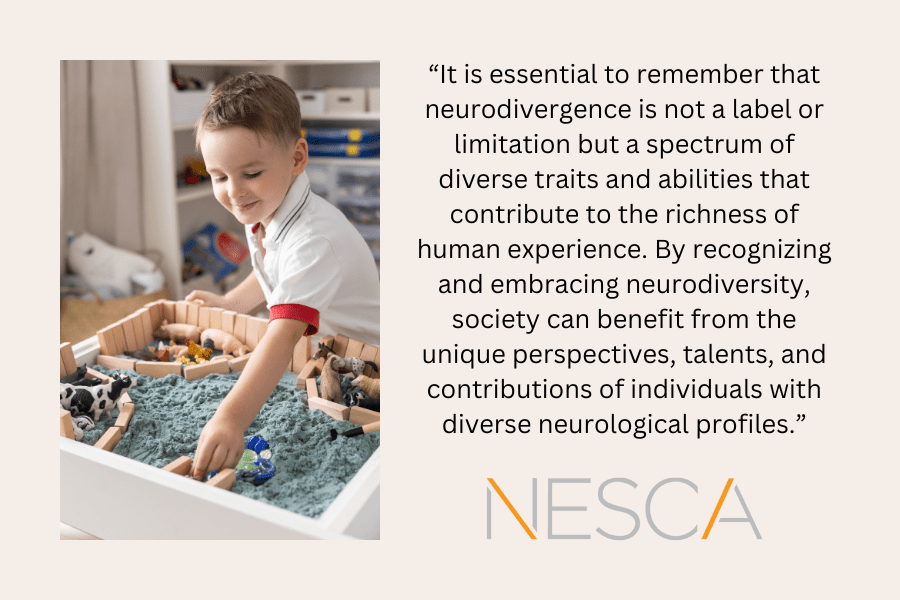
Observing patterns of behavior, communication, and sensory processing in your child can help indicate if they may be neurodivergent. Seeking a professional evaluation from a psychologist or developmental specialist can provide a more accurate diagnosis and guidance on supporting your child effectively. It is essential to remember that neurodivergence is not a label or limitation but a spectrum of diverse traits and abilities that contribute to the richness of human experience. By recognizing and embracing neurodiversity, society can benefit from the unique perspectives, talents, and contributions of individuals with diverse neurological profiles. Proper diagnosis, support, understanding, and accommodation are essential in helping neurodivergent individuals thrive and succeed in their lives.

About the Author

Dr. Cynthia (Cindy) Hess conducts neuropsychological evaluations as a pediatric neuropsychologist at NESCA. Dr. Hess enjoys working with children and young adults with complex emotional and behavioral profiles. She is skilled at evaluating social and emotional challenges as well as a range of learning profiles. Her experience allows her to guide families in understanding the supports and services their child requires to be successful in school.


To schedule an appointment with one of NESCA’s expert neuropsychologists, please complete our online intake form


NESCA is a pediatric neuropsychology practice and integrative treatment center with offices in Newton, Plainville, and Hingham, Massachusetts; Londonderry, New Hampshire; and staff in the greater Burlington, Vermont region and Brooklyn, New York, serving clients from infancy through young adulthood and their families. For more information, please email info@nesca-newton.com or call 617-658-9800.


Summer Planning for Teenagers

By | NESCA Notes 2024

By: Kelley Challen, Ed.M., CAS
Director of Transition Services, NESCA

March is an incredibly busy time in my household. Three out of four of our family members celebrate birthdays, winter sports turn into playoffs, and school events seem to pop up every week. March is also the time when we finalize our “summer camp plan” and manage lengthy online registration processes. If you have a teenager in the household, particularly a teen with a disability, you may also be thinking about summer and feeling particular pressure to “make the most” of the time while your child is still in high school. In case you are still scrambling for your own summer plan, I wanted to offer up several activities that are worth considering as part of your teen’s summer plan.

Get a paid summer job! Time and time again, research indicates that individuals who have paid employment in high school are more successful college students and more successful in obtaining employment as adults. If your child is college bound, having a paid work experience among their high school activities is a huge boost to their college applications. And, if not, paid work experiences teach soft skills for employment, help students figure out more about their career interests and preferences, and help to build meaningful resumes. Being able to do work that meets someone else’s standards is a vital life skill, and summer is an optimal time to build that skill.

Gain overnight experience. Students who plan to go to college but have never spent a night away from home need to know how they are going to handle that experience. There are all sorts of summer programs where students can spend time overnight, away from home, among peers. Overnight programs vary in length. Students who are just venturing out for the first time may feel most comfortable in a program that lasts a week or less, whereas other students may want a 3-week or 6-week experience. For college-bound students, I often recommend taking advantage of programs that happen right on college campuses in dorms. But there are also great programs outdoors or even travel programs in the United States or overseas. Knowing that you can spend the night away from family (and knowing what it’s like to “live” among a whole group of young people) is often a critical step in setting post-high school goals.

Use the time to build new executive functioning or emotional regulation skills. Students who struggle with executive functioning or emotional regulation often need coaching or therapy during the school year, just to keep up with school activities. However, students and families often reach out for these resources because they are already in crisis. A student will seek out an executive function coach when a student is already behind with assigned work or grades. Families often seek out therapy when an emotional crisis has occurred. School provides a number of executive functioning and emotional demands, so it can be hard for a coach or therapist to build new skills with a student while the student is also meeting those demands. Summer can be an optimal time to work more intensively to build new skills, strategies, and systems because it is a time when other demands are reduced. If your teen has a therapist, tutor, executive function coach, social pragmatic coach, or other support person who is helping them to tread water during the school year, it’s definitely worth asking whether intensive services over the summer might help the student to build skills that will last long-term and help the student be better prepared for the following school year.

Summer can also be a great time to tackle time-consuming activities, like completing the college application, drafting a college essay or two, cleaning out a bedroom or reorganizing study space, or building a new life skill, like driving, cooking, or mastering a laundry routine.

March is a great time to take stock of what your teenager wants to do after high school, what challenges might impede them smoothly transitioning to those activities, and thinking about how summer might be the perfect time to eliminate some of those challenges!

NESCA offers many services designed to help students bridge the transition from high school to college, work, and more independent adult life. Such services include executive function coaching, pre-college coaching, transition planning, and neuropsychological evaluation. To learn more specifically about our coaching services, visit: https://nesca-newton.com/coaching-services/. NESCA also offers postsecondary transition consultation to families who want support identifying the most meaningful ways for their student to spend the summer: https://nesca-newton.com/transition/#planning. To schedule an appointment with one of our expert clinicians or coaches, please complete our intake at: https://nesca-newton.com/intake/.


About the Author
Kelley Challen, Ed.M., CAS, is an expert transition specialist and national speaker who has been engaged in evaluation, development, and direction of transition-focused programming for teenagers and young adults with a wide array of developmental and learning abilities since 2004. While Ms. Challen has special expertise in working with youth with autism, she enjoys working with students with a range of cognitive, learning, communication, social, emotional and/or behavioral needs.

Ms. Challen joined NESCA as Director of Transition Services in 2013. She believes that the transition to postsecondary adulthood activities such as learning, living, and working is an ongoing process–and that there is no age too early or too late to begin planning. Moreover, any transition plan should be person-centered, individualized and include steps beyond the completion of secondary school.

Through her role at NESCA, Ms. Challen provides a wide array of services including individualized transition assessment, planning, consultation, training, and program development services, as well as pre-college coaching. She is particularly skilled in providing transition assessment and consultation aimed at determining optimal timing for a student’s transition to college, technical training, adult learning, and/or employment as well as identifying and developing appropriate programs and services necessary for minimizing critical skill gaps.

Ms. Challen is one of the only professionals in New England who specializes in assisting families in selecting or developing programming as a steppingstone between special education and college participation and has a unique understanding of local postgraduate, pre-college, college support, college transition, postsecondary transition, and 18-22 programs. She is additionally familiar with a great number of approved high school and postsecondary special education placements for students from Massachusetts including public, collaborative, and private programs.

Ms. Challen enjoys the creative and collaborative problem-solving process necessary for successfully transitioning students with complex profiles toward independent adulthood. As such, she is regularly engaged in IEP Team Meetings, program consultations, and case management or student coaching as part of individualized post-12th grade programming. Moreover, she continually works to enhance and expand NESCA’s service offerings in order to meet the growing needs of the families, schools and communities we serve.

When appropriate, Ms. Challen has additionally provided expert witness testimony for families and school districts engaged in due process hearings or engaged in legal proceedings centering on transition assessment, services and/or programming—locally and nationally.

Nearly two decades ago, Ms. Challen began her work with youth with special needs working as a counselor for children and adolescents at Camp Good Times, a former program of Milestones Day School. She then spent several years at the Aspire Program (a Mass General for Children program; formerly YouthCare) where she founded an array of social, life and career skill development programs for teens and young adults with Asperger’s Syndrome and related profiles. Also, she worked at the Northeast Arc as Program Director for the Spotlight Program, a drama-based social pragmatics program, serving youth with a wide range of diagnoses and collaborating with several school districts to design in-house social skill and transition programs.

Ms. Challen received her Master’s Degree and Certificate of Advanced Graduate Study in Risk and Prevention Counseling from the Harvard University Graduate School of Education. While training and obtaining certification as a school guidance counselor, she completed her practicum work at Boston Latin School focusing on competitive college counseling.

Ms. Challen has worked on multiple committees involved in the Massachusetts DESE IEP Improvement Project, served as a Mentor for the Transition Leadership Program at UMass Boston, participated as a member of B-SET Boston Workforce Development Task Force, been an ongoing member of the Program Committee for the Association for Autism and Neurodiversity (AANE), and is a member of the New Hampshire Transition State Community of Practice (COP).

She is also co-author of the chapter, “Technologies to Support Interventions for Social-Emotional Intelligence, Self-Awareness, Personality Style, and Self-Regulation,” for the book Technology Tools for Students with Autism: Innovations that Enhance Independence and Learning.

To schedule an appointment with one of NESCA’s transition specialists, please complete our online intake form

NESCA is a pediatric neuropsychology practice and integrative treatment center with offices in Newton, Plainville, and Hingham, Massachusetts; Londonderry, New Hampshire; the greater Burlington, Vermont region; and Brooklyn, NY (coaching services only) serving clients from infancy through young adulthood and their families. For more information, please email info@nesca-newton.com or call 617-658-9800.

Mindfulness-based Interventions for Children with ADHD

By | NESCA Notes 2024

By: Lauren Halladay, Ph.D.
Pediatric Neuropsychologist, NESCA

Children with Attention Deficit-Hyperactivity Disorder (ADHD) often struggle to sustain attention, follow directions, and appropriately interact with peers when compared to children with typical development. Executive functioning challenges, including difficulties with self-regulation, are also common in individuals with ADHD. Executive functioning refers to the neuropsychological-based functions involved in the regulation of behavioral states and the organization of goal-directed behavior. This can present as difficulty breaking down goals into steps, planning, monitoring the effectiveness of an approach to a task, modulating one’s emotions, etc.

Currently, evidence-based treatment methods for managing ADHD symptomology include medication, behavioral interventions, or the combination of the two. In addition, one domain that has received increased attention from the scientific community over the past several years is the integration of mindfulness-based interventions (MBI) within treatment (Felver & Jennings, 2016).

Mindfulness is the ability to bring one’s attention to experiences occurring in the present moment, which can allow an individual to consider alternative ways to perceive and react to a situation (Singh et al., 2007). Many MBI curriculums include lessons on focusing one’s attention on the present moment, which can improve individuals’ self-regulation, executive functioning, concentration, and emotional-reactivity, while reducing aggressive behavior, social problems, and anxiety (Keng et al., 2011; Parker et al., 2014).

One such curriculum, originally developed for adults with Intellectual Disabilities and aggressive behaviors, is Soles of the Feet (SoF) (Singh et al., 2003). The purpose of this exercise is to shift the individual’s attention from a typically triggering situation to a neutral stimulus. The SoF intervention involves teaching an individual to recognize situations that trigger an emotional response in real life or through role-play scenarios. Next, the individual is guided through steps in the curriculum that consist of finding a neutral body posture, breathing naturally while thinking about the triggering event, and shifting attention to the soles of the feet. Then the individual is guided to be mindful of their feet on the ground. The goal is for the individual to end this process having appropriately responded to the situation without engaging in behavior that was contrary to expectations. Research suggests that engaging in this intervention significantly improved participants’ ability to regulate their aggressive and disruptive behaviors, and appropriately engage with others (Felver et al., 2013; Singh et al., 2007).

There are several mindfulness-based activities, such as progressive muscle relaxation and focusing on your five senses, that can be modified to support children’s attentional and emotional regulation. For some ideas, please consider visiting the American Psychological Association (APA)’s Magination Press website, where they offer several children’s book titles related to a variety of topics, including mindfulness.

References

Felver, J. C., Doerner, E., Jones, J., Kaye, N., & Merrell, K. M. (2013). Mindfulness in school psychology: Applications for intervention and research. Psychology in the Schools, 50, 531–547

Felver, J. C., Celis-DeHoyos, C., Tezanos, K., & Singh, N. N. (2016) A systematic review of mindfulness-based interventions for youth in school settings. Mindfulness. doi:10.1007/s12671-015-0389-4

Keng, S. L., Smoski, M. J., & Robins, C. J. (2011). Effects of mindfulness on psychological health: a review of empirical studies. Clinical Psychology Review, 31(6), 1041-56.

Parker, A. E., Kupersmidt, J. B., Mathis, E. T., Scull, T. M., & Sims, C. (2014). The impact of Mindfulness education on elementary school students: evaluation of the Master Mind program. Advances in School Mental Health Promotion, 7(3), 184-204. doi:10.1080/1754730x.2014.916497

Singh, N. N., Wahler, R. G., Winton, Adkins, A. D., Myers, R. E., & The Mindfulness Research Group. (2003). Soles of the feet: A mindfulness based self-control intervention for aggression by an individual with mild mental retardation and mental illness. Research in Developmental Disabilities, 24, 158–169.

Singh, N. N., Lancioni, G. E., Winton, A. S. W., Singh, J., Curtis, W. J., Wahler, R. G., & McAleavey, K. M. (2007). Mindful parenting decreases aggression and increases social behavior in children with developmental disabilities. Behavior Modification, 31(6), 749-771. doi:10.1177/0145445507300924


About Lauren Halladay, Ph.D.

Dr. Halladay conducts comprehensive evaluations of toddlers, preschoolers, and school-aged children with a wide range of developmental, behavioral, and emotional concerns. She particularly enjoys working with individuals with Autism Spectrum Disorder, Intellectual and Developmental Disabilities, and complex medical conditions. She has experience working in schools, as well as outpatient and inpatient hospital settings. She is passionate about optimizing outcomes for children with neurodevelopmental disabilities by providing evidence-based, family-oriented care.


If you are interested in booking an appointment for an evaluation with a Dr. Halladay or another NESCA neuropsychologist/clinician, please fill out and submit our online intake form


NESCA is a pediatric neuropsychology practice and integrative treatment center with offices in Newton, Plainville, and Hingham, Massachusetts; Londonderry, New Hampshire; the greater Burlington, Vermont region; and Brooklyn, New York (coaching services only) serving clients from infancy through young adulthood and their families. For more information, please email info@nesca-newton.com or call 617-658-9800.

A Little Coaching for Caretakers Goes a Long Way When Building Executive Function Skills for Students

By | NESCA Notes 2024

By Jasmine Badamo, MA
Educational Counselor; Executive Function Coach

In my work as an executive function tutor, a priority is to foster collaborations with the other adults in my clients’ lives. Every relationship brings something different to a young person: different perspectives, areas of expertise, support abilities, opportunities for conflict management, etc. But while every person in your child’s life plays a unique role in their growth, family members often serve as the “control tower” for communication between the various environments of a child’s life. That’s why, of all the collaborations I engage in, parent/guardian collaboration can have the most significant impact on my clients’ executive functioning progress.

When I start working with an executive function client, I work to establish a clear line of communication with caregivers at the outset so they are well-informed of our session work. But direct parent/guardian coaching allows for collaboration on a much deeper and consistent level. Similar to executive function tutoring, parent/guardian coaching is regularly scheduled, has established goals, and serves as a space to discover and learn different strategies for supporting executive functioning skill development. Furthermore, because of the individualized nature of coaching, it can address a wide range of family needs, such as assistance with school documentation; brainstorming and creating home supports for a neurodivergent child; receiving reassurance and guidance in difficult-to-navigate or novel parenting situations; and managing your own daily demands so that you have more bandwidth for supporting your child, etc.

Here are some example situations demonstrating when and how parent/guardian coaching can have a big impact:

→ Your child is in elementary school and is still developing their self-awareness and ability to self-reflect. In their weekly executive function tutoring, they cannot always accurately self-report the daily demands they face or struggle with. You’ve set up brief weekly parent/guardian coaching in order to share important background/contextual updates that will help me direct my tutoring focus and strategy suggestions. I offer weekly tips that help you to practice accurate self-reflection with your child. It also allows you to share any new concerns that arise.

→ Your 9th grade child has been working with an executive function tutor for a little over a year now and has learned several executive function management strategies. They’ve reached the point in their development where they need to generalize their knowledge. You’ve decided to start parent/guardian coaching because you are uniquely positioned to support this generalization at home. I touch base with school staff to also support generalization at school.

→ Your high school child is struggling with executive functioning, and you want them to get support, but they are not open to meeting with an executive function tutor. You start parent/guardian coaching in order to learn concrete strategies to support your child with the executive function demands of school and home. The parent coaching is also helping you to reflect on the ways you can facilitate a better communication dynamic with your child.

As you can see in the above examples, even though the coaching sessions are attended by the parent/guardian, the purpose of the work is to supplement the executive function (EF) development of your child. Here are just a few ways in which parent/guardian coaching contributes to your child’s success. Coaching can:

→ help you further create a home environment that is supportive of your child’s EF needs and skill development

→ help you know how to “lend” your prefrontal cortex to your child in a way that reduces overwhelm, but still provides limits so that they have opportunities to develop and practice skills for managing EF tasks with greater independence

→ help you expand your strategies for responding to challenges or conflicts that arise while working on EF goals between tutoring sessions

→ help you know how to prioritize your focus in supporting your child’s goals (there are so many resources, it can be a challenge to know which to start with)

→ help you use strategies that promote a mindset of growth, reflection, and self-compassion (all important for your child’s EF skill development)

→ help normalize the act of receiving help and support. Your commitment to coaching models for your child the importance of getting support for your needs, being open to feedback, and embracing personal change/growth.

The list can go on because the opportunity to work with clients and caretakers in tandem offers exponential benefits for the client. What parent/guardian coaching does on a fundamental level is support families in developing a new filter, perspective, and framework for approaching and supporting the young person’s executive function needs.


About the Author

Jasmine Badamo, MA, is an educational counselor and executive function coach who works full-time at NESCA supporting students ranging from elementary school through young adulthood. In addition to direct client work, Ms. Badamo provides consultation and support to parents and families in order to help change dynamics within the household and/or support the special education processes for students struggling with executive dysfunction. She also provides expert consultation to educators, special educators and related professionals.

Ms. Badamo is a New York State Certified ENL and Special Education teacher. She has more than 10 years of teaching experience across three countries and has worked with students and clients ranging in age from 7 to adulthood. She earned her bachelor’s degree in Biological Sciences from Cornell University and her master’s degree in TESOL from CUNY Hunter College. She has also participated in graduate coursework focusing on academic strategies and executive function supports for students with LD, ADHD, and autism as part of the Learning Differences and Neurodiversity (LDN) certification at Landmark College’s Institute for Research and Training. In addition to being a native English speaker, Ms. Badamo is also conversationally fluent in verbal and written Spanish.

Having worked in three different New York City public schools, Ms. Badamo has seen firsthand the importance of executive function skills in facilitating student confidence and success. Her coaching and consultation work focuses on creating individualized supports based on the specific needs and strengths of each client and supporting the development of metacognition (thinking about one’s own thought processes and patterns), executive function skills, and independence. She will guide clients to generate their own goals, identify the barriers to their goals, brainstorm potential strategies, advocate for support when needed, and reflect on the effectiveness of their applied strategies.

Ms. Badamo is a highly relational coach. Building an authentic connection with each client is a top priority and allows her to provide the best support possible. Additionally, as a teacher and coach, Ms. Badamo believes in fostering strong collaborations with anyone who supports her clients including service providers, classroom teachers, parents, administrators, and community providers.

To book executive function coaching with Jasmine Badamo or another EF or Real-life Skills Coach at NESCA, complete NESCA’s online intake form

NESCA is a pediatric neuropsychology practice and integrative treatment center with offices in Newton, Plainville, and Hingham, Massachusetts; Londonderry, New Hampshire; the greater Burlington, Vermont region; and Brooklyn, New York (coaching services only) serving clients from infancy through young adulthood and their families. For more information, please email info@nesca-newton.com or call 617-658-9800.

Why is it so hard to develop Executive Function skills for college as a high school student?

By | NESCA Notes 2024

By: Kelley Challen, Ed.M., CAS
Director of Transition Services, NESCA

Students with disabilities often have challenges with executive function skills. These may include difficulties with organization, planning and prioritization, time management, task initiation, attention and effort, working memory, self-regulation, self-monitoring, and mental flexibility. Being successful as a college student often depends on using and integrating these skills. Therefore, it’s no surprise that most of the IEPs I read when working with teenage and young adult students have goals or objectives aimed at remediating executive function (EF) skills. However, many students on IEPs have these “EF” goals for years and still don’t effectively develop the skills they need to successfully manage executive functioning tasks as college students.

One of the reasons for the remaining skill gap when students matriculate to college is because high school student responsibilities are pretty radically different from college student responsibilities. While research indicates that individuals can continue developing executive function skills throughout the lifespan, this requires a very particular set of activities. Executive function skills develop through a combination of direct instruction and opportunities to practice using the learned skills with and without support. But there often are not opportunities for practicing the skills needed for college as a high school student.

Below is a list of executive function supports that exist in high school, but often disappear in college:

  • Classes are small and always taught by teachers
  • Class material is centralized in books or on the board in the classroom
  • Time is structured by the school
  • Students are told what they need to learn from homework
  • Students are reminded of assignments and due dates
  • Completed homework is checked by teachers
  • Reading is discussed in classes
  • Studying is limited to a few hours per week
  • Testing is frequent and covers small amounts of material
  • Teachers approach students who need help
  • Schools are required to find students with disabilities who need specialized instruction and accommodations
  • Parents and teachers will remind students of their responsibilities
  • Parents and teachers will help to set priorities (or simply set them for the student)
  • Parents and teachers will correct students when behavior is unexpected

In college, students may have large classes taught by other students or experts in their fields who aren’t experts on teaching. They have to use syllabi, manage their own schedules (with large swaths of unscheduled time), integrate academic materials from a wide range of sources, and self-direct long hours of reading and studying. They also have to be responsible for advocating for themselves, knowing when they need help, and knowing what they are responsible for (academically, socially, and in their dorms) and getting those things done without parent and teacher reminders. For students who have strengths with executive functioning, often the transition to college still presents a steep learning curve. But for those who have vulnerabilities in these areas, it can be critical to recognize that the gaps are large between these two learning environments, and sometimes additional support and instruction is necessary while students are taking college classes. Some students will still need to build effective academic and executive function skills, and practice and master those executive function skills, while they are in college and managing this new set of demands.

NESCA offers many services designed to help students bridge the transition from high school to college, including executive function coaching, pre-college coaching, transition planning, and neuropsychological evaluation. To learn more specifically about our coaching services, visit: https://nesca-newton.com/coaching-services/ . To schedule an appointment with one of our expert clinicians or coaches, please complete our intake at: https://nesca-newton.com/intake/ .

Reference:

Many of the bulleted items of executive function supports that exist in high school are adapted from this high school versus college comparison by King’s College: https://www.kings.edu/admissions/high_school_vs_college


About the Author
Kelley Challen, Ed.M., CAS, is an expert transition specialist and national speaker who has been engaged in evaluation, development, and direction of transition-focused programming for teenagers and young adults with a wide array of developmental and learning abilities since 2004. While Ms. Challen has special expertise in working with youth with autism, she enjoys working with students with a range of cognitive, learning, communication, social, emotional and/or behavioral needs.

Ms. Challen joined NESCA as Director of Transition Services in 2013. She believes that the transition to postsecondary adulthood activities such as learning, living, and working is an ongoing process–and that there is no age too early or too late to begin planning. Moreover, any transition plan should be person-centered, individualized and include steps beyond the completion of secondary school.

Through her role at NESCA, Ms. Challen provides a wide array of services including individualized transition assessment, planning, consultation, training, and program development services, as well as pre-college coaching. She is particularly skilled in providing transition assessment and consultation aimed at determining optimal timing for a student’s transition to college, technical training, adult learning, and/or employment as well as identifying and developing appropriate programs and services necessary for minimizing critical skill gaps.

Ms. Challen is one of the only professionals in New England who specializes in assisting families in selecting or developing programming as a steppingstone between special education and college participation and has a unique understanding of local postgraduate, pre-college, college support, college transition, postsecondary transition, and 18-22 programs. She is additionally familiar with a great number of approved high school and postsecondary special education placements for students from Massachusetts including public, collaborative, and private programs.

Ms. Challen enjoys the creative and collaborative problem-solving process necessary for successfully transitioning students with complex profiles toward independent adulthood. As such, she is regularly engaged in IEP Team Meetings, program consultations, and case management or student coaching as part of individualized post-12th grade programming. Moreover, she continually works to enhance and expand NESCA’s service offerings in order to meet the growing needs of the families, schools and communities we serve.

When appropriate, Ms. Challen has additionally provided expert witness testimony for families and school districts engaged in due process hearings or engaged in legal proceedings centering on transition assessment, services and/or programming—locally and nationally.

Nearly two decades ago, Ms. Challen began her work with youth with special needs working as a counselor for children and adolescents at Camp Good Times, a former program of Milestones Day School. She then spent several years at the Aspire Program (a Mass General for Children program; formerly YouthCare) where she founded an array of social, life and career skill development programs for teens and young adults with Asperger’s Syndrome and related profiles. Also, she worked at the Northeast Arc as Program Director for the Spotlight Program, a drama-based social pragmatics program, serving youth with a wide range of diagnoses and collaborating with several school districts to design in-house social skill and transition programs.

Ms. Challen received her Master’s Degree and Certificate of Advanced Graduate Study in Risk and Prevention Counseling from the Harvard University Graduate School of Education. While training and obtaining certification as a school guidance counselor, she completed her practicum work at Boston Latin School focusing on competitive college counseling.

Ms. Challen has worked on multiple committees involved in the Massachusetts DESE IEP Improvement Project, served as a Mentor for the Transition Leadership Program at UMass Boston, participated as a member of B-SET Boston Workforce Development Task Force, been an ongoing member of the Program Committee for the Association for Autism and Neurodiversity (AANE), and is a member of the New Hampshire Transition State Community of Practice (COP).

She is also co-author of the chapter, “Technologies to Support Interventions for Social-Emotional Intelligence, Self-Awareness, Personality Style, and Self-Regulation,” for the book Technology Tools for Students with Autism: Innovations that Enhance Independence and Learning.

To schedule an appointment with one of NESCA’s transition specialists, please complete our online intake form

NESCA is a pediatric neuropsychology practice and integrative treatment center with offices in Newton, Plainville, and Hingham, Massachusetts; Londonderry, New Hampshire; the greater Burlington, Vermont region; and Brooklyn, NY (coaching services only) serving clients from infancy through young adulthood and their families. For more information, please email info@nesca-newton.com or call 617-658-9800.

Sibling Stress: How to Support the Siblings of a Child with Emotional Needs

By | NESCA Notes 2024

By: Moira Creedon, Ph.D. 
Pediatric Neuropsychologist, NESCA

A child with significant mental health or developmental needs impacts the whole family system. The impact is multifaceted – from the way that a child interacts in the home environment to the challenging logistics of coordinating outpatient care and appointments. Families have to make sacrifices with their time, attention, and financial resources to address the mental health needs of one (and sometimes more than one) child. Families may also arrange schedules, including planning vacations or social events, for the family in order to accommodate treatment. It can add more stress when parents stop to consider: how is this impacting the other kids in the family?

To buffer siblings against negative impacts from being in the home with someone struggling with mental health:

  • Create an environment of safety and predictability. Talk in a family meeting about basic safety needs for the household – things like being safe with your body, being safe with property, and maintaining basic travel safety (e.g., staying buckled in the car). It is important that all siblings hear the rules and the consequences for violating the rules. If there is an episode of dysregulation, it can be very helpful to return to this conversation again.
  • Create a plan for when there is dysregulation. Remind your child/children without mental health concerns that the job of the parent is to re-establish safety, and where your other child/children should go while you address a problem. This can be their bedroom, basement playroom, or other identified place in the home. Take a moment to identify Plan B for where the safe place is if the dysregulation is happening in a common space. Talk to your child about what activities may distract and distance them from the commotion.
  • Remind your child what adults are available for them. If you are in a two-parent household, one parent can address dysregulation, and the other can stay with the sibling(s). If you are in a one-parent household (or a partner is not home), remind your child that they can call the other parent, aunt, uncle, grandparent, or identified friend or neighbor if they need some reassurance.
  • Put on your “oxygen mask” first. After an incident of dysregulation, check in with yourself as a parent to regulate emotionally before approaching your other child/children. Take a few moments for deep breaths or progressive muscle relaxation to calm your own nervous system. Once you are re-regulated, your message that safety has been re-established will be more soothing and believable.
  • Set aside time in each day to connect with each child. The focus can often be on positive connection with the child struggling. But, all children need the positive connection, praise, and child-driven interactions. This can help ensure that all children receive the attention they need to thrive.
  • Hold the frame. It can be easy to relax the rules with a sibling whose struggles and behavior may seem mild by comparison. It’s important to establish standards that work for each child’s unique skills and needs. It’s worth a candid conversation with each child about what the expectations are and why.
  • Use the village. Establishing a support system is critical to buffer the entire family from the overwhelming stress that can accompany emotional health issues. Enlist the support of other family members, neighbors, teammates’ families, or school personnel. If you feel that your support system is small, start with your child’s pediatrician or school to connect to community resources.
  • Reach out for help. It’s important to closely monitor siblings for signs of increased anxiety, stress response, low mood, or atypical behaviors. If you see classic signs of anxiety (fight/flight/freeze), reach out to your child’s school or pediatrician to evaluate symptoms and initiate treatment.

Additional resources to support siblings:


About the Author

Dr. Creedon has expertise in evaluating children and teens with a variety of presenting issues. She is interested in uncovering an individual’s unique pattern of strengths and weaknesses to best formulate a plan for intervention and success. With experiences providing therapy and assessments, Dr. Creedon bridges the gap between testing data and therapeutic services to develop a clear roadmap for change and deeper of understanding of individual needs.


If you are interested in booking an evaluation with Dr. Creedon or another NESCA neuropsychologist, please fill out and submit our online intake form


NESCA is a pediatric neuropsychology practice and integrative treatment center with offices in Newton, Plainville, and Hingham, Massachusetts; Londonderry, New Hampshire; the greater Burlington, Vermont region; and Brooklyn, NY (coaching services only) serving clients from infancy through young adulthood and their families. For more information, please email info@nesca-newton.com or call 617-658-9800.

Transition Goals: What are they and why do they matter in the IEP process?

By | NESCA Notes 2024

By: Kelley Challen, Ed.M., CAS
Director of Transition Services; Transition Specialist

As an evaluator and consultant, I spend a lot of time in team meetings. Usually, I expect to be invited to more of these at the beginning of the school year when teams meet to review assessments or important changes that have occurred during summer months. But May and June are also times when teams cram in meetings, especially for high school students who may be close to exiting public education. Therefore, it seems timely to write my blog on transition goals and their role in the IEP process.

For all students with individualized educational programs (IEPs), teams are accustomed to writing and implementing annual goals. But, for students 16 and older (or students who live in states where transition planning starts earlier such as students 14 and above in Massachusetts), their IEP process also needs to include transition goals. What is confusing about transition goals is that we commonly used this verbiage to describe a few different components of the IEP for transition-aged students.

In my opinion, the most important transition goals, are the measurable postsecondary goals, that are included in the IEP. These describe the outcomes that a team expects for the student to achieve after exiting public education and are based on the student’s own strengths, preferences, interests and vision. Every IEP across the country must include measurable postsecondary goals. In Massachusetts, postsecondary goals are documented in the student’s vision statement at the start of the IEP. For transition-aged students, the vision statement needs to include explicit statements about the outcomes that are expected for the student in transition planning areas. Postsecondary goals for education and/or training as well as employment are required for all students on IEPs, and many students will also have independent living and community participation goals. However, postsecondary goals and transition services are document differently in many states and it is important to familiarize yourself with the location of a student’s postsecondary goals in your own state’s IEP.

Below is a formula for writing a postsecondary goal that is adapted from the National Technical Assistance Center on Transition: The Collaborative (NTACT:C):


Within 2 months of graduation, Joseph will participate in supported employment training and community-based training with assistance from MA Department of Developmental Services. A few examples of measurable postsecondary goals are included below:

  • After earning her diploma, Sarah will attend a four-year college in Massachusetts or New Hampshire (and major in education or child development).
  • After graduation, Tom will work part-time at TJ Maxx with support from his coworkers and supervisor.
  • After high school, Joseph will use public transportation (e.g., subway, bus) to get to and from his apprenticeship.

Unlike annual goals, measurable postsecondary goals are not goals that will be achieved in the calendar year or even while the student is on an IEP. However, there is another type of “transition goal” that is closely related. Once an IEP team has clearly defined a student’s postsecondary goals, they are required to identify transition services that the student will need to make progress toward these goals. When the IEP is developed, the IEP must include annual IEP goals that clearly and directly relate to the student’s postsecondary goals and transition service needs. For example, a student who wants to attend college may need annual goals related to building executive functioning, self-advocacy and college-level academic skills; while a student who wants to use human service supports for community-based employment may need to build communication, self-regulation and work readiness skills. Annual IEP goals should be based on the student’s disability-related needs and also their postsecondary goals—Given the student’s disabilities, what skills does the student need to build this year to be able to attain their postsecondary goals in the future?

Special education is about preparing students for future education, employment, independent living and community engagement. Measurable postsecondary goals are how we make sure that special education is individualized for each student, and transition-related annual IEP goals are how we make sure we are progressing toward the postsecondary goals. When we know what the student wants for their adult postsecondary life, we can use the IEP process to help the student build academic and functional skills that can support the student in achieving that vision.

The next time you look at an IEP, take a look at the vision statement (or the section where your state records measurable postsecondary goals). Can you clearly tell what the student wants to do after high school? Are there both employment and education or training goals included? What about independent living and community engagement? These measurable postsecondary goals are the goalposts that provide direction for the IEP process and ensure that the team is working together to facilitate the student’s progress toward a meaningful adult life.

This link to a presenter’s guide for a presentation on Indicator 13 from NTACT:C is also a great resource for understanding the role of postsecondary goals and annual goals in the IEP process as outlined in IDEA: https://transitionta.org/indicator-13-presenter-guide/

For more information about postsecondary goals and annual IEP goals in Massachusetts, check out Technical Assistance Advisory SPED 2013-1: Postsecondary Goals and Annual IEP Goals in the Transition Planning Process from MA DESE: http://www.doe.mass.edu/sped/advisories/13_1ta.html. However, please note that the IEP will be changing in Massachusetts in Fall 2024 and postsecondary goals will be written on the first page of the document.


About the Author:

Kelley Challen, Ed.M., CAS, is an expert transition specialist and national speaker who has been engaged in evaluation, development, and direction of transition-focused programming for teenagers and young adults with a wide array of developmental and learning abilities since 2004. Since 2013, Ms. Challen has served as Director of Transition Services at NESCA, where she provides an extensive array of services including individualized transition assessment, planning, consultation, pre-college coaching, training, and program development services. She is particularly skilled in providing transition assessment and consultation for students with complex profiles who may not be able to engage easily with traditional and standardized testing tools. Ms. Challen received her Bachelor of Arts in Psychology as well as a Minor in Hispanic Studies from The College of William and Mary. She pursued her Master’s Degree and Certificate of Advanced Graduate Study in Risk and Prevention Counseling from the Harvard University Graduate School of Education. Ms. Challen has been actively involved in the MA DESE IEP Improvement Project, is a member of the Association of Autism and Neurodiversity (AANE) Program Committee and has mentored multiple transition specialist candidates in the Transition Leadership Certificate Program at UMass Boston. She is also co-author of the chapter, “Technologies to Support Interventions for Social-Emotional Intelligence, Self-Awareness, Personality Style, and Self-Regulation,” for the book Technology Tools for Students with Autism: Innovations that Enhance Independence and Learning. She is also the mother of two children and two puggles who continually help with her inventive and flexible thinking!

To schedule an appointment with one of NESCA’s transition specialists, please complete our online intake form.

NESCA is a pediatric neuropsychology practice and integrative treatment center with offices in Newton, Plainville, and Hingham, Massachusetts; Londonderry, New Hampshire; the greater Burlington, Vermont region; and Brooklyn, NY (coaching services only) serving clients from infancy through young adulthood and their families. For more information, please email info@nesca-newton.com or call 617-658-9800.

Why Do So Many Girls Get Diagnosed with ASD Later in Life?

By | NESCA Notes 2024

By: Renee Cutiongco Folsom, Ph.D.
Pediatric Neuropsychologist

In the 15 years that I have been doing neuropsychological evaluations, I have made countless diagnoses of Autism Spectrum Disorder (ASD) in females who are already in high school or even in college. Many times, the diagnosis comes as a surprise to the girls and the families alike, because no one has ever suggested it previously and/or their perceptions are colored by the stereotypes created in the media about autistic individuals. However, a discussion about what ASD is and how it manifests in females as opposed to males usually helps my clients and their families understand the nuanced and comprehensive nature of the ASD diagnosis. They often pivot to feelings of relief and gratitude for having a label for what they have been struggling with for a long time. Many of my clients learn to embrace this new diagnosis and use it as a framework for celebrating their strengths and looking for supports to address their vulnerabilities. They often say, “It totally makes sense!”

Autism Spectrum Disorder is a developmental disorder that manifests in challenges with social communication and interaction, and in the presence of repetitive, restricted behaviors that significantly impact functioning. When autism was first introduced by Dr. Leo Kanner in 1943, he described children (boys) who showed little interest in other people, insisted on routines, and displayed unusual body movements, like rocking back-and-forth and flapping their hands. Many of the children could talk but they rarely used their speech to communicate with others, and they had a variety of pervasive learning difficulties. For the most part, this continues to be the image that is conjured when people mention autism. However, with advances in research, especially within the last few decades, we have come to recognize the various manifestations of autism in children and adolescents who are higher functioning, have better communication skills, and have fewer learning issues. Thus, the newer conceptualization of autism as a spectrum with a wide range of capabilities and communication skills. More recently, researchers have also discovered that the presentation of autism varies in boys versus girls. This has made the diagnosis of ASD in girls difficult.

In their book Girls Growing Up on the Autism Spectrum, ASD researchers Shana Nichols, Ph.D., Gina Moravcik, MA, CCC-SLP, and Samara Pulver Tetenbaum, MA, outlined some preliminary findings of differences between males and females on the spectrum. They reported that:

  • The play of boys with ASDs is more restricted in range and more repetitive when compared to girls with ASDs who have stronger pretend-play skills.
  • Girls have stronger communication skills.
  • Sex-related social difficulties emerge over time – boys have more impairments early on (thus leading to earlier diagnoses), whereas for girls, the difficulties appear more in early adolescence.
  • Boys are more easily distracted when compared to girls.
  • Girls with mild difficulties may not be included in research samples.

They added that these differences could impact the assessment and diagnosis of ASD. They wondered if girls with ASD are being missed or overlooked during an evaluation because their presentation does not fit how professionals currently characterize ASD based on a male prototype. Other researchers have suggested that girls with ASD may be better able to compensate for symptoms despite having persistent core deficits associated with ASD, which might contribute to greater social “camouflage” or what is called “masking” (an individual hides or suppresses symptoms, behaviors, or difficulties). Indeed, as I have been learning more and working with girls diagnosed with ASD, I have been keeping in mind these potential sex differences. For example, I often compare my client’s social and communicative abilities to what is considered normative for girls their age and cognitive ability. I have been avoiding comparing my female clients with what has been the prototypical profile of autism in males. I also think about other manifestations of repetitive behaviors and interests in girls with ASD that are more socially acceptable, for example, an obsession on reading or running as opposed to preferred topics of males on the spectrum (e.g., trains, schedules, calendars, etc.).

Researchers have speculated that these differences in the manifestation of ASD in girls versus boys stem from how girls are socialized at an early age to pay attention to social cues/actions as opposed to boys. There is also research that suggests that girls are more able to follow social actions by delayed imitation. They observe and copy other children more effectively than do boys. This could lead to the phenomenon of masking and to milder presentations when compared to boys.

Sources:

Evans, S., et. al. (2019). Sex/gender differences in screening for autism spectrum disorder: Implications for evidence-based assessment. Journal of Clinical Child Adolescent Psychology, 48 (6), 840-854.

Nichols, S., Moravcik, G. & Tetenbaum, S. P. (2009). Girls growing up on the autism spectrum. London: Jessica Kingsley Publishers.

Ozonoff, S., Dawson, G. & McPartland, J. (2002). A parent’s guide to asperger syndrome and high functioning autism. New York: Guilford Press.


About the Author

Dr. Renee Cutiongco Folsom, Ph.D. has been working with families in the greater Boston area since 2015. Prior to this, she was on staff at Johns Hopkins University and trained at the University of California, Los Angeles (UCLA). She provides comprehensive neuropsychological evaluations of children, adolescents, and young adults who have learning, behavioral, and socio-emotional challenges. Her areas of expertise include Autism Spectrum Disorder and other conditions that usually co-occur with this diagnosis; Attention-Deficit/Hyperactivity Disorder; Dyslexia and other Specific Learning Disabilities; and Anxiety/Depression. She thinks that the best part of being a pediatric neuropsychologist is helping change the trajectory of children’s lives.

To schedule an appointment with one of NESCA’s pediatric neuropsychologists, please complete our online intake form

NESCA is a pediatric neuropsychology practice and integrative treatment center with offices in Newton, Plainville, and Hingham, Massachusetts; Londonderry, New Hampshire; and the greater Burlington, Vermont region, serving clients from infancy through young adulthood and their families. For more information, please email info@nesca-newton.com or call 617-658-9800.


College Myth Buster – Your Child’s 504 from High School Does Not Apply in College

By | NESCA Notes 2024

By: Kristen Simon, M.Ed, Ed.S
Transition Specialist; Psychoeducational Counselor

There can be a lot of confusion for students who have received special education services or accommodations in high school about what stays the same and what changes in college. Some high school families and staff know that if a student has received IEP services throughout school, the IEP does not travel with them to college. This is because an IEP is a document that is developed in accordance with IDEA, a special education law that affords protections to students with disabilities up until they graduate or age out of their local high school. When a student transitions to work or a college or university, this law is no longer relevant and the IEP essentially “expires.”

There is often greater confusion for families around whether colleges are required to follow 504 plans (i.e., accommodation plans) developed in high school. While it’s true that students with disabilities are protected by Section 504 of the Rehabilitation Act, it’s important to understand that high school 504 plans also effectively “expire” once a child graduates. Students can still receive accommodations under Section 504, but they are unlikely to hear the term “504” or to have any written “plan” related to their disability or those accommodations. There are some important differences between Section 504 mandates under subpart E (which covers postsecondary institutions) and those that fall under subpart D (which covers secondary schools). The key differences are described below:

  • Eligibility: Colleges and universities will have their own process for eligibility, and students have to be determined eligible by their university – even if they had been deemed eligible for accommodations in high school. Students will usually need documentation from a doctor or a psychologist that demonstrates the presence of a disability as well as how that disability substantially limits learning.
  • Available Accommodations: Colleges don’t have any obligation to provide the same services and accommodations that students may have received in high school, and not all of the accommodations provided by high schools are available at the college level. Moreover, different accommodations may be available at different colleges because the law mandates that the college provides accommodations which are “reasonable” and effective, not the best or most expensive.
  • Shift in Delivery: Professors will not automatically provide an accommodation as was the case in high school. Students have to seek out accommodations and can register for them after they are officially enrolled. At the college or university level, the expectation is that the young adult knows what support is available to them and that they self-advocate for the accommodations they need. Also, even if a student qualifies for an accommodation, they have to make the choice to actively use that accommodation – if they don’t advocate, they won’t get it.

Students should also know that while accommodations help, they can only go so far (e.g., if you don’t understand the content, having extra time on the exam won’t help). Students should be sure to connect with disability services to hear about tutoring options, academic coaching, writing centers, counseling supports, and anything else that is offered.

Resources:

U.S. Department of Education: Students with Disabilities Preparing for Postsecondary Education

Elizabeth Cohen Hamblet Learning Disabilities Consultant website: College Disability Accommodations Information – Elizabeth C. Hamblet (ldadvisory.com)


About the Author

Kristen Simon, M.Ed, Ed.S, has worked with transition-aged youth as a licensed School Psychologist for more than a decade. She has extensive experience working with children and adolescents with a range of learning and social/emotional abilities. Kristen’s strengths lie in her communication and advocacy skills as well as her strengths-based approach. She is passionate about developing students’ self-awareness, goal-setting abilities, and vision through student-centered counseling, psychoeducation, social skills instruction, and executive functioning coaching. Mrs. Simon has particular interests working with children and adolescents on the Autism spectrum as well as individuals working to manage stress or anxiety-related challenges.

Mrs. Simon is an expert evaluator and observer who has extensive working knowledge of the special education process and school-based special education services, particularly in Massachusetts. She has been an integral part of hundreds of IEP teams and has helped to coordinate care, develop goals, and guide students and their families through the transition planning process. Mrs. Simon further has special expertise helping students to learn about their diagnoses and testing and the IEP process in general. She enjoys assisting students, families, and educators in understanding a student’s disability-related needs as well as the strategies that can help the student to be successful in both academic and nonacademic settings. Mrs. Simon has often been a part of teams in the years when students are initially participating in transition services, and she has helped countless students to build the skills necessary to be part of their first team meetings. She is committed to teaching students—as well as parents and educators—how to participate in student-centered team meetings and the IEP processes.

At NESCA, Mrs. Simon works as a transition specialist and psychoeducational counselor. She works with adolescents, their families, and their school communities to identify and build the skills necessary to achieve their postsecondary goals. Mrs. Simon provides transition assessment (including testing, functional evaluations, and observations), program observations and evaluations, case management and consultation, and individualized counseling and skills coaching.


To schedule an appointment with one of NESCA’s transition specialists, please complete our online intake form


NESCA is a pediatric neuropsychology practice and integrative treatment center with offices in Newton, Plainville, and Hingham, Massachusetts; Londonderry, New Hampshire; and the greater Burlington, Vermont region, serving clients from infancy through young adulthood and their families. For more information, please email info@nesca-newton.com or call 617-658-9800.


Skip to content