To accommodate requests for neuropsychological evaluations after the start of the new school year, NESCA has added evaluation dates in its Newton, MA office. Immediate openings are now available for scheduling. Please complete our Inquiry/Intake Form for more information or to start the scheduling process.

Tag

sensory integration Archives - NESCA

Subscribe to NESCA Notes

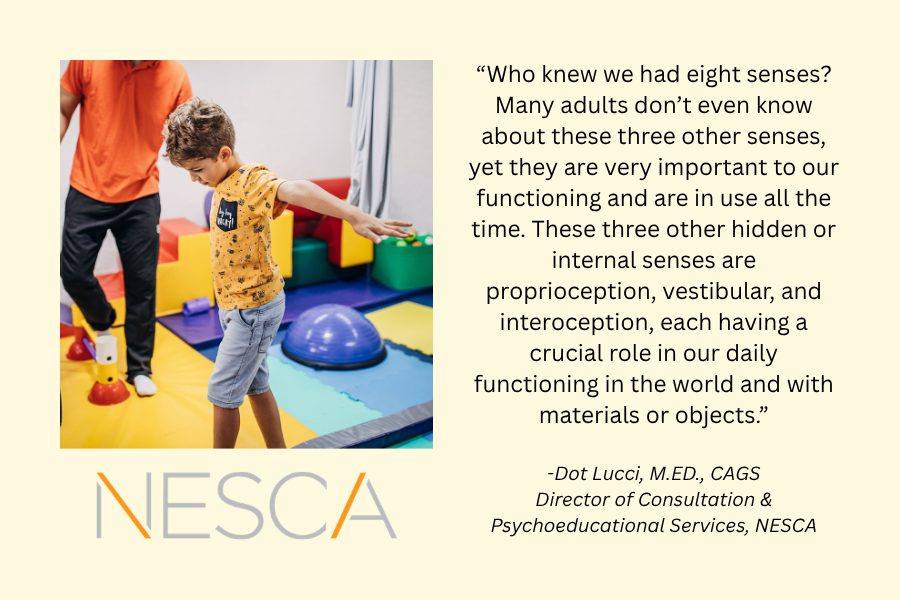
Image of child working in an OT session on balance and movement; quote from Dot Lucci of NESCA

Coming to our Senses

By | NESCA Notes 2026

Image of child working in an OT session on balance and movement; quote from Dot Lucci of NESCABy Dot Lucci, M.Ed., CAGS
Director of Consultation and Psychoeducational Services, NESCA

If you ask young children and adults to name their senses, they will typically name the five senses that are taught to all children in school – taste, smell, sight, hearing, and touch. Some of these senses “come on board” at birth while others continue to develop, refine, and mature into early adulthood. Then as we age, some of our senses may diminish – think eyesight and hearing, as well as fluidity of movement and balance. Most people wouldn’t think of fluidity of movement and balance as senses, but they are. These are considered part of our “hidden or internal senses,” and are connected to the three others. Who knew we had eight senses? Many adults don’t even know about these three other senses, yet they are very important to our functioning and are in use all the time. These three other hidden or internal senses are proprioception, vestibular, and interoception, each having a crucial role in our daily functioning in the world and with materials or objects.

Proprioception is often described as a sense of our body awareness in relation to the world around us. This system helps us integrate systems such as our musculoskeletal and central nervous systems. We get feedback from our muscles, ligaments, and joints so we know how to coordinate movements, sense where our body parts are in relation to our surroundings, and how to determine and apply the right amount of pressure or tension needed for certain tasks or movements. Proprioception is the secret ingredient that makes our motor skills intentional.

People with excellent proprioception are coordinated and may even be graceful. They rarely bump into things/people, don’t spill food on themselves, or misjudge how much pressure to use when touching someone else. They navigate their environment and materials well.

On the other hand, a person with poor proprioception may often bump into people, especially if the room/hallway is crowded. Or they may step on others’ toes while waiting in a line, stub their own toe, spill things on themselves, touch other people too hard or too lightly when playing tag, tear the paper when erasing, and so on. They may also experience difficulty with handwriting, using scissors, and doing other weight-bearing activities.

The vestibular system is located in the middle ear and is concerned with balance and gravitational awareness. I often use the term “sea legs” to describe this sense. If you are not familiar with “sea legs,” it is often used to describe a person’s ability to adjust their balance to a ship’s motion and not get seasick as well as the lingering sensation of movement or rocking when on land after disembarking a ship. It also is responsible for an awareness of gravity. Think of the astronauts who recently left the Artemis shuttle. They needed to be helped onto the “porch platform” and were then sat down as their bodies, having just been in space, had to adjust to the gravitational pull of the earth. This sense helps us to know if we are moving or stationary, how fast/slow we are moving, if we are standing still/speeding up, lying down, and more. Our vestibular system can be impacted by inner ear infections, head injuries, and other medical conditions. People with heightened vestibular systems may get dizzy often, suffer from car sickness, and dislike swinging, spinning, having their feet off the ground, or being upside down. On the flip side, some individuals have a hypo-responsive vestibular system. This can look like a constant hunger for movement. In this situation you may see someone excessively rocking back and forth, spinning for a long period of time without getting dizzy, happily swinging for hours, trying to reach the highest height, and have the constant need for high speed. People with “intact” vestibular system are seen as perfectly calibrated and can smoothly multitask balance, movement, and purposeful actions to move through the world with more ease.

Interoception is the third “hidden sense” and is related to what is happening inside our bodies – bringing our internal needs and awareness to our minds. This sense makes us aware of our internal organs, helping us to know when we are in pain, hungry, thirsty, or full, have to use the bathroom, are cold or hot, tired, ill, or have a fast heart rate. They can easily identify these sensations, whereas people with diminished awareness of their internal states have difficulty identifying feelings or sensations in their bodies. They may not notice when they are hungry, in pain, have to use the restroom, have a stomach or headache, are feeling their heart race, among other internal sensations. They may forget to drink or eat and get dehydrated or shake from low blood sugar, whereas people with heightened interoception may get “hangry” (hungry and angry) because they can’t tolerate hunger…and they recognize it. They may be overly sensitive to pain or temperature changes. Likewise, some foods are intolerable due to texture (smooth, chewy, etc.), and certain flavors (sweet, bitter, sour, etc.) may also not be tolerated. Therefore, they only eat bland foods.

People with impacted interoception “know they have a need or sensation,” but can’t identify it. This disrupts their quality of life as they may overeat or drink. People who are overly aware may become so anxious about these sensations that their anxiety may intensify until their need to handle the sensation is met.

Our senses and sensory profiles change with development, age, lifestyle, and health. Many of our senses work independently or behind the scenes, without our even thinking about them. However, if you try to walk on a balance beam versus just walking down the sidewalk, your balance may be challenged, requiring more conscious awareness. All of the senses work together to help us utilize, understand, and integrate sensory information to be in the world in a “functional way.” Many individuals with impacted sensory processing or integration systems may experience physical, mental, emotional, and social consequences as a result of an atypical sensory profile. Understanding one’s own sensory profile is important to living a full life. If warranted, an occupational and sensory evaluation may be necessary to help identify sensory-motor processing needs. This self-awareness and knowledge may help guide individuals to understand what they need, what they can and can’t do, what makes them comfortable, and what will help them better function and interact in the world. We are all sensory beings, and the better we are at knowing ourselves, the better we will be at advocating for ourselves.

If your child or teen can benefit from learning about their sensory system, complete NESCA’s online Inquiry/Intake Form for additional information or to book sessions with NESCA’s occupational therapists.


About the Author

NESCA’s Director of Consultation and Psychoeducational Services Dot Lucci has been active in the fields of education, psychology, research and academia for over 30 years. She is a national consultant and speaker on program design and the inclusion of children and adolescents with special needs, especially those diagnosed with Autism Spectrum Disorder (ASD). Prior to joining NESCA, Ms. Lucci was the Principal of the Partners Program/EDCO Collaborative and previously the Program Director and Director of Consultation at MGH/Aspire for 13 years, where she built child, teen and young adult programs and established the 3-Ss (self-awareness, social competency and stress management) as the programming backbone. She also served as director of the Autism Support Center. Ms. Lucci was previously an elementary classroom teacher, special educator, researcher, school psychologist, college professor and director of public schools, a private special education school and an education collaborative.

Ms. Lucci directs NESCA’s consultation services to public and private schools, colleges and universities, businesses and community agencies. She also provides psychoeducational counseling directly to students and parents. Ms. Lucci’s clinical interests include mind-body practices, positive psychology, and the use of technology and biofeedback devices in the instruction of social and emotional learning, especially as they apply to neurodiverse individuals.

To book a consultation with Ms. Lucci or one of our many expert clinicians, complete NESCA’s online intake form. Indicate whether you are seeking an “evaluation” or “consultation” and your preferred clinician/consultant/service in the referral line.

NESCA is a pediatric neuropsychology practice and related services center with offices in Newton, Plainville, and Hingham, Massachusetts; Londonderry, New Hampshire; and Coral Gables, Florida, serving clients from infancy through young adulthood and their families. For more information, please email info@nesca-newton.com or call 617-658-9800.


an image of a child thinking about how different each side of his brain is, used to describe the difference in functioning between both sides when nonverbal learning disability is present

What is a Nonverbal Learning Disability?

By | NESCA Notes 2024

an image of a child thinking about how different each side of his brain is, used to describe the difference in functioning between both sides when nonverbal learning disability is presentBy Angela Currie, Ph.D.
Pediatric Neuropsychologist; Londonderry, NH Director, NESCA

At August’s Democratic National Convention, Gus Walz, the teenage son of Democratic Vice Presidential nominee Tim Walz and his wife Gwen, melted hearts throughout the country with his outward show of emotions upon his father’s nomination. He exhibited deep love and pride for his dad in that moment. His tearful cheers evoked a sense of tenderness among many, confusion for others, and, sadly, public mockery, as well. At that time, many people were unaware that Gus carries the diagnosis of Nonverbal Learning Disability (NLD or NVLD) – a cognitive processing profile that often impacts emotion regulation and social cognition; however, his family’s openness about his condition has brought new attention to this profile.

There is often lack of awareness or confusion about what a NLD is. While NLD has been long-discussed in the neuropsychological and educational world, it has not been formally recognized by the medical field due to variability within individual profiles and lack of clarity on its causal factors. While this is so, there is a very clear pattern that is noted through the neuropsychological evaluation process. And most importantly, there is a breadth of interventions and supports to address NLD-related challenges, highlighting the importance of identifying and understanding this profile in children.

By definition, NLD is a relative strength in left-brain skills, which are largely verbal, and weakness in right-brain nonverbal skills. As such, to understand NLD, it is important to understand the right hemisphere of the brain.

The right side of the brain is responsible for the collection and integration of multiple sources of information, particularly sensory information, lending to an organized “big picture” understanding of events or information. The right brain is thus not only important for basic visual processing and reasoning, but it is also responsible for the organization and coordination of information and skills across a wide range of domains, including learning, motor coordination, self-regulation (e.g. sensory regulation and attention), social thinking, and task management.  As such, the word learning within the “Nonverbal Learning Disability” title is somewhat of a misnomer, as NLD can impact functioning across most any domain.

It is important to understand that NLD is a relative deficit, meaning that it is a personal weakness. Some individuals with NLD may have nonverbal skills that are all technically “average or better,” but they are still discrepant from that person’s strong verbal skills, causing variability within the profile.

Because many students with NLD have strong verbal reasoning, processing, and memory skills, they are often able to compensate and fly under the radar for some time. However, their over-reliance on verbal skills and rote learning tend to become less effective once they are tasked with the abstract demands of middle and high school. As such, while some individuals with NLD may be identified at a young age, others may not be flagged until much later.

As already stated, although NLD profiles can vary significantly, there are fairly predictable patterns that allow for its accurate identification, namely within the following areas:

Visual Reasoning – On structured intellectual assessment, individuals with NLD demonstrate a significant difference between their verbal and visually-based reasoning, with verbal being better. The Wechsler Intelligence Scale for Children, which is currently in its fifth edition and is the most commonly used intellectual test for children, contains two domains of visually-based reasoning. One is the Visual Spatial index, which contains more concrete puzzle-like tasks, and the Fluid Reasoning index, which assesses abstract pattern recognition. At times individuals with NLD struggle with both domains, while other times they may only demonstrate impairment within one. Because there are many factors that can contribute to challenges within either one of these visual domains, a proper NLD diagnosis can only be made through collection of a thorough history, direction observation, and the assessment of other associated challenges, detailed below.

Visual Processing and Perception – In spite of having perfectly fine vision, individuals with NLD have difficulty managing visual input. This may include problems with tracking lines while reading, difficulty discerning visual details (e.g. differentiating math or letter symbols, recognizing errors when editing their writing, misreading graphs and charts, etc.), or difficulty creating mental imagery (i.e. “seeing” and holding information in one’s head).

Motor Integration – Individuals with NLD demonstrate some level of motor integration or coordination difficulties. This may involve fine motor skills (e.g. poor handwriting and spacing on the page, difficulty tying shoes and using utensils, etc.), gross motor skills (e.g. clumsiness, awkwardness when running, poor hand-eye coordination, etc.), or both. Most often, individuals with NLD have appropriate motor strength, but they struggle to appropriately integrate and manage their movements within space and present demands. This may also correspond to difficulties with directionality and finding their way around, causing them to get lost easily.

Social Skills – Individuals with NLD most often meet early social milestones without any concern. In fact, some individuals with NLD may demonstrate early verbal precociousness that gives the appearance of advanced social engagement, which is aided by the fact that individuals with NLD generally possess appropriate foundational pragmatic skills, particularly when one-on-one or with adults. However, as these children grow older, they continue to over-rely on verbal language and miss out on nonverbal language (e.g. body signals) and context clues. As such, children with NLD may misperceive or misinterpret situations or interactions, or they may become overwhelmed by the complexity of typical peer interactions, causing them to withdraw. Often times, individuals with NLD know what they “should do” socially, but they struggle to actually generalize those skills to interactions.

Executive Functioning – Executive functioning refers to a complex set of skills that are responsible for an individual’s ability to engage in goal-directed behavior. This includes skills necessary for self-regulation, such as impulse control, attentional management, and emotional control, as well as skills for task management and cognitive regulation, such as organizing materials, creating a plan, starting a task and sustaining effort, prioritizing and organizing ideas, holding information in memory, etc. Individuals with NLD likely have some executive function strengths, particularly when they can rely on their verbal strengths; however, they are likely to demonstrate significant challenges with the executive function skills that rely on “big picture awareness,” such as organization, integration, planning, prioritizing, time management, and self-monitoring. Individuals with NLD are detail-focused – they often miss the forest for the trees. For some, they compensate by redoing work and over-exerting their efforts, eventually achieving a semblance of desired outcomes at the cost of time and energy; others may produce work that misses the main point of the task or demonstrates a lack of understanding; and others may just become overwhelmed and give up, appearing to lack “motivation.”

Learning – With the above profile, individuals with NLD tend to rely on rote learning, as they do well with concrete repetition of verbal information. However, they may have difficulty flexibly applying this knowledge, and they are likely to struggle with tasks that require more abstract, “big picture” thinking. Parents and teachers of individuals with NLD often report frustration because problems with information retrieval, pattern recognition, and generalization of skills can result in these individuals making the same mistakes over and over again, not seeming to learn from their errors.

Due to the above learning challenges, children with NLD often struggle with math reasoning, doing best with rote calculations than application of knowledge. Challenges with reading comprehension and written expression are also common, as they not only struggle to see the main idea and integrate information, but they also struggle to “see” the images or story in their head. For younger children with NLD, problems with mental imagery may be mistaken for a reading disability, such as dyslexia, due to difficulties holding, appreciating, and learning letters, numbers, and sight words.

Other Associated Challenges – Because the right hemisphere of the brain coordinates and manages sensory input and complexity, individuals with NLD are at higher risk for challenges with self-regulation. This may include sensory sensitivities, variable attention, or difficulties with emotion regulation. As such, those with NLD may demonstrate heightened anxiety or emotional reactivity that is only further-challenged by the complexity of their learning profile. Because of this, individuals with NLD often rely on a rigid, predictable routine. There is a high rate of comorbid, or co-occurring, diagnoses in individuals with NLD, including things such as ADHD, anxiety disorders, specific learning disabilities, and potentially autism spectrum disorder. Because of this, it is important to have a comprehensive understanding of each individual’s profile before devising their intervention plan.

What do we do to support individuals with NLD?

The supports set into place can be widely variable depending on the individual child’s profile. Some of the most common recommendations include social skills interventions that target “higher level” skills, such as social perspective taking and problem solving; executive function instruction that aims to teach task management skills, develop “big picture” thinking, and generalize skills across tasks and settings; academic remediation for any specific domain of impairment, potentially including math reasoning, reading comprehension, or written expression; and occupational therapy services to develop skills, such as handwriting and/or keyboarding, visual processing, and motor coordination.

It is important to understand that individuals with NLD struggle with abstraction, so concrete, explicit instruction, with frequent repetition, is often key. This not only applies to academic instruction, but also therapy or instruction in daily living skills at home. Things need to be rehearsed “in real time,” as there needs to be a plan for how to ensure skills translate to life.

Self-advocacy most often needs to be directly taught by first increasing self-awareness, as it may be difficult for individuals with NLD to recognize the patterns within their challenges or self-monitor when support may be needed.

There are many useful resources for further understanding ways to support individuals with NLD. One comprehensive resource is the NVLD Project (https://nvld.org/), a nonprofit organization that conducts research, offers educational workshops and community outreach, and has an extensive list of NLD-related resources for parents, clients, and schools.

Because NLD profiles can be variable, complex, and clouded by co-occurring challenges, a thorough neuropsychological evaluation can be a critical step toward fully understanding an individual child’s needs and thinking about how they will be best supported not just in school, but also in their day to day life. Should you require support in navigating such needs for a child, teen, or young adult in your life, more information about NESCA’s neuropsychological evaluations and team of evaluators is available at www.nesca-newton.com.


About the Author

Dr. Currie specializes in evaluating children, teens, and young adults with complex profiles, working to tease apart the various factors lending to their challenges, such as underlying learning, attentional, social, or emotional difficulties. She particularly enjoys working with the seemingly “unmotivated” child, as well as children who have “flown under the radar” for years due to their desire to succeed.


To book an evaluation with Dr. Currie or one of our many other expert neuropsychologists, complete NESCA’s online intake form. Indicate whether you are seeking an “evaluation” or “consultation” and your preferred clinician in the referral line.


NESCA is a pediatric neuropsychology practice and integrative treatment center with offices in Newton, Plainville, and Hingham, Massachusetts; Londonderry, New Hampshire; and staff in greater Burlington, Vermont and Brooklyn, New York, serving clients from infancy through young adulthood and their families. For more information, please email info@nesca-newton.com or call 617-658-9800.

Buyer’s Guide 101: How to Shop for a Pediatric Occupational Therapist

By | NESCA Notes 2021

By: Julie Robinson, OT
Director of Clinical Services; Occupational Therapist, NESCA

As a parent of a child who has just been referred for Occupational Therapy (OT) services, the prospect of what to do next and where to go can be quite confusing. With so many providers in the area, it can be difficult to know who would be the right fit for your family. Typically, when you reach out to express interest in OT services at NESCA, Julie Robinson, OT, our department director, will have a personal phone call with you to help you through the process. As you conduct your search for the right fit for your child and family, here are some good questions you might ask to help you determine what works best. We’ve offered answers regarding NESCA’s services to let you know more about how we provide OT services.

What type of insurance do you take for occupational therapy?

Here at NESCA, we are in-network for BCBS and Allways, and we bill them directly on behalf of our patients.

How long are your OT sessions?

We spend 45 minutes directly with a child and another 5 – 10 minutes at the end of the session to consult with the caregiver. Other practices provide 30 or 38 minute sessions to compensate for decreases in insurance payments since the outset of Covid-19.

How long do we have to wait for an OT session? 

We can initiate an evaluation within 2 – 3 weeks of initial contact. If you have availability to bring your child in for treatment during the school day, there is no waitlist at this time. If you require sessions in the afterschool hours, there is a very small waitlist.

How many patients does a clinician typically see per week?

Some practices require their clinicians to perform as many as 30 or 32 patient hours per week to maximize their income. Here at NESCA, we cap patient hours at 26 per week. It is very important for us to focus on providing excellent clinical care to our clients with staff who are not burnt out or struggling to manage paperwork, treatment planning, and administrative activities, such as phone calls and emails to support our families. We are proud to offer research-backed services and want to provide our clinicians with ample time for continued opportunities for learning, allowing them to reach their highest level of potential and skill as a therapist – which they then pass on that knowledge and skill to our families.

What does your OT practice focus on?

At NESCA, our focus of therapy is based on a holistic view of a child to encourage life-long functional skill acquisition. We use a combination of sensory motor, sensory integration, developmental, and trauma-informed techniques, as well as practice and repetition of those techniques. We offer coaching on daily living skills to address weaknesses across a variety of areas: self-regulation, executive functions, self-care skills, such as dressing and bathing, handwriting and fine motor development, feeding, academic readiness, organization and attention. Other practices may utilize sensory integration or applied behavioral analysis as the basis for their program, for example.

Does the practice provide OT services in a clinical setting, remotely, at home, in school, or in the community?

Our primary service provision at NESCA is in the office or over teletherapy. In some instances, where schedules can be accommodated, we will provide services in the home, schools, or in the community. There may be additional travel fees involved for services outside of the office.

Does your OT practice offer comprehensive or second opinion evaluations for academic programming if needed?

NESCA does provide this service.

Will your practice consult with teachers or other caregivers if needed?

Yes. Sometimes additional fees are required, as insurance does not cover this service. We believe that consultation with outside providers is a critical part of our success!

Does your practice provide any specific programs outside of traditional sensory-motor based Occupational Therapy services?

At NESCA, we provide several specialty services in addition to traditional OT:

  • Feeding therapy
  • Safe and Sound Protocol for auditory sensitivity and self-regulation
  • Handwriting Without Tears
  • Trauma-informed Sensory Integration

What makes our clinicians so special?

One of the things that makes our occupational therapists an ideal match for your family is our love for children, the work we do, and our commitment to lifelong learning and the development of our clinical skills. Our entire OT department has known each other for at least four years, and we all came together as a team from another practice, with clinicians that are hand-picked by our director. We meet together on a weekly basis to share ideas and information, as well as to support each other in our clinical development.

For more information about NESCA’s Pediatric Occupational Therapy services, please visit: http://nesca-newton.com/occupational_therapy/ or submit an online Intake Form: https://nesca-newton.com/intake-form/.


About the Author

Julie Robinson is an occupational therapist with over 25 years of experience as a clinician. The work Julie does is integral to human development, wellness and a solid family unit. She particularly enjoys supporting families through the process of adoption and in working with children who are victims of trauma. Julie has extensive experience working with children diagnosed with an Autism Spectrum Disorder (ASD), or who have learning or emotional disabilities. She provides services that address Sensory Processing Disorder (SPD) and self-regulation challenges, as well as development of motor and executive functioning skills.

To book an appointment or to learn more about NESCA’s Occupational Therapy Services or other clinical therapies, please fill out our online Intake Form, email info@nesca-newton.com or call 617-658-9800.


Neuropsychology & Education Services for Children & Adolescents (NESCA) is a pediatric neuropsychology practice and integrative treatment center with offices in Newton, Massachusetts, Plainville, Massachusetts, and Londonderry, New Hampshire, serving clients from preschool through young adulthood and their families. For more information, please email info@nesca-newton.com or call 617-658-9800.


A Halloween for Those with Sensory Challenges

By | NESCA Notes 2021

By: Julie Robinson, OT
Director of Clinical Services; Occupational Therapist, NESCA

Halloween – a holiday full of tricks and treats. For some children, getting in the Halloween spirit by getting dressed up, carving pumpkins, and going trick-or-treating with friends is what they look forward to all year. For others, dressing up in an itchy costume, not being able to see someone’s face because they are wearing a spooky mask, being out in the dark with crowds of noisy trick-or-treaters, carving pumpkins and having to touch the oooey goooey insides of a pumpkin, and seeing decorations that make sudden noises or movements may make this holiday overwhelming for these children. Halloween can be tricky for families with children living with sensory processing difficulties, but with some creativity and planning ahead, families can build their toolboxes with their own tricks to combat the challenges that come with Halloween so their child can enjoy the treats that Halloween has to offer.

Here are some tricks for some common challenges that Halloween brings up:

Prepare for the day

Have an open discussion with your child about the traditions and activities associated with Halloween. You can read Halloween-themed books or watch Halloween movies (perhaps not the really scary ones!) to prepare your child for what to expect, because the anticipation of a new routine or anticipation of participating in unfamiliar activities can cause stress on a child. Discuss the plan for Halloween regarding decorations, attending parties, going trick-or-treating, etc., ahead of time so the child knows what to expect when celebrating the holiday. Consider the use of a visual picture schedule with activities that may be added into your typical routine. Provide ample warnings for transitions, when possible, to give your child time to move from one activity to another.

Be creative and imaginative with your child’s costume

The most important aspect of a costume for a child with sensory processing difficulties is ensuring that the costume is comfortable. Certain costume material may be itchy or scratchy, costumes with masks may occlude a child’s vision or be too tight on their head, or make-up may smell off-putting to a child. Children should have the opportunity to try on their costume when walking, sitting, and reaching for things before wearing it for real to make sure they are comfortable moving around in it. It is important to remember the idea of “less is more” and to use your imagination when coming up with costume ideas. For example, if a child wants to be a superhero, consider attaching a superhero logo to the front of a shirt they wear regularly rather than having your child wear a full superhero one-piece costume that may be itchy, tight, and hot.

Choose activities that best fit your child’s sensory needs

Meaningful participation in Halloween festivities doesn’t just include carving pumpkins and going trick-or-treating. Halloween activities can include roasting pumpkin seeds, setting out the candy bowl for trick-or-treaters, doing Halloween-themed crafts, etc. It is important for you to pick activities that best fit your child’s sensory needs. For example, if your child dislikes carving pumpkins because they have to touch the messy pumpkin insides, consider having your child paint their pumpkin or decorate it with stickers instead or make a pumpkin out of paper to decorate. If you and your child really want to go trick-or-treating but your child becomes overwhelmed with noisy crowds, consider trick-or-treating on only quiet side streets, or limit your time, allowing for breaks in between. If your child becomes overwhelmed with flashing lights, loud noises, or scary decorations, consider doing a drive-by of the neighborhood before taking your child out for trick-or-treating so you know which houses to avoid. For some children who crave a great deal of movement, it may be useful to engage in some heavy work activity before participating in a Halloween activity: wall push-ups, yoga poses, carrying weighty objects, for example. It may also be useful to engage in calming sensory activity to ease the transition from a busy setting back into the house: tactile materials like playdough or putty, water play, or a sensory table may be worth trying, or consider making a play tent or fort with quiet books or puzzles, or drawing to smooth the transition.

Monitor for overstimulation

Knowing when your child has had enough of Halloween festivities is just as important as knowing how to get your child engaged in them. A child may not be overstimulated at first, but may become overwhelmed minutes later. It is important to give your child choices of activities and next steps they can take as well as alerting your child about the sequence of events and the timeframe of events so that they know what to expect. If possible, help your child learn to advocate for themselves by saying things like, “please don’t touch me,” or “no thank you, I don’t want wear that,” in order to give them some autonomy over the activities that they participate in. However, in situations where this isn’t possible, it is important as the parent to know when to stop or disengage from festivities when sensory overload occurs and return home or to a quieter, more familiar space to give the child time to decompress.

Resources:

Enjoying Halloween With Sensory Challenges. (2021). Aota.org. https://www.aota.org/About-Occupational-Therapy/Patients-Clients/ChildrenAndYouth/halloween-sensory.aspx?fbclid=IwAR23ux4OKqJmXEZdnCIzb2_Uh0of55YKuCf8ek97UEAc1jZflndR_ZEBRwM

Morin, A. (2019, August 5). Halloween Challenges for Kids With Sensory Processing Issues and How to Help. Understood.org; Understood. https://www.understood.org/articles/en/halloween-challenges-for-kids-with-sensory-processing-issues-and-how-to-help

‌5 Ways to Help Children with Sensory Challenges Participate in Halloween Festivities. (2021). Aota.org. https://www.aota.org/Publications-News/ForTheMedia/PressReleases/2019/102419-Halloween-Tips-Sensory-Challenges.aspx


About the Author

Julie Robinson is an occupational therapist with over 25 years of experience as a clinician. The work Julie does is integral to human development, wellness and a solid family unit. She particularly enjoys supporting families through the process of adoption and in working with children who are victims of trauma. Julie has extensive experience working with children diagnosed with an Autism Spectrum Disorder (ASD), or who have learning or emotional disabilities. She provides services that address Sensory Processing Disorder (SPD) and self-regulation challenges, as well as development of motor and executive functioning skills.

To book an appointment or to learn more about NESCA’s Occupational Therapy Services or other clinical therapies, please fill out our online Intake Form, email info@nesca-newton.com or call 617-658-9800.


Neuropsychology & Education Services for Children & Adolescents (NESCA) is a pediatric neuropsychology practice and integrative treatment center with offices in Newton, Massachusetts, Plainville, Massachusetts, and Londonderry, New Hampshire, serving clients from preschool through young adulthood and their families. For more information, please email info@nesca-newton.com or call 617-658-9800.


The Benefits of Working on a Vertical Surface

By | NESCA Notes 2021

By: Madelyn (Maddie) Girardi, OTD, OTR/L
Occupational Therapist, NESCA

What do you mean by a vertical surface?

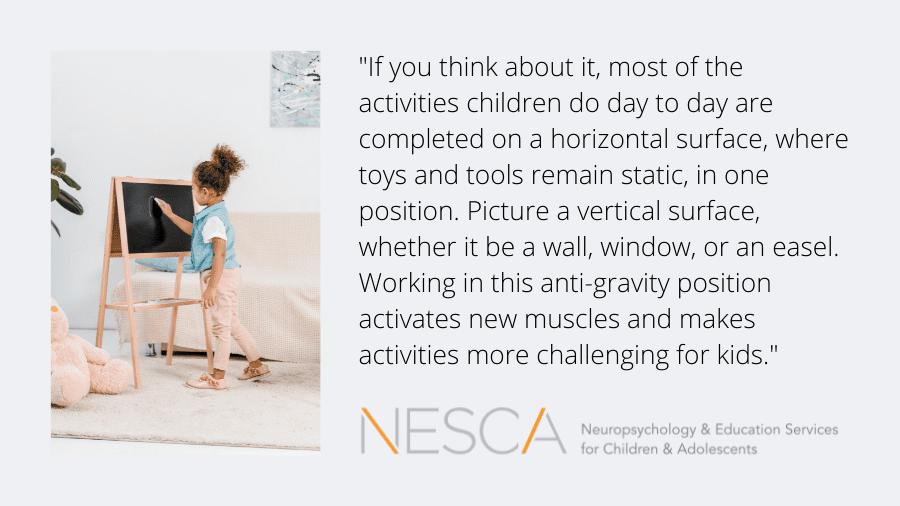
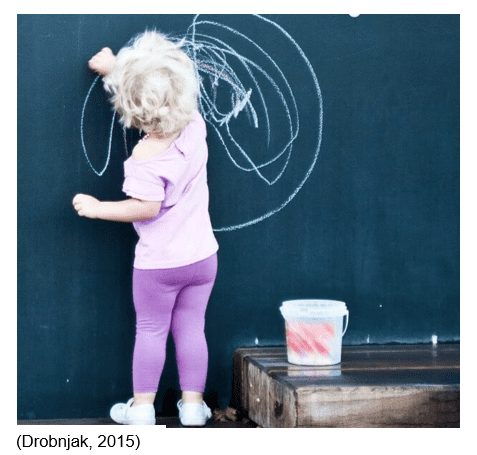
If you think about it, most of the activities children do day to day are completed on a horizontal surface, where toys and tools remain static, in one position. Picture a vertical surface, whether it be a wall, window, or an easel. Working in this anti-gravity position activates new muscles and makes activities more challenging for kids. Think “tummy time,” but for our elementary-aged kids.

What are the benefits of working on a vertical surface?

  • Shoulder, wrist, and elbow stability – These activities require a child to practice bigger arm movements that may not be utilized on a traditional, flat surface. These movements promote both strength and flexibility in the joints and muscles of the upper extremities.
  • Core strength & postural control – If a child is completing vertical work in standing, he or she must reach outside of their base of support, activating those core muscles. Further increase the demands of the task by having the child complete the task in kneeling or while sitting on a therapy ball. This promotes balance and use of the stomach and leg muscles. Building this solid ‘core’ foundation is extremely important so that a child can develop more controlled movements in the upper extremities.
  • Hand strength – Working against gravity requires a child to exert increased effort while building hand strength and endurance with a utensil.
  • Visual spatial awareness & crossing midline – Working on a large vertical surface means more space to cover. This requires a child to visually scan a greater distance left to right, reaching across the imaginary “midline” of our body. Crossing midline is essential for developing bilateral coordination skills.
  • Wrist extension for pencil grasp – This is a big one! Writing on a vertical surface naturally puts the wrist in extension, the ideal position for handwriting. In contrast, a flexed wrist limits finger mobility and control.
  • Proprioception & force modulation – When performing a task on a vertical surface – think stickers or drawing – the child is required to practice grading movements so that he or she can apply the right amount of pressure for success (Boitano, 2020; Drobnjak, 2015).

What pediatric population benefits from this?

All kids would benefit from participating in these kinds of activities! Working on a vertical surface work can particularly help children to further develop the essential fine, visual, and gross motor skills. Sensory integration can also be targeted, as these kinds of activities allow a child to explore and develop proprioceptive, tactile, and visual processing skills.

Activities that can be done on a vertical or slanted surface (Boitano, 2020; Drobnjak, 2015)

  • Writing
  • Drawing/coloring
  • Tracing (stencil) activities
  • Stickers
  • Painting (finger painting or with brush)
  • Magnets
  • Spray bottle activities
  • Squigz or suction cup games
  • Felt or Velcro boards
  • Chalkboard, easel, or whiteboard activities
  • Shaving cream
  • LEGO wall
  • Window or wall washing using sponge


Resources

Boitano, C. (2020, April 20). The benefits of writing and working on a vertical surface! OT Outside. Retrieved October 6, 2021 from https://www.otoutside.com/news/2020/4/19/the-benefits-of-writing-and-working-on-a-vertical-surface.

Drobnjak, L. (2015, June 27). Why Kids Should Work on a Vertical Surface. The Inspired Treehouse. Retrieved October 6, 2021 from https://theinspiredtreehouse.com/motor-skills-and-more-working-on-a-vertical-surface/


About the Author
Madelyn (Maddie) Girardi is a Licensed Occupational Therapist in Massachusetts with experience in both school-based and outpatient pediatric settings. Maddie received her undergraduate degree in Exercise Science/Kinesiology at The College of Charleston in South Carolina and  earned her Doctorate degree in Occupational Therapy from The MGH Institute of Health Professions in Boston.

Maddie is a passionate therapist with professional interest in working with young children with neurodevelopmental disorders, fine and gross motor delays and Autism Spectrum Disorder (ASD).

To book an appointment or to learn more about NESCA’s Occupational Therapy Services, please fill out our online Intake Form, email info@nesca-newton.com or call 617-658-9800.


Neuropsychology & Education Services for Children & Adolescents (NESCA) is a pediatric neuropsychology practice and integrative treatment center with offices in Newton, Massachusetts, Plainville, Massachusetts, and Londonderry, New Hampshire, serving clients from preschool through young adulthood and their families. For more information, please email info@nesca-newton.com or call 617-658-9800.


Skip to content