Real-life Skills Coaching Alert!

NESCA now has two Occupational Therapists offering in-person, community-based Real-life Skills Coaching in the Newton area. To learn more or book sessions, complete our Inquiry/Intake Form.

Tag

Special Needs Archives - Page 3 of 4 - NESCA

Subscribe to NESCA Notes

Multi-sensory Learning: Bringing it into the Home

By | NESCA Notes 2020

Sophie Bellenis, OTD, OTR/L

By: Occupational Therapist; Real-life Skills Program Manager and Coach

In our last OT Tuesday blog, we delved into the topic of multi-sensory learning: what it is, what it looks like in the classroom and what it intends to do. We reviewed the fact that this technique consists of targeting children’s auditory, visual, tactile and kinesthetic systems with hands-on learning activities. This week we will further discuss multi-sensory learning and brainstorm ways that this approach can be incorporated by parents into home-based learning. Multi-sensory learning is hugely variable and can be applied in a plethora of creative ways. Here are some tips to help tailor this approach to your child at home.

  1. Consider Your Child’s Learning Profile. It is common knowledge that both children and adults tend to have a unique style of learning, as well as preferences for how information is presented. Think about how your child has learned from you in the past. Did she learn to wash her hands thoroughly by singing a song? Watching a timer? Observing you demonstrate the best way first? Information from teaching simple tasks like these can help you suss out how your child may best learn and take in academic information. If you are unsure, consider reaching out to teachers and professionals who have worked with your student in the past. Teachers are excellent at determining the ideal way to present information to each child. They may be able to help you better understand your child’s unique learning profile and give suggestions for activities.
  2. Create Manipulatives. Manipulatives, or things that children can hold, feel and manipulate with their hands, are tools that help solidify concepts for many of our tactile learners. While school buildings are often full of creative manipulatives, many of these are easy to make using household objects. Have your child cut up cereal boxes to make letter cards. Write numbers on bottle caps or rocks and have your children count them out or create math equations. Cut up paper plates into slices to help visually represent fractions. Use an egg carton with ten cups to build a homemade ten frame. Write out words using pipe cleaners or clay. If you are not feeling particularly “DIY,” many manipulatives can be purchased online. Here are few options for manipulatives, by subject:
  1. Consider Learning Opportunities in Your Community. There are, of course, universal lessons and aspects of curricula that are consistent across the Unites States. Children all work to learn their letters, the basics of addition and subtraction, and eventually how to write a paragraph. In contrast, the unique fabric of the varied communities across our country, allows for specific education through hands-on experiences in our environments. In New England, we have access to the coast, historic sites relating to the Revolutionary War, and many state and national parks. Teach environmental science by exploring tidepools and looking at sea creatures. Involve kinesthetic learning by having your children walk along part of the Freedom Trail. Get your children outside and show them physical representations of the things that they read about and see in pictures.
  2. Tap into Online Resources. Some of the most effective multi-sensory learning tools are quite simple. Having a child follow along in a book as they listen to someone read out loud targets both the visual and auditory systems. Kids both review their spelling and focus on reading comprehension while they listen. Videos and audio recordings of educators and parents reading children’s books aloud can be found on YouTube, Audible and many other internet sites. Look at your personal library and search the titles to see whether this option is readily available. Additionally, with this teaching method becoming increasingly evidenced-based and popular, sites such as Pinterest, TeachersPayTeachers and Understood.org have excellent ideas and examples of activities to incorporate into your day.
  3. Use What You Have. Many of the multi-sensory learning activities, especially for younger children, invite kids to get their hands dirty and feel. We prompt children to practice writing their letters in bins of beans or rice. We practice patterns with popsicle sticks or blocks. We use playdough or clay to both make art projects and forms letters. Look around your house and see what you already have available. If you do not have rice or beans, but you do have some sand outside, write letters in sand! If your supply of popsicle sticks ran out back in March, have your children step outside and collect 20 small sticks each. Use those sticks to spell out words. Color them with markers and then line them up to create patterns. Have your child dip them in water mixed with food coloring and practice writing letters on a piece of paper. Multi-sensory learning is all about having children learn from the complex and rich environments around them, while using multiple sensory pathways within their bodies. Teaching materials are all around us!


About the Author

Dr. Sophie Bellenis is a Licensed Occupational Therapist in Massachusetts, specializing in educational OT and functional life skills development. Dr. Bellenis joined NESCA in the fall of 2017 to offer community-based skills coaching services as a part of the Real-life Skills Program within NESCA’s Transition Services team. Dr. Bellenis graduated from the MGH Institute of Health Professions with a Doctorate in Occupational Therapy, with a focus on pediatrics and international program evaluation. She is a member of the American Occupational Therapy Association, as well as the World Federation of Occupational Therapists. Having spent years delivering direct services at the elementary, middle school and high school levels, Dr. Bellenis has extensive background with school-based occupational therapy services.  She believes that individual sensory needs and visual skills must be taken into account to create comprehensive educational programming.

To book an appointment or to learn more about NESCA’s Occupational Therapy Services, please fill out our online Intake Form, email info@nesca-newton.com or call 617-658-9800.


Neuropsychology & Education Services for Children & Adolescents (NESCA) is a pediatric neuropsychology practice and integrative treatment center with offices in Newton, Massachusetts, Plainville, Massachusetts, and Londonderry, New Hampshire, serving clients from preschool through young adulthood and their families. For more information, please email info@nesca-newton.com or call 617-658-9800.


Testing at NESCA during COVID-19

By | NESCA Notes 2020

By: Ann Helmus, Ph.D.
NESCA Founder/Director

I’m sure you can agree, it’s been an interesting time due to the onset of COVID-19. Our worlds, livelihoods and professional lives have been turned upside down. At NESCA, where our entire business revolves around the in-person evaluations, assessments, coaching and treatment of children, adolescents and young adults, much of our “In Real Life (IRL)” activity had to be put on hold to prevent the risk of infection among our clients and staff.

After making the decision to temporarily close our physical offices, our clinical and administrative staff swiftly geared up to provide as many services as possible remotely. While we were considered an “essential” business by the State of Massachusetts, we opted to pause our neuropsychological testing for the safety of all involved while initiating research into how we could conduct this critical service to our families. We are keenly aware of the long wait times for testing and the associated stress that puts on parents while they seek out answers about their children’s behavior or learning differences—all the while making children who need supports earlier than later wait in the wings as well. We also knew there would be an increased need for testing because of the impact COVID-19 was and is likely to have on the mental health of children and teens; schools would eventually be inundated with a back-log of evaluations already in the works as well requests for new evaluations that, by law, have to be conducted within a specific time period; and to help fulfill the ever-present need to assist schools and parents in providing support to children with special needs.

Knowing our pause of testing was not a long-term, viable option, after careful consideration and much intense research, we identified several options on how we could bring our neuropsychological evaluation services back to the NESCA community. The options we identified as possibilities included conducting teletherapy, using a partial plexiglass screen (akin to what you would see protecting a store cashier), observing social distancing and constructing a two-office model. We examined the risk to both clients and clinicians, privacy and technology constraints, ethics surrounding the validity of the test findings and legal issues concerning the credibility of evaluation findings/diagnosis among other topics.

While we determined that teletherapy has a role in the testing process, including parent intake and feedback sessions, we ultimately decided that it would not be a solution for NESCA to adopt for the actual evaluation of a child. Next, the partial plexiglass shield did not provide enough risk mitigation for the child or evaluator, and it may not have been a secure enough physical barrier for some of the more aggressive children we test to keep both parties properly distanced.

So, where does that leave us? We do have social distancing in the mix as a potential option. While it does not provide maximum risk reduction, some families see it as the most natural option. The child, and if necessary, a parent helper, are at one end of a long conference table, and the evaluator is at the other end, at least six feet away at all times. All people in the room wear masks to further reduce risk. All testing materials are set up in advance for the child or parent helper. Most tests can be conducted on an iPad, which is controlled by the evaluator’s computer.

Since we were very aware that some parents would not be comfortable with this model, we continued our exploration and education, landing on an innovative two-office model. The two-office set-up involves a four foot by eight foot clear plexiglass window to be installed between two offices. This allows for clear observation of the child by the evaluator, the ability for the child and evaluator to communicate with each other via a high-quality intercom system and for the evaluator to visually demonstrate activities that the child is asked to perform during testing. A parent helper can be allowed in the room with the child should they need support during the session. Again, many of the tests would be administered via an iPad, which is controlled by the evaluator in the adjoining room. All additional test materials are organized and arranged in the office where the child is prior to testing.

NESCA’s two-office approach was piloted in our Londonderry, N.H. office by Dr. Angela Currie. Due to its maximum risk reduction for all parties and its similarity to the standard testing experience, NESCA expanded its testing capabilities with this model to the Newton office, where there are currently two of these testing areas available. While it does have some limitations, it is working very well with our families.

Along with the new testing models implemented, NESCA is, of course, taking all precautions available to reduce risk of exposure. We require risk assessment questionnaires, temperature checks and hand sanitizing; implemented a “touchless” check-in process; limit the number of people to a total of eight at one time in the 7,000 square foot Newton office, with testing being done at opposite ends of the office; provide private waiting rooms for parents who are not involved in the child’s testing; and sanitize all equipment and rooms used both before and after every appointment. We continue to follow the CDC and State’s guidelines for re-opening requirements.

We are very proud of our ability to continue to serve parents, children, families and schools during this extremely difficult time. I am once again so grateful to the cohesive and collaborative team we have in place here at NESCA and for its creativity, innovation, determination and dedication. The needs of families with children who have special needs never stop. While we may be forced to pause, NESCA will do everything in its power not to stop either.

Resources/Notes:

  • To view the Federation for Children with Special Needs webinar with Dr. Ann Helmus, visit Testing in the Age of Remote Learning
  • Dr. Helmus will present, “Testing in the Time of Covid,” to the Massachusetts Urban Project, a statewide network of special education leaders from 15 urban school districts across the state, on June 9.
  • Dr. Helmus will present on this topic in conjunction with Massachusetts Advocated for Children in June TBD.


About the Author: 

NESCA Founder/Director Ann Helmus, Ph.D. is a licensed clinical neuropsychologist who has been practicing for almost 20 years. In 1996, she jointly founded the  Children’s Evaluation Center (CEC) in Newton, Massachusetts, serving as co-director there for almost ten years. During that time, CEC emerged as a leading regional center for the diagnosis and remediation of both learning disabilities and Autism Spectrum Disorders.

In September of 2007, Dr. Helmus established NESCA (Neuropsychology & Education Services for Children & Adolescents), a client and family-centered group of seasoned neuropsychologists and allied staff, many of whom she trained, striving to create and refine innovative clinical protocols and dedicated to setting new standards of care in the field.

Dr. Helmus specializes in the evaluation of children with learning disabilities, attention and executive function deficits and primary neurological disorders. In addition to assessing children, she also provides consultation and training to both public and private school systems. She frequently makes presentations to groups of parents, particularly on the topics of non-verbal learning disability and executive functioning.

To book an evaluation with Dr. Helmus, NESCA Founder and Director, or one of our many other expert neuropsychologists, complete NESCA’s online intake form

Neuropsychology & Education Services for Children & Adolescents (NESCA) is a pediatric neuropsychology practice and integrative treatment center with offices in Newton and Plainville, Massachusetts, as well as Londonderry, New Hampshire. NESCA serves clients from preschool through young adulthood and their families. For more information, please email info@nesca-newton.com or call 617-658-9800.

Multi-sensory Learning: More than Just a Buzz Word!

By | NESCA Notes 2020

By: Sophie Bellenis, OTD, OTR/L
Occupational Therapist; Real-life Skills Program Manager and Coach

As teaching methods continue to become more and more creative, and learning is being facilitated through interventions that target all types of students, the term “multi-sensory learning” has started to cement its place in the educational lexicon. You may have seen a line in an evaluation, such as, “This student would benefit from a multi-sensory learning approach,” or “The use of multi-sensory teaching methods will help this student to solidify their learning.” In some ways this phrase is easy to interpret. Multi means many. Sensory refers to the body’s different senses, the tools we use to interpret and experience the environment around us. Reason would tell us that this phrase means using all of these senses to acquire knowledge, information, and skills, and….it does! But what does this look like in practice? How are professionals actually using this method to help our children learn?

If you picture a typical classroom from a few decades ago, there is a teacher standing up at the front of the room providing students with information to copy down into their notebooks. These students are receiving information through the auditory system only. They are being expected to listen, comprehend and retain the lesson using one sense, their hearing.

Now let’s picture the classroom of a teacher using multi-sensory learning techniques. Often, students are clustered in different areas with a teacher checking in at every table to provide each small group with support. Students are looking at images or pictures of the object they are studying, both reading information and hearing it clarified by their teacher, and are likely using manipulatives, or things they can feel to help understand the content. These students are learning through their visual, auditory and tactile systems.

Humans grow, evolve and learn in complex, multi-sensory environments that are constantly targeting all of our senses. Our brains are built to learn through a combination of visual, auditory, tactile and kinesthetic data (Shams & Seitz, 2008). Using visual methods helps children learn through the sense of sight; auditory through the sense of hearing; tactile through the sense of touch; and kinesthetic through body movement. Children display greater performance when learning activities target all of these systems, as opposed to when they are taught using one modality (Broadbent, White, Mareschal, & Kirkham, 2018).

As an example, let’s look at teaching Kindergarten students their letters. A robust multi-sensory approach to teaching the alphabet includes looking at pictures of the letters, saying the sounds out loud as a class, tracing the letters in the air with one finger, making each letter out of playdough, writing the letters in bins of rice, making the student’s bodies into the shape of individual letters, and finally picking up a pencil to attempt to form the letters on the page independently. Students gain a comprehensive understanding of the letters as their brains have been targeted across multiple sensory systems.

There is substantial research for using this multi-sensory approach for another foundational academic skill: reading (Walet, 2011). Many of the most well-known phonics and reading programs, such as Orton-Gillingham and the Wilson Reading System, use these strategies to help students who learn differently to master this skill (AOGPE, 2012 & Wilson, 2017). When using some programs students learn to tap out syllables and letters on their fingers as they read, incorporating tactile feedback. Others focus on including books on tape so that students both see and hear each word as it is read aloud.

Other excellent examples of multi-sensory learning in the classroom include:

  • Songs and rhythm to solidify content
  • Base ten cubes as math manipulatives
  • Fieldtrips!
  • Games involving movement, such as flashcard races, Around the World and clapping games
  • Paper with raised or highlighted lines for tactile or visual feedback
  • Video clips to review concepts
  • Real coins and dollars when learning about money
  • Science experiments in a high school lab

While students are currently all at home receiving their lessons and assignments through a digital medium, many are missing out on the creative ways that their fabulous teachers use these strategies in their classrooms. In my next blog, we will discuss some ways to incorporate these strategies in the home!


References

Academy of Orton-Gillingham Practitioners and Educators (AOGPE). (2012). The Orton-Gillingham

Broadbent HJ, White H, Mareschal D, Kirkham NZ. Incidental learning in a multisensory environment across childhood. Dev Sci. 2018;21(2):e12554. doi:10.1111/desc.12554

Shams, L., and Seitz, A.R. Benefits of multisensory learning. Trends in Cognitive Sciences, 60, November 2008, pp. 411-17.

Walet, J. (2011). Differentiating for Struggling Readers and Writers: Improving Motivation and Metacognition through Multisensory Methods & Explicit Strategy Instruction. Journal of the American Academy of Special Education Professionals,83-91.

Wilson, B. (2017). Teaching total word structure. Wilson Language Training Corporation.


About the Author

Dr. Sophie Bellenis is a Licensed Occupational Therapist in Massachusetts, specializing in educational OT and functional life skills development. Dr. Bellenis joined NESCA in the fall of 2017 to offer community-based skills coaching services as a part of the Real-life Skills Program within NESCA’s Transition Services team. Dr. Bellenis graduated from the MGH Institute of Health Professions with a Doctorate in Occupational Therapy, with a focus on pediatrics and international program evaluation. She is a member of the American Occupational Therapy Association, as well as the World Federation of Occupational Therapists. Having spent years delivering direct services at the elementary, middle school and high school levels, Dr. Bellenis has extensive background with school-based occupational therapy services.  She believes that individual sensory needs and visual skills must be taken into account to create comprehensive educational programming.

To book an appointment or to learn more about NESCA’s Occupational Therapy Services, please fill out our online Intake Form, email info@nesca-newton.com or call 617-658-9800.


Neuropsychology & Education Services for Children & Adolescents (NESCA) is a pediatric neuropsychology practice and integrative treatment center with offices in Newton, Massachusetts, Plainville, Massachusetts, and Londonderry, New Hampshire, serving clients from preschool through young adulthood and their families. For more information, please email info@nesca-newton.com or call 617-658-9800.


Visual Motor Integration Deep Dive – Part 2

By | NESCA Notes 2020


By: Sophie Bellenis, OTD, OTR/L
Occupational Therapist; Real-life Skills Program Manager and Coach

Last week’s blog taught us the nuts and bolts of Visual Motor Integration. Let’s jump into the what VMI really means for students who struggle with VMI.

Research has shown a statistically significant correlation between performance on visual motor integration assessments and teachers’ assessments of early elementary school students’ reading, mathematics, writing and spelling ability (Optometry and Vision Science, 1999; Pereira, D., Araujo, R., & Braccialli, L., 2011). Now that we understand what visual motor integration is as a concept and that it is a foundational skill for academics, let’s look at some areas of education that may be difficult for children with visual motor dysfunction.

  • Written Output – Beginning in preschool, children start to learn how to draw vertical, horizontal and diagonal lines. They practice circles, squares, crosses and drawing an X. All of these are considered pre-handwriting practice. As a child moves along in their academic career, they start incorporating these movements into letters and eventually words. Children who struggle with VMI have particular difficulty recreating the images that they see. This often manifests itself in letter reversals, illegible written output and inability to judge whether their copy looks like the model or not. As children get into later grades, visual motor dysfunction may include difficulty copying information from a whiteboard, trouble staying on the line or within the space provided, and a simple lack of fluidity when writing. Tasks, such as filling out graphic organizers and brainstorming, feel tedious and tiring, as opposed to helpful.
  • Math – While math is not typically thought of as a motor-based task, substantial portions of current math curriculums rely on visual motor integration. For younger students, drawing shapes, writing equations and recognizing patterns may be particularly tough. As students get older, geometry requires them to write out proofs and draw shapes, while calculus requires graphing and drawing lines based on complex equations. Building on VMI helps students to access more than simple written output.
  • Using Classroom Tools – While this may not seem as academically focused as the other areas that are affected by VMI, classroom tools are frequently used throughout the school day. Scissors, a stapler, a hole puncher and a mouse/keyboard all require some level of visual motor function.

It’s difficult to briefly sum up all of the ways that students are incorporating their visual motor integration skills into a typical school day, or realistically a day in general. They use these skills without even realizing it, which means they unintentionally practice them all day. VMI is something that can continue to develop all through the lifespan. Artists pick up new tools and build mastery, adult calligraphy classes have become a new fad as people learn to modify and improve their handwriting, and even Tom Brady continues to work on perfecting that spiral. Targeted intervention can help children build on their foundation and find confidence in their abilities. If you feel that VMI might be affecting your child’s education, reach out to an occupational therapist and see if they can help you better understand your child’s individual profile.


References

Optometry and Vision Science: March 1999 – p 159-163. Retrieved from https://journals.lww.com/optvissci/Abstract/1999/03000/Relationship_between_Visual_Motor_Integration.15.aspx

Pereira, D., Araujo, R., & Braccialli, L. (2011) Relationship between visual-motor integration ability and academic performance. Journal of Human Growth and Development, 21(3), 808-817. Retrieved_from https://www.researchgate.net/publication/317462934_Relationship_analysis_between_visual-motor_integration_ability_and_academic_performance


About the Author

Dr. Sophie Bellenis is a Licensed Occupational Therapist in Massachusetts, specializing in educational OT and functional life skills development. Dr. Bellenis joined NESCA in the fall of 2017 to offer community-based skills coaching services as a part of the Real-life Skills Program within NESCA’s Transition Services team. Dr. Bellenis graduated from the MGH Institute of Health Professions with a Doctorate in Occupational Therapy, with a focus on pediatrics and international program evaluation. She is a member of the American Occupational Therapy Association, as well as the World Federation of Occupational Therapists. Having spent years delivering direct services at the elementary, middle school and high school levels, Dr. Bellenis has extensive background with school-based occupational therapy services.  She believes that individual sensory needs and visual skills must be taken into account to create comprehensive educational programming.

To book an appointment or to learn more about NESCA’s Occupational Therapy Services, please fill out our online Intake Form, email info@nesca-newton.com or call 617-658-9800.


Neuropsychology & Education Services for Children & Adolescents (NESCA) is a pediatric neuropsychology practice and integrative treatment center with offices in Newton, Massachusetts, Plainville, Massachusetts, and Londonderry, New Hampshire, serving clients from preschool through young adulthood and their families. For more information, please email info@nesca-newton.com or call 617-658-9800.


Visual Motor Integration Deep Dive – Part 1

By | NESCA Notes 2020

By: Sophie Bellenis, OTD, OTR/L
Occupational Therapist; Real-life Skills Program Manager and Coach

If your child is currently receiving occupational therapy services in either a sensory clinic or a school-based setting, it is likely that you have heard the phrase “visual motor integration (VMI).” It has possibly been described as the ability to “see something and then recreate it with a pencil,” or “coordination between the eyes and the hands to create an intended outcome.” While these phrases or simple definitions do give some insight into the skill, there are layers to understanding the intricacies of VMI and how it may affect someone in a classroom setting. Why is visual motor integration important? Why does this skill affect a child’s ability to successfully access their curriculum? And really, why do occupational therapists seem to be so focused on this foundational skill?

Let’s start by dissecting the phrase visual motor integration, as each word truly highlights an important aspect.

Visual.

In this sense, “visual” refers to the functional visual skills and visual perception. Functional visual skills include being able to follow along a horizontal, vertical or diagonal line with one’s eyes, as well as being able to account for depth by focusing on objects that are both close to the face (a book) and far away (the whiteboard). Clinically, these skills are referred to as visual tracking and convergence respectively. Visual perception is the brain’s ability to interpret the data that the eyes are seeing and turn it into meaningful information. This is not simply the ability to clearly see something, a skill that is often assessed by school nurses or optometrist. It is the ability to understand it. Visual perception is complex in its own right, but the specific details are for another time, or potentially another blog.

Motor.

Similar to visual skills, “motor” refers to one’s overall motor skills. This includes:

  • Fine motor control – the ability to use the small muscles in the hands to make coordinated movements;
  • Gross motor – the ability to use the large muscles in the body; and
  • Postural stability – the ability to create a supported foundation when sitting or standing; a child’s postural stability is hugely affected by their core muscles and their position when sitting.

Integration.

Some students have visual motor dysfunction because of a deficit in either their visual skills or their motor skills. They find using these two skills together difficult simply because one foundational piece is already affected. Conversely, some students have trouble with VMI simply because of this integration piece. Being able to use these two skills in conjunction with intention and coordination is a skill within itself. Through standardized assessment and clinical observation, occupational therapists should be able to determine the root cause of a child’s VMI dysfunction. This helps to guide appropriate intervention and accommodation. In some ways, visual motor integration is similar to hand-eye coordination.  Being able to recreate something that a child sees, such as a square, the letter “A” or a horizontal line is truly using VMI skills.

Next week, we’ll dive further into VMI and how it serves as a foundational skill for academics, its impact on learning and the output students produce.


About the Author

Dr. Sophie Bellenis is a Licensed Occupational Therapist in Massachusetts, specializing in educational OT and functional life skills development. Dr. Bellenis joined NESCA in the fall of 2017 to offer community-based skills coaching services as a part of the Real-life Skills Program within NESCA’s Transition Services team. Dr. Bellenis graduated from the MGH Institute of Health Professions with a Doctorate in Occupational Therapy, with a focus on pediatrics and international program evaluation. She is a member of the American Occupational Therapy Association, as well as the World Federation of Occupational Therapists. Having spent years delivering direct services at the elementary, middle school and high school levels, Dr. Bellenis has extensive background with school-based occupational therapy services.  She believes that individual sensory needs and visual skills must be taken into account to create comprehensive educational programming.

To book an appointment or to learn more about NESCA’s Occupational Therapy Services, please fill out our online Intake Form, email info@nesca-newton.com or call 617-658-9800.


Neuropsychology & Education Services for Children & Adolescents (NESCA) is a pediatric neuropsychology practice and integrative treatment center with offices in Newton, Massachusetts, Plainville, Massachusetts, and Londonderry, New Hampshire, serving clients from preschool through young adulthood and their families. For more information, please email info@nesca-newton.com or call 617-658-9800.


The Therapeutic Great Outdoors—Part 2

By | NESCA Notes 2020

By: Sophie Bellenis, OTD, OTR/L
Occupational Therapist; Real-life Skills Program Manager and Coach

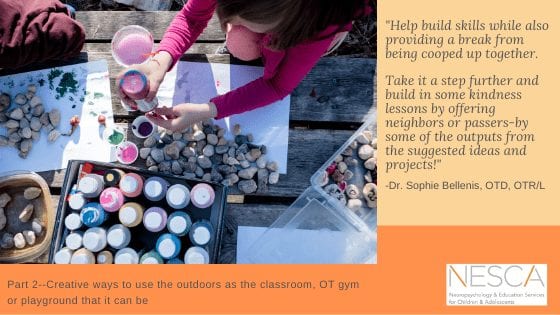
In last week’s blog, we provided the first five ideas on how to teach and build OT skills by getting outdoors. This week, we bring the next installment of ideas to help build skills while also providing a break from being cooped up together. Take it a step further and build in some kindness lessons by offering neighbors or passers-by some of the outputs from the suggested ideas and projects!

  1. Make Fossils. This activity consists of finding unique and special treasures outdoors and making imprints of them back inside. First, find some small solid objects, such as rocks, small sticks, acorns, leaves or shells. This is a perfect activity to do after a nature scavenger hunt! Then have your children press these objects into playdough or plaster of Paris to make their own fossils. Children work on their fine motor skills as they roll out the plaster, pinch their objects and push them down to make an imprint. Try making this great playdough recipe together before you get started. For some extra creative options, to try include: incorporating small toys, such as dinosaur figurines or LEGOs or using cookie dough as a base, then eat your fossils for a snack!
  2. Make a Bird Feeder. There are many different creative ways to make bird feeders with your children. Choose a bird feeder that requires multiple fine motor skills and is appropriate for your child’s level! Two options are:
    1. Bagel Feeder – Start with a bagel. Help your child tie a string or piece of ribbon through the center hole of the bagel in a large loop. Next, have your child choose a topping to put onto the bagel. I generally suggest peanut butter! Have the child practice spreading this topping all over the bagel. Using a knife to spread such a thick, sticky substance is a pretty difficult fine motor task! Next have your child use their “pinchy fingers” (thumb and pointer finger) to pick up bird seed and sprinkle it on the peanut butter. The end product will be a bagel covered in peanut butter and bird seed that is ready to hang on a tree outside. Place it near a window and let your children watch the birds enjoy their creation!
    2. Cheerio Feeder – You may have heard that stringing beads is an excellent occupational therapy activity that promotes bilateral coordination, fine motor precision, motor planning and a pincer grasp. Consider making a bird feeder by stringing Cheerios (or any cereal with a hole in the center) onto a piece of string and hanging them in the trees. Birds will love to peck off the individual pieces as a snack.
  3. Paint Rocks or Shells. Painting rocks and other outdoor treasures is a great activity that allows children to be creative while using tools and practicing a functional grasp. Allow children to pick up the rocks and get messy to help promote some bilateral coordination!
  4. Draw with Sidewalk Chalk. While writing with chalk may seem very similar to writing with a pencil to us adults, for children who are just learning to manipulate a pencil, it can be a hugely different experience. Writing on the uneven ground provides tactile feedback. Holding a piece of chalk that moves with the contours of the ground requires increased hand strength. Children get to practice modulating how hard they need to push down on the chalk to make a solid line. If your child is hesitant to practice handwriting, try sneaking outside 5 or 10 minutes before them to create a few “sidewalk worksheets” for them to complete before they start to draw their creative masterpieces. For some children, there is a huge sensory piece to sidewalk chalk, as they work to tolerate the new texture and the feeling of chalk on their hands.
  5. Bring out the Bubbles. In occupational therapy, we often use bubbles to help children work on their oral motor skills. Children work to make their mouth into a round “O” shape and blow with enough force to create the bubbles themselves. Prompt your kids to pop bubbles by clapping their hands together. This helps to practice eye-hand and bilateral coordination. Next, have your child try to keep their eyes on one bubble as long as possible to practice visual tracking!


About the Author

Dr. Sophie Bellenis is a Licensed Occupational Therapist in Massachusetts, specializing in educational OT and functional life skills development. Dr. Bellenis joined NESCA in the fall of 2017 to offer community-based skills coaching services as a part of the Real-life Skills Program within NESCA’s Transition Services team. Dr. Bellenis graduated from the MGH Institute of Health Professions with a Doctorate in Occupational Therapy, with a focus on pediatrics and international program evaluation. She is a member of the American Occupational Therapy Association, as well as the World Federation of Occupational Therapists. Having spent years delivering direct services at the elementary, middle school and high school levels, Dr. Bellenis has extensive background with school-based occupational therapy services.  She believes that individual sensory needs and visual skills must be taken into account to create comprehensive educational programming.

To book an appointment or to learn more about NESCA’s Occupational Therapy Services, please fill out our online Intake Form, email info@nesca-newton.com or call 617-658-9800.


Neuropsychology & Education Services for Children & Adolescents (NESCA) is a pediatric neuropsychology practice and integrative treatment center with offices in Newton, Massachusetts, Plainville, Massachusetts, and Londonderry, New Hampshire, serving clients from preschool through young adulthood and their families. For more information, please email info@nesca-newton.com or call 617-658-9800.


The Therapeutic Great Outdoors—Part 1

By | NESCA Notes 2020

By: Sophie Bellenis, OTD, OTR/L
Occupational Therapist; Real-life Skills Program Manager and Coach

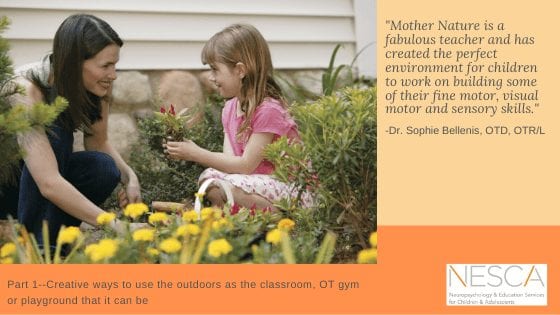
Aside from a spring snowfall this week, it looks like springtime may have truly arrived here in New England. Flowers are popping up on trees, the peepers and morning birds are singing and the warm sun is finally convincing most of us to leave the coats and hats inside. Now more than ever, the opportunity for children to get outside seems like a welcome reprieve from the weeks either cooped up or bundled up.  Mother Nature is a fabulous teacher and has created the perfect environment for children to work on building some of their fine motor, visual motor and sensory skills. This week, we’ll explore five of 10 creative ways to use the outdoors as the classroom, OT gym or playground that it can be! Check back next Tuesday for the next five!

  1. Get Dirty! Thankfully, some of the simplest activities work on the most skills. Letting kids get as dirty as they can works on building sensory tolerance. Digging in the dirt builds hand strength and endurance. Squatting down to play in the mud builds gross motor coordination and whole-body control. Consider bringing out utensils, cups and bowls and so your children can practice scooping, pouring and mixing!
  2. Plant a Garden. Take playing in the dirt one step further by incorporating the steps to planting a garden. This “garden” could be flower or veggie patch, a planter or just a little pot to keep on the window sill. Children work on isolating one finger by poking a hole in the soil, a pincer grasp by picking up small seeds between their thumb and pointer finger and hand strength by digging holes and burying seeds. This is also a great opportunity for children to practice the responsibility of watering plants every day. Add in some math review by having them measure the height of their plants and recording the information in a table.
  3. Climb Trees. The age-old activity of climbing trees works on building gross motor coordination, muscle strength and motor planning. To incorporate some visual skills practice, have children bring “binoculars,” or two toilet paper rolls taped together, to seek out different things that they can see from a new vantage point.
  4. Nature Scavenger Hunt. Scavenger hunts are an excellent way to target building visual skills as they prompt kids to scan their environment, search for specific things in a busy visual field and ignore the overwhelming amount of visual stimulation around them. Bring in a sensory element by asking children to observe, feel and smell each of their treasures. Check out this fabulous Egg Carton Nature Scavenger Hunt created by The Silvan Reverie.
  5. Build a Fort. Encourage kids to use their imagination and build outside. Provide them with twine or string, an old sheet, and a hammer and nails (if they can use them safely). If they are not ready to use these tools, they can practice propping sticks up against a tree to build a lean-to or gathering sticks and branches to make a platform to sit on. All of these options require motor planning, trial and error, and get kids to move their bodies.


About the Author

Dr. Sophie Bellenis is a Licensed Occupational Therapist in Massachusetts, specializing in educational OT and functional life skills development. Dr. Bellenis joined NESCA in the fall of 2017 to offer community-based skills coaching services as a part of the Real-life Skills Program within NESCA’s Transition Services team. Dr. Bellenis graduated from the MGH Institute of Health Professions with a Doctorate in Occupational Therapy, with a focus on pediatrics and international program evaluation. She is a member of the American Occupational Therapy Association, as well as the World Federation of Occupational Therapists. Having spent years delivering direct services at the elementary, middle school and high school levels, Dr. Bellenis has extensive background with school-based occupational therapy services.  She believes that individual sensory needs and visual skills must be taken into account to create comprehensive educational programming.

To book an appointment or to learn more about NESCA’s Occupational Therapy Services, please fill out our online Intake Form, email info@nesca-newton.com or call 617-658-9800.


Neuropsychology & Education Services for Children & Adolescents (NESCA) is a pediatric neuropsychology practice and integrative treatment center with offices in Newton, Massachusetts, Plainville, Massachusetts, and Londonderry, New Hampshire, serving clients from preschool through young adulthood and their families. For more information, please email info@nesca-newton.com or call 617-658-9800.


Helping Children Transition from One Activity to the Next

By | NESCA Notes 2020

By: Sophie Bellenis, OTD, OTR/L
Occupational Therapist; Real-life Skills Program Manager and Coach

Here at NESCA we often talk about Transition as the process by which an adolescent or young adult develops the necessary skills to function independently in the adult world (Big “T”), but many younger students are working to master much smaller transitions throughout the day (little “t’s”). Classroom teachers are all acutely aware of the difficulty that some student have when transitioning back from activities, such as lunch, recess, physical education or art class. These students also frequently struggle switching from math to English or social studies to science. It is a balancing act when determining what is a reasonable expectation and what supports we may need to build in for our kids to be successful during these times. Here are some tips to try at home, as parents continue to take on the role of teacher and attempt to keep children on task and sticking to a schedule.

  • Give warnings. Some children just need a quick heads-up, such as, “In 5 minutes we will be heading inside to practice your math problems!” Other children may need repetition, with 5-minute, 3-minute and 1-minute warnings. Consider using a timer if your children seem hesitant to believe that it has truly been a whole 5 minutes!
  • Remember that children love to finish! Allow adequate time for kids to complete the project or activity that they are so diligently working on. If this is not possible, identify a specific time that they can come back to the project. For example, “It’s time for you to move onto your math homework, but at 1 o’clock you can take out your art supplies and finish your picture. 1 o’clock will probably be right after we eat lunch.”
  • Use movement. Movement breaks or “brain breaks” are often great transition activities between two sedentary tasks. If a student is transitioning from Delta Math online to a reading comprehension activity, movement can help them re-regulate their bodies and wake up their nervous system a little bit. Getting outside for a quick run around the backyard, kicking a soccer ball back and forth or doing 10 jumping jacks are great outdoor options. On rainy days or when there is limited outdoor space, consider videos from GoNoodle, Cosmic Kids Yoga or The Learning Station YouTube Channel. Try to keep these movement breaks to under 5 minutes so that children do not lose their focus.
  • Use calming activities. While movement breaks may be a great option between two low energy tasks, kids may need a different strategy to help them transition back to schoolwork from a high energy activity. This is the case for many of our students after lunch in a traditional school setting. Creating a calming environment (i.e. soft music, low light and minimal distractions) and allowing children to choose one peaceful activity, such as coloring, building with Legos or reading a favorite book, to focus on for 10 minutes can help them calm their bodies and prepare for work. Make sure that it is something they truly enjoy.
  • Try a transition “cue.” A transition cue is really any prompt that is used to notify a child that it is about to be time to switch activities. It acts as a concrete representation of the upcoming shift. These prompts can be auditory, visual or tactile. Examples of each include:
    • Auditory – Many teachers use songs as auditory cues throughout the day. From the Welcome Song to The Clean Up Song, teachers prompt their students to change their behavior and get ready for the next activity of the day through song. If you do not feel comfortable singing at home or this feels too immature for your child, consider picking a song to play when it is time to start transitioning. Challenge your student to be ready for the next activity by the end of the song. Provide a direct explanation of expectations, such as, “By the end of this song I want to see the table clear of your art materials, your science notebook in front of you, and you seated at the table with a pencil.”
    • Visual – Visual cues could include a transition card that is carefully placed next a child 5-minutes before they need to move to a new activity, a visual timer or even a pre-agreed upon hand signal.
    • Tactile – Tactile cues are less frequently used in the school setting, but may be helpful at home. Some children benefit from a transition object, such as a fidget, a ball or favorite stuffed animal to hold and play with while a new activity is being set up.
  • Give feedback and teach children to self-monitor. Make sure to give feedback on both the positives and the negatives. Many children thrive on positive reinforcement and love having their successes highlighted. Consider including children in this process and allowing them to reflect on how they did during a transition. Use questions such as, “How did playing that song work for you? Was it helpful?” or “I noticed that you had a hard time calming down after we played outside today, do you think that coloring or a listening to a book on tape would help? What do you think might work for you?” Giving our children the language they need to describe how they are feeling and experiencing this learning process will help them to develop the ability to self-monitor and reflect on their own performance.

As we all do our best to get through these unique times, remember that sometimes the littlest things are the most difficult. Accept that our children are almost all still building the ability to transition successfully, and they will need time to practice, especially in the new remote learning environment.


About the Author

Dr. Sophie Bellenis is a Licensed Occupational Therapist in Massachusetts, specializing in educational OT and functional life skills development. Dr. Bellenis joined NESCA in the fall of 2017 to offer community-based skills coaching services as a part of the Real-life Skills Program within NESCA’s Transition Services team. Dr. Bellenis graduated from the MGH Institute of Health Professions with a Doctorate in Occupational Therapy, with a focus on pediatrics and international program evaluation. She is a member of the American Occupational Therapy Association, as well as the World Federation of Occupational Therapists. Having spent years delivering direct services at the elementary, middle school and high school levels, Dr. Bellenis has extensive background with school-based occupational therapy services.  She believes that individual sensory needs and visual skills must be taken into account to create comprehensive educational programming.

To book an appointment or to learn more about NESCA’s Occupational Therapy Services, please fill out our online Intake Form, email info@nesca-newton.com or call 617-658-9800.


Neuropsychology & Education Services for Children & Adolescents (NESCA) is a pediatric neuropsychology practice and integrative treatment center with offices in Newton, Massachusetts, Plainville, Massachusetts, and Londonderry, New Hampshire, serving clients from preschool through young adulthood and their families. For more information, please email info@nesca-newton.com or call 617-658-9800.


Skill Highlight: Touch Typing!

By | NESCA Notes 2020

By: Sophie Bellenis, OTD, OTR/L
Occupational Therapist; Real-life Skills Program Manager and Coach

As you are sitting at home with your child and working to find a reasonable balance of academics, physical movement, chores, social time and relaxation, one specific skill to consider targeting is touch typing or keyboarding. As we move further and further into the digital age and, more recently, an unprecedented era of remote learning, the ability to successfully type and get ideas onto the screen is paramount. We often joke that our children are more technologically adept that we are, as they easily navigate between iPad apps and turn on anything with a screen. While this is, in many ways, true, two things I constantly observe in students are the propensity to type with just their pointer fingers (hunt and peck method) and that they initially learn about a keyboard for games rather than academics.

As their fingers fly around the keyboard, I am often asked, “Why does it matter if they can use all ten fingers? Who cares if they are typing with two fingers if they are getting the information out of their head?” These are all great questions, and I hope to answer and provide clarity around the ones I hear most frequently.

Why does ten-finger, touch-typing matter?

Massachusetts State Guidelines recommend that a student should be typing at a speed of 5 times their grade level with 80-95% accuracy. For example, a third grader should be typing at 15 words per minute (3 x 5), and a seventh grader should be typing at about 35 words per minute (7 x 5). Following this formula, by graduation, a senior in high school should type with a speed of at least 60 words per minute, a functional speed for an adult in most professions.

While it is likely that some third grade students can use two fingers and type at a rate of 15 words per minute, as these students get older and the demand increases, it is unlikely they will be able to keep up with these guidelines if they have not been taught a functional typing approach.

That may be true for some students, but I promise my child is able to type quickly! Can I just let her teach herself?

While children may be able to type quickly using their own typing method, ten-finger typing uses almost of all of the intrinsic hand muscles to complete the task. This means that children are much less likely to feel fine motor fatigue than if they were using two or three fingers. While this may not matter for a young student typing a paragraph, it will absolutely affect a high school student who is working on a 10- or 15-page paper. Teaching the correct approach will set young students up for future success.

Is it okay to start later in elementary school? My student is still working on handwriting.

There are some mixed opinions on the best time to start teaching keyboarding. I personally recommend first or second grade as an appropriate starting point. At this level, most students can identify their letters and are used to using computers to some extent. As with most motor tasks, practice makes perfect, and the more time our children spend using all ten fingers to type, the better at it they will be. It is perfectly fine to learn handwriting and keyboarding simultaneously.

How much time do you recommend my child spends practicing?

I recommend students practice for about 20-30 minutes at a time. This allows time for direct practice, as well as time for playing games that promote correct finger placement. If a student can do this practice two to three times a week, they will absolutely start to develop the motor patterns necessary and commit them to muscle memory.

What are your thoughts on speech-to-text software?

Speech-to-text software programs are excellent tools when they are used with the right student. They increase accessibility, help students get information on the page and can increase the speed at which a student completes their work. I am hesitant to introduce these tools too early or with the wrong student.  The need to type will not go away and not all programs can support a speech-to-text option. Additionally, in an academic setting, using a speech-to-text option requires a student to have extra testing accommodations, such as a separate room for testing and 1:1 test administration. For some of our students, this is exactly what they need for success, but for others these accommodations are not reasonable or necessary.

Can I leave my child to practice on their own?

Children quickly slip back into old habits. I recommend keeping a watchful eye to ensure that a ten-finger approach is truly being practiced.

Is there anything else I should consider?

Yes! Make sure to consider your child’s posture as they sit at the computer. Ideally, ankles, knees, hips and elbows should all be at 90 degrees, while wrists should be “neutral” or flat.

Where can I go to find lessons or tutorials for my child?

Great Question! Fortunately, there are many excellent online options to help teach children how to type. Some free online sites that directly teach and help to practice ten-finger typing include www.typingclub.com and www.typing.com. Other reasonably priced options include Typing Instructor for Kids Platinum, Mavis Beacon Keyboarding Kidz and Mickey’s Typing Adventure. For more entertaining, game-based practice, take a look at www.abcya.com and www.typinggames.zone.


About the Author

Dr. Sophie Bellenis is a Licensed Occupational Therapist in Massachusetts, specializing in educational OT and functional life skills development. Dr. Bellenis joined NESCA in the fall of 2017 to offer community-based skills coaching services as a part of the Real-life Skills Program within NESCA’s Transition Services team. Dr. Bellenis graduated from the MGH Institute of Health Professions with a Doctorate in Occupational Therapy, with a focus on pediatrics and international program evaluation. She is a member of the American Occupational Therapy Association, as well as the World Federation of Occupational Therapists. Having spent years delivering direct services at the elementary, middle school and high school levels, Dr. Bellenis has extensive background with school-based occupational therapy services.  She believes that individual sensory needs and visual skills must be taken into account to create comprehensive educational programming.

To book an appointment or to learn more about NESCA’s Occupational Therapy Services, please fill out our online Intake Form, email info@nesca-newton.com or call 617-658-9800.


Neuropsychology & Education Services for Children & Adolescents (NESCA) is a pediatric neuropsychology practice and integrative treatment center with offices in Newton, Massachusetts, Plainville, Massachusetts, and Londonderry, New Hampshire, serving clients from preschool through young adulthood and their families. For more information, please email info@nesca-newton.com or call 617-658-9800.


An OT’s Guide to Home Learning: Board Games and Puzzles

By | NESCA Notes 2020

By: Sophie Bellenis, OTD, OTR/L
Occupational Therapist; Real-life Skills Program Manager and Coach

As social distancing recommendations, stay-at-home orders and shelter-in-place mandates continue to keep families confined to the home, parents are quickly being asked to take on the roles of teacher, therapist, warden, work-from-home professional, best friend and more. For parents of children with special needs and learning differences, this can feel extra daunting. There are countless online resources providing specific in-home activities, recommendations, and suggestions for working on targeted skills (e.g., literacy, fine motor, sensory integration, gross motor, etc.) in the home. It’s easy to get quickly overwhelmed by the onslaught of information.

While I believe there are many useful and creative free resources available online (I’ve written some of them!), our “new normal” includes many barriers to easy implementation including time, expertise, resources and confidence. Today, I want to share how some fun activities involving board games that you may already have in your home could make the task of keeping children engaged, interested and learning a little bit easier. Our game makers are getting increasingly creative and aware of their role in helping children build their skills, and the games listed below are just a few of the many options available.

5 Board Games for Development of Visual Perception

  • Connect 4 – Playing Connect 4 with the traditional rules requires kids to track horizontally, vertically and diagonally with their eyes. They need to visualize where their checker will land and place it in the correct spot at the top. Additionally, children need to monitor two colors at a time to ensure that they do not need to block their opponent on their next turn. For younger children, consider using the board to practice patterns or make shapes out of one color.
  • Quirkle – Quirkle combines colors, shapes and a grid pattern to create an interactive game for children to play with their parents. It promotes form perception, visual discrimination, tracking and matching.
  • Dominoes – There are many different games that can be played with Dominoes, making it easy to scaffold the activity for all different ages. Dominoes works on many of the same skills as Quirkle, but really allows children to practice visual figure ground. Figure ground is the ability to distinguish relevant information from a busy or overwhelming background. Dominoes have lots of different colored little dots in different patterns and alignments allowing children to practice this skill. Notably, Dominoes often have a tactile aspect allowing children to both see and feel the dots.
  • Spot it! / Spot it Jr! – Spot it! has quickly become a favorite game of occupational therapists, speech language pathologists and school psychologists alike. It practices a multitude of important skills. In terms of visual perception, Spot it! focuses on visual discrimination, hand-eye coordination, attention to detail, figure ground and more. Due to its popularity, Spot it! has provided us with an excellent variety of specific versions, such as Alphabet, NFL, Gone Camping, Animals, as well as substantial Spot it Jr.! options.
  • Memory – Unsurprisingly, the game Memory works on increasing visual memory! Children have to remember which cards they have picked, where they are on a grid and where the matches are. There are lots of options to order online, but this can absolutely be played used playing cards or DIY pictures drawn on pieces of paper. Children are also able to practice pronation/supination by flipping over the cards and placing them back down on the table.

 5 Board Games for Development of Fine Motor Skills

  • Trouble – Trouble allows children to work on building hand strength as they push down the pop-o-matic die roller. Try to ensure that children are using the muscles in their hands and fingers to push down, and limit the amount of body weight they use to help them push down. Additionally, children practice a pincer grasp as they pinch their pegs to move them around the board.
  • Hi-Ho! Cherry-O! – This game includes little plastic fruit that need to be placed in a basket to promote a pincer grasp and a spinner board that helps teach kids to flick or push a spinner.
  • BedBugs – Tongs and tweezers are part of an OT’s go-to toolbox as they promote fine motor precision, keeping an open webspace, and hand strength and coordination. This game is for children age 4 and up and provides each player with their own tongs to try and catch little bouncy bugs on a bed. Add a layer of complexity by having kids each try to catch one color!
  • Avalanche Fruit Stand – Another game that incorporates tweezers, Avalanche Fruit Stand promotes grip strength, pincer grasp and problem-solving as children need to balance different fruits on a stand. There is also a spinner to add in another element.
  • Hungry Hungry Hippos – Use this game to practice finger isolation and increase finger/hand strength. Encourage your children to use one finger at a time to depress the lever and make their hippo eat the marbles. Try switching fingers for each round.

*Bonus!* While many of these games work on more than one skill at a time, one age-old recreational activity that targets visual perception, visual motor integration and fine motor skill is simply completing a puzzle. Focus on teaching strategy and problem-solving by having your children start with the edge pieces, organize by color or choose one figure or character in the puzzle to build independently.

About the Author

Dr. Sophie Bellenis is a Licensed Occupational Therapist in Massachusetts, specializing in educational OT and functional life skills development. Dr. Bellenis joined NESCA in the fall of 2017 to offer community-based skills coaching services as a part of the Real-life Skills Program within NESCA’s Transition Services team. Dr. Bellenis graduated from the MGH Institute of Health Professions with a Doctorate in Occupational Therapy, with a focus on pediatrics and international program evaluation. She is a member of the American Occupational Therapy Association, as well as the World Federation of Occupational Therapists. Having spent years delivering direct services at the elementary, middle school and high school levels, Dr. Bellenis has extensive background with school-based occupational therapy services.  She believes that individual sensory needs and visual skills must be taken into account to create comprehensive educational programming.

To book an appointment or to learn more about NESCA’s Occupational Therapy Services, please fill out our online Intake Form, email info@nesca-newton.com or call 617-658-9800.


Neuropsychology & Education Services for Children & Adolescents (NESCA) is a pediatric neuropsychology practice and integrative treatment center with offices in Newton, Massachusetts, Plainville, Massachusetts, and Londonderry, New Hampshire, serving clients from preschool through young adulthood and their families. For more information, please email info@nesca-newton.com or call 617-658-9800.


Skip to content