To accommodate requests for neuropsychological evaluations after the start of the new school year, NESCA has added evaluation dates in its Newton, MA office. Immediate openings are now available for scheduling. Please complete our Inquiry/Intake Form for more information or to start the scheduling process.

Tag

task initiation Archives - NESCA

Subscribe to NESCA Notes

The Intersection of Mental Health and Executive Function

By | NESCA Notes 2024

By: Carly Edelstein, MSW, LCSW
Licensed Clinical Social Worker and Executive Function Coach

Mental Health challenges and executive function (EF) deficits are often intertwined, as one can easily impact the severity of the other. As a psychotherapist and executive function coach, I find myself regularly assessing my clients with comorbid EF and mental health challenges in order to identify which presented first.

Why does this matter?
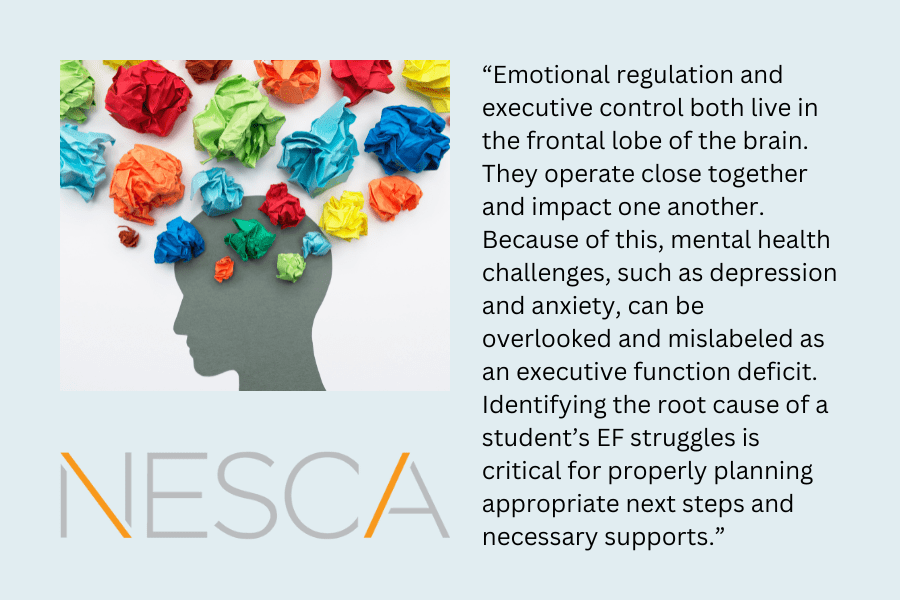
Emotional regulation and executive control both live in the frontal lobe of the brain. They operate close together and impact one another. Because of this, mental health challenges, such as depression and anxiety, can be overlooked and mislabeled as an executive function deficit. Identifying the root cause of a student’s EF struggles is critical for properly planning appropriate next steps and necessary supports. For example, if a student’s depression is causing them not to initiate and/or complete work, the depression usually needs to be addressed before they receive EF coaching. If the student is already working with a mental health professional, such as a therapist, it is important for them to be cleared by the therapist to add in an EF coach. Working on too many new skills at once can be overwhelming, so it is important that enough foundational coping skills are learned first.

An example of anxiety causing an EF deficit:
Clara gets extremely anxious in social situations due to a lack of self-esteem. She had a negative experience in middle school where other students made fun of her lisp whenever she read out loud in class. Now, in high school, Clara is afraid to ask questions, even when she is confused. She is left not fully understanding the material, class assignment expectations, or how to approach studying for quizzes and tests. Rather than asking for help, Clara keeps to herself. Even when teachers offer to help her, she responds with, “Thank you, but I’m all set.”

Clara’s parents can see that she struggles to initiate homework assignments, rarely studies for upcoming tests, and that her grades are declining. They don’t fully understand why, because when they ask her, she is quick to deflect and change the subject.

By checking in with Clara’s teachers, her parents may receive feedback that she often shies away from their support. With a lack of understanding why, her teachers aren’t sure how else to approach the situation other than continuing to check in. Jumping into EF coaching to address her task initiation and study skills may help, but it doesn’t address the root of the problem. A more appropriate action plan would be for Clara to first receive psychotherapy, addressing the bullying that led to her social anxiety and self-esteem issues and then shifting to EF skill building.

An example of an EF deficit causing anxiety/depression:
Gabriel is a seventh grade student diagnosed with ADHD. He has a difficult time advocating for himself and asking for help due to some additional communication challenges. His ADHD also makes it challenging to stay on task and pay attention to details. This results in Gabriel constantly forgetting what his homework assignments are and when they are due, creating a lot of missing work. Gabriel’s teachers are often redirecting him and reminding him of incomplete work. They have tried to help him develop plans to make it up, but he struggles to follow through with these plans. At home, Gabriel’s parents often share their frustrations with him and try to help him get back on track. With adults constantly reminding him he’s behind, Gabriel has developed internalized anxiety, often wondering why he can’t be like everyone else. He tries so hard to remember what his homework is and when it is due, but can never seem to get it right. Over time, he begins to experience symptoms of depression as his self-esteem declines.

In this situation, Gabriel’s lack of EF skills is the root cause of his negative thinking patterns. By receiving EF coaching, he can learn ways to regularly track his assignments. He can be taught how to break them down into smaller, more manageable tasks in a way that helps him overcome procrastination. Additionally, he is able to become proactive and communicate with his teachers so that they are kept on the same page. As these skills get stronger, Gabriel becomes more responsible, and gets praise from his teachers and parents in return. Given the impact of this situation, he may also benefit from short-term counseling to better understand the connection between his EF and anxiety. Increased self-awareness helps students learn how to advocate for themselves the next time they encounter a similar situation.

Does this sound familiar?
These scenarios are common and can be difficult to navigate without proper assessment and guidance from professionals. If you or your child struggles with mental health and EF-related challenges and you are not sure where to start, book a free introductory call with me or one of our other wonderful and experienced EF coaches. NESCA also offers comprehensive neuropsychological evaluation services and neuropsychological consultation for families who are wondering about possible missed learning, attention, mental health, or other diagnoses. We look forward to working with you!


About the Author

Carly Edelstein is a Licensed Clinical Social Worker practicing in Massachusetts and Rhode Island. Having worked both in private practice and schools, she has extensive experience supporting students, families and educational teams to make positive changes. Ms. Edelstein provides executive function coaching and psychotherapy to clients ranging from middle school through adulthood. She also offers consultation to schools and families in order to support her clients across home and community environments.

To schedule an appointment with one of NESCA’s counselors, coaches, or other experts, please complete our online intake form. 

NESCA is a pediatric neuropsychology practice and integrative treatment center with offices in Newton, Plainville, and Hingham, Massachusetts; Londonderry, New Hampshire; and staff in the greater Burlington, Vermont region and Brooklyn, New York, serving clients from infancy through young adulthood and their families. For more information, please email info@nesca-newton.com or call 617-658-9800.
 

Why is it so hard to develop Executive Function skills for college as a high school student?

By | NESCA Notes 2024

By: Kelley Challen, Ed.M., CAS
Director of Transition Services, NESCA

Students with disabilities often have challenges with executive function skills. These may include difficulties with organization, planning and prioritization, time management, task initiation, attention and effort, working memory, self-regulation, self-monitoring, and mental flexibility. Being successful as a college student often depends on using and integrating these skills. Therefore, it’s no surprise that most of the IEPs I read when working with teenage and young adult students have goals or objectives aimed at remediating executive function (EF) skills. However, many students on IEPs have these “EF” goals for years and still don’t effectively develop the skills they need to successfully manage executive functioning tasks as college students.

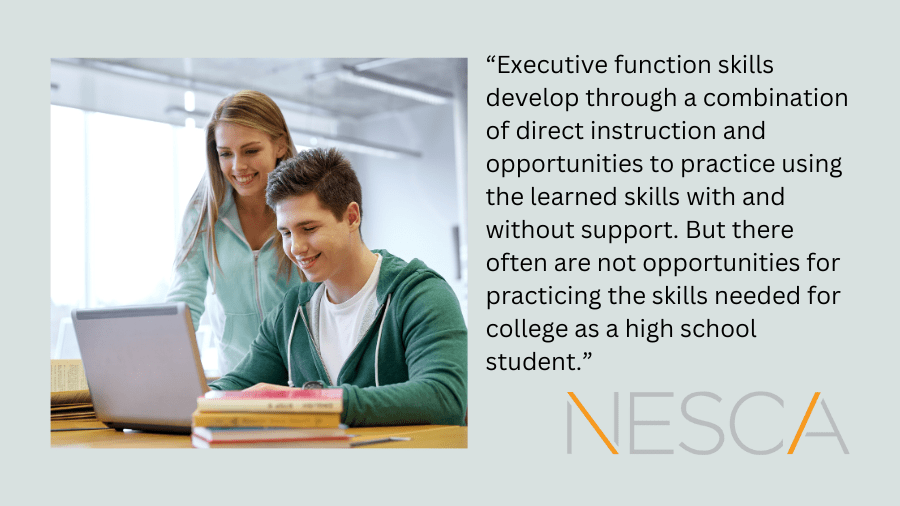
One of the reasons for the remaining skill gap when students matriculate to college is because high school student responsibilities are pretty radically different from college student responsibilities. While research indicates that individuals can continue developing executive function skills throughout the lifespan, this requires a very particular set of activities. Executive function skills develop through a combination of direct instruction and opportunities to practice using the learned skills with and without support. But there often are not opportunities for practicing the skills needed for college as a high school student.

Below is a list of executive function supports that exist in high school, but often disappear in college:

  • Classes are small and always taught by teachers
  • Class material is centralized in books or on the board in the classroom
  • Time is structured by the school
  • Students are told what they need to learn from homework
  • Students are reminded of assignments and due dates
  • Completed homework is checked by teachers
  • Reading is discussed in classes
  • Studying is limited to a few hours per week
  • Testing is frequent and covers small amounts of material
  • Teachers approach students who need help
  • Schools are required to find students with disabilities who need specialized instruction and accommodations
  • Parents and teachers will remind students of their responsibilities
  • Parents and teachers will help to set priorities (or simply set them for the student)
  • Parents and teachers will correct students when behavior is unexpected

In college, students may have large classes taught by other students or experts in their fields who aren’t experts on teaching. They have to use syllabi, manage their own schedules (with large swaths of unscheduled time), integrate academic materials from a wide range of sources, and self-direct long hours of reading and studying. They also have to be responsible for advocating for themselves, knowing when they need help, and knowing what they are responsible for (academically, socially, and in their dorms) and getting those things done without parent and teacher reminders. For students who have strengths with executive functioning, often the transition to college still presents a steep learning curve. But for those who have vulnerabilities in these areas, it can be critical to recognize that the gaps are large between these two learning environments, and sometimes additional support and instruction is necessary while students are taking college classes. Some students will still need to build effective academic and executive function skills, and practice and master those executive function skills, while they are in college and managing this new set of demands.

NESCA offers many services designed to help students bridge the transition from high school to college, including executive function coaching, pre-college coaching, transition planning, and neuropsychological evaluation. To learn more specifically about our coaching services, visit: https://nesca-newton.com/coaching-services/ . To schedule an appointment with one of our expert clinicians or coaches, please complete our intake at: https://nesca-newton.com/intake/ .

Reference:

Many of the bulleted items of executive function supports that exist in high school are adapted from this high school versus college comparison by King’s College: https://www.kings.edu/admissions/high_school_vs_college


About the Author
Kelley Challen, Ed.M., CAS, is an expert transition specialist and national speaker who has been engaged in evaluation, development, and direction of transition-focused programming for teenagers and young adults with a wide array of developmental and learning abilities since 2004. While Ms. Challen has special expertise in working with youth with autism, she enjoys working with students with a range of cognitive, learning, communication, social, emotional and/or behavioral needs.

Ms. Challen joined NESCA as Director of Transition Services in 2013. She believes that the transition to postsecondary adulthood activities such as learning, living, and working is an ongoing process–and that there is no age too early or too late to begin planning. Moreover, any transition plan should be person-centered, individualized and include steps beyond the completion of secondary school.

Through her role at NESCA, Ms. Challen provides a wide array of services including individualized transition assessment, planning, consultation, training, and program development services, as well as pre-college coaching. She is particularly skilled in providing transition assessment and consultation aimed at determining optimal timing for a student’s transition to college, technical training, adult learning, and/or employment as well as identifying and developing appropriate programs and services necessary for minimizing critical skill gaps.

Ms. Challen is one of the only professionals in New England who specializes in assisting families in selecting or developing programming as a steppingstone between special education and college participation and has a unique understanding of local postgraduate, pre-college, college support, college transition, postsecondary transition, and 18-22 programs. She is additionally familiar with a great number of approved high school and postsecondary special education placements for students from Massachusetts including public, collaborative, and private programs.

Ms. Challen enjoys the creative and collaborative problem-solving process necessary for successfully transitioning students with complex profiles toward independent adulthood. As such, she is regularly engaged in IEP Team Meetings, program consultations, and case management or student coaching as part of individualized post-12th grade programming. Moreover, she continually works to enhance and expand NESCA’s service offerings in order to meet the growing needs of the families, schools and communities we serve.

When appropriate, Ms. Challen has additionally provided expert witness testimony for families and school districts engaged in due process hearings or engaged in legal proceedings centering on transition assessment, services and/or programming—locally and nationally.

Nearly two decades ago, Ms. Challen began her work with youth with special needs working as a counselor for children and adolescents at Camp Good Times, a former program of Milestones Day School. She then spent several years at the Aspire Program (a Mass General for Children program; formerly YouthCare) where she founded an array of social, life and career skill development programs for teens and young adults with Asperger’s Syndrome and related profiles. Also, she worked at the Northeast Arc as Program Director for the Spotlight Program, a drama-based social pragmatics program, serving youth with a wide range of diagnoses and collaborating with several school districts to design in-house social skill and transition programs.

Ms. Challen received her Master’s Degree and Certificate of Advanced Graduate Study in Risk and Prevention Counseling from the Harvard University Graduate School of Education. While training and obtaining certification as a school guidance counselor, she completed her practicum work at Boston Latin School focusing on competitive college counseling.

Ms. Challen has worked on multiple committees involved in the Massachusetts DESE IEP Improvement Project, served as a Mentor for the Transition Leadership Program at UMass Boston, participated as a member of B-SET Boston Workforce Development Task Force, been an ongoing member of the Program Committee for the Association for Autism and Neurodiversity (AANE), and is a member of the New Hampshire Transition State Community of Practice (COP).

She is also co-author of the chapter, “Technologies to Support Interventions for Social-Emotional Intelligence, Self-Awareness, Personality Style, and Self-Regulation,” for the book Technology Tools for Students with Autism: Innovations that Enhance Independence and Learning.

To schedule an appointment with one of NESCA’s transition specialists, please complete our online intake form. 

NESCA is a pediatric neuropsychology practice and integrative treatment center with offices in Newton, Plainville, and Hingham, Massachusetts; Londonderry, New Hampshire; the greater Burlington, Vermont region; and Brooklyn, NY (coaching services only) serving clients from infancy through young adulthood and their families. For more information, please email info@nesca-newton.com or call 617-658-9800.

NESCA Welcomes Back Carly Edelstein, MSW, LCSW, Licensed Clinical Social Worker and Executive Function Coach

By | Nesca Notes 2023

By: Jane Hauser
Director of Marketing & Outreach, NESCA

NESCA welcomes Ms. Carly Edelstein, MSW, LCSW, back to its coaching and psychotherapy services teams. She previously interned with NESCA, and we are thrilled to have her back on board as both a Psychotherapist and Executive Function Coach. Read more about Ms. Edelstein’s career journey and her return to NESCA in the following Q&A interview.


This is your second time working with NESCA. Tell us what you did with NESCA previously.
Yes, and I am elated to be back! During my graduate studies at Simmons University, I interned at NESCA as a psychotherapist. In addition to providing individual psychotherapy to children, adolescents, and young adults, I worked with a few high school and college students as an executive function (EF) coach. I also provided psychotherapy to clients from India and the Philippines, which was an incredible and unique experience. I have yet to find a practice as dynamic and integrative as NESCA and look forward to rejoining as a seasoned clinician!

You will be splitting your time and talents in two roles here at NESCA. Fill us in on your dual role and what your previous experiences bring to both.
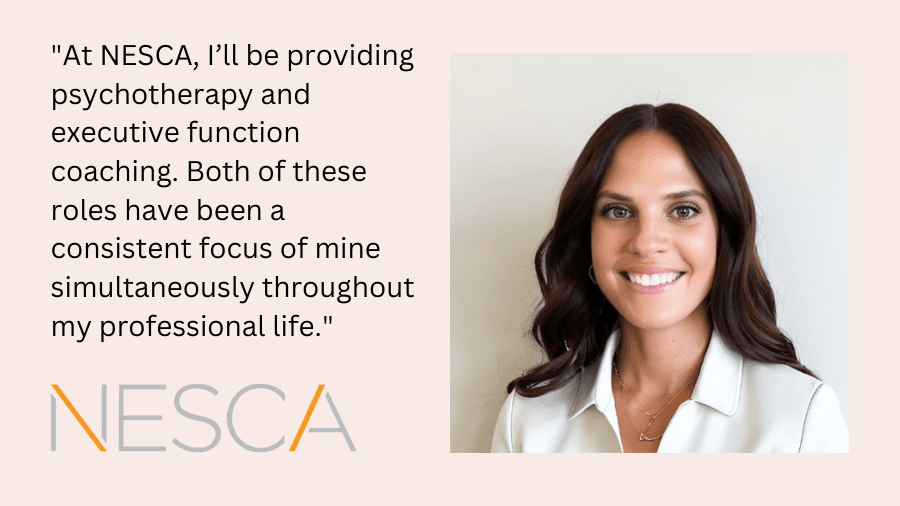
At NESCA, I’ll be providing psychotherapy and executive function coaching. Both of these roles have been a consistent focus of mine simultaneously throughout my professional life. After obtaining a B.S. in education at the University of Vermont, I worked in special education as a paraprofessional, supporting students with special needs in the classroom. In this role, I helped students learn new strategies to maintain their focus, self-regulate, and improve their organization. Additionally, throughout graduate school, I worked part-time as an EF coach at Engaging Minds, helping elementary, middle, and high schoolers with their homework and school assignments by finding ways to improve their task initiation, organization, time management, and planning skills.

My interest in social work/mental health counseling was sparked by my experience as a student teacher at UVM. During the entirety of my practicum, I found myself  gravitating towards students who struggled academically, mentally, socially, and emotionally. I was determined to help these students navigate their challenges by building meaningful connections, providing additional academic support, and increasing their self-confidence by focusing on their strengths.

My counseling experience officially started in graduate school with two full-year-long internships. My first internship took place in the counseling department at Boston Green Academy, a public charter school for grades 6-12, and my second was at NESCA. After graduate school, I worked as a school adjustment counselor at Newton South High School and also took on clients part-time at a private practice. In these roles, I supported the social and emotional wellbeing of students with special needs, as well as their families. After working in corporate wellness for the last year and a half, I am excited to return to the clinical setting, working for a practice that was a major part of my social work journey.

Having worked as a high school adjustment counselor, you must have seen many of the challenges students have with executive function. What are your biggest takeaways from that experience? How do you think that prepared you to be an EF coach?
The majority of my students struggled with executive function, therefore providing support in this area was part of my day-to-day routine. My biggest takeaways are:

  1. Identifying a “why” helps individuals become more motivated to be proactive in their EF journey. For example, I tend to ask people how improving these skills will affect their academic goals, mental health, social relationships, etc., so that there is significant meaning to the work being done.
  2. There is a system that works for everyone! Whether it’s electronic or physical, once someone identifies an organization system that increases their independence, it’s important that they stick to it and are consistent with it. Having a set system will allow them to easily locate their assignments, know when they are due, and how they’ll go about completing them. It’s always helpful for parents and teachers to be made aware of this system as well so that everyone is on the same page.
  3. Creating a regular homework routine is key to increasing productivity and limiting distractions. This includes having an identified start time, location, and plan. I always recommend structured breaks being part of this plan as well.
  4. I always advise folks to not compare themselves to others when it comes to their EF skills! We all have natural strengths. A skill that comes easy to you may be the most challenging task for someone else.

There have been countless reports and studies related to the negative impact COVID had on kids. As a psychotherapist to teens and young adults, what challenges are you seeing most in youth post-pandemic?
There’s no doubt that the impact of COVID on our youth has presented serious and complex challenges. The loss of structure, social opportunities, and extracurriculars (to name a few) is a shock to the system and very traumatic. The biggest challenges I’ve seen post-pandemic have been an increase in digital dependence, cyberbullying, school-based anxiety/refusal, and regression in social skills. That being said, as important as it is to identify post-pandemic challenges, there is value in pointing out gained strengths as well. A lot of students who I worked with learned new coping skills, acquired a deeper understanding of their needs, and discovered exciting new hobbies that they now get to share with others.


About Carly Edelstein, MSW, LCSW
Carly Edelstein is a Licensed Clinical Social Worker practicing in Massachusetts and Rhode Island. Having worked both in private practice and schools, she has extensive experience supporting students, families and educational teams to make positive changes. Ms. Edelstein provides executive function coaching and psychotherapy to clients ranging from middle school through adulthood. She also offers consultation to schools and families in order to support her clients across home and community environments.


To schedule an appointment with Ms. Edelstein for psychotherapy or EF coaching, please complete our online intake form. 


NESCA is a pediatric neuropsychology practice and integrative treatment center with offices in Newton and Plainville, Massachusetts, Londonderry, New Hampshire, and the greater Burlington, Vermont area, serving clients from preschool through young adulthood and their families. For more information, please email info@nesca-newton.com or call 617-658-9800.
 

Skip to content